You’re the sales manager deciding whether to roll out AI training to your team, and you need a program you can defend if a rep’s outreach or data handling goes wrong.
Or maybe you’re the founder doing your own sales, and you’ve heard AI could speed up prospecting and follow-ups but don’t have time for a generic AI course to figure out how.
Either way, prompting alone hasn’t produced anything you’d want to defend in a pipeline review.
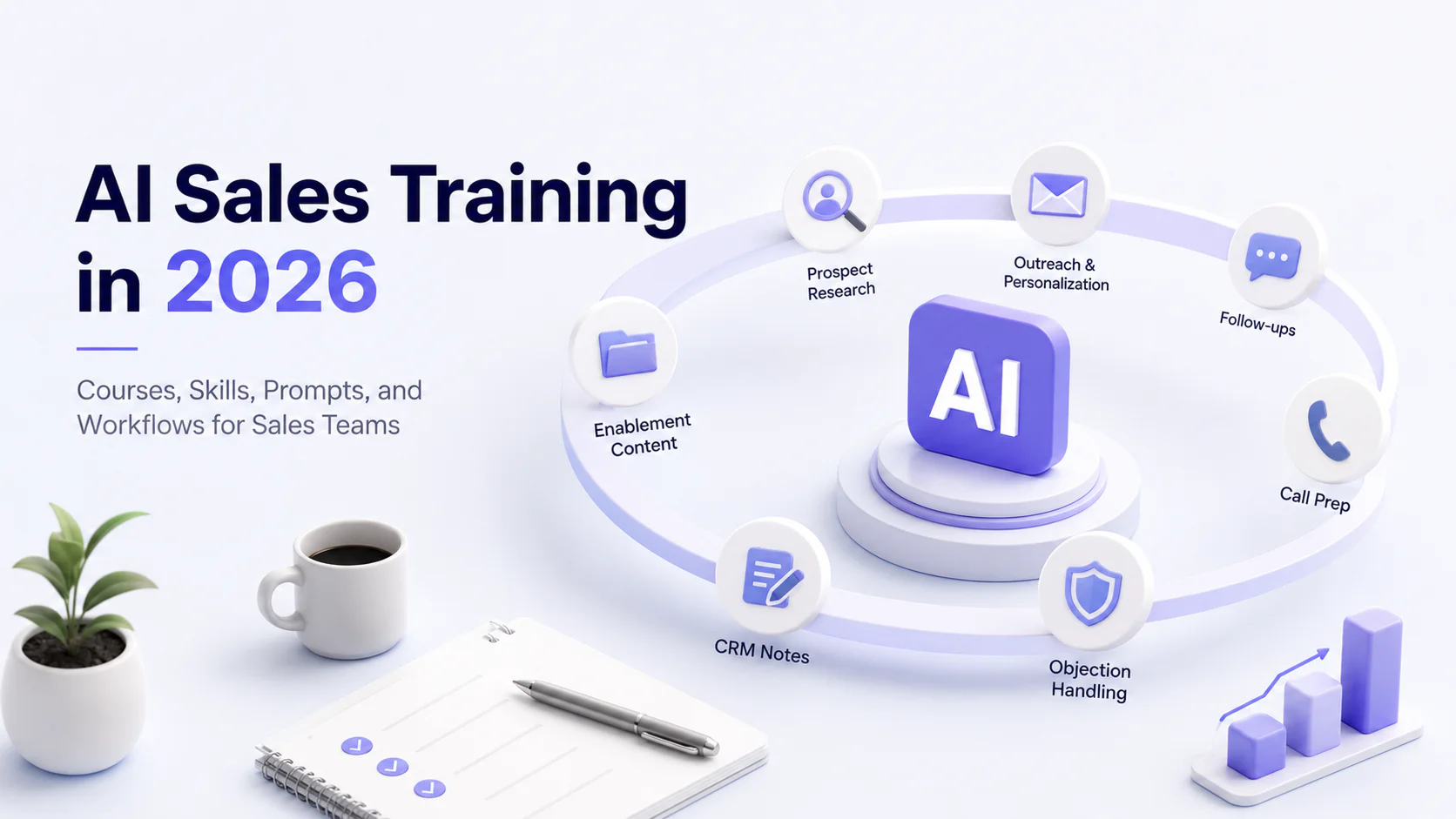
Good AI sales training teaches reps how to use AI across the full sales workflow: prospect research, outreach, personalization, follow-ups, call prep, objection handling, CRM notes, and enablement content.
This guide walks through:
- What a real AI sales training curriculum covers
- Who needs it
- How ChatGPT-specific training differs from broader AI sales training
- What to check before you enroll in a certificate program
- Where teams tend to get hurt when they skip the guardrails
What is AI sales training?
AI sales training teaches reps how to apply AI to the specific tasks that make up a sales cycle, not how to use AI in general. That’s the line that separates it from a generic “intro to ChatGPT” course.
A generic AI course teaches you how a chatbot works and how to write a decent prompt.
AI sales training starts from the sales workflow instead:
- Research an account before a call
- Draft a first-touch email that doesn’t sound like everyone else’s
- Prep for a discovery conversation
- Write a CRM note fast enough to keep the CRM current
The AI skill sits inside each of those tasks.
ChatGPT sales training vs general AI sales training
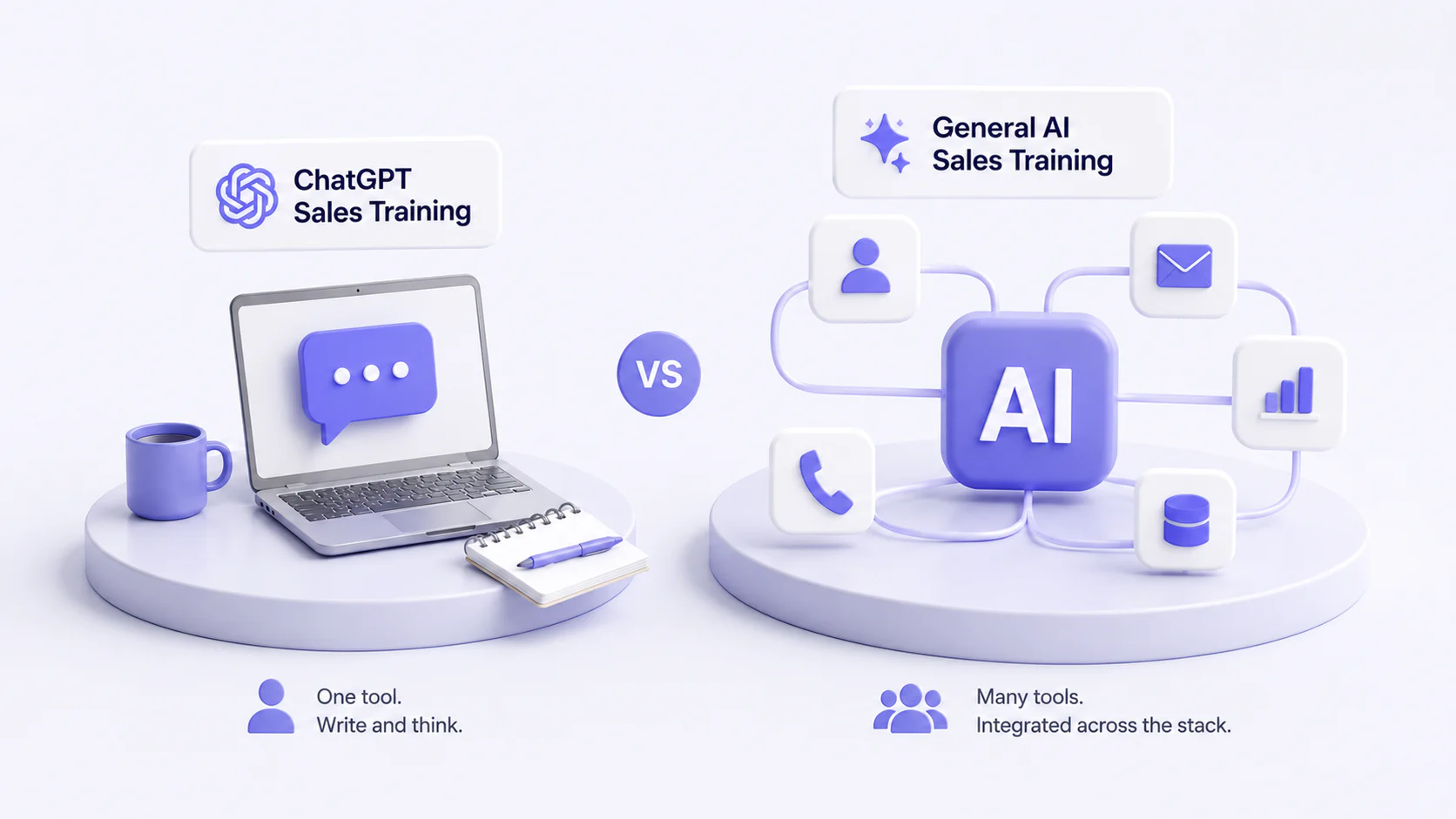
Sales teams often start with ChatGPT because it’s the tool most reps already know. Whether that’s enough depends on how the team’s workflow actually runs.
A ChatGPT for sales course makes sense for a rep or a small team doing manual outreach, research, and note-taking, where the AI tool is a writing and thinking partner rather than a piece of infrastructure.
If your workflow is “open a chat window, paste in context, get a draft,” strong ChatGPT skills cover most of what you need.
That’s the same skill set behind using ChatGPT for business and ChatGPT prompts for marketing tasks, just pointed at sales instead.
A broader generative AI for sales course becomes necessary once AI touches more than one tool in the stack.
That includes teams using AI features built into the CRM itself, sequencing platforms with AI-assisted personalization, or call intelligence tools that generate coaching insights from transcripts, along with other AI tools for business that touch the same accounts.
In that setup, the skill isn’t just prompting well. It’s understanding how AI outputs move between tools and how to keep messaging consistent when three different AI features are touching the same account.
RevOps leads evaluating a training vendor should ask directly which category a program falls into, since a course built around one chat interface won’t prepare a team to manage AI across a full sales tech stack.
Who needs AI sales training?
AI sales training applies differently depending on where you sit in the sales org, but almost nobody on a revenue team is exempt from it.
SDRs get the most direct lift, since prospecting and outreach are the most repetitive, AI-assistable parts of the job.
AEs benefit less from volume and more from prep speed: faster account research before a call, faster recap after one.
For CSMs, AI shifts customer success from reactive to proactive: monitoring health signals and onboarding milestones so risk gets caught before a renewal conversation is already in trouble, not after.
Sales managers need a different angle entirely. They’re less focused on prompting and more focused on what “good AI use” looks like on their team, so they can coach to it and catch problems before a prospect does.
RevOps and sales enablement leads usually end up owning the training decision itself, which means they need criteria for evaluating a vendor or program, not just skills for themselves.
Founders doing their own sales sit somewhere between an SDR and an AE: they need the full range of workflows but without the manager layer, often alongside the broader AI tools for small business that they’re already piecing together.
AI for sales training: quick curriculum checklist
Before you commit time or budget to a course, use this checklist to see whether it covers the modules that actually matter for sales work.
| Module | What the learner practices | What you’ll produce |
|---|---|---|
| AI basics for sales | How large language models work, where they’re reliable and where they hallucinate | A one-page “when to trust AI, when to check it” reference |
| Prospect and account research | Turning public signals (funding news, leadership changes, tech stack) into a usable account brief | A 3-bullet account summary before a discovery call |
| Cold email and LinkedIn outreach | Writing a first-touch message with AI that still sounds like the rep, not a template | A personalized cold email draft in under 5 minutes |
| Follow-up sequences | Building a sequence that adapts to how a prospect responded, not a fixed cadence | A 4-touch follow-up sequence with branch logic |
| Call prep and discovery questions | Generating discovery questions specific to the account and vertical | A tailored discovery question list before a call |
| Objection handling | Drafting response frameworks for common objections, then testing them against real transcripts | A one-page objection response guide |
| CRM notes and recap emails | Turning a call transcript into a clean CRM note and a client-facing recap | A CRM entry and recap email from one call |
| Sales enablement content | Repurposing win stories and product updates into reusable talk tracks | A battlecard section built from a recent deal |
| Quality control and human review | Building a review habit before anything goes to a prospect or into the CRM | A pre-send checklist reps actually use |
Notice that the last module isn’t an afterthought. Programs that treat human review as a bolt-on, rather than a core skill, tend to be the ones that produce the generic outreach and CRM errors covered later in this guide.
AI sales workflows every course should teach
A curriculum checklist tells you what a course covers. Workflows show you what that looks like in practice, which is the part most generic AI tutorials skip.
Account research
Instead of asking an AI tool to “research this company,” a trained rep gives it structure: company name, what you’re selling, and a request for three specific angles, like recent leadership changes, funding activity, and any public statements about the problem you solve.
That structure is what turns a vague chatbot answer into something usable before a call.
Outreach
Outreach works the same way. A generic prompt produces a generic email. A trained rep feeds the AI tool specific inputs (the prospect’s role, one piece of account-specific context, the actual value prop for that segment) and asks for a short first-touch draft, then edits it before sending.
The editing step isn’t optional.
For finding the right people to reach in the first place, that same workflow usually pairs with dedicated prospecting tools.
Follow-up sequences
Follow-up sequences benefit from AI in a subtler way: instead of one fixed cadence, a rep can draft branch logic ahead of time (what to send if the prospect opens but doesn’t reply, what to send if they click a link but go quiet) so the sequence adapts without the rep improvising in the moment.
Call prep and CRM notes
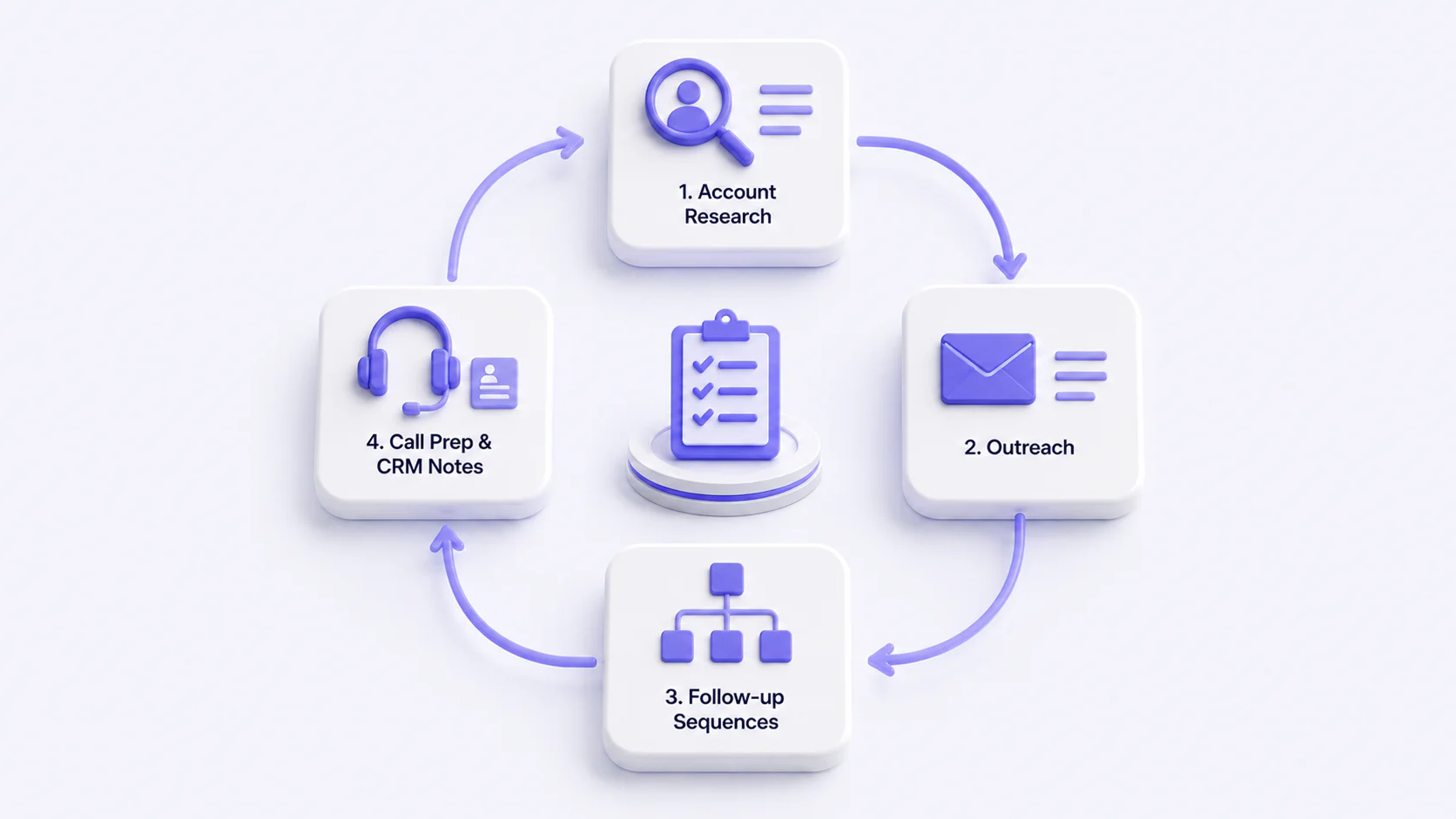
Call prep and CRM notes close the loop. Before a discovery call, a rep can turn account research into a short list of tailored questions instead of running through a generic script.
After the call, the same AI tool can turn a transcript or a rep’s rough notes into a clean CRM entry and a client-facing recap. Both are still reviewed before anything gets sent or saved.
AI sales certification: what to check before enrolling
“AI sales certification” gets used loosely, so it’s worth knowing what you’re actually buying before you enroll a team.
Most AI sales courses issue a certificate of completion, not an accredited certification. That distinction is real, not semantic.
A certificate of completion shows you finished an AI sales course and, depending on the program, passed some kind of assessment.
An accredited certification means an independent third-party body has verified the program against a defined standard, which is a different, heavier process most online courses don’t go through.
That doesn’t make a certificate of completion worthless. It’s still a legitimate way to document that a rep built specific skills, and it’s useful on a resume or in a manager’s coaching conversation.
The problem shows up when a program markets a certificate of completion as if it carries the weight of an accredited credential.
That distinction matters most when a rep needs proof that holds up externally, like satisfying an employer’s formal training requirement or passing a background/credential check tied to a role.
Before enrolling, check exactly how the program describes what you’ll earn, and be skeptical of any AI sales course that implies its certificate alone guarantees a job outcome or promotion.
The same scrutiny applies to any prompt engineering certification marketed on its own.
A few other checks matter before you commit a budget:
- How recently the curriculum was updated, since AI tools and buyer behavior both move fast enough that a two-year-old course is teaching an outdated workflow
- Practical exercises tied to real sales tasks, not just video lessons
- Role-specific examples (SDR versus AE versus manager), since a one-size-fits-all curriculum tends to fit no one well
- Explicit guidance on data privacy and what’s safe to paste into an AI tool
Risks and mistakes to avoid
Most of the damage from AI in sales doesn’t come from the technology. It comes from skipping the review step that training is supposed to build as a habit: verify facts, check tone, and confirm what’s safe to send.
Skip that habit, and these are the risks and mistakes that follow.
Generic, unedited outreach. A message that reads like every other AI-drafted cold email signals to the buyer that no one looked at their account before hitting send, which does more harm than sending nothing.
Hallucinated account facts. An AI tool asked to “research this company” can produce a confident, specific, and wrong answer, like a funding round that didn’t happen or a title that changed last quarter. A rep who repeats it in a call loses credibility instantly.
Sensitive CRM data pasted into unapproved tools. Customer names, deal terms, or contract details fed into a consumer AI tool that wasn’t cleared for that data is how companies end up rewriting their AI policy after the fact.
Samsung banned external AI tools company-wide in 2023 after staff uploaded source code and meeting notes into a consumer chatbot, and that same pattern keeps showing up across industries.
Over-automation with no human review. A sequence with zero review can technically run itself, but it also removes the judgment that catches a bad send before it reaches a prospect. The fix isn’t avoiding automation; it’s building a specific, non-negotiable review point into the workflow.
Final recommendation
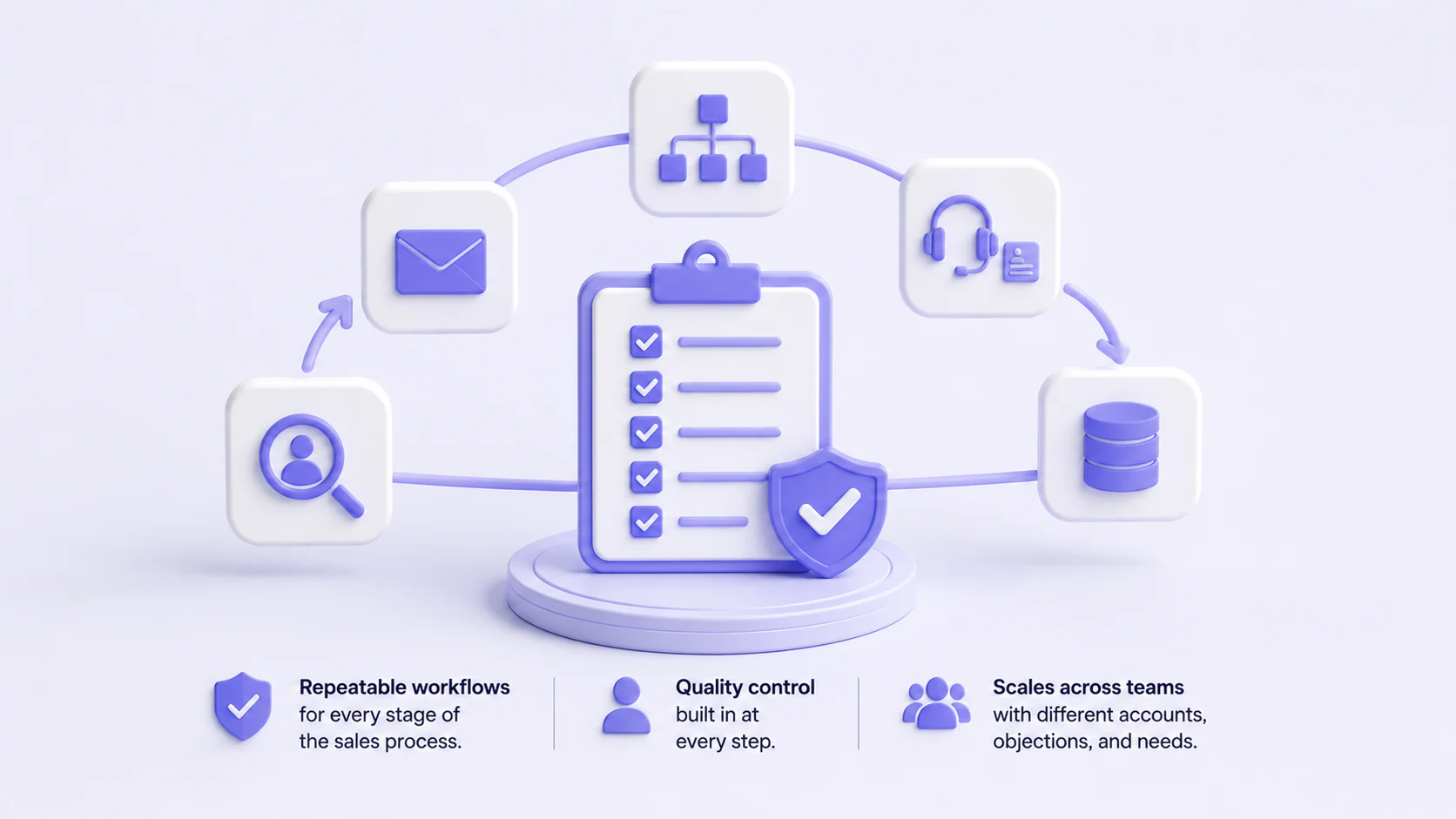
A list of AI prompts can get a rep through one good email. It won’t build the habit of checking AI output before it reaches a prospect, and it won’t scale across a team of ten reps with different accounts, different objections, and different review needs.
That’s the gap real AI sales training is supposed to close: repeatable workflows for research, outreach, follow-ups, call prep, and CRM notes, with quality control built in at every step instead of bolted on afterward.