There’s a moment every marketer eventually hits, staring at a campaign brief at 11 PM and wondering how competitors ship polished content, smart ads, videos, and reports without hiring twice the team. They are not doing it alone. They have handed the repeatable parts of the grind to AI.
But “AI tools for marketing” is now too crowded to buy randomly. The right question is not “what is the best AI marketing tool?” It is “which marketing bottleneck is costing us the most time right now?”
Quick answer: start with ChatGPT or Claude for strategy and copy, Canva or Firefly for visuals, Runway or Descript for video, Hootsuite/Buffer/Metricool for social, HubSpot/Zapier/Make for automation, and Google/Meta native AI for paid media — but keep human controls around claims, brand voice, and budget.
| Marketing bottleneck | Best AI tool category | Example tools |
|---|---|---|
| Blank-page campaign briefs | General AI assistant | ChatGPT, Claude, Gemini |
| Blog, landing page, email copy | Content AI | Jasper, Copy.ai, Writer, Claude |
| Social content and scheduling | Social AI | Hootsuite, Buffer, Metricool, Later |
| Visual concepts | Image/design AI | Canva, Adobe Firefly, Midjourney |
| Video ads and repurposing | Video AI | Runway, Descript, OpusClip, Pika |
| Paid ads optimization | Ad platform AI | Google Performance Max, Meta Advantage+ |
| Reporting and analytics | Data/BI AI | Looker Studio, Supermetrics, HubSpot AI |
| Repetitive workflows | Automation/agents | Zapier, Make, n8n, Gumloop |
Source check — June 4, 2026: OpenAI’s marketing guide frames ChatGPT around campaign briefs, multi-channel copy, research, brainstorming, data analysis, and performance narratives. Google says Performance Max uses Google AI across bidding, budget optimization, audiences, creatives, attribution, and placements, while still depending on advertiser inputs like goals, assets, audience signals, and feeds. So this guide favors workflows with human strategy plus AI execution, not black-box automation.
If you want task-specific guides, start with ChatGPT for marketing, Claude AI for marketing, ChatGPT for social media, and AI ecommerce tools.
How Are AI Tools Used in Marketing? Automating Market Research With AI Search Engines
AI has compressed the research pipeline from weeks to hours. Tools like Perplexity AI, ChatGPT with web browsing, and Google’s AI Overviews let a solo marketer synthesize competitive landscapes, keyword trends, and consumer sentiment without commissioning a single report. What’s changed most is the nature of the questions you can ask. Content gap analysis, rising micro-niches, and competitor repositioning – it’s all promptable now.
How AI Improves Targeting and Campaign ROI
The biggest shift in paid advertising: rule-based audience targeting, which relies on predefined criteria, is giving way to AI-driven predictive models that use algorithms to anticipate user behavior. Google’s Performance Max and Meta’s Advantage+ expand targeting beyond manually defined audiences using machine learning – which sounds helpful until your ads appear in completely wrong contexts. The smarter approach experienced media buyers use is to treat AI targeting as a starting hypothesis, not a final answer. One concrete reality worth knowing – Meta’s Advantage+ Shopping Campaigns perform most reliably for e-commerce brands that feed the algorithm a minimum of 50 conversion events per week. Below that threshold, results tend to be erratic.
AI Workflow Automation Without Writing Code
Zapier, Make, and n8n have added AI-native workflow steps that chain actions like: new lead submits form → summarize their LinkedIn profile → draft personalized outreach → schedule for tomorrow morning. No developer needed. The caveat: treat no-code AI automation like a junior hire. Give it clear instructions, build in checkpoints, and review outputs before scaling.
Connecting LLMs to Internal Tools
In 2026, connecting large language models to internal CRM systems and analytics platforms via LangChain or the MCP (Model Context Protocol) standard has become genuinely practical. Your AI assistant can pull live sales data from HubSpot, cross-reference it with GA4 campaign performance, and produce a coherent summary with no SQL query. The barrier is lower than it was eighteen months ago, and the productivity gains for marketing ops teams are real.
Choosing the Right AI Tools for Your Business Model
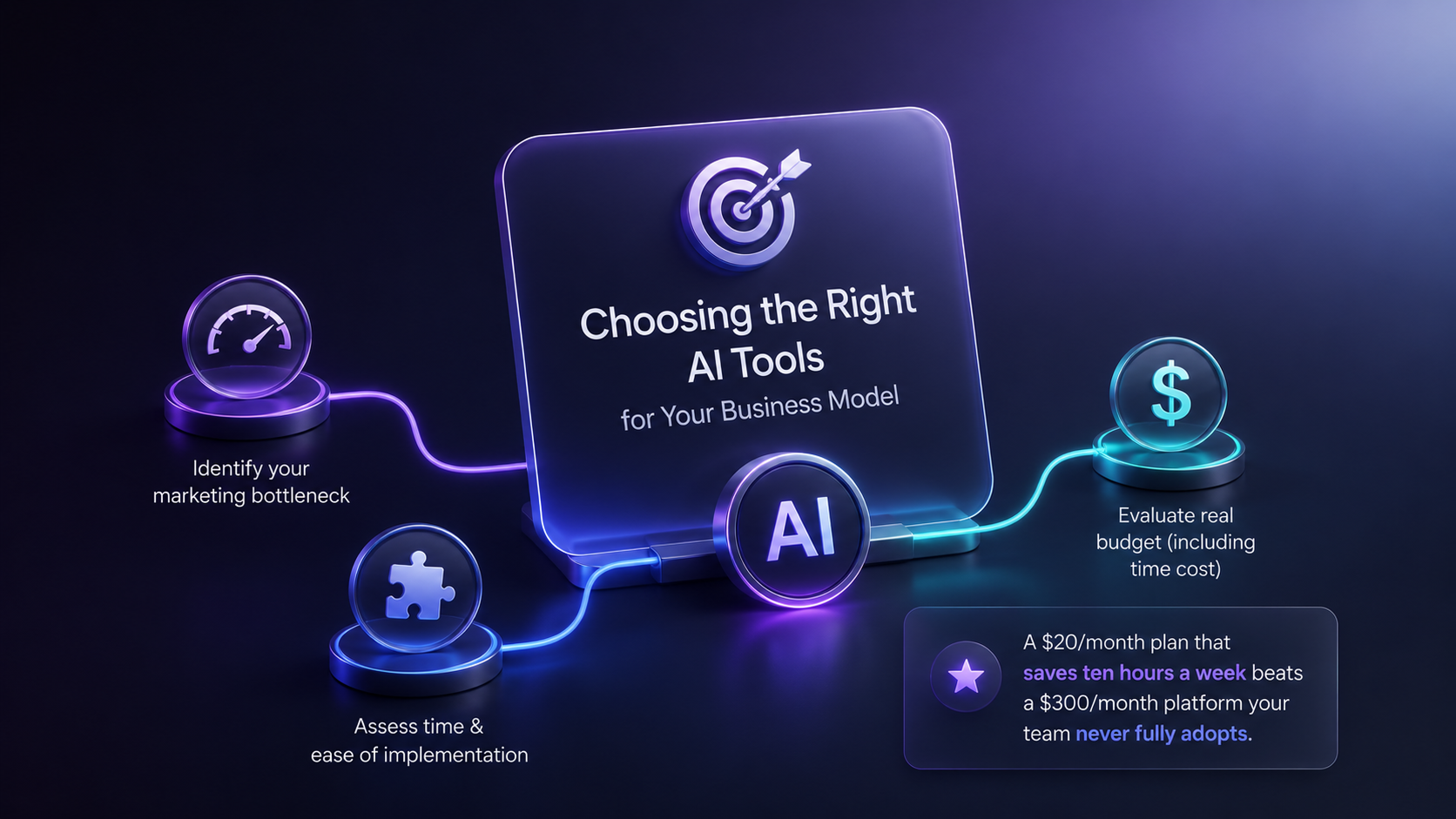
There’s no universal “best” AI marketing stack. A DTC e-commerce brand has completely different needs than a B2B SaaS startup or a local service business. Before evaluating any tool, answer three questions honestly:
- What specific bottleneck is slowing your marketing output right now?
- Do you have time to configure a sophisticated tool, or do you need something that works out of the box?
- What’s your real budget, including the time cost of learning something new?
A $20/month plan that saves ten hours a week beats a $300/month platform your team never fully adopts.
Best Free AI Tools for Marketing in 2026
Free tiers have gotten genuinely usable. Several tools now offer meaningful capabilities at no cost – enough for a freelancer or small business to run real marketing operations. The seven tools below are the strongest free options available, each in a distinct category.
ChatGPT (Free Tier)
Still the most versatile starting point. The free tier includes GPT-4o – a legitimately capable model for copywriting, content calendars, email sequences, and competitive research. Zero onboarding, enormous breadth.
Pros:
- The free version of GPT-4o allows you to write and analyze complex data.
- Personalized instructions allow you to maintain a consistent brand tone without having to rewrite each session.
- Built-in web search for competitors and industry news.
- A huge library of accessible and local resources online.
Cons:
- Usage limitations become apparent during peak hours, which irritates the mind.
- Long-term memory is absent by default; memory loss occurs between sessions.
- Tendency to hallucinate that sounds certain, always check the statistics.
- The free version lacks image creation and complex data processing.
Canva (Free Plan + Basic AI Tools)
Canva has evolved from a simple design tool into an AI-assisted content production platform. Magic Write, background removal, and a library of templates optimized for every major social format – Reels, LinkedIn carousels, ad creatives – make it genuinely useful for non-designers.
Pros:
- The template library constantly updated for trending formats
- Brand Kit (basic, free) stores colors, fonts, and logos for consistent output
- Collaboration features work on the free tier
- Exports directly to social platforms and Google Slides
Cons:
- Most powerful AI features (Magic Media video, advanced editing) locked behind Canva Pro at $15/month
- Magic Write quality is inconsistent for anything longer than short captions or taglines
- Free storage limits become an issue at any real production volume
Microsoft Copilot (Browser / Copilot Mobile)
It is available for free in Edge and as a standalone mobile app. Powered by GPT-4o via Microsoft’s OpenAI partnership, with DALL-E 3 image generation and Bing-grounded web search built in.
Pros:
- Free DALL-E 3 image generation with a generous daily credit allowance
- Web-grounded answers with cited sources reduce hallucination risk on research tasks
- Works natively inside Edge for in-browser drafting and page summarization
Cons:
- Conversation continuity weaker than ChatGPT Plus – complex multi-step projects get awkward
- Deep Microsoft 365 integration requires a paid subscription; the browser version is its own limited product
- Less community support and third-party prompt resources than ChatGPT
eesel AI Blog Writer (Free Trial / Freemium)
eesel connects to your existing knowledge base – Notion, Google Docs, Confluence – and generates content grounded in your internal documentation rather than generic internet training data. The Blog Writer component is designed specifically for SEO-aware long-form content, which means it is optimized for search engine visibility and includes strategies to improve ranking in search results.
Pros:
- Knowledge base integration means output that actually reflects your brand voice and guidelines
- SEO-focused writing with outline generation and keyword integration
- Free trial gives genuine access to evaluate before committing
Cons:
- Output quality depends entirely on the quality of your source documentation
- Narrower use case than general-purpose tools – a specialist, not a Swiss Army knife
- Smaller community means fewer tutorials and use case examples online
Metricool (Free Plan)
Metricool (free plan) is a social media and advertising analytics platform that uses AI for post scheduling. The free plan allows you to manage one brand, covers most popular platforms, and includes built-in recommendations for optimal post timing.
Pros:
- Single dashboard for Instagram, Facebook, TikTok, LinkedIn, X, Pinterest, and Google My Business
- AutoList AI recommends optimal publishing times based on your historical engagement data
- Competitor tracking for up to five accounts – available on the free plan
Cons:
- One brand only on the free tier; not viable for agencies
- Historical data access is capped, limiting trend analysis
- Reporting exports require a paid plan
AnswerThePublic (Free Searches)
One of the oldest tools here, still one of the most useful for content strategy. It visualizes the actual search questions people type around any keyword – the “who,” “what,” “how,” “why,” “when,” “where” – making content gaps immediately visible.
Pros:
- The visual search cloud presents an entire ecosystem of topics at a glance.
- This is real search engine autocomplete data, not just guesses.
- Invaluable for FAQs, blog content, YouTube concepts, and keyword development for contextual advertising.
Cons:
- With a free search of a few queries per day, business people quickly reached their limit.
- There’s no information on the volume of queries; what matters is not how many times people ask a question, but what they ask.
- There are no real-time updates, this indicates current trends in the past, not critical changes.
Hootsuite (Free Trial)
The established player in social media management, now meaningfully AI-forward. The free trial covers its AI writing assistant, smart scheduling, and social listening features. Not cheap post-trial, but the trial is functional enough to properly evaluate.
Pros:
- OwlyWriter AI generates captions and repurposed content from URLs or topics
- Best-time-to-post recommendations based on your actual audience data, not platform averages
- Strong team workflow features: approval queues, role assignments, content calendars
Cons:
- Pricing post-trial is difficult to justify for small businesses or solo operators
- Interface complexity has grown with the feature set – real learning curve
- AI writing is solid for captions and weak for anything longer
Types of AI Marketing Tools for Small Business by Task
The most useful framing isn’t “which tool is best” – it’s “which task is my actual bottleneck?” A local restaurant needs a chatbot and consistent Instagram content. A SaaS startup needs SEO content and CRM automation. The tools that matter are the ones solving your specific problem, not the ones with the longest feature list. The fastest ROI categories for small businesses are content creation, customer communication, advertising optimization, and analytics reporting.
AI Agents That Work 24/7 for Your Team

A useful definition of an AI agent in 2026 is software that doesn’t simply respond to inputs but monitors, plans, and executes a series of steps autonomously. Relevance AI and Gumloop are developing in this direction. In today’s reality, agents are very good at clearly defined, repetitive tasks with inputs and outputs. They lack strategic thinking. Use them accordingly.
Marketing AI Tools for Website Prototyping and Landing Page Design
Framer AI, Wix ADI, and Webflow’s AI features generate full landing page layouts from a text prompt in minutes. The real value is rapid A/B test variant creation. Iteration speed goes from days to hours.
AI-Generated Video Ads That Actually Convert
Runway Gen-3, Kling AI, and Pika Labs have crossed a quality threshold where AI-generated video is usable in paid social. The most effective strategy in 2026: AI will generate the background, emojis, and additional footage, while the main part of the message will be voiced by a real person on-screen. While all AI-powered video production works, a hybrid approach still wins.
Automating Scriptwriting, Voiceovers, and Editing
ElevenLabs (voiceover), Descript (script-to-edit), and Opus Clip (long-form repurposing) have compressed video production significantly. A 45-minute podcast can become six polished short-form clips with captions in under thirty minutes. The bottleneck has shifted from writing to judgment – knowing which output is actually good.
AI Image Generation
Midjourney leads on aesthetic quality for brand lifestyle content. Adobe Firefly is the safest commercial choice, trained on licensed material. Stable Diffusion-based tools like Leonardo AI offer the most customization for product imagery. Practical rule: AI handles concepts, variations, and backgrounds. Do not replace professional photography with hero product shots.
AI-Powered Chatbots
Intercom’s Fin, Drift, and Voiceflow have made genuinely useful chatbots deployable without a development team. Current AI chatbots handle nuanced follow-up questions, escalate intelligently to humans, and personalize responses via CRM integration. For e-commerce, a well-configured bot deflects a meaningful share of support tickets – freeing agents for complex cases.
AI-Driven Paid Advertising Optimization
Third-party tools provide transparency and control in addition to Google’s built-in tools and Meta AI. Madgicx is an intelligent service that provides Meta Analytics for audiences and creatives. Optmyzr is a robot that manages bids and optimization in Google Ads. The basic approach is to redefine strategic constraints, specifying CPA, brand safety measures, and creative refresh cycles, and then allowing the algorithm to operate within them. Budgets are wasted in a fully automated, uncontrolled environment.
Web Scraping and Competitor Analysis and Monitoring
Competitors won’t announce when they change their pricing page or reposition their messaging. Crayon and Klue track competitor website changes, content updates, and hiring patterns at the enterprise level. For tighter budgets, Browse AI sets up no-code scrapers that alert you to specific page changes. Pair with AI summarization, and you have a competitive monitoring system at a fraction of enterprise pricing.
Automating Reporting and Dashboards
Looker Studio, Supermetrics, and the AI reporting in HubSpot and Metricool have made the monthly reporting grind less painful. The emerging capability – natural language querying: ask “Which campaigns drove the most revenue last quarter under $50 CPA?” and the AI builds the view. Marketing teams waste real hours on data assembly that contributes zero strategic insight. Automating it returns that time to actual analysis.
Combining Multiple AI Tools Into One System
Here’s what most articles skip: the real power of AI in marketing isn’t any single tool – it’s connecting them. AnswerThePublic finds a trending question, ChatGPT drafts the post, Canva generates the header image, Metricool schedules and reports on it. That’s a complete AI-assisted content operation one person can run. Make or Zapier connects most of these without code.
The result isn’t magic – you still need someone with good judgment directing the whole thing. But the output capacity of a skilled marketer running an integrated AI stack is genuinely different from what was possible two years ago. The tools are ready. The question is whether you’ve given them a clear enough strategy to execute.
FAQ