For adjacent reading, see what is prompt engineering, how to learn AI in 2026, and AI training careers.
A prompt engineering certification can be worth it – but only if it teaches actual workflow skills, not just a list of “magic” phrases. The good ones cover how to give an AI model context, structure a task, test the output, catch mistakes, protect sensitive data, and reuse what works for real jobs at work. The bad ones hand you a PDF of 50 prompts and call it a career credential. If you’re a beginner trying to figure out which is which, the short version is: look for hands-on practice, not promises.
That’s really the whole question this article is built around. Let’s break it down properly.
Is prompt engineering certification worth it?
Honestly, it depends on what you think you’re buying.
If you expect a certificate to function like a law degree or a CPA license – something an employer is required to recognize – you’ll be disappointed. There’s no governing body that accredits “prompt engineers” the way there is for accountants or electricians. Most certificates in this space are issued by the course provider itself, which means the value lives entirely in what you actually learned, not in the paper.
But that doesn’t make the training pointless. A decent prompt engineering course gives you a structured way to practice something most people are currently doing badly: typing vague requests into ChatGPT or Claude and getting frustrated when the answer is generic. Learning how to set context, specify the output format, and iterate on a response is a real, transferable skill – closer to “learning to use Excel formulas well” than “becoming a software engineer.”
So the honest answer: worth it if the program focuses on guided practice, workplace tasks, and habits you’ll actually use Monday morning. Not worth it if it’s mostly a sales funnel built around the words “certified” and “guaranteed.”

When it’s a smart investment
You’re a marketer, analyst, teacher, or assistant who already uses AI tools weekly and wants to stop guessing. A short course that drills you on structuring requests, checking outputs, and building a personal prompt library pays off fast – you’ll feel the difference in your next project, not in six months.
When to skip it
If a program’s main pitch is “get certified and land a six-figure prompt engineering job,” slow down. There’s no reliable, independently verified data supporting that kind of guarantee, and any course that leans on it that hard is selling the credential, not the skill.
Prompt engineering certification: quick decision table
Here’s a fast way to sort what you actually need from what you’re being sold.
| Learner goal | What to look for | Red flags | Best next step |
|---|---|---|---|
| Get better at AI tools for my current job | Practical exercises tied to real tasks (emails, reports, analysis) | Course is just a list of prompts with no practice component | Try a short hands-on course before committing to a longer bootcamp |
| Build a portfolio for job applications | Projects you can show, not just a certificate badge | “Certificate” implies official accreditation it doesn’t have | Pair the course with real work samples, not the badge alone |
| Switch careers into AI-adjacent roles | Curriculum covering workflow design, tool comparison, and evaluation | Vague claims about “guaranteed” hiring outcomes | Treat it as one skill among several (data literacy, domain expertise) |
| Just curious / casual user | Beginner-friendly course with low time commitment | Heavy upsells before you’ve learned anything | Start with a free or low-cost intro before paying for certification |
Certificate vs certification vs course: what the wording means
This part trips a lot of people up, and honestly, some course marketing pages don’t help.
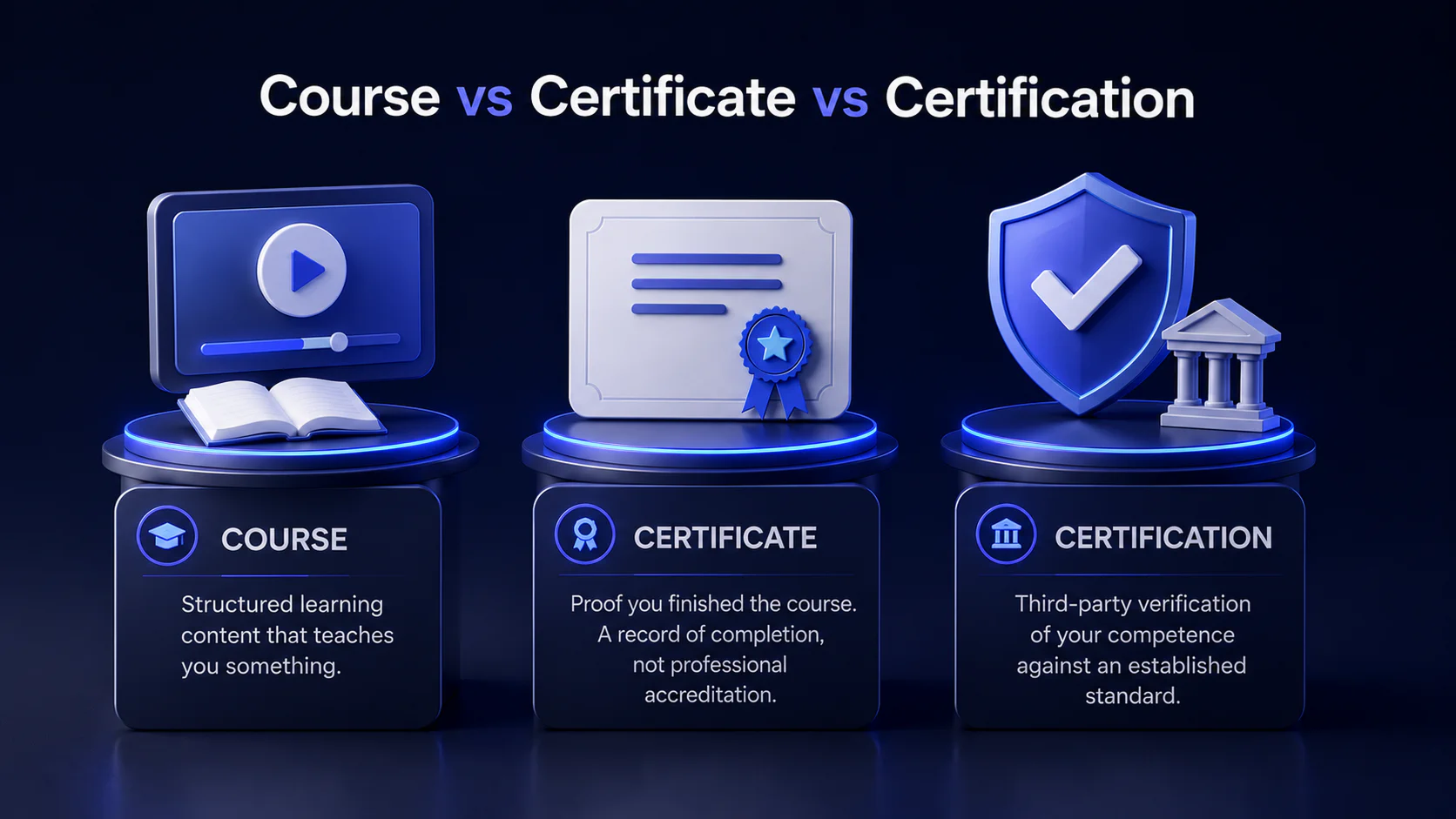
A course is just structured learning content – videos, exercises, readings. It teaches you something. It doesn’t, by itself, prove anything to anyone else.
A certificate of completion means you finished the course. That’s it. It’s a record that you went through the material, sometimes with a quiz or final project attached. It’s useful as a personal milestone and a LinkedIn line item, but it is not the same as professional accreditation.
Certification, in the strict sense used in regulated fields, usually means a third-party body has tested and verified your competence against an established standard – think medical boards, bar exams, or PMP project management certification. As of now, there is no single recognized, accredited “prompt engineer certification” body equivalent to that. When a course calls itself a “certification,” it almost always means an internal certificate of completion, not third-party accreditation.
None of this means the training is worthless – it just means you should read the fine print. If a page promises your certificate will be “recognized by employers” or “equivalent to an official OpenAI or Anthropic credential,” that’s a claim worth questioning, since neither company currently issues a general-purpose prompt engineering certification of that kind.
Why the distinction actually matters
If you’re putting this on a resume, an employer is going to care more about what you can demonstrate in an interview than the name of the badge. Courses that focus on building real, reusable skills tend to translate into better interview answers than courses that just hand out certificates.
What a good prompt engineering course should teach
This is the part that actually determines whether the money was well spent. A solid curriculum doesn’t read like a vocabulary list – it reads like a set of habits you build over a few weeks.
| Skill | Why it matters | Example workplace task |
|---|---|---|
| Context setting | Vague prompts get vague answers; giving background changes everything | Briefing the AI on your company’s tone before drafting a client email |
| Role/task/output instructions | Tells the model exactly what to act as and what format to return | “Act as a financial analyst, summarize this report in 5 bullet points” |
| Examples and constraints | Showing a sample output narrows the gap between what you want and what you get | Pasting a past report as a style example before asking for a new one |
| Iterative prompting | First answers are rarely final; refining gets you closer each round | Asking for a shorter, punchier version after the first draft |
| Evaluation and fact-checking | AI models can sound confident and still be wrong | Cross-checking a generated statistic against the original source |
| Reusable prompt libraries | Saves time once you’ve found a structure that works | Keeping a saved template for weekly status report summaries |
| Workflow design | Chaining steps (research → draft → review) instead of one-shot prompts | Building a 3-step process for turning meeting notes into action items |
| Privacy and responsible AI | Protects sensitive data and avoids compliance headaches | Knowing not to paste client PII into a public AI tool |
If a course skips evaluation and fact-checking, that’s a real gap – not a nitpick. AI outputs can look polished and still contain errors, and a training program that doesn’t teach you to catch that is teaching you half a skill. For a broader grounding in the basics before diving into a paid course, this overview of what prompt engineering actually is is a useful starting point.
Who should consider prompt engineering training?
The honest answer is “more people than you’d think,” but the reason differs by role.
- Beginners benefit because structured practice beats trial-and-error – you skip months of guessing.
- Marketers use it to speed up content drafts, ad variations, and campaign brainstorming without losing brand voice.
- Analysts use it to summarize reports and turn raw data into plain-language explanations.
- Teachers use it to create lesson plans and differentiated materials.
- Salespeople draft outreach and follow-ups faster while still personalizing before sending.
- HR teams use it for job descriptions, interview question banks, and policy drafts.
- Executive assistants save time on scheduling summaries, meeting notes, and email sorting.
- Small business owners save hours on document work when they juggle multiple roles.
What job seekers gain from the certificate is less the certificate itself and more the ability to speak fluently about how they use AI in their workflows, even in roles that aren’t technical.

If you’re new to all of this and want a slower on-ramp before jumping into certification, a beginner’s guide to learning AI or a free starting point might make more sense as a first step.
What beginners should learn first
Before anyone touches “advanced prompting frameworks,” there are basics that matter more.
Start with the structure of a prompt itself – what context, instructions, and constraints actually do. Then learn the practical differences between tools: ChatGPT, Claude, and Gemini don’t behave identically, handle files differently, and have different strengths for writing versus analysis versus coding. This beginner walkthrough of ChatGPT is a reasonable place to start if you’ve never used these tools seriously.
A few things every beginner should get comfortable with early:
- How to upload and reference files (PDFs, spreadsheets, images) so the AI works from your actual data instead of guessing
- How to recognize the model’s limitations – outdated information, occasional made-up facts, and inconsistent math – so you know when to double-check
Quality control isn’t optional. The single biggest mistake new users make is trusting the first answer without verifying it. And safe data handling matters more than people assume – once something is typed into a chat tool, you’ve lost a layer of control over it, so sensitive client or financial information needs extra caution.
How to evaluate a prompt engineering certification program
Before paying for anything, run it through a quick mental checklist.
- Does it include hands-on tasks and projects, not just video lectures and reading?
- Does it cover current tools (not screenshots from a tool version that’s two years old)?
- Does it include practical workplace examples?
- Does it address responsible AI use?
- Does it describe the certificate honestly – no inflated claims about guaranteed jobs or official accreditation?
If a program passes that test, it’s probably built around teaching, not selling. If the sales page leads with income promises before it tells you what you’ll actually learn, that’s worth noticing.
Prompt engineering examples for work
Theory is fine, but this is where it gets useful. Here are real task types a decent course should have you practice:
- Summarize – condense a 10-page report into a one-paragraph executive summary.
- Rewrite – turn a stiff internal memo into a clear, friendly team update.
- Analyze – ask the model to identify trends or outliers in a dataset you describe or upload.
- Brainstorm – come up with 15 campaign taglines, then narrow them with follow-up questions.
- Develop a plan – create a 30-day onboarding plan for a new hire with weekly milestones.
- Make a table – turn messy notes into a structured comparison table for a vendor decision.
- Review output – have the AI reread its initial output and identify weak spots.
- Convert notes to deliverables – turn raw meeting notes into action items with owners and deadlines.
- Translate tone – rewrite the same message for three audiences: a client, a manager, and a teammate.
- Draft and refine – write a first version, then iterate three times toward something publish-ready.
Practicing these ten scenarios teaches more than memorizing prompt templates ever will, because you’re learning to adjust, not just copy. A structured challenge format – working through tasks like these day by day – tends to stick better than passive lectures, which is roughly the idea behind something like the 28-day AI challenge.

Final recommendation
Here’s where this lands: the best prompt engineering certification is genuinely useful as a way to build a habit of working with AI tools well – structuring context, testing outputs, catching errors, reusing what works. It is not a guaranteed ticket to a new job title, and it’s not an officially accredited profession the way some marketing pages imply.
If you’re choosing a program, treat it like you’d treat any practical skills course – judge it by the exercises, not the certificate name. Look for one that teaches workflow design and responsible AI habits alongside the basics, and that’s upfront about what the certificate does and doesn’t mean.
If you’d rather build that habit through guided, hands-on practice instead of piecing together random prompt examples from blog posts, a structured prompt engineering course is built around exactly that – practical workflows you can apply the same week, not just a badge to add to a profile. It won’t replace your job expertise, but paired with it, it’s a reasonable way to get faster and more reliable with AI prompting. For a wider view of how this fits into a broader AI skill set, this guide on AI training and careers and this roundup of beginner AI courses are worth a look too.
FAQ