For adjacent reading, see how to learn AI, how to train your own AI model, and create a personal AI assistant.
If you’ve ever used AI tools – specifically chatbots where you type in a question to get an answer – you’ve likely heard of the concept of a prompt. Even if you haven’t, some of your chatbot questions might have been prompts themselves. By 2026, the concept of a prompt will no longer be just a well-crafted query, but an entire art form and a source of career opportunities.
What Is Prompt Engineering in Simple Terms: Definition and Meaning
Prompt engineering is the ability to formulate requests to artificial intelligence in such a way as to obtain accurate, useful, and expected results. Put even more simply, it is the ability to converse with a chatbot so that it does exactly what you need. When you write “write a text about marketing,” you get one thing. When you write “you are an experienced copywriter at a B2B company, write a compelling landing page for a SaaS product targeting HR directors of small businesses, in a 5-block format with headings, without technical jargon” – you get something completely different. The difference between these two prompts is the essence of prompt engineering.
This term originated in NLP (natural language processing) and began to be widely used after the release of chatbots. While it was once simply a skill for crafting a well-formulated prompt, it has now evolved into a full-fledged engineering discipline. Also, this was affected by the full development of AI in 2026, when specialists in prompt-making began to be in demand.
Key Concepts Behind AI Prompts
A prompt itself is any text you send to a language model. But behind simple text lies an entire system of concepts.
- Context is the information that defines the scope of the task. The more precisely you define the context, the more relevant the response will be.
- Instructions are commands to the model of what to do and how to do it. The clearer your instructions are, the more effectively the model will perform the task.
- Role is about assigning the model a particular expert role. Giving the model a role helps it to take a more direct approach to the task.
- Constraints are the conditions that the model must follow. These can include specifications regarding format, tone, length, scope, audience, as well as what to avoid.
- Examples are sometimes more important than anything else. Samples of the desired output help guide the model in the right direction and produce the result you expect.

Difference Between Prompts and Traditional Programming
There is a significant difference between traditional programming and prompts – the former operates through specific, rigid “if A, then B” instructions. In this case, the code is deterministic and reproducible. With prompt engineering, users do not program behavior directly but only create conditions under which the probability of the desired behavior is maximized. It is also worth noting that this is a probabilistic system. The same words can yield different results, whereas traditional programming usually produces the same output for the same input. This is precisely why a prompt engineer thinks not like a programmer, but rather like a psychologist and a technical writer combined.
Traditional programming uses programming languages such as Python, Java, C++, and others. When writing a prompt, natural language is used. When it comes to control and logic, in prompts AI decides how to solve the problem based on our query. Traditional programming implies that the programmer specifies every step. And of course, to work in traditional programming, you need to have programming skills and a grasp of algorithms. When writing a prompt, you need skills in natural language communication and an understanding of AI behavior.
Types of Prompts: Zero-Shot, Few-Shot, and Chain-of-Thought
There are several types of prompts depending on the completeness of the request, the inclusion of examples, and so on.
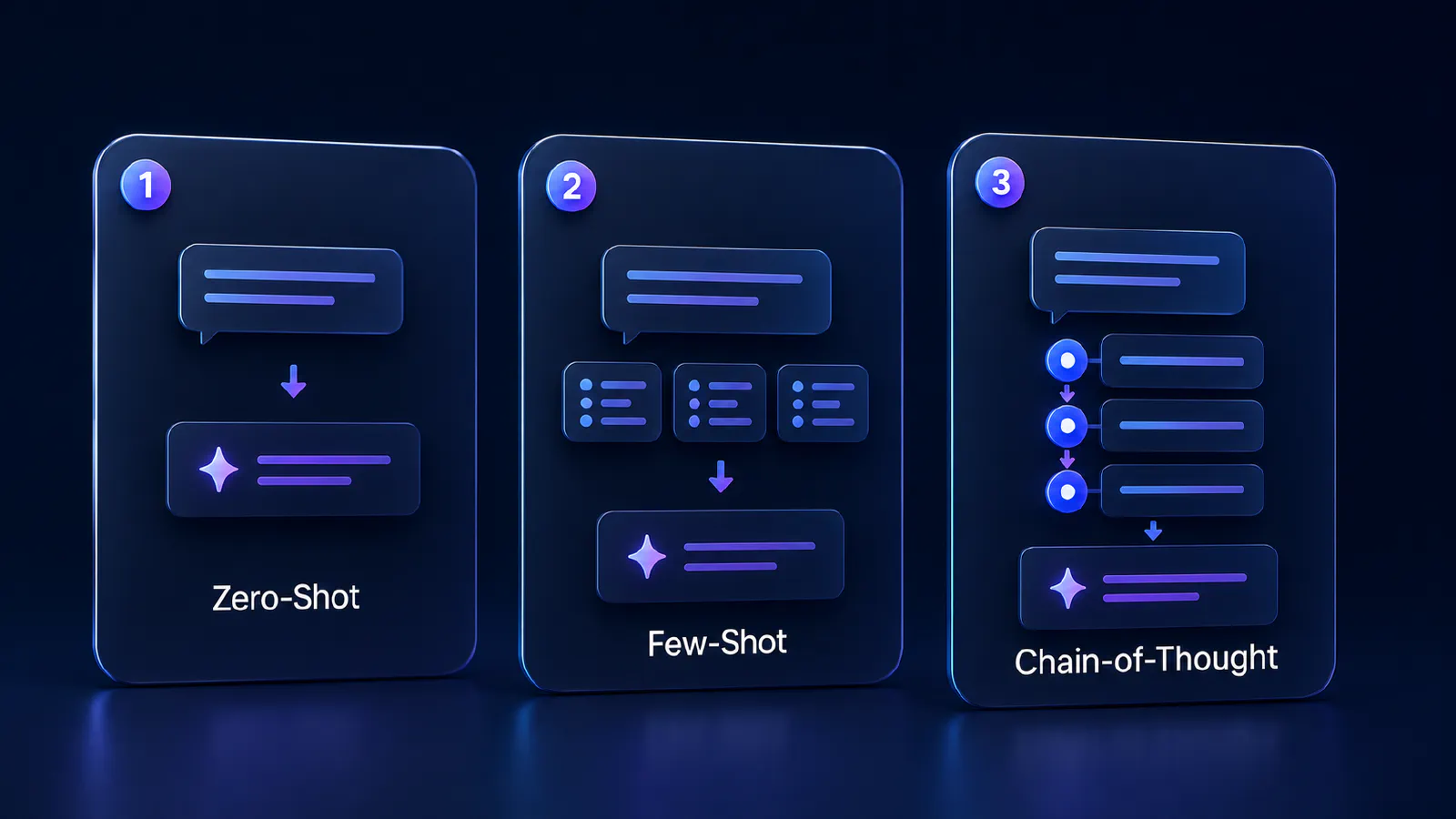
- Zero-shot prompting is when you provide a task without examples and expect the model to handle it on its own. It is suitable for simple, standard, routine tasks that do not require high precision and call for a general-purpose response.
- Few-shot prompting – in this case, you include several examples in the prompt (“this is what the answer should look like”). This significantly improves the accuracy of the response, especially for specific formats and tasks. For example, adding examples is effective for marketing tasks where you need to create something in the same style or format.
- Chain-of-thought prompting – this is the most detailed and comprehensive prompt, and the scenario where you ask the model to think step-by-step before providing the final answer. This approach is particularly effective for logical tasks, calculations, and multi-step reasoning.
How Prompt Engineering Works with Modern Language Models
How Large Language Models Interpret Prompts
It is important to understand that large language models (LLMs) do not “understand” text the way humans do. They operate on probabilities – upon receiving input text, the model predicts which token (word, part of a word, or character) is most likely to follow the previous one. What does this mean when working with a prompt? When you submit your prompt, the model processes it entirely as context and generates a response token by token. This is precisely why the structure and word order in the prompt matter, as they literally alter the probability distribution of the next token.
Tokenization and Context Windows Explained
This is where the term tokenization comes in. Tokenization is the process of breaking text down into basic processing units. A single word can be one token (e.g., “car”) or several (“tokenization” → “token” + “ization”). A single sentence can be broken down into tokens one word at a time. “I love cars” becomes “I”, “love”, “cars”. Each word, part of a word, or punctuation mark can be a separate token.
Context Window is the amount of text that the model can “keep in memory” at one time. Modern models have context windows ranging from 8,000 to 2 million tokens. This is critically important for prompt engineering because the model cannot “see” anything that falls outside the context window.
The Importance of Prompt Structure and Clarity
The content of the prompt itself is very important, but its structure is equally important. This directly affects the quality of the response. A vague question can yield an equally vague answer. Therefore, when writing a prompt you should follow a clear separation into sections depending on the type of task, context, format and constraints. This provides the model with a “skeleton” upon which it builds its response.
Role of Instructions, Constraints, and Examples
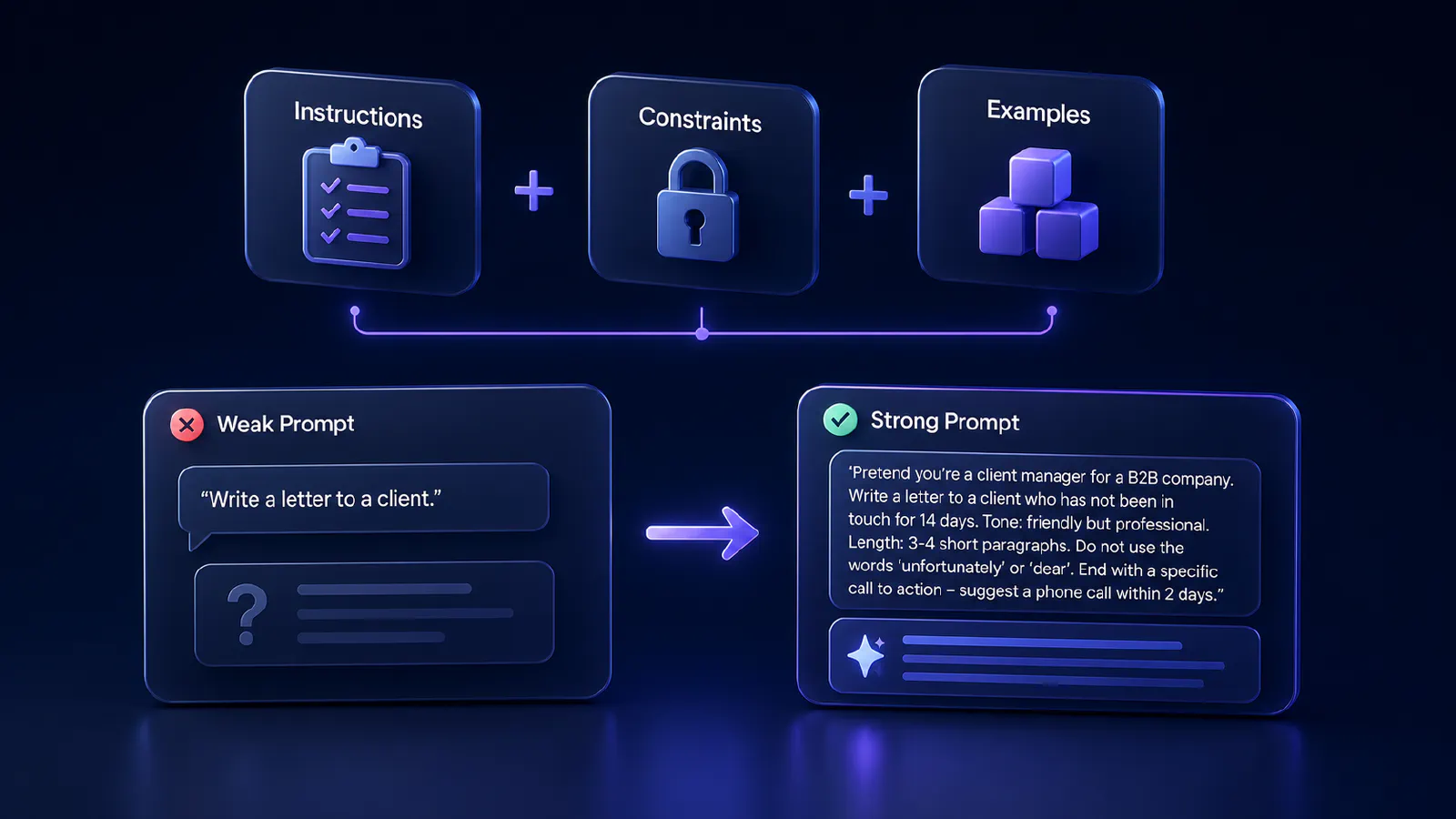
A high-quality prompt must include these three elements: instructions, constraints, and examples. They work especially well together. Instructions tell the model exactly what to do. Constraints specify what not to do and the parameters within which to perform the task. Examples demonstrate exactly what the result should look like.
Here are two examples, one will give a vague result and the other will give a high quality and expected result. Weak prompt example: “Write a letter to a client.” Strong prompt example: “Pretend you’re a client manager for a B2B company. Write a letter to a client who has not been in touch for 14 days. Tone: friendly but professional. Length: 3-4 short paragraphs. Do not use the words ‘unfortunately’ or ‘dear’. End with a specific call to action – suggest a phone call within 2 days.”
Iteration and Refinement in Prompt Design
Writing a good prompt is not a simple task; it requires editing and several attempts. Most often, a prompt engineer’s actual workflow looks like this: write → test → analyze errors → refine → repeat. Only through testing can you see how effective the prompt was, what changes should be made, and so on. Iteration in prompt engineering is particularly important for this very reason – repetition and refinement yield high-quality results.
Common Prompt Engineering Techniques
As prompt engineering has evolved, various techniques have emerged. The most common include:
- Zero-shot prompting – simply a question without examples
- Few-shot prompting – including examples in the prompt to complete the task
- Role prompting – assigning the model the role of an expert: “You are an experienced lawyer specializing in copyright law.” This activates the model’s corresponding behavioral patterns.
- Chain of thought – a request to reason step-by-step with an explanation of the thought process.
- Step-by-step prompting – a technique similar to chain of thought, but with an emphasis on the sequence of actions. Example: “First, analyze the problem; then, propose a solution; then, evaluate its pros and cons.”
- Output formatting – specifying the format in the prompt. For example: Markdown, table, bulleted list. Reduces the need for post-processing of results.
- Persona prompting – similar to role prompting, but here the model is assigned a specific personality style. For example: “Explain quantum physics as a friendly school teacher.”
- System prompts – instructions that define the model’s behavior at a level “above” the user’s query. Used in products and applications.
Prompt Engineering Techniques and Best Practices
As mentioned above, there are many prompt writing techniques available today. In addition, it is also important to be specific, maintain structure, and follow certain guidelines.
Writing Clear and Specific Prompts
Being specific is one of the key principles of prompt writing. Instead of “make it shorter,” it’s better to write “shorten it to 150 words”. Instead of “simplify,” write “rewrite it so that a 16-year-old without a technical background can understand it.” This gives the model less room for interpretation, which in turn leads to a more accurate result.
Using Step-by-Step Instructions for Better Output
Using the step-by- is one of the most effective techniques. When the phrase “think step by step” or “break the task into stages” is added to the prompt, it literally changes the architecture of the response – instead of jumping instantly to a conclusion, the model builds a chain of reasoning, which significantly reduces the number of factual errors and also helps us track the quality of the response.
Leveraging Few-Shot Prompting for Accuracy
Examples are very useful when you want to see a specific result. To achieve this, the few-shot technique is helpful. It is particularly effective when you need a specific style or format that is difficult to describe in words. Instead of a long description, simply show a few examples. The model “picks up” the pattern and reproduces it.
Tools and Platforms for Prompt Engineering
Nowadays, there are also various platforms and tools available for creating good prompts that can simplify this task or improve the process.
Prompt Engineering Tools and Extensions
The ecosystem of tools for prompt engineering is rapidly evolving. Leading platforms in prompt management include:
- PromptLayer – version and performance tracking for prompts
- LangSmith – debugging LLM applications. One of the market leaders.
- Promptfoo – prompt testing and evaluation
- Weights & Biases Prompts – for ML teams
For working with the models themselves, platforms such as OpenAI Playground (especially for rapid prototyping), Anthropic Console (especially convenient for testing prompts for models in the Claude family), Google AI Studio (the main tool for working with Gemini models), and Amazon Bedrock (highly relevant in corporate environments and allows working with models from different providers through a single interface).
For building chains and agent systems, LangChain remains the largest ecosystem. LlamaIndex is particularly relevant for RAG systems (working with documents and knowledge bases). Also rapidly gaining popularity is Crew AI, which is often chosen for creating multi-agent systems due to the ease of configuring agent roles.
No-Code vs Low-Code AI Tools
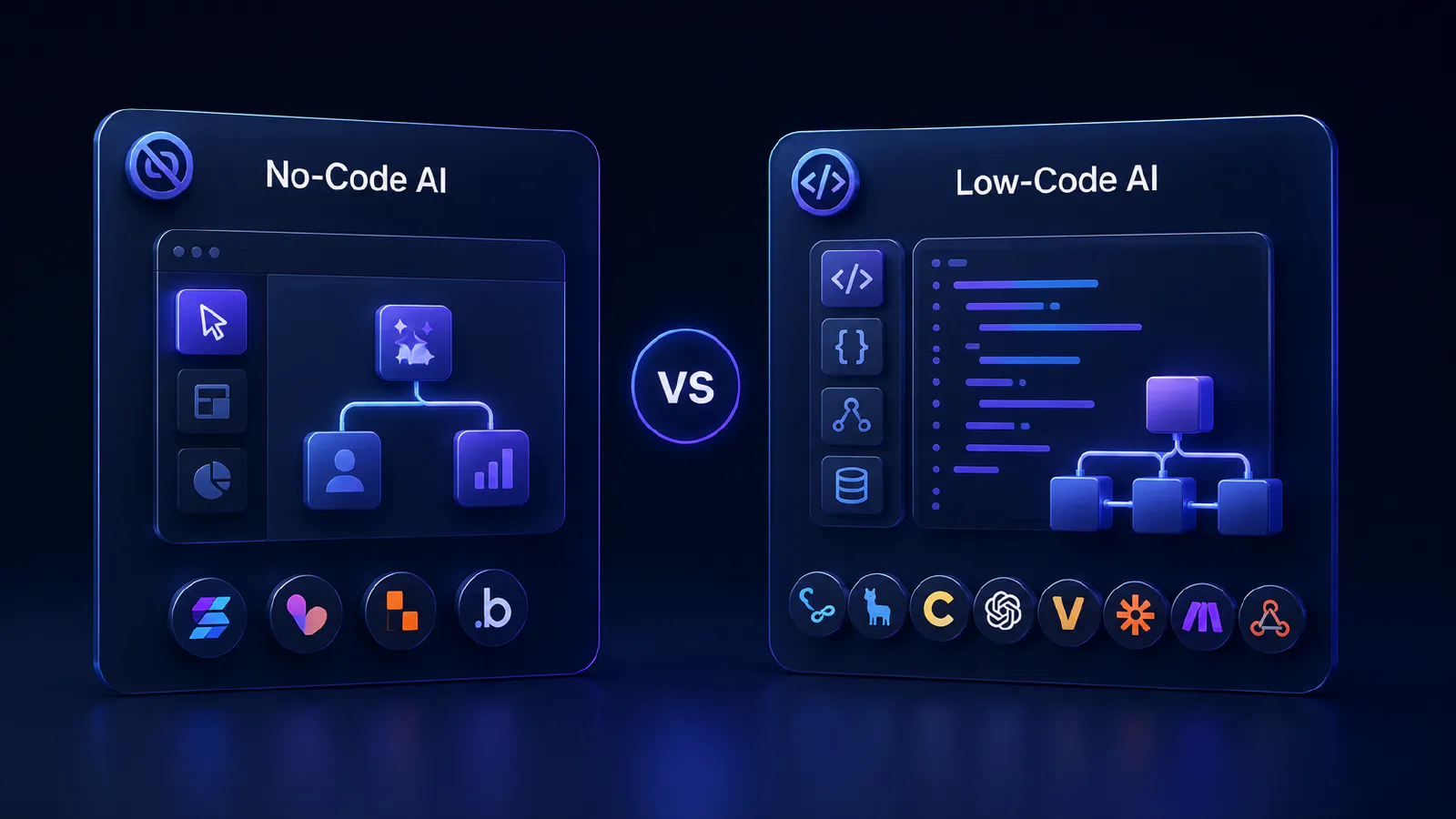
No-Code AI tools are tools where you don’t write any code for prompts or logic at all, but simply configure everything through the interface. No-code tools such as Shipper, Lovable, Replit, and Bubble allow you to create applications without writing code. This has opened up the field to marketers, managers, and analysts.
Low-code tools require an understanding of APIs, JSON, and basic automation logic, but offer incomparably more flexibility. When using low-code, in addition to prompts, you add code, build chains, RAGs, and agents. In other words, the user has full control over prompts and can build AI agents and RAGs, but this requires programming skills. Among the most common tools are: LangChain, LlamaIndex, CrewAI, OpenAI API, Vellum, Zapier, Make, and n8n.
Role of APIs and Automation in Prompt Engineering
Today, prompt engineering is not just about writing good prompts, but about creating systems where prompts operate automatically via APIs and automation processes. An API (Application Programming Interface) is the method by which an application “communicates” with the model. APIs are used to create dynamic prompts (the prompt is generated automatically based on user data). They also allow you to route different tasks to different models. For example, long-form text and analysis tasks go to Claude, while multimodal tasks go to Gemini. APIs also enable the use of reusable structures, making prompts scalable and reusable.
Automation in prompt engineering is when processes involving prompts are executed without human intervention at every step. The following techniques can be used for automation:
- Prompt pipelines – instead of a single request, a sequence of steps is created.
- Automatic prompt evaluation – systems check the quality of prompts on their own. They run several variants, compare responses, and evaluate quality (accuracy, style, completeness). Tools like Promptfoo, LangSmith, and W&B Weave.
- Automatic data preparation – before sending data to the model, the system cleans the text, breaks it into chunks, removes noise, and selects the necessary context. This improves the quality of responses without changing the prompt.
- RAG (Retrieval-Augmented Generation) or automatic information retrieval, where the system searches the database for data, finds relevant documents, inserts them into the prompt, and sends them to the model. Example: “Explain my notes.” The system finds the notes itself and inserts them into the query.
In this way, APIs have transformed prompts from a manual task into scalable production systems. Through OpenAI, Anthropic, or Google Gemini APIs, a single well-written prompt can automatically process thousands of requests per day – in data pipelines, CRM systems, and content platforms.
Prompt Engineering Examples and Real-World Applications
By 2026, virtually everyone using AI tools – particularly chatbots will encounter prompt engineering. Here are the most common prompt engineering examples, as well as the fields that use prompts most frequently.
Content Marketing
Content marketing has become one of the earliest and most mature areas of application. Teams and specialists use prompts to generate text drafts, create variations of ad copy, perform SEO optimization, write email newsletters, and adapt content for different audiences. A well-written prompt that clearly defines the brand’s voice, includes examples, and sets boundaries yields a finished draft requiring minimal editing.
Customer Support Automation
LLM-based chatbots with properly configured system prompts can handle routine inquiries without human intervention. At the same time, the conversation context is preserved, and complex cases can be escalated to humans. In this case, the prompt must simultaneously define the bot’s personality, knowledge base, and constraints.
Software Development
Developers use LLMs to write code, generate documentation, write tests, and more. Prompt engineering here means the ability to precisely describe the task – which language, which version, what constraints, what style, and what cannot be used.
Data Analysis and Research
Analysts use AI tools to interpret data, formulate hypotheses, write SQL queries, and summarize research. Prompts here must be particularly precise, as an incorrectly defined task can lead to incorrect conclusions that appear convincing.
Career Opportunities in Prompt Engineering (2026)
Prompt engineering is already a fully-fledged profession and a field of work that requires specific skills and opens up many opportunities. Currently, there is a demand for specialists in this field in the job market, and employers offer competitive salaries.
What Is a Prompt Engineer Job Role?
A prompt engineer is a specialist who designs, tests, and optimizes prompts to achieve specific results. By 2026, this job had become much more mature and technically demanding than in the early days when AI was just forming. Typical responsibilities include designing system prompts for products, creating prompt libraries and standards, testing and benchmarking output quality, integrating prompts into production systems, and monitoring and iteratively improving them.
High-Demand Prompt Engineering Jobs in 2026
The prompt engineering role changed a bit in 2026; it morphed into bigger roles. According to PE Collective, which tracks AI and prompt engineering jobs, standalone job postings with the exact title “Prompt Engineer” have decreased by approximately 30% since 2024, but the number of job openings requiring prompt engineering skills in any form has tripled over the same period. This means that prompt engineering skills are now mandatory and in demand under various job titles. Among them:
- AI Engineer – develops LLM applications, writes prompts as part of the product code.
- AI Product Manager – determines how AI features should behave, works with engineers on prompts.
- Conversational Designer – designs dialogues for chatbots and voice systems.
- AI Content Strategist – builds content systems on top of LLMs.
- ML Ops / LLM Ops Engineer – monitors and optimizes production AI systems.
Freelance vs. Full-Time Prompt Engineering Jobs
Full-Time Prompt Engineering Jobs Prompt engineering professionals have the flexibility to choose their work format – the market offers both freelance and full-time jobs.
Full-time jobs provide stability, access to proprietary models, and more income potential. Typical tasks include building prompt pipelines, building production AI systems, working with RAG and agents, testing model quality, integrating LLMs into products, etc. According to Glassdoor, the median total compensation is around $131,000, which includes a base salary of $83,000–$130,000, with the rest as bonuses and additional payments. Freelancing also provides good opportunities for prompt engineers. One-off projects such as quick audits, creating chatbots, and developing system prompts for startups are always in demand on platforms like Upwork and Toptal. The advantages of freelancing include the freedom to select your projects, the opportunity to work remotely from anywhere in the world, and the flexibility to integrate it with other pursuits. The downsides may include unstable income, the need to find clients, and other factors.

Industries Hiring Prompt Engineers
It’s not just AI-related companies looking for specialists in this field. Demand is spread across several key sectors.
- Technology and SaaS – every product company releasing AI features.
- Finance and Insurance – for compliance bots, contract summarization, and risk modeling.
- The IT sector – offers the highest salaries and has many related positions requiring prompt engineering skills.
- Healthcare – uses AI for diagnostics, patient care, and medical docs too.
- Marketing and media – use it to create and optimize content on a large scale.
- Retail and logistics – for personalization, demand forecasting, and customer support.
According to Gartner forecasts, by 2026, about 80% of enterprises will be using generative AI, which will fundamentally support the demand for prompt engineering specialists in all these sectors.
Remote Work Opportunities in AI Prompting
Prompt engineering is the ideal profession for remote work. The work takes place in a browser, documents, and on a computer. It is one of the few technical specialties where geographic location has virtually no impact on job availability. Most positions are advertised as fully remote or hybrid. Freelancers now have a global market to tap into. While jobs like Prompt Engineer often aren’t standalone, skills from that role are key in many positions – AI Engineer, LLM Engineer, Product Engineer, and others. The AI Automation Specialist is really popular too. They create AI-powered automations and work with no-code/low-code tools and model APIs, so the role is super accessible to remote workers. Even non-tech jobs like AI Content & Prompt Writers are playing a big role. These writers create prompts, create templates for text generation, and polish the tone of voice.
If you’re hunting for a gig, keep an eye out for roles such as AI Engineer, LLM Engineer, Automation Engineer, Data/AI Product Engineer, and RAG Developer. For 2026, prompt engineering looks to be integrated into these kinds of roles rather than being on its own.
Key ideas
When you look up “prompt engineering meaning,” you get lots of definitions. Yet, over the last few years, it’s evolved hugely – from simply crafting good queries to an actual engineering field. Now it has its own tools and norms and job tracks. This evolution opens new doors in the world of AI and can advance your career too.