AI consultant certification online can help beginners structure what to learn, but it’s not a job guarantee – and anyone who tells you otherwise is selling you something. A useful AI consulting course should teach practical AI workflows, business process analysis, prompt and tool selection, responsible AI use, client communication, and how to turn messy, real-world business problems into scoped AI projects. The strongest path isn’t a certificate alone. It’s training paired with a small, honest portfolio of real workflow examples you can actually show someone.
That’s the short version. Now let’s get into what the job actually looks like, because most people searching for “how to become an AI consultant” have a fuzzy picture of the role – somewhere between “tech expert” and “magic productivity fairy.” Neither is quite right.
What does an AI consultant do?
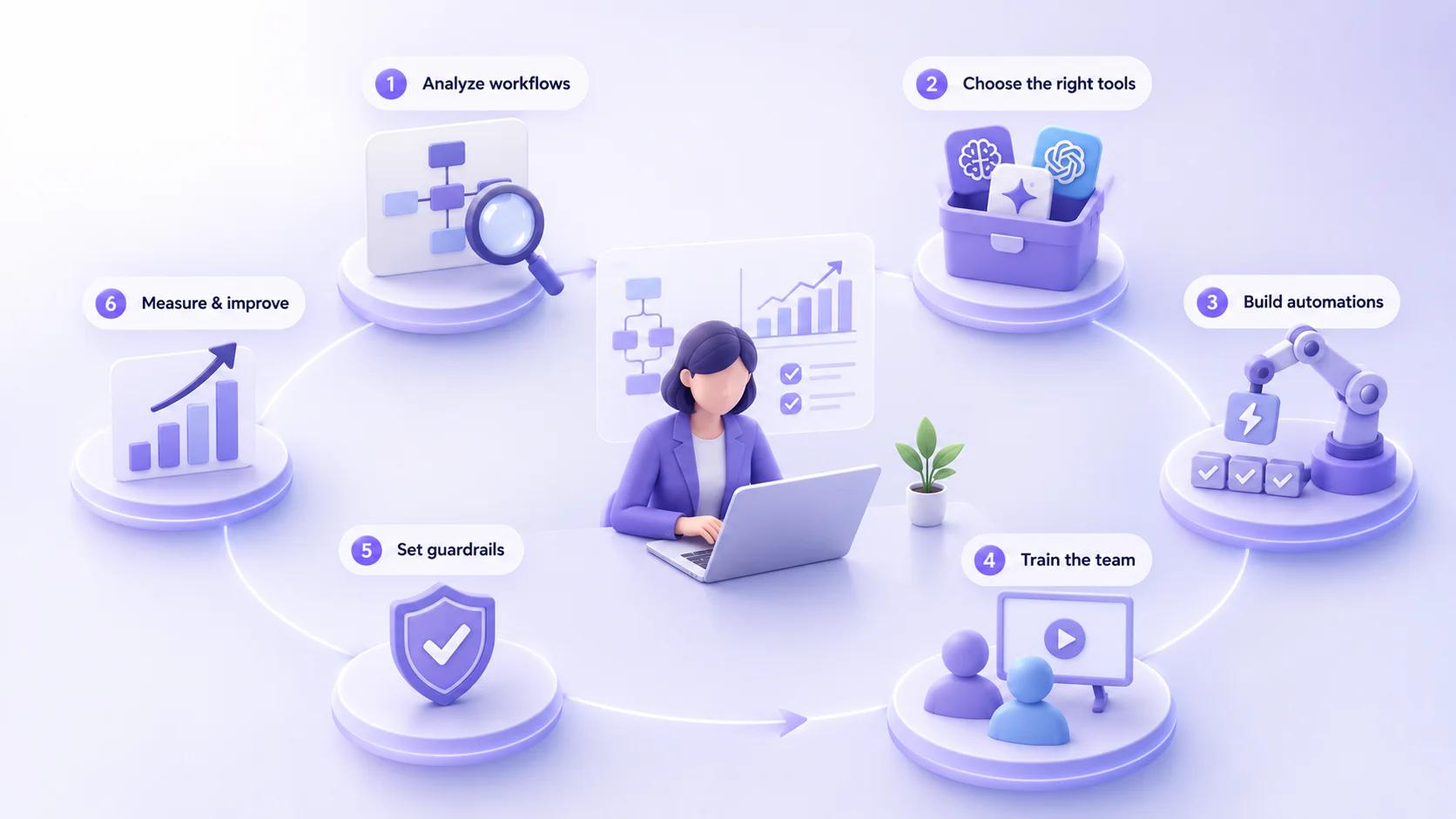
Strip away the buzzwords and an AI consultant does something fairly old-fashioned: they look at how a business actually works, find the slow or repetitive parts, and figure out where AI tools genuinely help – not where they sound impressive in a sales pitch.
In practice, that means:
- Mapping existing workflows (how a sales team qualifies leads, how an HR team screens resumes, how a support team triages tickets) and identifying where AI can realistically plug in.
- Choosing the right tools for the job, writing and testing prompts, building light automations, training the team that has to actually use the thing, documenting guardrails (what the AI should never do unsupervised), and evaluating outputs over time instead of declaring victory after one demo.
If you’re weighing this against other paths into the field, it’s worth comparing notes with people exploring remote AI jobs with no experience – the skills overlap more than you’d think, even though consulting and salaried work are different tracks. Either way, the first real question is the same one this section answers.
Is AI consultant certification worth it?
Here’s the honest, slightly unsatisfying answer: it depends on what you’re hoping it does for you.
Certification (or, more accurately in most cases, a certificate of completion) is genuinely useful for structured learning. Going in blind and trying to piece together AI consulting knowledge from scattered YouTube videos and Twitter threads is exhausting and inefficient. A good course gives you a curriculum, a logical order to learn things in, and – this is underrated – a deadline, which is often the thing people actually need to stop procrastinating.
It’s also a reasonable credibility signal. When you’re brand new and have zero consulting history, “I completed structured training in AI workflows and tool evaluation” is a more concrete thing to say than “I’ve been messing around with ChatGPT a lot.” It’s not nothing.
What it isn’t: a replacement for business experience, a guaranteed client pipeline, or proof that you can actually deliver results for a real company with real stakes. Clients don’t hire a piece of paper. They hire someone who can look at their specific, messy operation and make it better without breaking anything. That trust gets built through a portfolio and track record, not a badge.
So is it worth it? For structured learning and a baseline of credibility – yes, often. As a shortcut around doing the actual work of building skills and proof – no, not really, and you’ll find that out fast the first time a prospective client asks “okay, but what have you actually done?”
AI consultant certificate: quick decision table
Different people need different things from training. Here’s a rough breakdown to help you figure out where you fit before you pick a course.
| Learner type | What they need | Best training focus | Warning signs to avoid |
|---|---|---|---|
| Career changer (no AI background) | Foundational structure, vocabulary, confidence | AI fundamentals + prompt engineering + workflow mapping | Courses that skip fundamentals and jump straight to “sell consulting packages” |
| Freelancer/marketer adding AI skills | Tool fluency, niche application, quick wins | Tool evaluation + automation basics + a focused niche | Programs that promise instant high-ticket clients |
| Operations or business analyst | Process documentation, governance framing | Workflow mapping + governance/human review | Anything that treats “AI strategy” as just prompt tricks |
| Founder exploring AI for their own business | Practical implementation, not consulting credentials | Automation basics + data/privacy basics | Courses pitched purely as a “consulting income” opportunity |
If you read that table and thought “I’m a mix of two of these,” that’s normal – most people are. Use it as a starting filter, not a rigid label.
Skills an AI consultant course should teach
This is the part worth scrutinizing before you pay for anything. A lot of “AI consultant” courses are really just prompt engineering courses with a different label slapped on the cover. Prompting matters, but it’s one skill among several, and treating it as the whole job is how you end up underprepared for an actual client conversation.
A solid AI consulting course should cover:
- AI fundamentals (how models actually work, what they’re good and bad at, where hallucination risk shows up)
- Prompt engineering (clear, testable instructions – not just “tricks,” but a repeatable method)
- Workflow mapping (documenting a process step by step before touching any tool)
- Tool evaluation (comparing platforms honestly, including cost, data handling, and limitations)
- Data and privacy basics (what you can and can’t do with client data, and why that’s not optional)
- Automation basics (connecting tools so work actually flows, not just one-off chatbot demos)
- Client discovery (asking the right questions before proposing any solution)
- Change management (helping a team actually adopt a new workflow, not just tolerate it)
- Governance and human review (building in checkpoints so AI output gets checked before it matters)

Here’s how those map to real deliverables – the kind of thing you’d actually hand a client, not just talk about in a course module:
| Skill | Business application | Example deliverable |
|---|---|---|
| AI fundamentals | Setting realistic expectations with stakeholders | One-page “what AI can and can’t do here” brief |
| Prompt engineering | Producing consistent, usable outputs | Tested prompt library for a specific task (e.g., customer email replies) |
| Workflow mapping | Finding where AI actually fits | Visual process map with bottlenecks flagged |
| Tool evaluation | Choosing the right platform, not the trendiest one | Short comparison sheet (cost, accuracy, data policy) |
| Data/privacy basics | Avoiding compliance disasters | Data-handling checklist for the project |
| Automation basics | Reducing manual repetitive steps | Simple automation connecting two tools (e.g., form to CRM) |
| Client discovery | Scoping the right project, not the flashiest one | Discovery call notes + problem statement |
| Change management | Getting a team to actually use the new process | Short training session or how-to guide for staff |
| Governance/human review | Catching errors before they reach a customer | Review checkpoint built into the workflow |
If a course you’re considering skips most of the right-hand column and only talks about prompts and “AI hacks,” that’s worth noticing.
How to become an AI consultant in 2026
There’s no single official path here – there’s no licensing board for this the way there is for accountants or lawyers. But there is a sensible order of operations that keeps you from getting ahead of yourself.
Start with the basics. You genuinely don’t need to learn to code, but you do need a working understanding of how AI tools function, where they fail, and why. This is also where structured AI courses for beginners can save you a lot of wasted time compared to random self-study.
From there, pick a niche instead of trying to be a generalist “AI guy” for everyone. Niching down – say, AI for real estate admin work, or AI for small accounting firms – makes you faster to learn, easier to market, and more credible than someone claiming to help “any business with AI.”
Next, build demos before you build a client list. Make small, real examples of the kind of work you’d actually deliver – this is a good moment to skim a roundup of best AI tools for business so your demos aren’t built on something already falling out of favor. Document the workflows you build, including what didn’t work, because that honesty is more convincing than a highlight reel. Offer audits – low-commitment reviews of a business’s current process – as a low-risk way to start working with real (if small) stakes. Turn a few of those into case studies, even informal ones. And through all of it, keep human review built in. Not as a disclaimer, but as an actual practice.
This is roughly the same arc covered in a broader look at AI training and career paths in 2026, and it overlaps a lot with general guidance on how to learn AI in 2026 – the consulting layer just adds the client-facing and governance pieces on top.
Best niches for new AI consultants
Going broad is tempting because it feels like you’re not closing any doors. In practice it usually means you’re not memorable to anyone. Some niches that tend to be approachable for newer consultants, mostly because the workflows are well-defined and the stakes start small:
- Small business marketing and sales – content drafting, lead follow-up sequences, basic CRM automation.
- HR and operations – resume screening support (with human review, always), onboarding documentation, internal FAQ bots.
- Customer support – ticket triage, response drafting, knowledge base organization.
- Real estate, accounting/bookkeeping, and ecommerce – each has repetitive, document-heavy processes (listings, invoices, product descriptions) that are easier to scope and automate than something open-ended like strategic planning.
Notice none of these involve giving legal, medical, or financial advice through an AI system. That’s intentional, and we’ll come back to why. For a closer look at one of the most common entry points — using AI tools inside an existing business rather than starting from scratch — see this breakdown of ChatGPT for business, which covers a lot of the same ground new consultants end up applying with clients.

Portfolio examples to build before selling services
Before you pitch anyone, build something you can actually show. None of these require real client data – that’s the point.
- A documented workflow map for a common small-business process (e.g., lead intake to follow-up), with the “before AI” and “after AI” version side by side.
- A tested prompt library for one specific task, like writing product descriptions or summarizing meeting notes.
- A simple automation demo connecting two free or low-cost tools.
- A “tool comparison” writeup for a specific use case (e.g., three AI writing tools compared for a real estate agency).
- A mock client discovery document – the questions you’d ask, and how you’d turn the answers into a project scope.
- A short case study built from your own business or a volunteer project, including what didn’t work the first time.
- A one-page governance template (how outputs get reviewed before going live).
- A short training guide you’d hand to a non-technical team member.
You’ll notice prompt-writing shows up constantly across these. If that part feels shaky, it’s worth a closer look – what prompt engineering actually is is a reasonable place to shore that up before going further. If you want to go deeper specifically on that one skill, there’s also a dedicated look at prompt engineering certification worth reading alongside any broader AI consulting course you’re considering.
Risks and compliance cautions
This is the section people skip and shouldn’t. AI consulting sits in a slightly unregulated space right now, which means the responsibility for staying within ethical and legal bounds falls more heavily on you, not less.
A few lines worth not crossing: don’t position yourself as giving legal, medical, or financial advice through an AI system unless you’re actually qualified and licensed to give that advice in the first place – AI doesn’t change the underlying requirement. Be careful with client data; “I fed it into a chatbot” is not a privacy policy, and clients deserve to know exactly where their information is going. Don’t claim an automation does something it doesn’t, even if it worked once in a demo – workflows that look polished in a five-minute walkthrough can fall apart with messier real-world data. And don’t promise ROI numbers you can’t actually back up. “This will save you 10 hours a week” sounds great in a pitch and terrible in a follow-up call six weeks later when it didn’t happen.
None of this is meant to scare you off the work. It’s meant to keep you in business longer than the consultants who overpromised and quietly disappeared.
Final recommendation
Certification and structured training are genuinely useful – as a foundation, not a finish line. They give you a logical learning order, fill in gaps you didn’t know you had, and offer a credibility signal that’s better than nothing when you’re starting from zero. What they don’t do is replace the slower, less glamorous work of building real examples, having honest client conversations, and keeping a human in the loop on every output that matters.

If you want a structured starting point, Coursiv’s AI consultant training is built around exactly the gap most generic prompt-engineering courses leave open: practicing workflow mapping, tool evaluation, client discovery, and responsible AI use before you ever try to sell a service. Combine that kind of training with a handful of real demos, and you’ll walk into client conversations with something far more convincing than a certificate – actual proof you know what you’re doing.
Frequently asked questions