Home
›
Courses
› ChatGPT Course, Training & Certification
ChatGPT CourseBeginner Training
ChatGPT Course:
Prompts, Custom GPTs, and Workflows
Learn ChatGPT from scratch with practical prompt engineering, files, data analysis, writing workflows,
Custom GPTs, and work-ready AI systems — built for beginners and professionals.
Professionals from global companies use Coursiv to build practical AI skills.
1M+
Learners worldwide
20min
Per day is all you need
30 days
To certification
10h+
Saved per week with AI
Why most teams underuse ChatGPT
Most people use ChatGPT like a search box. Professionals use it as a workflow system.
This ChatGPT course turns random prompting into repeatable skills: prompt engineering, files, data analysis,
writing, Custom GPTs, and safe review habits for real work.
Without a ChatGPT workflow
Generic prompts produce generic answers that still need heavy editing
Files, data, and context are pasted inconsistently, so results are unreliable
Useful prompts get lost instead of becoming reusable templates
No clear review loop for accuracy, privacy, or final human approval
After this ChatGPT training
Clear prompts produce structured drafts, summaries, analyses, and plans
Custom GPTs support recurring workflows with your context and examples
Reusable prompt templates cover writing, research, data, email, and planning
Every output goes through source checks, privacy checks, and human review
What you can do with ChatGPT after this course
Real skills, real workflows — not just theory.
Writing and Content Creation
Draft emails, articles, social posts, briefs, summaries, and marketing copy with clearer prompts and
stronger review steps.
Popular
Files, Spreadsheets, and Data Analysis
Use ChatGPT with documents, tables, CSVs, reports, and spreadsheets to summarize findings and explain
metrics.
High impact
ChatGPT for Work Communication
Create client messages, follow-ups, meeting notes, status updates, SOPs, and decision memos faster.
Time saver
Planning, Research, and Strategy
Plan projects, compare options, research topics, structure decisions, and turn scattered ideas into
practical next steps.
Versatile
Marketing, SEO, and Business Tasks
Build campaign briefs, SEO outlines, customer research summaries, sales drafts, and business workflows
with reusable prompts.
Growth
Custom GPTs and Prompt Libraries
Create tailored AI assistants and saved prompt systems for recurring personal, professional, and team
workflows.
Eligibility overview for Beginners, Professionals, Business Users, Teams.
Section
Candidate Type
Eligible?
Typical Requirement
Notes
Primary fit
Beginners, Professionals, Business Users, Teams
Yes
No strict prerequisite
Primary target audience for this course.
Primary fit
Team leads and managers
Yes
Process or project ownership
Useful for team-wide adoption and execution standards.
Primary fit
Individual contributors
Yes
Interest in AI-powered workflows
Can apply modules directly to daily tasks.
Adjacent backgrounds
Professionals from related roles
Yes
Basic domain context helpful
Good fit for cross-functional collaboration.
Adjacent backgrounds
Freelancers and consultants
Yes
Client delivery experience
Supports faster output and clearer communication.
Adjacent backgrounds
Operations or support specialists
Yes
Process-oriented mindset
Great for documentation and workflow consistency.
Experience level
Absolute beginners
Yes
Usually none
Course starts from practical fundamentals.
Experience level
Mid-level professionals
Yes
Current role workflows
Helps scale speed and quality in current responsibilities.
Experience level
Senior leaders
Yes
Decision-making responsibility
Useful for governance, adoption, and systems thinking.
Course Modules
6 units · 35 lessons · ~6 hours total duration
Lesson 1 — ChatGPT as an LLM
What is ChatGPT and how does it work?
Lesson 2 — Discovering ChatGPT Models
Explore, compare, and apply ChatGPT models.
Lesson 3 — Intro to Prompting
Prompt engineering matters.
Lesson 4 — Feed ChatGPT with Data
How to use ChatGPT to maximize its potential.
Lesson 5 — File Attachments & Image Upload
Work smarter with files in ChatGPT.
Lesson 6 — Voice Chat
Interact with ChatGPT without typing.
Lesson 1 — Prompt Engineering Techniques
Create complex and effective prompts.
Lesson 2 — Context Management in Prompts
How to manage multi-turn conversations.
Lesson 3 — Image Generation
Turn prompts into pictures.
Lesson 4 — ChatGPT for SMM
Your first post with ChatGPT.
Lesson 5 — Travel Planning
Assist Horizon Havens using ChatGPT.
Lesson 6 — Event Planning
Use ChatGPT for event planning.
Lesson 7 — Content Creation
Generate an article about work-life balance.
Lesson 1 — Prompts for Data Processing
Create prompts for analyzing a company's revenue.
Lesson 2 — SEO Optimization with ChatGPT
Boost content's SEO effectively.
Lesson 3 — Complex Problem Solving
Create prompts for complex tasks.
Lesson 4 — Performance Analysis
How to analyze prompt performance.
Lesson 5 — Monetize Prompt Engineering
Create high-quality prompts and market them for sale.
Lesson 6 — Ethical Considerations
How to mitigate risks when using AI.
Lesson 7 — Revise and Recap
Review key points and summarize.
Lesson 1 — Know Your GPT
Pick the best GPT model before you prompt.
Lesson 2 — Prompting with Purpose
Start to prompt strategically for precise AI results.
Lesson 3 — Layered Prompts
Break complex tasks into sequential steps.
Lesson 4 — Role-Play Techniques
Assign specific personalities for targeted responses.
Lesson 5 — Iterative Prompt Development
Refine prompts through systematic testing cycles.
Lesson 6 — Challenge: Write a Freelance Productivity Guide
Apply all techniques in a comprehensive project.
Lesson 1 — What Are Projects & Why Use Them
Build smarter workflows with Projects.
Lesson 2 — Organizing Prompts, Files & Context
Keep your files and prompts aligned.
Lesson 3 — Collaborating Like a Team
Work together, even solo.
Lesson 4 — Challenge: Launching an Event Agency
Run your first team project.
Lesson 1 — What Are Custom GPTs?
Explore tailored AI assistants for specific needs.
Lesson 2 — Building Your First GPT
Define purpose, personality, and core settings.
Lesson 3 — Teaching with Data
Transform generic GPTs into domain experts.
Lesson 4 — Evaluating & Improving Performance
Test and refine GPT performance.
Lesson 5 — Challenge: Build an Email Assistant GPT
Create a specialized business communication assistant.
Official Certificate
Earn Your ChatGPT
Certificate
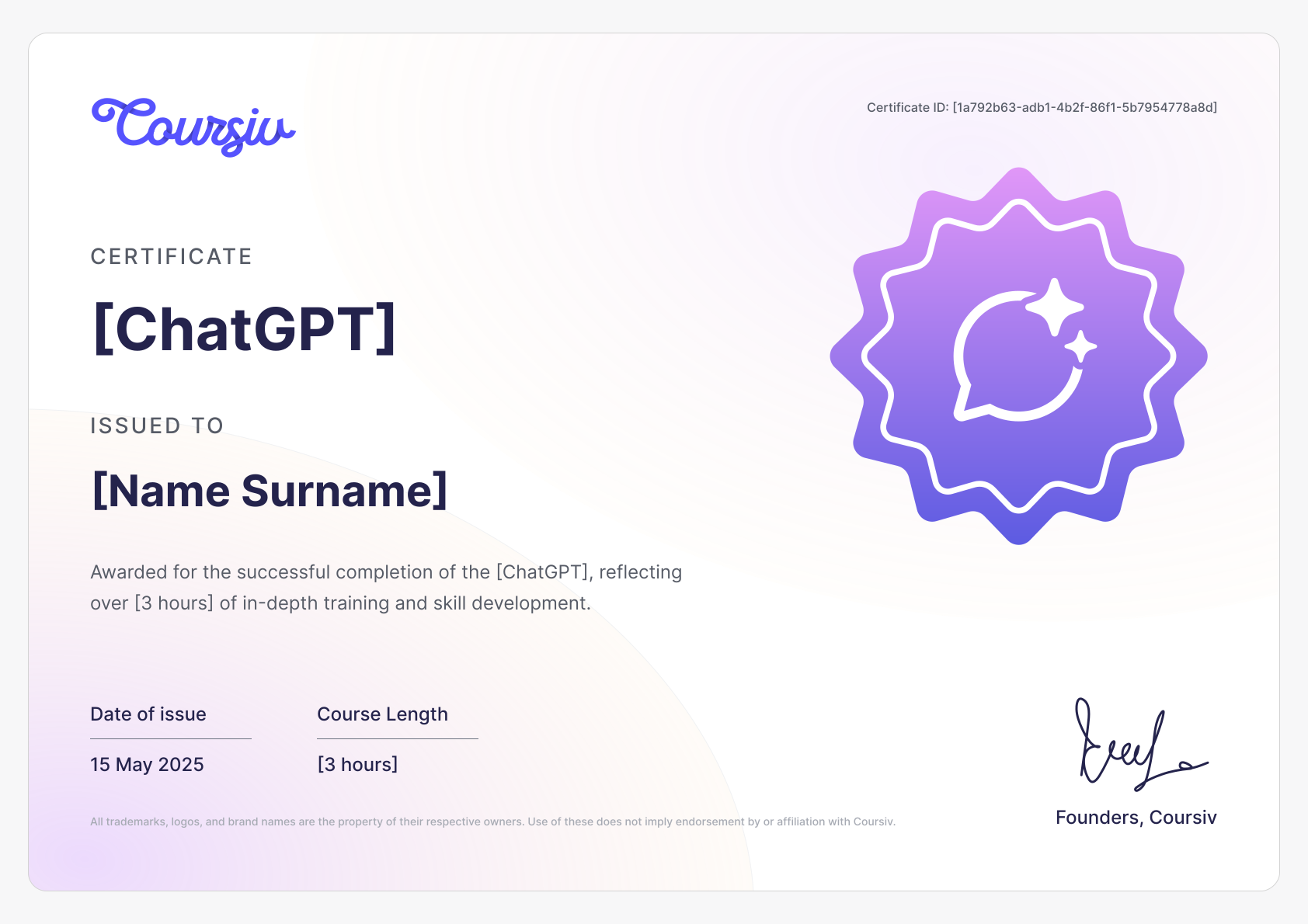
Complete the lessons, build practical prompt workflows, finish the final assignment, and receive a Coursiv
certificate of completion for your ChatGPT training.
Add to LinkedIn
Showcase your AI expertise on your professional profile
The best ChatGPT course for beginners starts with practical basics: what ChatGPT can do, how prompts work,
how to add context, how to use files and data, how to review answers, and how to build reusable workflows.
This Coursiv course is designed for learners with no coding background.
Yes. Completing the lessons and final assignment gives you a Coursiv certificate of completion for ChatGPT
training. It demonstrates applied skills in prompting, work workflows, files, data analysis, writing, and
Custom GPTs. It is not an official OpenAI credential.
This course is delivered by Coursiv, not OpenAI. The certificate validates completion of Coursiv's
applied ChatGPT course and practical assignments. Use it to show structured AI training, but do not
represent it as an official OpenAI certification.
You learn ChatGPT fundamentals, prompt engineering, context setting, file and image workflows, writing
prompts, research prompts, data-analysis prompts, communication workflows, Projects, prompt libraries,
Custom GPTs, and responsible review habits for professional work.
No. The course is built for beginners and professionals who want to use ChatGPT at work. If you can write
an email, explain a task, and review a draft, you can learn the prompt patterns taught in the course.
Most learners complete the course in about 30 days with short daily lessons. The program is designed
around bite-sized practice so you can build confidence without blocking large chunks of time.
Yes. You build reusable ChatGPT prompts for writing, summarizing, research, planning, email, data
analysis, SEO, marketing, business tasks, and prompt review. The goal is to create a prompt library you
can reuse instead of starting from scratch every time.
Yes. The advanced modules cover what Custom GPTs are, how to define a GPT's purpose and behavior, how
to add useful context, how to test output quality, and how to improve a GPT for recurring work tasks.
Yes. The course focuses on work-ready workflows: emails, reports, meeting notes, SOPs, research summaries,
data analysis, marketing drafts, project plans, decision memos, and role-specific next steps.
This ChatGPT course is ChatGPT-first and beginner-friendly. Prompt Engineering Certification is broader
and covers multi-model prompting across tools such as ChatGPT, Claude, and other AI systems. Many learners
start here, then move to prompt engineering.
After the foundation, choose the page closest to your work: ChatGPT for Business, Marketing, Excel, Data
Analysis, Finance, HR, Sales, Project Managers, Accountants, Customer Service, or Resume Prompts. The
foundation teaches the shared skills; role pages teach specialized workflows.
Yes, if your current use is mostly ad-hoc. The value of training is learning repeatable prompt structures,
context management, review loops, and workflows that save time consistently rather than occasionally
producing a useful answer.
Related courses for Beginners, Professionals, Business Users, Teams
Practical workflows tailored for Beginners, Professionals, Business Users, Teams.
A practical ChatGPT course for beginners and professionals who want structured ChatGPT training, prompt
engineering skills, work-ready workflows, Custom GPT practice, and a Coursiv certificate of completion.
ChatGPT Course for Beginners and Professionals
This ChatGPT course is the broad foundation for learners who want to use ChatGPT confidently at work, in
business, and in everyday tasks. It is built for beginners, but it goes beyond basic chatbot use: you learn
prompt engineering, context setting, file workflows, data analysis, writing prompts, research prompts,
Custom GPTs, and review habits that make AI output more reliable.
If you are searching for a
ChatGPT course
,
ChatGPT training
,
learn ChatGPT course
,
ChatGPT for beginners
, or
ChatGPT course for professionals
, this page is the general starting point. After the foundation, you can move into role-specific paths like
ChatGPT for Business
,
ChatGPT for Marketing
,
ChatGPT for Excel
, or
ChatGPT for Data Analysis
.
ChatGPT Certification Course and Certificate
The program includes a Coursiv certificate of completion after you finish the lessons and final assignment.
This makes it a practical
ChatGPT certification course
for learners who want a structured credential showing they completed applied ChatGPT training. The
certificate is issued by Coursiv and should not be described as an official OpenAI certification.
The ChatGPT course certificate is tied to practical outputs: reusable prompts, workflow examples, Custom GPT
practice, and a final project. If your goal is a broader multi-model credential, pair this page with the
Prompt Engineering Certification Course
. If your goal is a broader AI credential across multiple tools and business use cases, use the
AI Certificate Program
.
What You Learn in ChatGPT Training
The course starts with the basics: what ChatGPT is, how large language models behave, why context matters,
and how to write clear instructions. Then it moves into practical prompt engineering: role prompts, task
prompts, output formats, examples, constraints, iterative refinement, and follow-up prompts.
ChatGPT fundamentals:
how to start, structure, and refine useful conversations.
Prompt engineering:
how to write prompts that include context, task, audience, format, examples, and review criteria.
Files and data:
how to use ChatGPT with documents, tables, reports, spreadsheets, and CSV-style exports.
Writing and communication:
how to draft emails, summaries, posts, briefs, reports, and stakeholder updates.
Planning and research:
how to compare options, structure projects, summarize sources, and prepare decisions.
Custom GPTs:
how to build, test, and improve tailored AI assistants for recurring workflows.
Responsible AI use:
how to check accuracy, protect private data, and keep a human review loop.
ChatGPT Prompts and Prompt Engineering Skills
Most learners do not need more random prompt lists. They need a repeatable way to create prompts that work.
This course teaches prompt engineering as a practical workflow: define the goal, provide context, specify
the output format, add examples, ask for reasoning or assumptions when useful, and review the result before
using it.
You build a ChatGPT prompt library for common tasks: writing, summarizing, brainstorming, data analysis,
research, email, SEO, marketing, planning, and business communication. For learners specifically looking for
resume workflows, the
ChatGPT Prompts for Resume Course
is the focused next step.
How to Use ChatGPT for Work
ChatGPT becomes more valuable when it is connected to real work. The course shows how to use ChatGPT for
work tasks such as meeting notes, follow-up emails, client messages, SOPs, report summaries, project plans,
decision memos, training materials, content drafts, and simple analysis. The goal is not to replace your
judgment; it is to reduce blank-page time and make first drafts faster.
The course introduces practical ChatGPT data analysis workflows: summarizing tables, explaining reports,
reviewing spreadsheet exports, finding patterns, and turning numbers into plain-language notes. You also
learn where ChatGPT needs verification: formulas, calculations, source data, assumptions, and high-stakes
decisions should always be reviewed by a human.
ChatGPT is useful for marketing and sales because it speeds up drafts, variants, briefs, summaries, and
follow-up messages. In the foundation course, you learn the shared prompt patterns behind content creation,
campaign brainstorming, customer research, SEO outlines, sales emails, and performance summaries.
The advanced part of the course teaches you how to move from single prompts to reusable systems. You learn
how to organize prompts, files, context, and examples into projects, then use that structure to create
repeatable workflows for writing, research, communication, data review, and planning.
You also build and improve Custom GPTs. A Custom GPT is most useful when it has a clear purpose, examples of
good output, rules for what to avoid, and a review process. The course shows how to test a GPT, spot weak
outputs, and improve instructions so the assistant becomes more reliable over time.
ChatGPT Course vs Prompt Engineering Certification
The ChatGPT Course is the best starting point if you want to learn ChatGPT from scratch. It focuses on
ChatGPT features, prompts, files, workflows, and Custom GPTs. The
Prompt Engineering Certification Course
is broader and better when you want to apply prompting principles across ChatGPT, Claude, Gemini, and other
AI tools.
Many learners take this ChatGPT certification course first, then move into prompt engineering or
role-specific courses once they know the fundamentals. That sequence prevents the common problem of jumping
into advanced AI use without a reliable prompting foundation.
Is a ChatGPT Course Worth It?
A ChatGPT course is worth it if you want repeatable results instead of occasional useful answers.
Self-teaching can work, but many people stay stuck in trial-and-error prompting. Structured training
shortens that path by showing you examples, frameworks, review loops, and assignments you can apply
immediately.
The biggest outcome is not memorizing prompts. It is learning how to turn a vague task into a structured AI
workflow: define the goal, add context, request the right format, review the answer, refine the prompt, and
save the pattern for next time.
Ready to start your AI journey?
Join over 1 million learners mastering ChatGPT with Coursiv.
Get certified in 30 days with just 20 minutes a day.