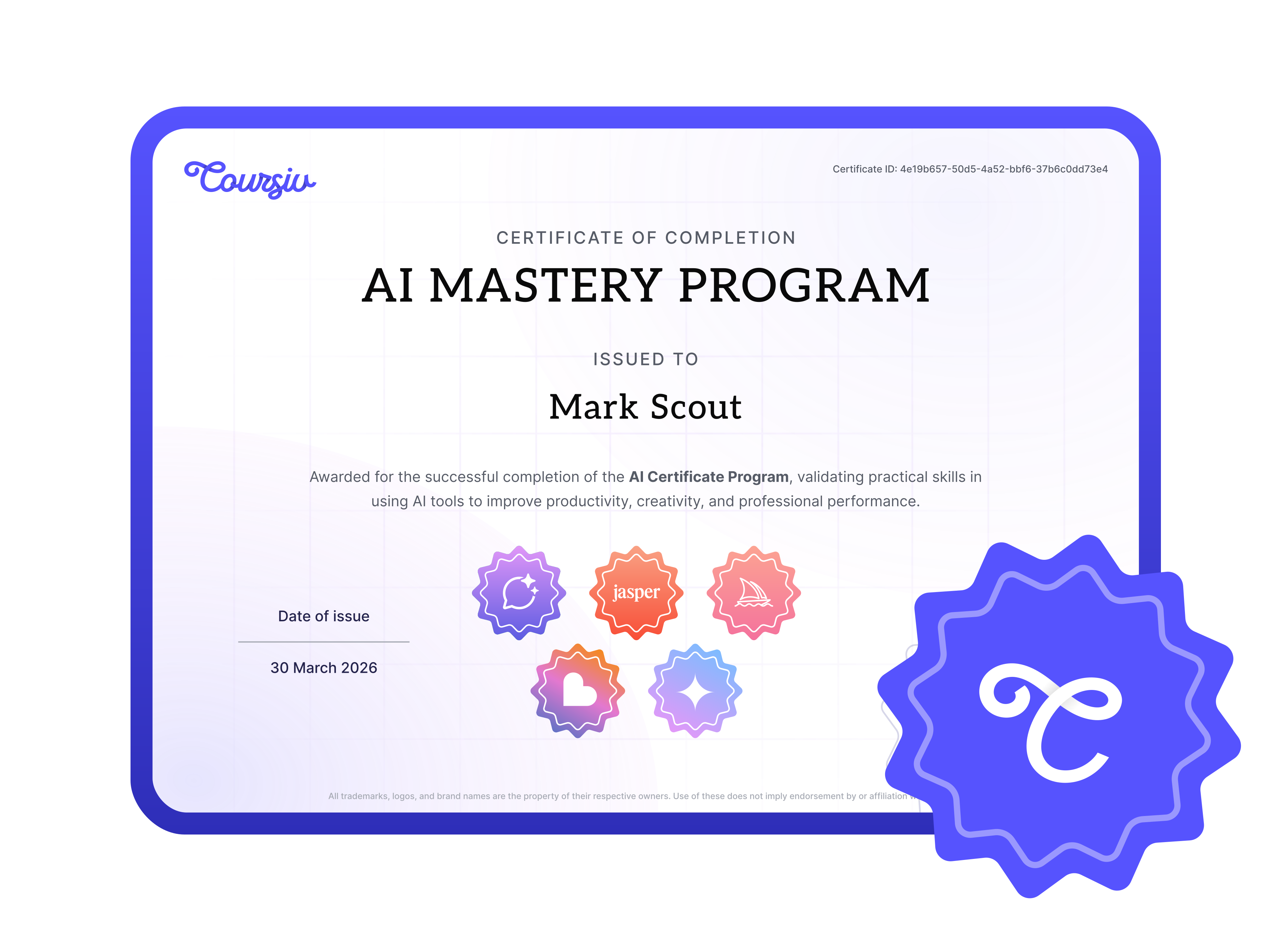
Professionals from global companies use Coursiv to build practical AI skills.
3x
Faster financial analysis prep
31
Finance-focused lessons
530+
Finance pros enrolled weekly
9
Reusable analysis templates
Why most teams underuse ChatGPT
Finance automation is stalled by manual reporting and fragmented data — ChatGPT for finance changes that.
Financial analysts spend most of their time compiling reports and reconciling spreadsheets instead of
interpreting results. This program teaches you to use AI for cash flow analysis, budget planning, financial
modeling, and stakeholder communication — so you can focus on the insights that improve financial
performance.
Without finance automation and AI workflows
Monthly reports take days to compile from scattered financial data sources and spreadsheets
Cash flow analysis is reactive and limited because each scenario takes hours to build
Stakeholder updates are rushed and lack the clarity executives need to act on financial performance
Recurring financial analysis tasks are rebuilt from scratch every cycle instead of templated
After completing this program
Report generation is streamlined — narratives are drafted in minutes with clear variance commentary
Cash flow and budget planning scenarios are modeled quickly with structured sensitivity frameworks
Executive updates follow a concise format that highlights decisions backed by financial data
Finance automation runs on prompt templates that ensure consistency every reporting period
How finance professionals and analysts use ChatGPT after this course
Practical workflows tailored for finance professionals and analysts.
Budget Planning
Build structured budgeting assumptions, compare scenarios, and explain trade-offs to stakeholders clearly.
High impact
Cash Flow Analysis
Monitor and forecast cash flow patterns using AI-assisted templates that surface risks early.
Popular
Financial Analysis
Accelerate variance analysis, ratio calculations, and trend interpretation with reusable prompt workflows.
Core skill
Financial Modeling
Create best/base/worst-case financial models with sensitivity tables and clearly documented assumptions.
Advanced
Report Generation
Draft concise monthly and quarterly report narratives that highlight key variances and financial
performance.
Time saver
Finance Automation
Automate recurring analysis tasks with prompt templates that standardize output and reduce manual effort.
Operations
Ready to spend less time on reports and more on analysis?
Finance professionals use ChatGPT to draft report narratives, build budget assumptions, analyze cash flow
patterns, and prepare stakeholder updates. The course teaches you structured prompt workflows for each of
these tasks so output is consistent and audit-ready.
ChatGPT accelerates financial analysis by structuring variance commentary, ratio interpretation, and trend
summaries. It does not replace professional judgment, but it reduces the manual effort of assembling and
formatting analytical outputs significantly.
Finance automation with AI means turning recurring tasks — monthly close narratives, cash flow summaries,
budget-vs-actual commentary — into prompt templates that produce consistent first drafts in minutes
instead of hours.
Yes. Cash flow analysis and budget planning are two of the six core use cases. You will build reusable
templates for forecasting, scenario comparison, and sensitivity analysis that you can adapt to your own
reporting cycles.
The program covers both foundational financial logic and business-oriented workflows including financial
modeling, report generation, and cross-functional stakeholder communication.
No formal credential is required. The course is built for working finance professionals — financial
analysts, FP&A teams, controllers, and finance managers — who want to integrate AI into their existing
workflows.
Related courses for finance professionals and analysts
Practical workflows tailored for finance professionals and analysts.
A structured certification for finance professionals who want to use ChatGPT for finance workflows — from
financial analysis and budget planning to cash flow forecasting, report generation, and finance automation.
Built for financial analysts, FP&A teams, controllers, and finance leaders.
ChatGPT for Finance Professionals
ChatGPT for finance is reshaping how financial analysts, controllers, and FP&A teams handle their day-to-day
work. Instead of spending hours compiling data from scattered spreadsheets and ERP exports, finance
professionals now use large language models to draft first-pass narratives, structure assumptions, and
surface anomalies faster than ever before. The shift is not about replacing financial judgment — it is about
removing the manual overhead that prevents finance teams from spending time on the analysis that actually
drives decisions.
This certification program teaches you how to integrate ChatGPT into real finance workflows. You will learn
to build prompt templates for budgeting, variance commentary, scenario planning, and executive reporting.
Every module is designed around outputs that finance professionals produce on a recurring basis — monthly
close narratives, quarterly board packs, cash flow summaries, and ad-hoc analysis requests from business
partners. The goal is not prompt engineering in the abstract; it is practical finance automation that saves
hours every reporting cycle.
The course is built for working professionals. Whether you are a financial analyst preparing your first
budget model or a finance director overseeing a team of ten, the workflows scale to your level of
responsibility. Research published in the Financial Analysts Journal and by the CFA Institute increasingly
points to AI literacy as a core competency for modern finance roles. This program helps you build that
competency with hands-on practice, not theory.
ChatGPT financial analysis skills are also increasingly relevant in banking, real estate finance, and
corporate treasury. The ability to analyze financial statements, draft investment memos, and structure
due-diligence commentary with AI assistance is becoming a differentiator for finance professionals across
industries. Whether you work in investment banking, commercial lending, or corporate FP&A, the prompt design
patterns you learn here apply directly to your daily workflow.
The resources included in this program go beyond video lessons. Each module provides downloadable prompt
templates, example outputs, and a self-assessment rubric so you can measure your own progress. You will also
learn how to evaluate the quality of AI-generated financial content — a critical skill as more organizations
adopt language models for internal and external reporting. By the end of the program, you will have both the
technical prompt skills and the professional judgment to use ChatGPT for finance tasks confidently and
responsibly.
Finance Automation with AI
Finance automation has traditionally meant ERP implementations, robotic process automation, and custom
scripts. These tools are powerful but expensive to build and maintain. ChatGPT introduces a different layer
of finance automation — one that sits on top of your existing tools and handles the unstructured,
language-heavy tasks that software alone cannot address. Think of the narrative section of a monthly
variance report, the qualitative commentary in a board presentation, or the email that explains a budget
reforecast to a non-financial stakeholder. These are tasks that consume significant analyst time and benefit
enormously from AI-assisted drafting.
In this program, you will build a library of reusable prompt templates for recurring finance tasks. Each
template follows a structured input-output format: you provide the financial data and context, and the
prompt produces a first draft that you review, refine, and finalize. Over time, this approach reduces the
time spent on report generation by hours per cycle while improving consistency across periods and across
team members. Finance automation with AI is not a replacement for platforms like Tipalti, SAP, or NetSuite —
it is a complementary layer that handles the communication and interpretation tasks those platforms were
never designed to do.
The business case for finance automation is straightforward. When analysts spend less time formatting and
more time analyzing, the quality of financial advice to business partners improves. Decisions get made
faster because the supporting analysis is available sooner. And finance teams can take on more strategic
projects — competitive benchmarking, pricing analysis, capital allocation modeling — without adding
headcount. This is the promise of AI for finance, and this course gives you the practical skills to deliver
on it.
Cost reduction is another driver. Many finance teams evaluate automation software by comparing
implementation cost against hours saved. ChatGPT-based finance automation has a much lower barrier to entry
than traditional robotic process automation because it requires no code, no IT involvement, and no
multi-month implementation. A single financial analyst can build and test a prompt template in an afternoon
and deploy it in the next reporting cycle. That speed of adoption is what makes language-model-driven
finance automation compelling for organizations of every size.
Research from industry sources confirms that finance professionals who adopt AI-assisted workflows report
measurable improvements in both speed and output quality. The key is structured adoption — not asking
ChatGPT random questions, but building a disciplined library of prompt templates tied to specific recurring
tasks. This program teaches that structured approach from the ground up, so you can scale finance automation
across your team with confidence and clear governance.
Cash Flow Analysis and Budget Planning
Cash flow is the lifeblood of any business, and yet cash flow analysis remains one of the most manual and
time-consuming tasks in finance. Forecasting future cash positions requires pulling data from accounts
receivable, accounts payable, treasury, and operations — then synthesizing it into a coherent narrative that
explains where the business stands and where it is heading. ChatGPT does not replace the data pipeline, but
it dramatically accelerates the interpretation layer. You can feed it a summary of your cash position and
receive a structured commentary that highlights key drivers, flags risks, and suggests areas for further
investigation.
Budget planning follows a similar pattern. The mechanical work of building a budget — populating line items,
applying growth assumptions, allocating overhead — is increasingly handled by planning software. But the
strategic work of explaining why a budget looks the way it does, defending assumptions to leadership, and
communicating trade-offs to department heads remains a deeply human task. ChatGPT helps financial analysts
draft these explanations faster and with greater clarity. In this course, you will build prompt templates
for budget narrative generation, assumption documentation, and scenario comparison that you can use in your
next planning cycle.
The cash flow and budget planning modules are among the most popular in the program because they address
tasks that every finance professional performs regularly. Whether you work in a startup managing burn rate
or a large enterprise managing working capital, the frameworks apply. You will leave with reusable templates
for weekly cash flow summaries, monthly budget-vs-actual commentary, and quarterly reforecast narratives.
Effective budget planning also requires clear communication with non-financial stakeholders. Department
heads and business unit leaders need to understand the financial constraints and trade-offs that shape their
budgets. ChatGPT helps you draft those explanations in plain language — translating complex financial data
into actionable guidance that non-finance colleagues can understand and act on. This communication layer is
often the difference between a budget that gets followed and one that gets ignored.
Financial Modeling and Data Analysis
Financial modeling is a core skill for analysts and FP&A professionals. Building a three-statement model, a
DCF, or a sensitivity table requires technical precision and clear documentation. ChatGPT cannot build your
model for you — the calculations still need to live in Excel or Google Sheets — but it can help you document
assumptions, generate scenario narratives, and draft the executive summary that accompanies every financial
model. This is where most analysts lose time: not in the formulas, but in the communication layer that makes
the model useful to decision-makers.
Data analysis in finance goes beyond modeling. Financial analysts routinely analyze financial data to
identify trends, explain variances, and benchmark performance against peers or prior periods. ChatGPT
accelerates this work by helping you structure your analysis framework before you dive into the numbers.
Instead of staring at a spreadsheet wondering where to start, you can prompt ChatGPT with your analysis
objective and receive a structured approach — which metrics to examine first, what comparisons to run, and
how to organize your findings for the intended audience.
The financial modeling module in this course covers three-scenario planning (best case, base case, worst
case), sensitivity analysis documentation, and assumption log generation. The data analysis module covers
variance decomposition, trend commentary, and peer benchmarking narratives. Both modules emphasize output
quality — the goal is not just speed, but clarity and precision in the financial analysis you deliver to
stakeholders.
For professionals working in real estate finance, investment analysis, or M&A, the financial modeling skills
transfer directly. You can use ChatGPT to draft investment memo narratives, structure due-diligence
checklists, and generate comparable-company analysis commentary. The underlying skill — using a language
model to accelerate the documentation and communication layer of financial models — is the same regardless
of the asset class or transaction type.
ChatGPT Financial Analysis for Decision-Making
The ultimate purpose of financial analysis is to support better decisions. Whether you are advising a CFO on
capital allocation, helping a product team evaluate a pricing change, or preparing a board memo on strategic
options, the value of your work is measured by the quality of decisions it enables. ChatGPT financial
analysis workflows help you get to that decision point faster by handling the preparation and formatting
work that traditionally slows the process down.
Consider a typical decision-support request: a business partner asks you to evaluate whether to invest in a
new market. You need to gather market data, build a rough financial model, analyze the cash flow
implications, assess the risks, and present your findings in a format the leadership team can act on.
Without AI, this process takes days. With ChatGPT, you can draft the analysis framework in minutes, generate
first-pass commentary on each section, and spend your time refining the substance rather than wrestling with
formatting and structure.
This course teaches you how to build decision-support workflows that combine ChatGPT with your existing
analytical tools. You will learn to create prompt chains — sequences of prompts that build on each other to
produce a complete analysis package. For example, the first prompt structures your assumptions, the second
generates scenario narratives, the third drafts risk commentary, and the fourth produces an executive
summary. Each step produces a reviewable output, so you maintain full control over the final product.
Financial advice backed by this kind of structured process is faster to produce and easier for stakeholders
to trust.
The decision-making module also addresses a common concern: can you trust AI-generated financial analysis?
The answer depends entirely on the process around it. This course teaches you to treat ChatGPT output as a
first draft that accelerates your work, not a final answer that replaces your judgment. Every workflow
includes a review checkpoint where you validate the numbers, check the logic, and refine the narrative
before it reaches stakeholders. This discipline is what separates effective ChatGPT financial analysis from
careless automation.
Another dimension of decision-making covered in the course is cross-functional communication. Financial
analysts often need to present their findings to colleagues who lack a finance background — product
managers, engineering leads, or marketing directors. ChatGPT helps you translate complex financial data into
clear, jargon-free summaries that non-financial stakeholders can understand and act on. Learning to use AI
for this translation step is one of the most immediately valuable skills finance professionals gain from the
program.
Report Generation and Financial Performance
Report generation is the single largest time sink in most finance teams. Monthly close reports, quarterly
earnings narratives, board presentations, and ad-hoc analysis requests all require significant writing and
formatting effort. The irony is that much of this content follows predictable patterns — variance
commentary, trend descriptions, and forward-looking statements — yet analysts rebuild it from scratch every
cycle. ChatGPT changes this by enabling template-driven report generation that produces consistent,
high-quality first drafts.
In this program, you will build a complete report generation system. It starts with a monthly close
narrative template that takes your key financial data — revenue, COGS, operating expenses, EBITDA, and cash
position — and produces a structured commentary with variance explanations. From there, you will build
quarterly reporting templates that layer in trend analysis, peer comparisons, and forward guidance. The
system is designed to be modular: you can use individual templates standalone or chain them together for
comprehensive reporting packages.
Financial performance communication is about more than just numbers. The best finance teams tell a story —
they explain what happened, why it happened, and what it means for the business going forward. ChatGPT helps
you tell that story more efficiently. Instead of spending three hours writing commentary for a monthly
report, you spend thirty minutes reviewing and refining a draft that already captures the key messages. The
time you save goes back to the analysis and interpretation work that makes your financial performance
narrative genuinely useful to the people who read it.
Consistency is another benefit of template-driven report generation. When every analyst on your team uses
the same prompt structure, the output follows the same format, covers the same key metrics, and meets the
same quality standard. This is especially valuable during quarterly earnings preparation and board
reporting, where multiple contributors need to produce sections that read as a single coherent document.
Standardized report generation reduces revision cycles and gives finance leaders confidence in the output
before it reaches external stakeholders.
AI for Finance: Tools and Integrations
ChatGPT is one tool in a growing ecosystem of AI for finance applications. Financial analysts today work
with a mix of traditional software — Excel, Power BI, Tableau, ERP systems — and newer AI-powered tools for
tasks like anomaly detection, natural language querying of financial data, and automated reconciliation.
This course focuses on ChatGPT because it is the most accessible and versatile tool for the language-heavy
tasks that dominate finance workflows, but the skills you learn transfer to any large language model.
The integrations module covers how to connect ChatGPT workflows with your existing finance technology stack.
You will learn best practices for preparing financial data as prompt input, structuring outputs for easy
transfer back into spreadsheets and presentations, and building quality-control checkpoints that catch
errors before they reach stakeholders. The course also covers the limitations of AI for finance — where
ChatGPT adds genuine value and where it introduces risk. Financial data requires accuracy, and responsible
use of AI means knowing when to trust a draft and when to verify every number manually.
The broader trend is clear: AI for finance is moving from experimentation to adoption. Organizations that
build internal capabilities now — training their financial analysts to use AI tools effectively and
responsibly — will have a significant advantage as these tools mature. This course gives you the foundation
to lead that adoption within your team, whether you are an individual contributor looking to save time or a
finance leader building an AI-enabled function. The skills you build here — prompt design, output quality
control, workflow integration — are transferable across tools, roles, and industries in the financial
sector.
Looking ahead, the convergence of AI and finance will only accelerate. As language models become more
capable of interpreting structured data, the line between financial analysis software and AI assistants will
blur. Finance professionals who learn to work with these tools now — who understand both their capabilities
and their limitations — will be positioned to lead their organizations through the next wave of digital
transformation. This course is designed to give you that head start, with practical skills you can apply
from day one and a learning framework that grows with you as the technology evolves.