Marketing Data Analytics for SEO, Email Marketing, Paid Ads and Social Media

Let’s be honest: most marketing teams didn’t see this coming. Three years ago, ChatGPT was a curiosity - something to play with, screenshot, and share on LinkedIn. In 2026, it’s running campaign briefs, writing A/B test variants, and flagging keyword gaps before a human analyst even opens a browser tab.
This isn’t a trend piece about “the future of AI.” This is about right now - what’s actually working, where ChatGPT genuinely moves the needle, and where it still needs a human in the room.
ChatGPT vs Traditional Analytics Tools and Methods in 2026
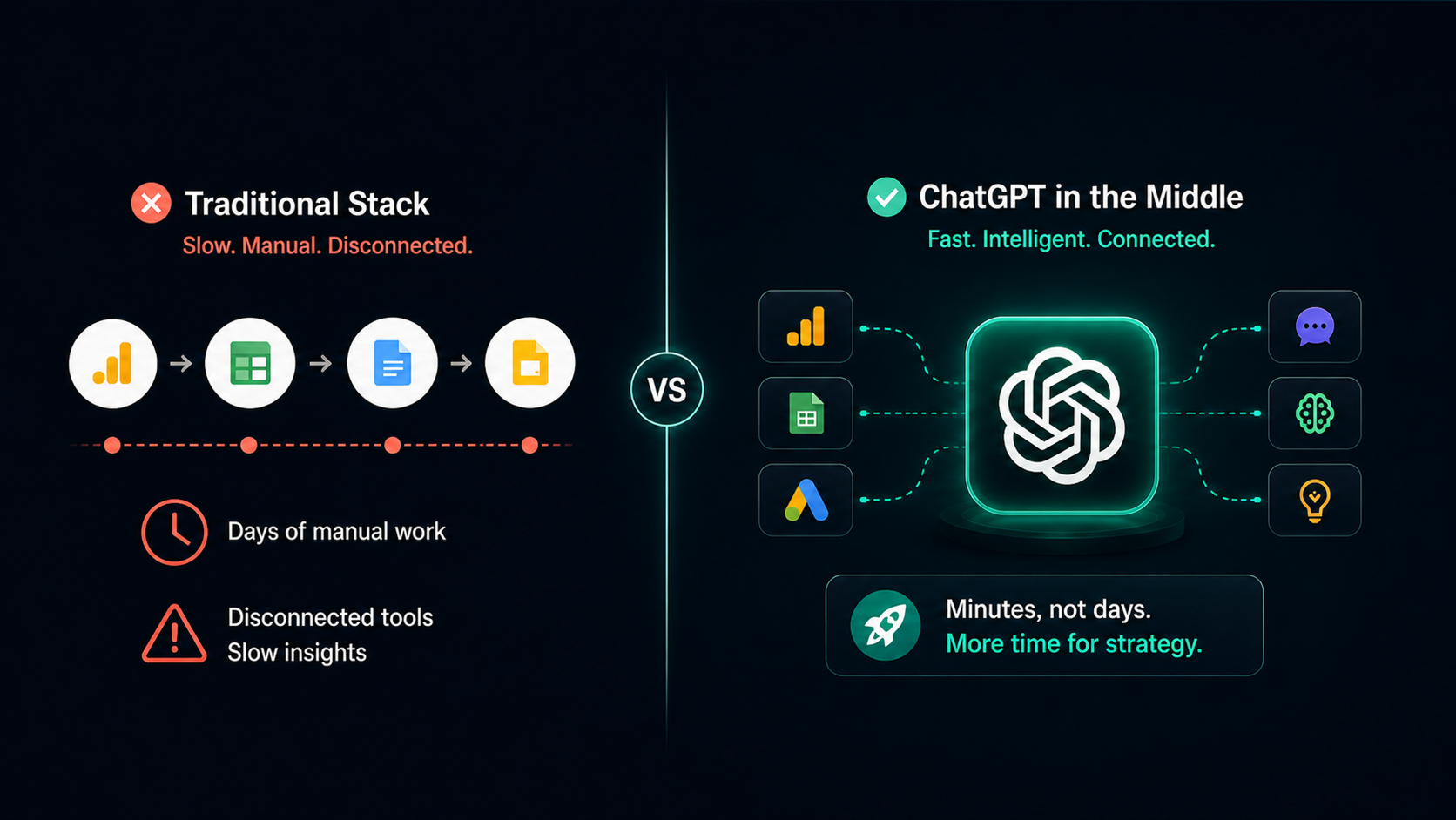
Traditional marketing stacks weren’t built for speed. A typical campaign analysis might involve pulling data from Google Analytics, exporting to a spreadsheet, building a pivot table, writing a summary, and presenting it - a cycle that could eat two or three days of a strategist’s time.
ChatGPT collapsed that cycle. Not because it replaced those tools, but because it sits between them and the people who need answers. Ask it to interpret a bounce rate spike, and it doesn’t just say “bad.” It reasons through possible causes - page speed, seasonality, a tracking error - and suggests which to investigate first.
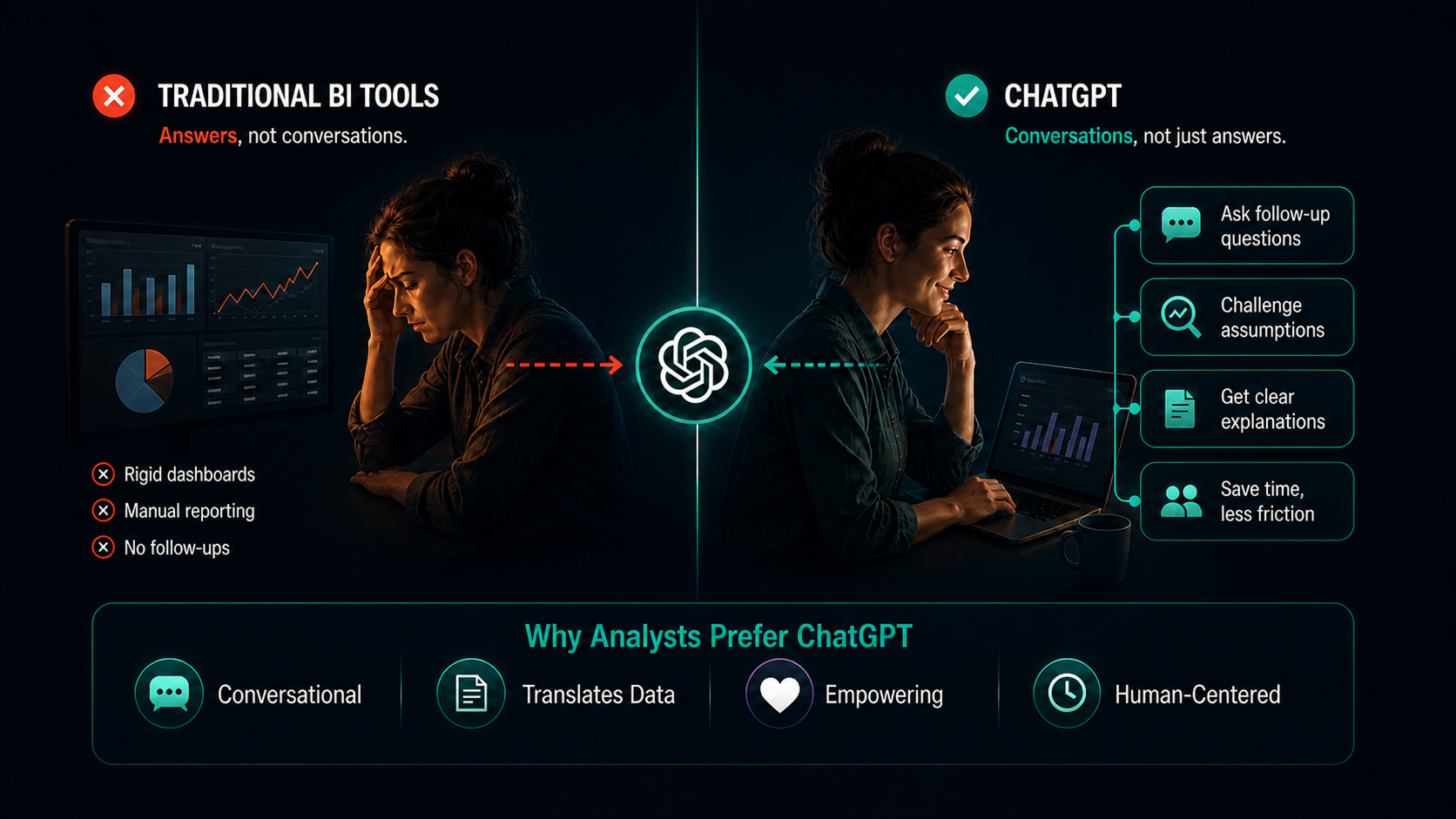
Where traditional BI tools give you dashboards, ChatGPT gives you a conversation. That’s a different kind of value, and for marketing specifically, it’s often the more useful one.
How Data Analysts Use ChatGPT in Daily Workflows
The changes here are less dramatic than people expected, and more practical than most case studies admit.
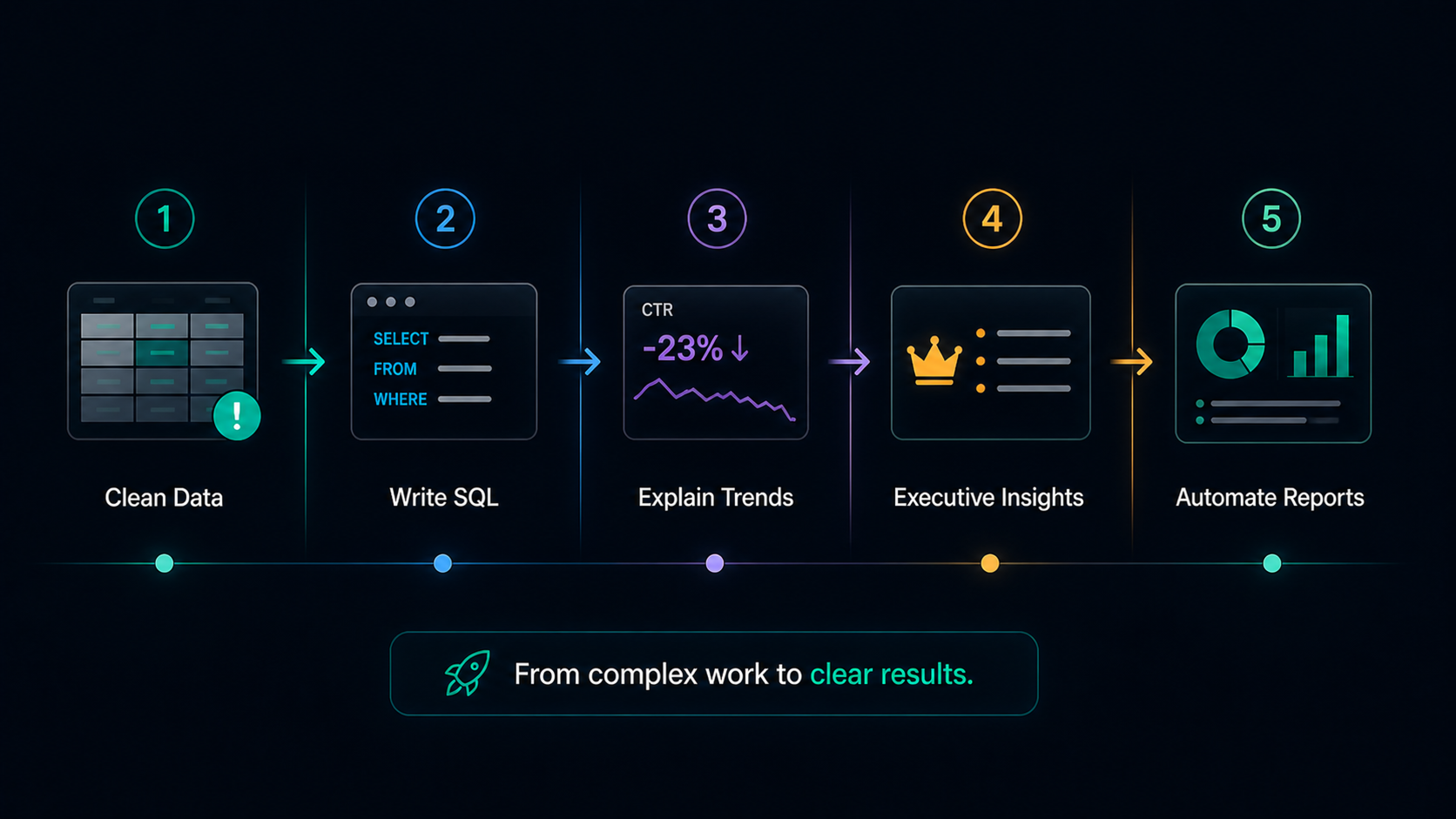
Cleaning Messy Datasets
Campaign data is chronically dirty - mismatched UTM parameters, duplicate entries, inconsistent date formats across platforms. Analysts now paste a sample of their data directly into ChatGPT and ask it to write a cleaning script in Python or R. What used to take an hour takes ten minutes, and the code is usually solid enough to run with minor edits.
Writing SQL Faster
This is quietly one of ChatGPT’s most-used marketing applications. Analysts describe their data schema in plain language, explain what they need, and get a working SQL query back. It’s not perfect every time - complex joins still need review - but it’s dramatically faster than writing from scratch, especially under deadline pressure.
Explaining Trends in Plain English
Here’s a scenario that plays out constantly: a junior analyst has a chart showing a 23% drop in click-through rate across paid search campaigns. They know what happened but not why, and they need to present it to a director who doesn’t want to look at raw numbers. ChatGPT helps translate the pattern into a clear, contextual explanation - without the analyst having to fake confidence they don’t have.
Turning Tables into Executive Insights
Monthly performance tables are useful. Executive summaries are what actually get read. Analysts feed ChatGPT a table of campaign metrics and ask it to produce a three-paragraph summary with the key takeaways highlighted. The output rarely runs without editing, but it gives you 80% of the draft in 30 seconds.
Automating Weekly Reports
Some teams have built light automation where ChatGPT is part of a weekly reporting pipeline - data exports feed into a prompt template, and a structured summary comes out the other side. It’s not magic. The prompts require upfront investment to get right. But once they work, they work consistently.
What Can ChatGPT Analyze Well?
The short answer: pattern recognition in text, logical reasoning about data relationships, and turning structured information into narrative.
It handles keyword clustering surprisingly well. Give it a list of 200 search terms and ask it to group them by intent - informational, transactional, navigational - and it does a credible job. Not flawless, but good enough to be a useful first pass.
It’s also strong at comparative analysis. “Here are my campaign metrics from Q1 and Q2 - what changed and what might explain it?” is exactly the kind of question ChatGPT handles well, provided the data is accurate going in.
Email subject line testing, ad copy variation, social caption rewrites - all of these play to its strengths. Language is where it’s most reliable.
Where Human Analysts Still Win
Nowhere more clearly than in judgment calls.
ChatGPT doesn’t know your brand. It doesn’t know that last quarter’s dip in conversions was actually expected because you pulled spend during a brand refresh. It can’t feel the difference between a metric that looks bad and a metric that is bad in context.
Statistical rigor is another gap. ChatGPT can explain statistical concepts clearly, but for actual significance testing, regression modeling, or anything that needs proper methodology, you want a trained analyst - or at minimum, a specialist tool - reviewing the work.
And then there’s accountability. Someone still needs to own the recommendation. ChatGPT doesn’t take responsibility for a strategy that misses its targets. The human in the loop still matters, a lot.
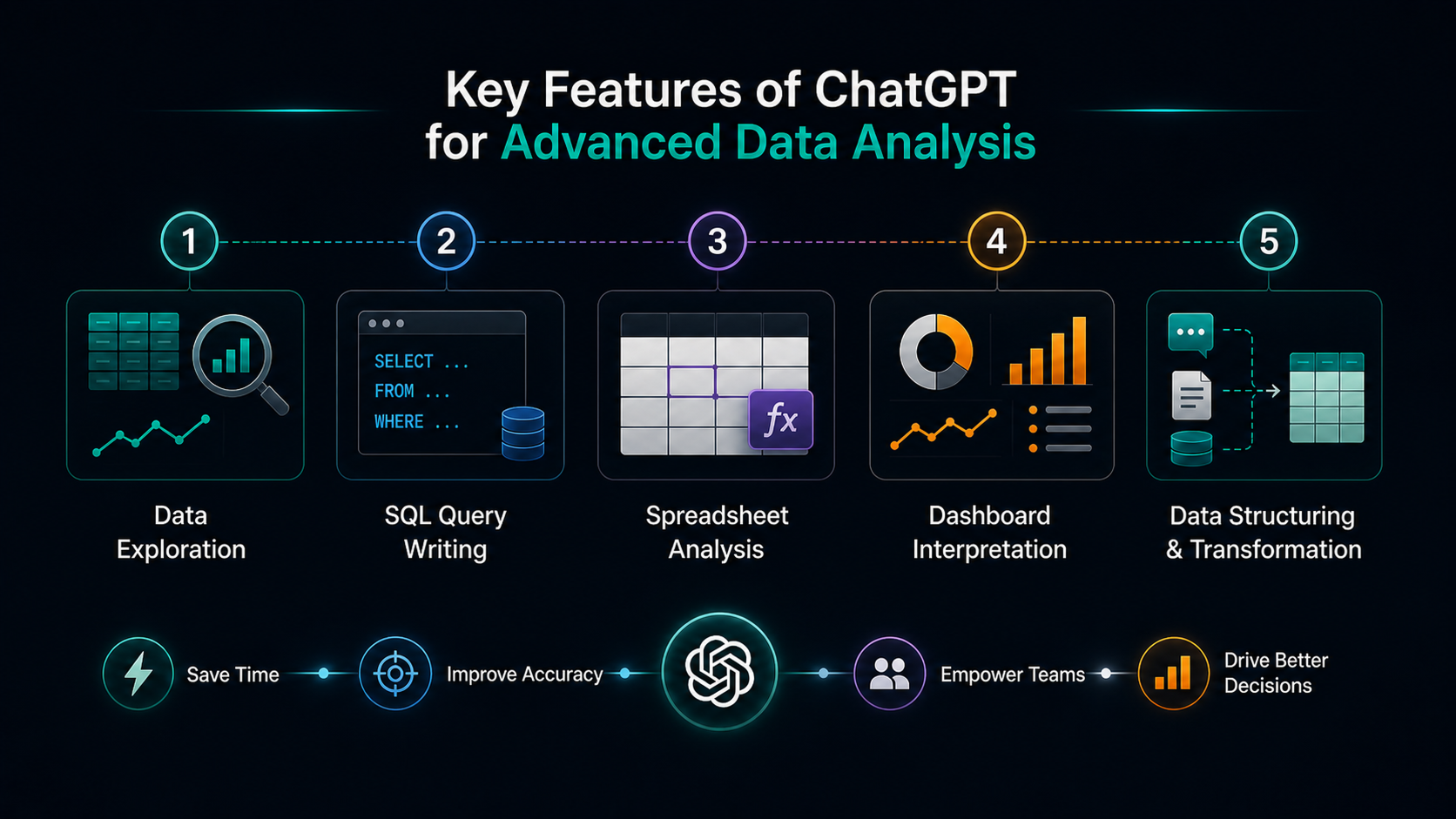
Key Features of ChatGPT for Advanced Data Analysis
Fast and Accurate Data Exploration
Drop in a dataset (or a description of one) and ChatGPT will surface patterns, outliers, and potential anomalies quickly. It’s not running statistical models - it’s doing something closer to intelligent pattern matching. For exploratory work, that’s often exactly what you need.
Automated SQL Query Writing
Already covered this above, but worth emphasizing: this single capability has saved measurable hours across marketing and analytics teams. The productivity gain is real.
Spreadsheet Analysis and Formula Generation
“Write me an Excel formula that calculates month-over-month growth and flags anything above 15%” - this kind of request takes seconds. For marketers who live in spreadsheets but don’t have a technical background, it’s a genuine unlock.
Dashboard Interpretation
Feed it a screenshot or description of a dashboard and ask what stands out. It will identify the metrics that look unusual and suggest follow-up questions. This is not a replacement for someone who built the dashboard, but it is useful for getting a fresh perspective quickly.
Data Structuring and Transformation
Turning unstructured data - survey responses, customer feedback, scraped content - into structured formats is tedious manual work. ChatGPT handles a lot of this: categorization, extraction, normalization. Again, not perfect, but faster than doing it by hand.
Most Popular Ways to Use ChatGPT for Data Analytics in 2026
Business Intelligence and KPI Reporting
Teams are using ChatGPT to draft KPI commentary, generate variance explanations, and produce board-ready summaries from raw numbers. The output quality depends heavily on how specific your prompts are.
Customer Data Analysis and Segmentation
Describing customer segments in plain language, then having ChatGPT suggest targeting angles or messaging approaches for each - this is a practical workflow that marketing teams have adopted widely.
Sales Forecasting and Revenue Trend Analysis
ChatGPT isn’t a forecasting tool in the traditional sense, but it can help analysts structure their thinking, identify which variables to weight, and communicate forecast assumptions to non-technical stakeholders.
Marketing Analytics and Campaign Performance Tracking
Week-over-week campaign summaries, creative performance analysis, and channel mix assessments are high-volume, repetitive tasks that ChatGPT handles well once the prompts are dialed in.
Financial Data Analysis and Risk Assessment
ChatGPT can help you frame conversations around marketing budgets, ROI modeling, and spend efficiency analysis and do some initial calculations, but you should have a finance professional review the output before you base any mission-critical decisions on it.
Operations Analytics and Process Optimization
Identifying bottlenecks in campaign workflows, analyzing where time is lost, and suggesting process improvements is a less glamorous use case, but a genuinely useful one.
Is ChatGPT Plus Worth It for Data Professionals?
As of 2026, the paid tier includes access to the most capable models, longer context windows, advanced data analysis tools, and integration with external data sources. For a marketing analyst or strategist, the honest answer is probably yes, if you’re using it regularly.
The free tier is fine for occasional tasks. But the productivity gains from the advanced features - especially the ability to work with longer documents and richer data inputs - add up quickly for professionals who are in the tool daily.
The cost is modest relative to what an hour of analyst time costs. The math isn’t complicated.
Why Analysts Often Prefer ChatGPT for Data Interpretation and Reporting
This comes up a lot, and the reason isn’t what you’d expect. It’s not just speed. It’s the conversational format.
Traditional BI tools give you answers. ChatGPT lets you ask follow-up questions. You can say, “Wait, but what if that’s just seasonality?” and it will engage with that reasoning, consider it, and update its thinking. That back-and-forth is what analysts actually want from a colleague, and it’s something no dashboard has ever offered.
There’s also the language piece. Analysts are often technically strong but writing-averse. Turning a solid analysis into a readable narrative has always been the unglamorous last mile of the job. ChatGPT handles that last mile better than almost any other tool available, and it does so without making the analyst feel like they are doing it wrong.
That’s not a small thing. That’s why this tool stuck.