Real estate work rarely unfolds in a clean, predictable order. A buyer sends a message early in the morning, a seller needs fresh listing copy before the day is over, and a document review can appear minutes before an important call. That pace is one reason ChatGPT for real estate has become part of the workflow in 2026. It can help with drafting, research, and routine admin much faster than older tools. Still, speed is only part of the job. Real estate also depends on judgment and quick decisions in live situations, and those are the areas where ChatGPT still falls short.
Will ChatGPT replace real estate agents?
Not in the full sense of the role. NAR’s 2025 technology survey found that 41% of REALTORS® were already using AI or generative AI, and 33% said AI had a moderately positive impact on their business. That tells you the technology is already in the workflow. It does not tell you that clients are ready to hand the deal to a chatbot.
The better way to frame the question is this: which parts of the agent’s day are becoming software work? Drafting listing copy fits that bucket. Summarizing disclosures fits too. Writing follow-up emails, extracting details from PDFs, and turning market stats into digestible language also fit.
The client meeting, the pricing strategy, the hard conversation after inspection, and the split-second adjustment during negotiations do not. Even broader labor coverage in late 2025 found little evidence of widespread AI replacement in service roles, and real estate agents were named as an example of work that had not simply disappeared.
Why AI tools are adopted in real estate
Adoption is rising because the work itself produces too much text, too many documents, and too many small interruptions. NAR reported that 70% of REALTORS® were using at least one new tool in 2025, with AI and generative AI leading that group. In property management, adoption jumped from 20% in 2024 to 58% in 2025, according to Buildium data cited by NAR.
Real estate teams keep turning to AI for a few plain reasons:
- They want faster admin work. AI helps with summaries, drafts, and first-pass research, which cuts time spent on routine writing.
- They need a quicker client response. A draft in 30 seconds is not a finished answer, but it helps agents reply before the lead cools off.
- They handle too many documents. ChatGPT can read spreadsheets, PDFs, and uploaded files, which makes it useful in listing prep and transaction support.
- They want better targeting. NAR points to lead scoring, personalized marketing, and predictive analytics as active AI use cases in real estate.
This is also why the question of how to use ChatGPT for real estate keeps coming up more often. The value is in removing slow manual work from parts of the day that do not need deep human judgment.
Real estate prompt engineering tips 2026
Prompting matters more in real estate than many people expect. ChatGPT for real estate can sound polished even when the substance is weak. It may miss a zoning detail. It may blur a legal point that should stay exact. Better prompts do not make the result perfect, but they do make it easier to review and easier to trust. That is a big part of how to use ChatGPT for real estate well in daily work.
#1. Ask for sources and separate facts from guesses
One of the fastest ways to improve output is to force the model to show its basis. If you upload a market report, ask it to point to the exact page or section behind each claim. If it writes a property summary, ask it to label verified facts separately from assumptions. That simple step makes weak answers much easier to spot before they reach a client.
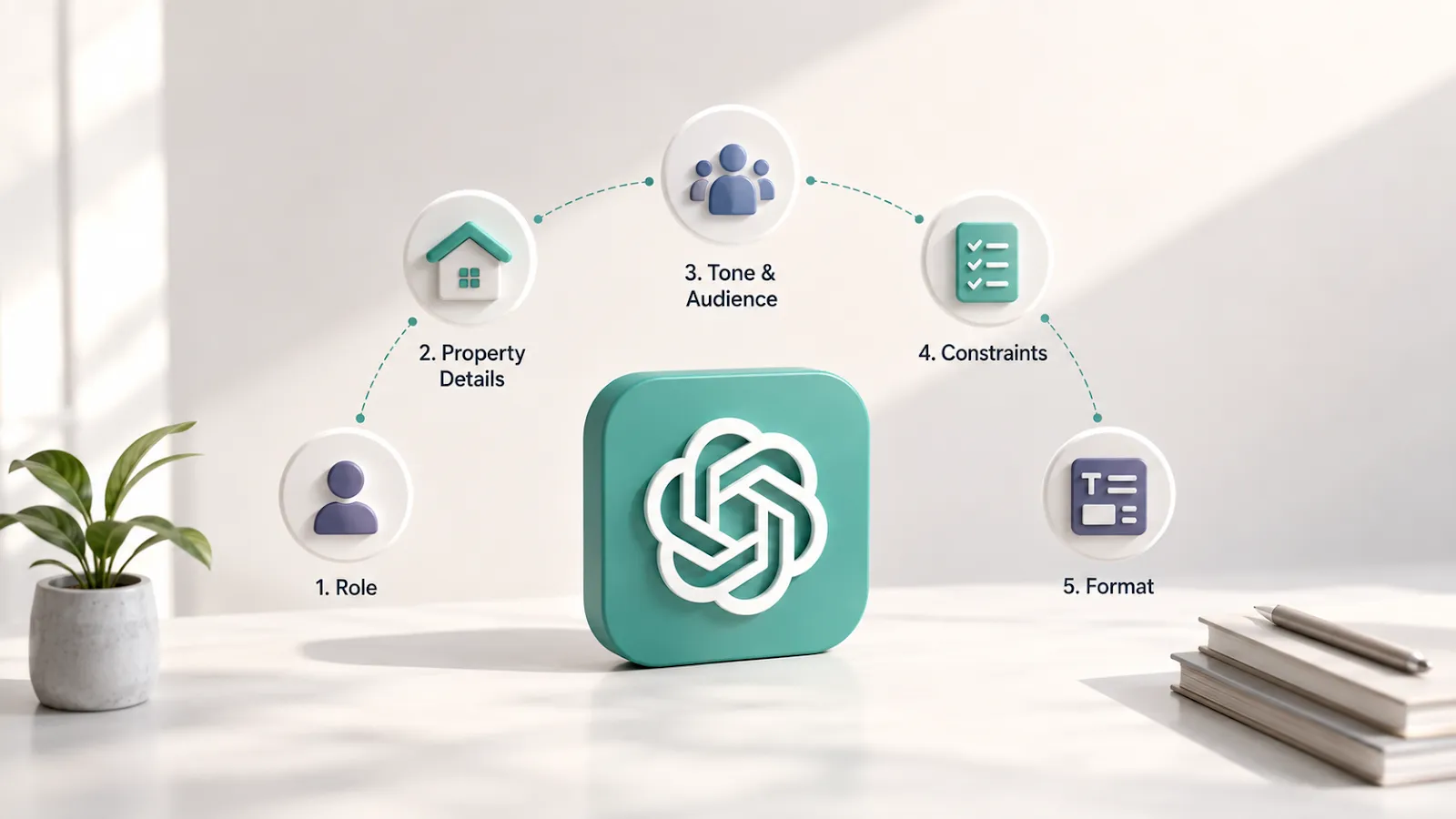
#2. Give ChatGPT a clear real estate role
The model writes differently once it knows the role it is supposed to play. A listing agent uses different language from a transaction coordinator. A landlord representative frames value in a different way from a buyer’s agent. The role changes the tone, and it also changes the logic behind the response. That is why this is one of the most useful rules in how to use ChatGPT for real estate without getting generic copy back.
#3. Say exactly what you want it to produce
Many weak prompts fail for one simple reason: the task is too vague. “Write something about this property” leaves too much room for filler. A better prompt names the output from the start. Ask for a client’s email. Ask for a lease abstract. Ask for a short social caption or a pricing memo. Once the destination is clear, the response usually becomes more focused.
#4. Show the style you want with one example
A short sample often works better than a long explanation. If you already have a listing description or an email that sounds right, paste it into the prompt and ask ChatGPT to follow that structure. This cuts down on generic wording and helps the output sound closer to your real voice. It also saves time during editing.
#5. Add the property details that change the message
Real estate writing depends on specifics. If the prompt leaves out the facts that make the property different, the result will usually feel flat. Include the details that change how the property should be presented. That may be the property type. That may be its size. It may be recent renovations, HOA limits, school information, or lease terms. ChatGPT for real estate works much better once the prompt gives it enough substance to work with.
#6. Explain the setting and the audience
Property facts are only part of the picture. The model also needs to know how the property should be framed and who will read the result. A downtown rental should not sound like a suburban resale. An investor email should not sound like first-time buyer copy. Once you add that context, the output becomes more relevant and easier to use.
How to use ChatGPT for real estate? Prompt engineering tips for 2026
Understanding what makes a strong prompt is useful. Applying it in the middle of a busy real estate day is the harder part. Agents are usually working between calls, showings, client messages, and document review, so the prompt needs to be practical under real pressure. That is why how to use ChatGPT for real estate is not only a question of writing better instructions. It is also a question of building a workflow that fits the pace of the job.
A simple workflow helps keep the output focused from the start. Begin with the audience and the job the text needs to do. Then give ChatGPT the facts in a clean block, choose one format for the answer, and end with a short review rule. This keeps the response tighter and makes it easier to check before it goes to a client.
A workable sequence often looks like this:
- Start with the audience and use case. Ask for a seller update, a buyer follow-up, a renter-facing summary, or an investor note.
- Add the source facts in one clean block. Include the figures, dates, property type, location, and any limits tied to disclosure or compliance.
- Request one output format. A short email, a pricing summary, a table, or a brief listing draft usually works better than asking for everything at once.
- End with a review instruction. Tell ChatGPT to flag missing facts, separate assumptions, and avoid claims that are not supported by the material provided.
This method works well because it matches the way agents actually work. Most tasks do not need a perfect first draft. They need one that is usable, quick to review, and easy to correct. That is one of the clearest examples of how to use ChatGPT for real estate without slowing the workflow down.
How efficient is using ChatGPT for document and data analysis?
This is one of the strongest use cases for ChatGPT for real estate right now. It can work through spreadsheets, PDFs, CSV files, and other uploaded materials far faster than most manual review. That makes it useful for comparing documents, summarizing file contents, and pulling out the parts that matter first. In practice, this can save a lot of time during listing prep, transaction support, or internal review.
Still, efficiency is not the same as legal reliability. ChatGPT can pull dates from a lease, compare closing statements, summarize inspection notes, or spot repeated clauses in a management agreement. However, it can’t certify legal sufficiency. It also can’t know which small omission matters in your state without being told. That makes it great for first-pass review and weak as a final check.
What are the routine tasks where ChatGPT is preferred by real estate brokers?
Routine work is where brokers feel the payoff fastest. That work is repetitive, text-heavy, and full of minor rewrites. It is also the work that tends to steal evenings from solo agents and small teams.
Listing copy and service descriptions
This is still one of the most common starting points. ChatGPT can take raw property details and turn them into usable marketing copy much faster than a blank page can. It helps with listing descriptions, service blurbs, postcard drafts, and other short-form materials that need polish but do not need hours of thought. The result still needs a human pass, especially to remove generic phrasing and confirm every fact, but it saves time at the moment when speed matters most.
Open house posts and market announcements
Agents also use ChatGPT for short public updates that need to go out quickly. That includes open house posts, price-change notices, and local market commentary built around fresh data. This use case has gained real traction across the industry. NAR and RPR have moved in the same direction with AI ScriptWriter tools that turn market data into ready-to-use content. That makes ChatGPT for real estate especially useful for agents who need faster communication without starting from scratch every time.
Day-to-day support for solo agents
Solo agents often feel the benefit most clearly because they carry every small task themselves. ChatGPT can help draft follow-up emails, clean up showing notes, prepare nurture copy, and summarize property or market data for a quick review. It does not replace the judgment behind those tasks, and it does not turn one person into a full team. What it does is reduce the time lost between one small task and the next, which is a big part of how to use ChatGPT for real estate in a way that actually supports the day.
Where ChatGPT can’t replace real estate agents
ChatGPT starts to lose value at the exact points where deals become fragile. These moments are rarely tidy, and they do not follow a script. That is where a real estate agent still does work that software can’t handle on its own.
Reading the room during negotiations
Negotiation is not just about finding the right words. It is about sensing hesitation, pressure, and intent before the other side says them out loud. A buyer who says they need more time may be worried about price. They may be nervous about financing. ChatGPT can suggest responses, but it can’t hear the pause in someone’s voice or know when silence matters more than another message.
Knowing the market beyond the report
ChatGPT can summarize public market data, but that is not the same as real local knowledge. An agent learns over time which block sells faster, which building has a slow board, and which developer has a pattern of overpromising. That kind of knowledge is built through repeated deals and direct experience. It does not come from a summary tool, no matter how polished the output sounds.
Building trust when the stakes feel personal
Real estate clients do not just share transaction details. They often share stress, family plans, money worries, and major life changes. Trust grows through timing, tone, and judgment across many small moments. It gets tested even more when something goes wrong. A calm agent can protect that relationship in a way software can’t, especially when the client needs reassurance more than information.
Handling pressure when the situation changes fast
Some deal problems need an immediate response, but the right answer can change within minutes. An inspection issue can shift the negotiation. An appraisal gap can change the financing plan. A title problem can delay everything at once. ChatGPT can help draft options or organize facts, but a person still has to weigh the risk, speak to the client, and choose the next move.
Which ChatGPT version is enough for real estate agents: Free or Plus?
This is the question most agents ask after two or three busy weeks with the tool. The answer depends on the workload. If you only use ChatGPT for occasional listing drafts or simple emails, the free plan may be enough. If you rely on it for document review, repeated prompting, and daily client-facing work, Plus starts to make more sense.
The differences become clearer when you look at how each plan fits an agent’s weekly workload.
| Feature | Free version | Plus version ($20/mo) | Why it matters for agents |
|---|---|---|---|
| Daily usage | Lower limits | Higher limits | Plus is easier to rely on during active listing or buyer weeks. |
| File-based work | Fewer project uploads | More project uploads | Plus is more practical for agents working with PDFs, comps, and disclosure files. |
| Access during busy periods | Standard access | Priority access | Plus is more dependable when timing matters before a showing, meeting, or client call. |
| Workflow depth | Better for occasional tasks | Better for repeated daily tasks | The gap shows up once ChatGPT becomes part of listing prep, research, and follow-up. |
| Best fit | Light support | Daily support | Free suits for occasional use. Plus suits agents who treat ChatGPT as a working assistant. |
What other AI can be used in real estate?
ChatGPT for real estate is useful, but it is not the only AI tool that belongs in the workflow. Once you look at the tasks that fill a real estate week, the pattern becomes easier to understand. ChatGPT handles writing and first-pass analysis well. Other tools do a better job when the task depends on visuals, design, or specialized data.
That is why a small AI stack often works better than one general tool. One tool helps with copy. Another reads property photos. Another turns local market data into client-ready content. This is also part of how to use ChatGPT for real estate in a more practical way. The point is not to force it into every task. The point is to use it where it fits and bring in other tools where they do the job better.
A few tools stand out for real estate teams:
- RPR AI ScriptWriter works well for market updates and local content. RPR can turn market trend data into branded social videos, social cards, presentations, and other ready-to-share formats in a matter of minutes. That makes it useful for agents who need polished local commentary but do not want to start from a blank page every time.
- Restb.ai is built for property image analysis. The company’s computer vision tools can detect room types, interior and exterior features, architectural styles, and damage from listing photos. In practice, that helps teams tag images, choose stronger visuals, and make image-heavy listing workflows less manual.
- Canva Magic Write fits agents who create marketing materials inside Canva. Canva’s Magic Write is an AI text generator that helps users produce first drafts from a prompt, and Magic Studio places that writing tool inside a larger design workflow. That is useful when the copy and the visual layout need to come together in the same place.
- Perplexity is strong for fast research. Perplexity is an AI-powered answer engine that searches the web, identifies sources, and synthesizes current information into direct responses. For real estate, that is helpful when you need a quick read on a zoning change, a new employer in the area, or current development activity before speaking with a client.
Can AI replace mortgage brokers?
AI can take over part of the mortgage workflow, but it cannot replace the broker. It works well on the operational side of the job, where speed matters most, and the steps are easier to repeat. That includes document sorting, file summaries, missing-item checks, and early processing work. In that sense, the logic is similar to ChatGPT for real estate. The tool is useful where the work is structured, but the full role still depends on human judgment.
The broker becomes most valuable once the file stops being routine. That often happens when a borrower needs help comparing loan options, or when a lender raises concerns about income, debt, or the property itself. At that point, the work shifts away from process and toward judgment. The client needs clear advice and someone who can guide the deal through pressure. AI can support that work, but it can’t take responsibility for it.
How do you use AI to generate leads in real estate?
AI is most useful in lead generation after a person has already shown interest. It does not replace prospecting or local marketing. Its real value appears in the next step, when an agent needs to respond and keep the conversation moving. Many leads are lost at that stage, not at the first point of contact. The reply arrives too late, or the message feels too generic to hold attention. That is one of the clearest examples of how to use ChatGPT for real estate in a way that supports real business activity.
That is where AI helps. It can sort leads based on behavior, shape the message around likely intent, and make follow-up easier to manage during a busy week. For example, an agent can use AI to prepare one follow-up for a first-time buyer and another for a homeowner who may be ready to sell. The point is not to create more content. The point is to make the response faster and more relevant once interest appears.
A more practical lead workflow looks like this:
- Use CRM actions or repeat site visits to identify which leads show stronger intent.
- Write separate follow-ups for buyers, sellers, investors, or renters instead of sending the same message to everyone.
- Turn one neighborhood change or one pricing shift into content that feels timely and specific.
- Prepare the first reply and the next follow-up before the lead loses interest.
Conclusion
Real estate did not suddenly become an AI business. It became a faster business with more documents and much less patience for slow admin work. That is why ChatGPT for real estate fits so naturally into some parts of the job, especially the manual ones that take time but do not always require deep judgment. But the work that shapes real outcomes is still human work. Pricing decisions, negotiations, local credibility, and client trust have not been handed over to software.
The agents who get the most value from AI in 2026 are not the ones who try to automate the whole process. They are the ones who understand how to use ChatGPT for real estate with clear limits and know where not to trust it at all.