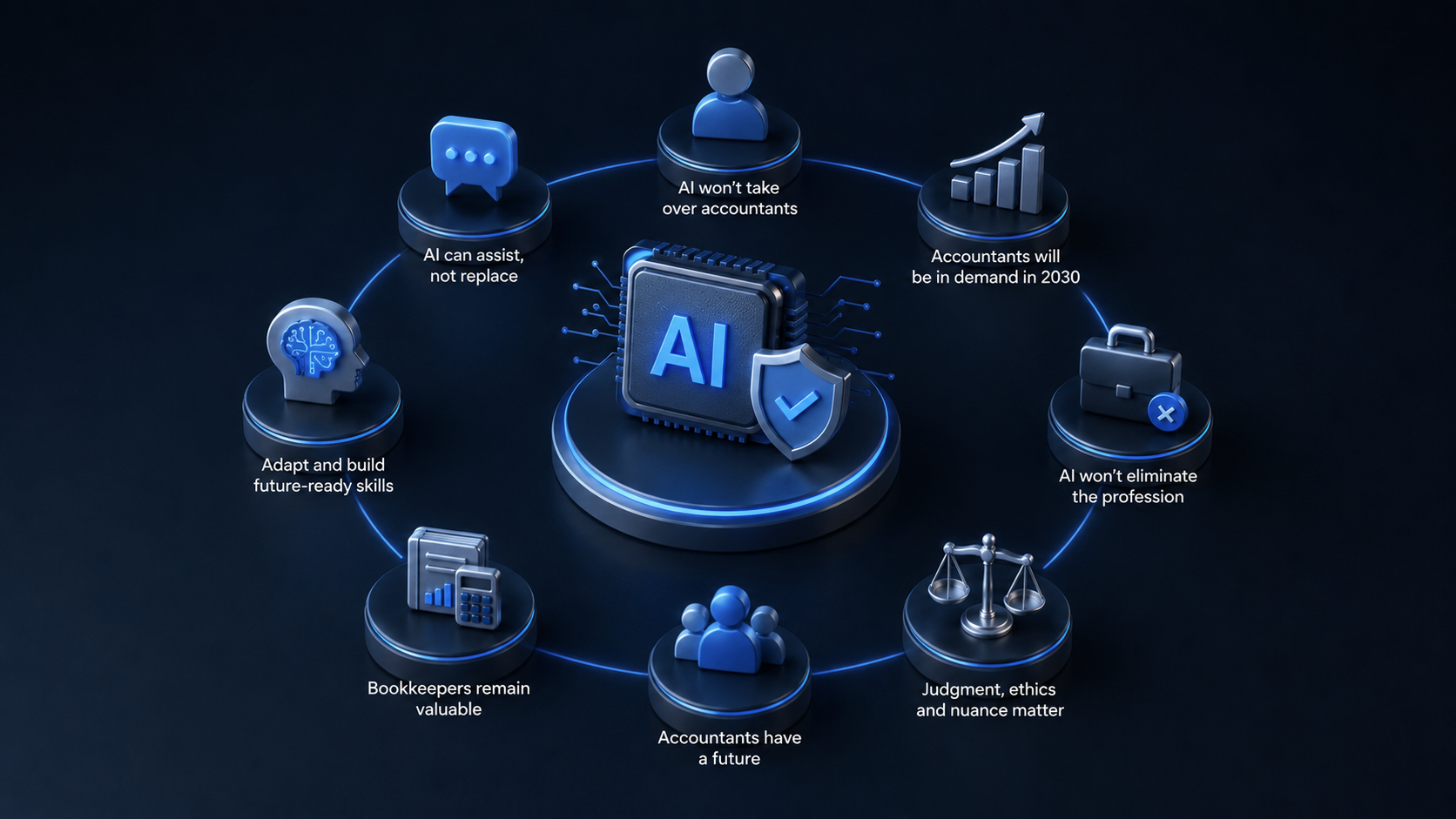
Whatever brought you here, the question behind your search is personal: Is my career safe?
Quick answer: AI is unlikely to replace accountants and CPAs as a whole by 2030, but it will automate many bookkeeping, reconciliation, tax-prep, document-processing, and routine audit tasks. Bookkeepers and entry-level roles built mostly around data entry are more exposed. Accountants who move toward advisory, controls, audit judgment, tax interpretation, client communication, and AI-assisted review are safer.
Accounting tasks AI will automate first
| Accounting work | AI automation risk | Human work that remains valuable |
|---|---|---|
| Data entry and coding transactions | High | Exception handling and controls |
| Bank reconciliation | High | Reviewing anomalies and policy decisions |
| Invoice and receipt processing | High | Vendor judgment and fraud escalation |
| Basic tax prep | Medium to high | Tax strategy and unusual cases |
| Month-end close support | Medium | Controller review and sign-off |
| Audit sampling and evidence review | Medium | Risk assessment and professional skepticism |
| Forecasting and variance summaries | Medium | Business interpretation and recommendations |
| Client advisory | Low | Trust, strategy, and judgment |
| Regulatory interpretation | Low to medium | Applying rules to messy real situations |
Source check: this update uses labor-market context from the BLS Accountants and Auditors outlook and broader workforce context from the World Economic Forum Future of Jobs Report 2025. For practical AI workflows, compare ChatGPT for finance and Claude AI for finance.
The profession is transforming, and the gap between accountants who use AI and those who avoid it widens every quarter. Routine compliance work is shifting to machines. Advisory, strategy, controls, and judgment-driven work are worth more than ever. Accounting is just one of several professions navigating this shift — see our broader overview of what jobs AI will replace by 2030 for the full picture.
You have time. And you don’t need a computer science degree to stay ahead. You need to understand what AI does in your field right now, where it falls short, and where to focus your energy next.
If you want the practical prompt workflows behind that shift, explore Coursiv’s ChatGPT for Accountants course.
Let’s walk through all of it.
How AI Is Transforming Accounting: The Growth of AI in Daily Accounting Tasks
AI adoption in accounting became non-linear in 2024. It accelerated.
Wolters Kluwer’s 2025 Future Ready Accountant report found AI adoption in accounting firms jumped from 9% to 41% in a single year. Thomson Reuters reported a similar surge: 44% of tax firms using or planning to use generative AI reported using it daily (or multiple times a day), and another 29% use it at least weekly.
Intuit’s 2025 survey of 700 U.S. accounting professionals showed 46% use AI daily. 98% reported improvements in accuracy.
Can AI Do What Accountants Do?
Parts of it, yes — and those parts are growing fast. AI excels at repetitive, rule-based, data-heavy tasks: categorizing transactions, matching invoices, reconciling accounts, drafting financial reports, and flagging anomalies.
A 2025 Stanford GSB study found that accountants who used AI to finalize monthly statements completed the process 7.5 days faster and spent 8.5% less time on routine processing.
Where AI adds the most value, though, is in the hands of experienced professionals. The same Stanford study found that senior accountants gained far more from AI than juniors. They knew when to trust the output and when to override it.
Lovely McInerney, a former Big Four auditor who spent a full year building AI systems for accounting workflows, put it simply: domain expertise is the unlock. She built AI tools that could parse purchase agreements, generate journal entries, and handle transaction classification, but only because she designed the guardrails and knew what “right” looked like from a decade of doing the work manually.
What Tasks Do AI Agents Perform in Accounting?
For now, AI agents work across these tax and accounting workflows:
Document processing and data capture. AI uses OCR and machine learning to read receipts, invoices, and contracts. It pulls out the key data and sorts transactions into categories automatically. Advanced models spot duplicate invoices and flag misclassifications with around 75% accuracy.
Bookkeeping and reconciliations. Automation bots reconcile accounts, match payments to invoices, and flag issues like late payments or unusual entries.
Tax research and compliance. AI searches federal, state, and local tax codes and returns cited answers in seconds. It also prepares returns, applies tax treatments, and runs compliance checks automatically.
Financial close and reporting. Generative AI drafts narrative sections of filings, compiles financial statements, and produces flux analyses. Predictive models turn historical data into cash flow forecasts and budget projections. Microsoft Copilot generates expense reports, regulatory narratives, and scenario models. Agentic AI monitors transactions and delivers real-time insights to decision makers.
Audit and fraud detection. AI scans entire transaction datasets to catch fraud and anomalies, eliminating the blind spots of traditional sampling. With intelligent automation, firms cut fieldwork time in half and reduce deficiency rates from 28% to single digits.
Specialized agents. Purpose-built AI agents handle due diligence, lease analysis, contract review, claims triage, and financial report drafting.
What AI Tools Are Accountants Using Right Now?
The landscape is broad and growing fast. Here are the leading tools, organized by function.
Tax research and compliance:
- CoCounsel Tax (Thomson Reuters). An AI assistant that handles research, drafts documents, and runs compliance checks. Used by over 2,000 law and tax firms.
- TaxGPT. Provides cited answers to federal, state, and local tax questions on demand. Users report saving up to five hours a day on research.
- Bloomberg Tax Answers. Pulls answers straight from Tax Management Portfolios with citations and tracks compliance deadlines automatically.
Return preparation:
- Ready to Review (Thomson Reuters). Uses AI agents to process source documents and produce 1040 returns ready for review.
- Filed. Reads, sorts, and preps returns while learning how your firm works. Selected for the 2025 AICPA Startup Accelerator.
- Black Ore. Full 1040 automation for CPAs with built-in review workflows.
Bookkeeping and accounts payable:
- Vic.ai. Automates accounts payable using machine learning to process invoices and organize tax documents.
- Dext Prepare. Scans receipts and invoices using OCR and pushes entries into accounting software.
- ccMonet AI. Bookkeeping and bank reconciliation for small businesses, with a human reviewing the work before it’s finalized.
Accounts receivable and payments:
- Quadient AR Automation. Reads remittance data, reconciles payments, pairs them with invoices, and highlights discrepancies.
- Aiwyn. Handles payment collections and follow-up reminders for accounting firms automatically.
Revenue recognition and financial close:
- HubiFi. Connects to CRMs, payment processors, and ERPs to handle ASC 606 compliance and build amortization schedules automatically.
- DualEntry AI. Enterprise platform that automates month-end close, cash flow monitoring, and ongoing compliance.
Practice management and workflow:
- Karbon. AI-powered workflow and capacity management for task assignments, time tracking, and client communication.
- Canopy. Handles client onboarding, billing, document management, and practice automation.
Audit and analytics:
- MindBridge. Analyzes every transaction using ensemble AI to detect fraud and assess risk.
- DataSnipper. AI-powered document extraction and cross-referencing for audit teams.
General productivity:
- ChatGPT / Microsoft Copilot. Summarizing, brainstorming, and data analysis across any accounting workflow. Not sure which AI assistant fits your workflow? Check our comparison of the best AI chatbots in 2026.
Not sure where to start? That’s normal. Many accountants begin with the AI assistant already embedded in their existing software: Intuit Assist, Sage Copilot, or Microsoft Copilot for Finance. You don’t need a new tech stack. Use the one you have differently. For a full comparison of available tools, check out our best AI chatbots in 2026.

Why Human Decisions Remain Fundamental in Accounting
AI continues to get faster and more accurate — which is why headlines claiming “AI will replace accountants” keep circulating.
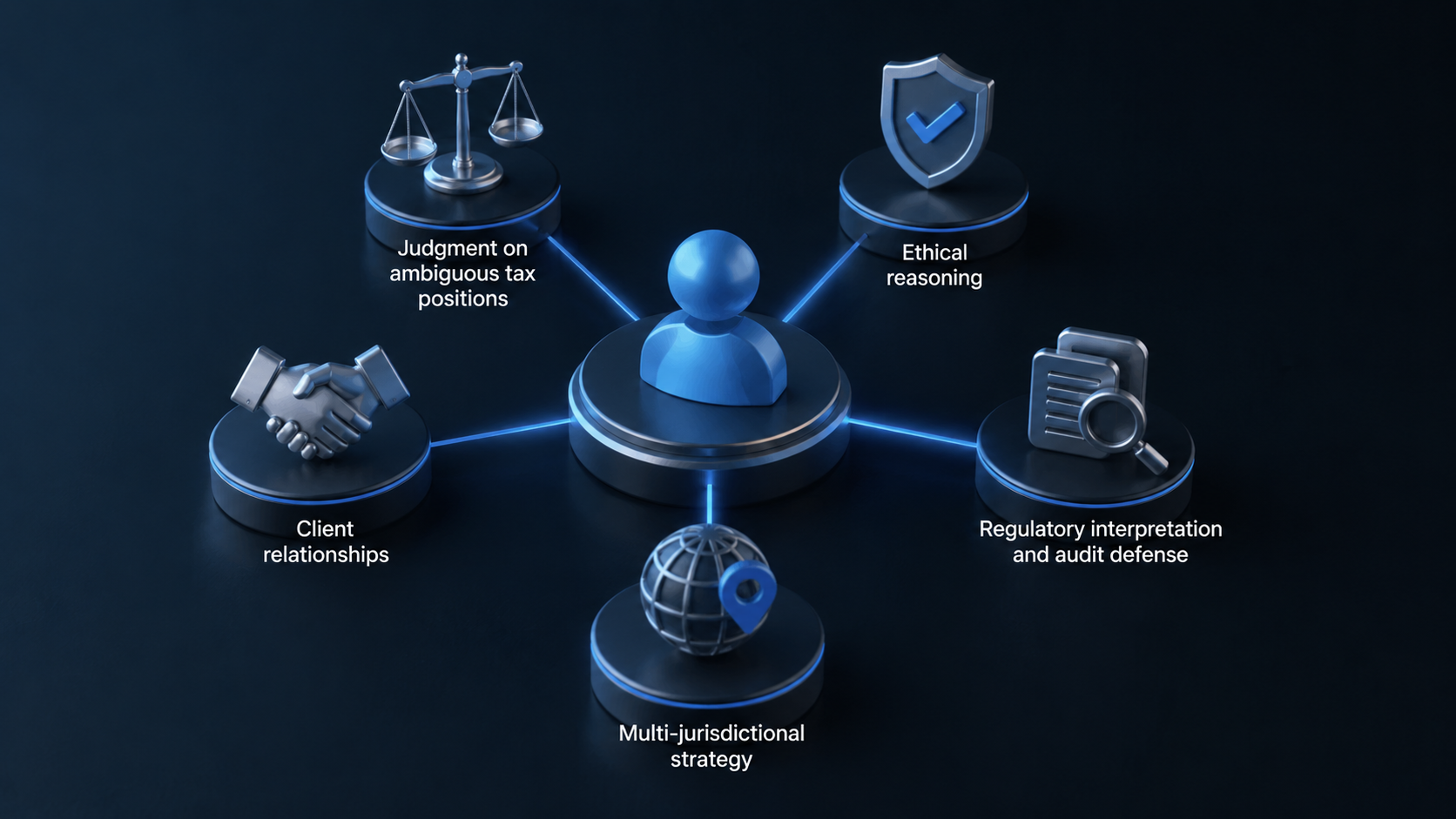
The work that makes an accountant valuable, though, lives in a different category entirely. Here’s a look at the accounting work that still needs a human:
Judgment on ambiguous tax positions. AI struggles with distinctions that hinge on intent and context, such as classifying hobby income versus business activity.
Ethical reasoning. AI generates responses with confidence even when fabricating information entirely. It has no capacity to weigh ethical implications, exercise professional skepticism, or apply the kind of doubt that experienced tax professionals rely on daily.
Client relationships. Clients don’t want accurate numbers alone. They want someone who understands their business, anticipates their needs, and provides counsel they trust. AI handles the “what.” A great accountant delivers the “so what” and “now what.”
Regulatory interpretation and audit defense. Tax law evolves constantly. Some AI models’ databases lag years behind current law. And when AI-generated advice triggers an audit, the taxpayer bears full liability — not the AI provider. CPAs sign audit opinions, represent clients before the IRS, and carry professional responsibility.
Multi-jurisdictional strategy. A quality individual return integrates federal, state, and local tax laws, IRS regulations, and supporting case law. Partnership and trust returns add another layer. While AI can assist with research, data extraction, and initial calculations, R&D tax credit determinations require human expertise to apply legal precedent, assess business context, and exercise professional judgment in ways AI cannot handle on its own.
Dean Zerbe, former senior counsel to the U.S. Senate Finance Committee, put it plainly: “Doubt, skepticism, critical thinking, and judgment aren’t just nice to have; they’re the most critical traits of a tax professional. These qualities are also human—something that AI can’t replicate.”
Will AI Replace Chartered Accountants?
Will AI replace accountants with chartered credentials? The answer is a strong no, but with a caveat.
The BLS projects 5% job growth for accountants and auditors through 2034, with 124,200 annual openings.
CPAs carry legal authority that no algorithm replicates: signing audit opinions, representing clients before the IRS, and holding professional liability.
The credential alone, though, is no longer enough. A chartered accountant who also understands AI tools commands dramatically more value than one who doesn’t. As early as 2024, AI-skilled workers saw an average 56% wage premium – up from 25% the previous year.
Will Entry-Level Accounting Jobs Disappear?
The honest answer is that entry-level roles are changing dramatically, but not disappearing.
Stanford research from 2025 found hiring for junior, AI-impacted roles (including accounting) fell 16% in two years. The roles aren’t vanishing, though. Their functionality changes from data collection to earlier review of AI tools’ output, exception handling, and analysis.
In response, the AICPA launched its Profession Ready Initiative in February 2026 and defined the skills early-career CPAs need in an AI-driven marketplace.
Career Opportunities in AI-Enhanced Accounting
Now the focus moves from jobs under threat to opportunities taking shape. Here are the new roles emerging as AI reshapes the profession.
- AI compliance officers make sure the firm’s AI use remains ethical, transparent, and audit-ready.
- Exceptions managers step in when AI hits discrepancies it can’t resolve. These evolved AP/AR specialists manage the relationship and make the judgment call.
- AI audit reviewers now oversee investigations as auditing has moved from sampling to full visibility. They also train AI to recognize complex regulatory details.
- Tax prompt engineers understand how to query AI models for precise legislative insights.
- T-shaped professionals combine deep expertise with broad capabilities in analytics, digital fluency, and strategic thinking. The AICPA calls 2026 the year this profile becomes the standard.
Skills That Accountants Should Develop to Stay in Demand
You don’t need to learn to code. You need to work with AI tools, interpret their output, and communicate the results to clients who trust you.
Four areas matter most right now.
AI tool proficiency. Use ChatGPT, Copilot, or a tax-specific tool like TaxGPT to research a question, draft a memo, or summarize a document. Start with the AI assistant already built into your current software, then branch out.
Data interpretation. Power BI and Tableau are becoming the next Excel. You don’t need data scientist-level expertise. Comfort with basic dashboards and AI-generated visualizations is the bar. Power BI Desktop is free, which makes it a low-risk starting point. AI is also reshaping data visualization as a field, so staying current on these trends matters for your long-term value.
Advisory communication. As AI handles more technical output, your ability to explain what numbers mean (and what to do about them) becomes your differentiator.
Prompt engineering. The Journal of Accountancy identifies prompt engineering as integral to modern accounting, noting it “reinforces essential competencies such as professional skepticism, ethical reasoning, and critical thinking.” In practical terms, better questions produce better answers from any AI tool.
What To Do This Week
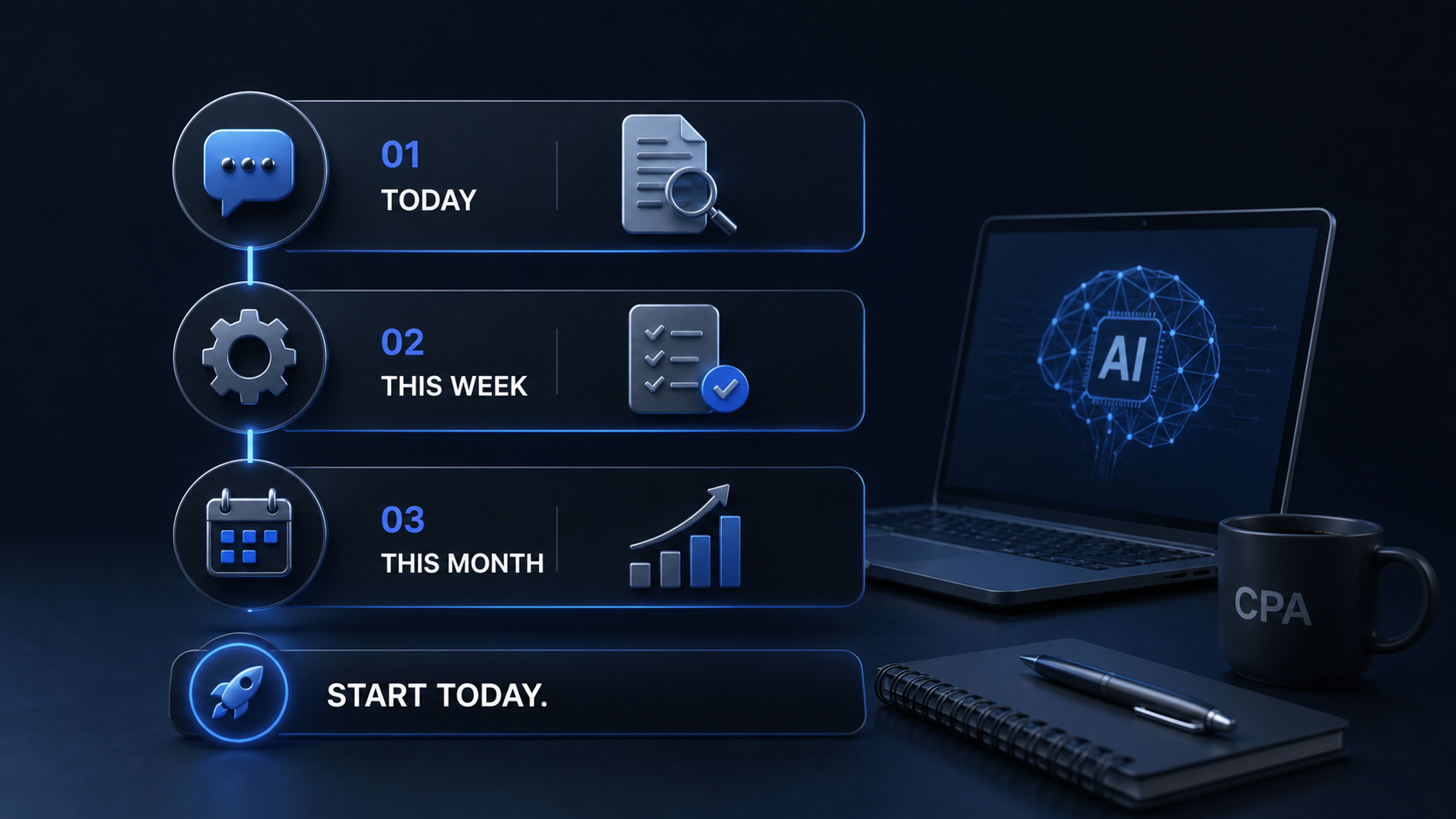
You’ve read the data. Here’s the action part.
Today: Open ChatGPT (or Copilot, or whichever AI tool you already have access to) and try one real work task. Summarize a client document. Draft an email. Ask a tax research question and check the answer against what you know.
This week: Identify one repetitive task in your workflow that AI could handle. Invoice processing, data extraction, and compliance deadline tracking. Check the tools in this article and try one.
This month: Commit to 10 minutes a day of structured AI learning. Coursiv’s AI Mastery pathway was built for this: 53 guides, daily challenges, and built-in AI tools that let you learn by doing. No tech background required. Daily momentum. Start with the 28-Day AI Challenge to build a consistent learning habit. The same pressure you’re facing in accounting is happening across other advisory professions, from financial advisors to customer service teams, so learning together with professionals in your network can strengthen your approach.
You’ve spent decades building expertise that no algorithm replicates. The accountants who thrive by 2030 won’t be the ones who feared AI. They’ll be the ones who made it part of their toolkit.
Start today.
Frequently Asked Questions About AI Replacing Accounting Jobs