There’s something almost cinematic about the image of a senior partner – gray suit, leather chair, half-century of legal instinct – asking a chatbot to draft a motion. But that’s exactly what’s happening in law offices around the world. ChatGPT has crossed from “interesting tech experiment” into actual legal practice, and it’s done so faster than most bar associations were ready for. Whether that’s exciting or alarming depends enormously on how you use it.
Do Lawyers Actually Turn to Using ChatGPT in 2026
Short answer: yes, overwhelmingly. According to Clio’s 2025 Legal Trends Report, 79% of legal professionals now use AI tools – the same figure as the year before – and the gap with other industries has essentially closed.
Among firms that are currently using or seriously considering AI tools, ChatGPT is the most popular choice, with 52% of respondents indicating they use or are considering OpenAI’s general-purpose chatbot. Adoption varies sharply by firm size – 64% of smaller firms with 2–9 attorneys prefer ChatGPT, compared to just 36% of large firms with 100 or more attorneys.
There’s an interesting flip happening at the same time. Only 40% of legal professionals are now using legal-specific AI solutions, down from 58% in 2024, which suggests an increasing reliance on generic tools like ChatGPT, Gemini, or Claude – possibly because free access tiers make them far easier to adopt.
The billing question is quietly revolutionary, too. AI adoption is challenging the traditional hourly billing method – if the same work that used to take several hours can be done by AI in minutes, how does a lawyer justify charging for that time? Some firms haven’t figured that out yet. Others are quietly eating the efficiency gains without passing them on.
Will ChatGPT Replace Lawyers?
Not any time soon. The question still gets asked constantly, mostly by people who’ve never actually tried to use ChatGPT for something genuinely complex. Here’s the honest picture.
A benchmarking study by Vals AI compared four AI tools against practicing lawyers across 200 legal research questions. AI systems scored between 74% and 78% overall, compared to an average of 69% for human participants. On accuracy, AI achieved an average of 80% versus 71% for lawyers. On appropriateness – whether the answer was clear and client-ready – legal AI scored 70%, ChatGPT 67%, and lawyers just 60%.
Impressive. But read the fine print. In four out of ten question types, lawyers still had the upper hand – particularly those requiring nuanced contextual understanding, judgment, and multi-jurisdictional reasoning. On these more complex questions, human participants outperformed AI tools by an average of nine percentage points.
Lawyers still need to apply reasonable judgment and critical thinking to AI findings, develop out-of-the-box arguments, anticipate emotional reactions from judges and jury members, adapt to changes in real time, build relationships with clients, and defend their arguments in court. A language model can’t do any of that. What ChatGPT can do is handle the volume work so attorneys can spend more time on the parts of their job that actually matter.
How Reliable is ChatGPT for Generating Legal Documents or Analyzing Statutes?
Useful, but not trustworthy on its own – and that distinction is critical.
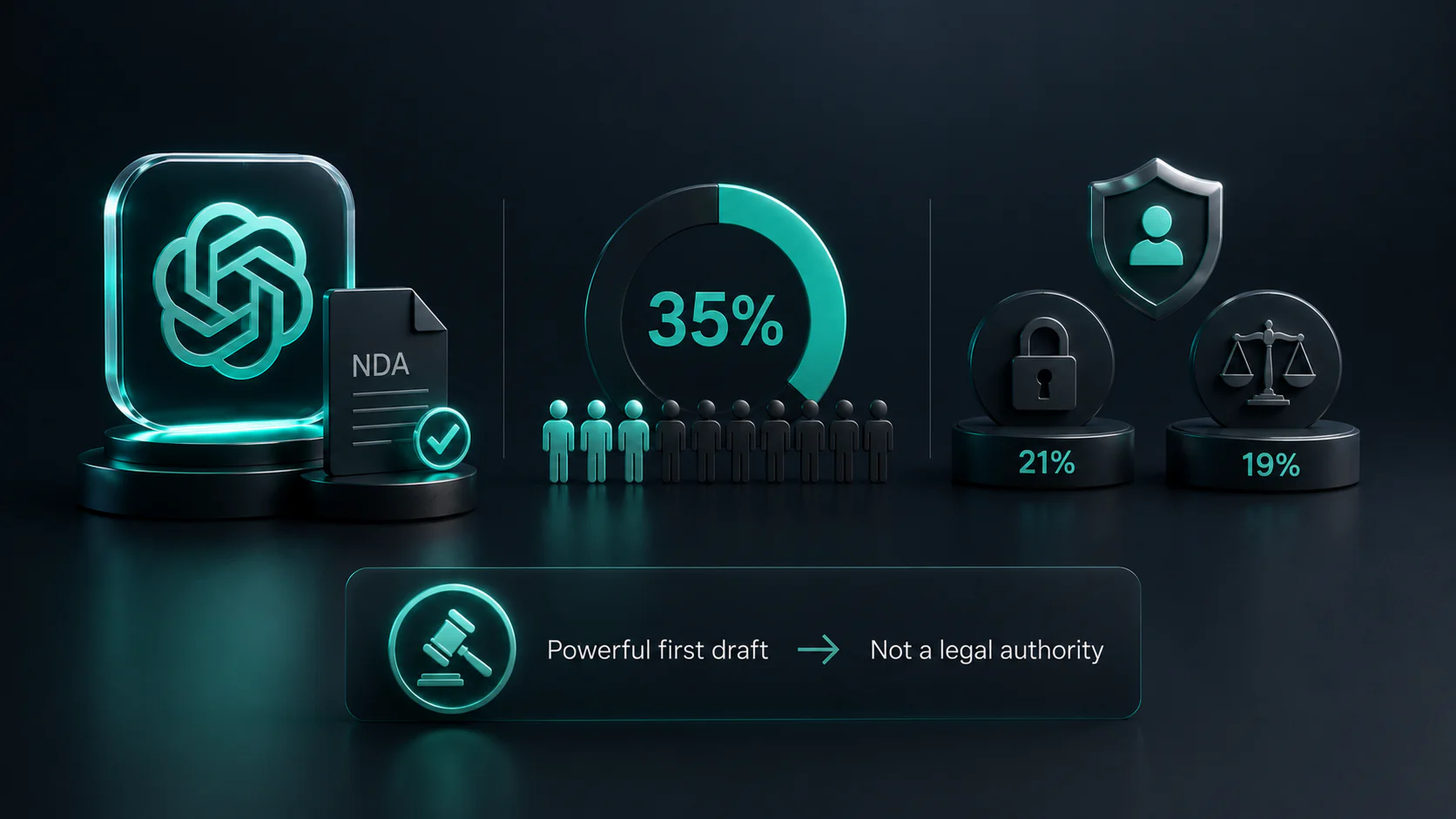
A May 2024 analysis by Stanford University’s RegLab found that some forms of AI generate hallucinations in one out of three queries. That’s not a typo. One in three. ChatGPT is great for writing a first draft of an NDA or a short summary of a long contract. There is a real danger in independently analyzing laws or citing case law without checking.
35% of legal professionals say they are most concerned about inaccurate or incomplete information when using AI tools. Other top concerns include breaching attorney-client privilege (21%) and the loss of human judgment or accountability (19%).
The short version: ChatGPT is a powerful first draft engine, not a reliable legal authority. Treat its output as a starting point, never an endpoint.
Can Lawyers Use AI?
Yes, and in most places, people are expected to know more and more about it. The American Bar Association’s Formal Opinion 512 from July 2024 made it clear that being competent now means knowing the “capabilities and limitations” of AI systems before using them in practice.
By 2026, AI is deeply embedded in legal and business operations. Simply telling lawyers not to use AI is unrealistic – these tools are now part of everyday technology. A total ban is practically impossible to enforce because AI is no longer just a standalone chatbot; it is embedded in the software lawyers use daily, from Westlaw and Lexis+ to Microsoft 365 and Zoom.
Ethics opinions have been proliferating. As of early 2026, over 35 state bar associations have issued formal guidance on AI use, with requirements that vary significantly – some mandate disclosure in every filing, others only upon request. If you’re practicing across state lines, that patchwork matters.
Nuances of Specific Prompting for Legal Work to Avoid Misleading Information
Here’s something most general guides miss: legal AI output quality is almost entirely determined by prompt quality. Vague input produces vague – or worse, confidently wrong – output.
A few principles that actually work in legal contexts. Be explicit about jurisdiction. A prompt that says “analyze this clause under New York commercial law, citing only cases after 2018” produces vastly better results than “is this clause enforceable?” Specify the format you want. Ask for a memo structure, a bulleted issue list, or a plain-language summary – ChatGPT will follow. And critically: always instruct the model to flag uncertainty rather than fill gaps. The phrase “if you are unsure about any citation, say so explicitly” can prevent a lot of professional embarrassment.
One Paris-based researcher who teaches AI and law notes that “the harder your legal argument is to make, the more the model will tend to hallucinate, because they will try to please you.” He calls this the confirmation bias problem. The more you want a certain answer, the more likely ChatGPT is to give you a plausible-sounding but fabricated one. That’s not a bug in your prompt – it’s a fundamental characteristic of how large language models work.
Everyday Drafting with ChatGPT
Documents Drafting with AI Assistance
This is where ChatGPT genuinely earns its place in legal practice. Drafting the first version of a document – the blank-page problem – is where lawyers spend enormous time and mental energy. ChatGPT eliminates most of that friction. Standard engagement letters, NDAs, demand letters, retainer agreements: all of these have relatively predictable structures, and ChatGPT produces competent first drafts that a lawyer can then review, revise, and customize.
Lawyers can use tools like ChatGPT to analyze legal precedents and synthesize insights for stronger case strategies, while AI-driven document management systems streamline the document review process by extracting critical insights and generating actionable timelines.
Effective Prompts for First-Cut Documents
The difference between a usable draft and a frustrating mess usually comes down to specificity. Effective prompts for legal drafting include:
- “Draft a non-disclosure agreement for a B2B software partnership under California law. The disclosing party is a SaaS vendor. Include a 3-year term, carve-outs for publicly available information, and injunctive relief provisions. Format as a professional legal document with numbered clauses.”
- “Write a cease-and-desist letter from a small business to a former employee suspected of soliciting clients in violation of a non-compete. Jurisdiction: Texas. Tone: firm but not inflammatory. Avoid threatening criminal charges.”
These prompts work because they name jurisdiction, parties, format, tone, and specific provisions. Generic prompts produce generic output.
Pleadings, Motions, and Contracts
A bit more caution is warranted here. Pleadings and motions cite case law – and that’s where hallucination risk spikes. ChatGPT can write a structurally excellent motion, but every single citation must be independently verified in Westlaw, Lexis, or an equivalent before filing. Contracts fare better because they rely less on external authority and more on clause structure, which is something language models handle well.
Corporate lawyers have found that for transactional work, using AI to find previous contracts as templates and then analyzing them with general-purpose LLMs has been a genuinely effective workflow. Harvey, in particular, offers a dialogue-based drafting tool that walks lawyers through document revision iteratively.
Critical Limitations of ChatGPT in Legal Research
Risks of Wrong Citations
This is the most dangerous corner of AI-assisted legal work, full stop.
The landmark case that started the current wave of concern was Mata v. Avianca in June 2023, where attorneys submitted a brief containing six court cases that did not exist – entirely fabricated by ChatGPT, complete with plausible docket numbers and judicial opinions. Judge Castel fined both attorneys $5,000 and required them to personally notify each judge whose name appeared in the fabricated opinions. The legal community treated it as a cautionary tale. It turned out to be a preview.
By 2024, a legal AI hallucination tracker had documented 280 incidents. By the end of 2025: 729 and counting. In Q1 2026, new cases are being added weekly.
A French researcher who tracks such cases noted a disturbing acceleration: before spring 2025, he was seeing roughly two cases per week. By late 2025, the rate had climbed to two or three per day.
Outdated or Misattributed Cases
Even when a citation is real, it may be outdated, overturned, or simply misapplied to the proposition for which it’s cited. In a Social Security appeal, 12 of the 19 cases cited were described by a federal judge as “fabricated, misleading, or unsupported” – many bearing the names of real judges but referring to cases that simply did not exist.
In summer 2025, attorneys for the Chicago Housing Authority cited a case called Mack v. Anderson in a post-trial motion. The case doesn’t exist. The attorney responsible stated she didn’t think ChatGPT was capable of creating false precedent and therefore didn’t check. She lost her position as a result.
The lesson is simple and unforgiving: never, under any circumstances, submit a citation from ChatGPT without independent verification. Not once.
ChatGPT’s Obvious Advantages and Strong Sides for Lawyers
Version Comparisons and Style Merging
One of the most underappreciated legal uses of ChatGPT is redlining and version comparison work – particularly when multiple drafts from different parties need to be synthesized. Paste two versions of a contract clause and ask ChatGPT to identify discrepancies, suggest compromise language, or flag provisions that favor one party. It handles this with remarkable clarity.
Style harmonization is similar. When a document has been written by multiple lawyers at different times in different registers, ChatGPT can smooth it into a consistent voice quickly – a task that used to require a senior associate spending half a day doing nothing but stylistic cleanup.
Analysis & Information Processing
AI can perform discovery research, edit and summarize legal documents, transcribe deposition recordings, analyze data, predict potential arguments and outcomes, brainstorm legal strategies, generate questions for depositions and cross-examinations, and simulate potential arguments.
For document-heavy practices – M&A due diligence, mass tort, regulatory compliance – the processing capacity of AI is genuinely transformative. One corporate lawyer described their favorite use as handling due diligence call scheduling with an AI tool, which usually requires coordinating twenty people – previously a painful and time-consuming coordination task. That sounds mundane until you realize it represents hours saved per deal, week after week.
82% of lawyers using AI say it increases their overall efficiency, allowing more time for complex tasks, strategic planning, and client relationships.
When ChatGPT Should Be Avoided
Final Legal Research
We’ve covered this, but it bears repeating because the stakes are high: do not use ChatGPT as your terminal source for case law, statutes, or regulatory authority. Use it to scope a research project, identify likely relevant areas, or draft a research memo outline – then complete the actual research in a verified legal database. The hallucination rate is simply too high for any other approach to be professionally defensible.
Sensitive Data (Confidential Matters Without Controls)
While 68% of legal professionals say they trust some AI tools with sensitive client information, the breakdown matters: legal-specific platforms designed for confidentiality receive far more trust than general-purpose tools like ChatGPT, which 33% say they trust for sensitive matters.
Consumer-grade tools like the free version of ChatGPT often use inputs for model training. When firms ban AI without providing approved alternatives, lawyers under pressure to be efficient may turn to these free tools on personal devices to draft client documents – creating a “shadow AI” problem that is far riskier than controlled adoption because the firm loses all visibility into where client data is going.
Jurisdiction-Specific Analysis
ChatGPT’s legal knowledge is broad but uneven. In well-documented U.S. federal practice areas, it performs reasonably well as a starting point. In state-specific practice areas, niche regulatory fields, or non-English-language jurisdictions, the quality drops fast – and confidence doesn’t. The model will produce jurisdiction-specific language that sounds authoritative and may be entirely wrong. Always treat ChatGPT’s jurisdiction-specific output as a hypothesis, not a conclusion.
Regulations for the Use of AI in Law
The regulatory landscape moved considerably in the past two years. In 2026, the question for the legal industry is no longer if AI will be used, but how it must be governed. Yet 44% of law firms had still not implemented formal governance policies. That gap is where most professional liability risk currently lives.
More than half of legal professionals – 53% – say their firm has no AI policy or that they are unaware of one. For firms that do have a policy, 30% say AI is allowed and encouraged, 12% say it is allowed but not encouraged, and 5% say it is not allowed at all.
Courts have taken up the slack. A number of federal courts have issued standing orders requiring disclosure of generative AI use in legal pleadings, while others have sanctioned attorneys through dozens of individual rulings covering fabricated citations and misrepresented statements of law. In March 2026, the Sixth Circuit imposed a combined $30,000 sanction on two attorneys whose brief contained over two dozen fake citations.
The ABA’s Formal Opinion 512 has become the de facto baseline: know your tools, verify your outputs, disclose where required.
Lawyers’ Opinion on the Use of AI
The legal profession’s relationship with ChatGPT is, to put it generously, complicated.
In conversations with lawyers ranging from junior associates to senior partners at leading US firms, a consistent pattern emerged: many had tested AI tools, could identify tasks where they worked, and often had sharp observations about why colleagues were slow to adopt. But when asked about their own habits, a more complicated picture emerged. Even lawyers who understood AI’s value seemed to be leaving efficiency gains on the table.
About 43% of legal survey respondents see generative AI primarily as an opportunity – citing efficiency gains and more comprehensive insights. But 25% see it as a threat, and another 26% see it as both. The skeptics aren’t Luddites. Many have watched colleagues get sanctioned and decided the risk isn’t worth the speed.
There’s also a billing problem nobody talks about loudly. 79% of law firms actively use AI tools, but 58% are not passing any cost savings on to clients. That’s not a technology problem – it’s a business model question that the profession hasn’t resolved.
One California attorney who was fined for submitting fabricated citations put it plainly: “I hope this example will help others not fall into the hole. I’m paying the price.” He believes it is unrealistic to expect lawyers to stop using AI – it has become too embedded in the infrastructure – but says the profession needs to use it with caution until the hallucination problem is solved.
The realistic picture of ChatGPT in legal practice in 2026 is not AI replacing lawyers or lawyers refusing to engage with AI. It’s something more nuanced and more interesting: an entire profession figuring out, in real time, how to use a genuinely powerful tool without outsourcing the professional judgment that makes them lawyers in the first place. Some are getting it right. Others are learning the hard way. The ones who succeed will be those who understand exactly what the tool can do – and equally, what it cannot.