Let’s be honest: HR has never been a simple job. You’re simultaneously a recruiter, a mediator, a compliance officer, a therapist, and somehow also the person who organizes the office birthday cake. The paperwork alone could bury a small village.
So when ChatGPT started making real waves in professional environments, HR teams were among the first to quietly experiment – and among the most surprised by the results. Not because the tool is magic, but because so much of what HR does every day involves writing, structuring, and communicating. And that’s exactly where AI earns its keep.
Here’s what’s actually happening in 2026.
How Do HR Teams Use ChatGPT in 2026?
The short answer: constantly, and for more things than most people outside HR would guess.
The longer answer involves a shift in how HR professionals think about their own time. According to a 2024 SHRM report, HR practitioners spend roughly 57% of their time on administrative tasks – things like drafting communications, updating templates, sorting through applications, and preparing documentation. That’s more than half the workday spent on work that, technically, doesn’t require a decade of human resources expertise.
ChatGPT doesn’t replace that expertise. But it handles the scaffolding – the first drafts, the structural outlines, the formatted summaries – so HR specialists can spend more time on the things that actually require human judgment. Difficult conversations. Culture-building. Retention strategy. The stuff that a language model genuinely cannot do.
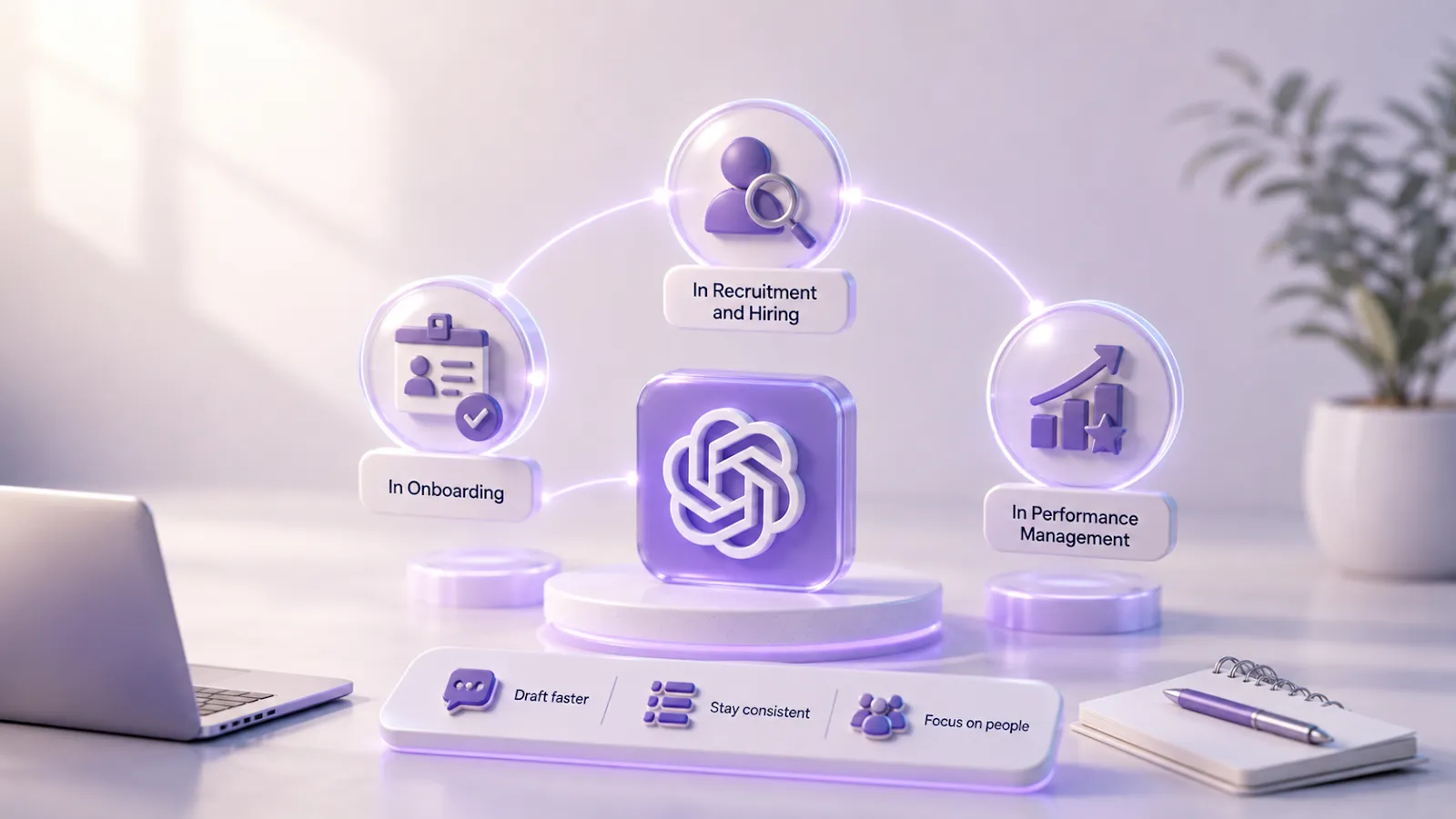
In practice, in 2026 ChatGPT for HR is used across four main areas: recruitment and hiring, onboarding, performance management, and internal communication. Each one has its own quirks, and each one comes with real caveats – which we’ll get to.
Real HR Use Cases of ChatGPT
In Recruitment and Hiring
This is where most HR teams start, and it makes sense. Recruitment is intensely writing-heavy. Job descriptions, outreach emails, interview question banks, rejection letters, offer letter templates – the volume is significant, and the quality has to be consistent.
ChatGPT accelerates all of it. An HR specialist can go from a hiring manager’s rough notes (“we need someone for ops, mid-level, knows Excel, good with people”) to a polished, inclusive job description in under five minutes. That same specialist can then generate a set of structured interview questions tailored to the role, calibrated by seniority level, and formatted for a panel interview – before lunch.
There’s also a subtler use: bias checking. HR professionals are increasingly using ChatGPT to review their own job postings for gendered language or unnecessarily exclusionary requirements. Prompts like “Review this job description for potentially biased language and suggest more inclusive alternatives” have become genuinely common in recruiting workflows.
What ChatGPT cannot do here: evaluate actual candidates. It has no access to application data, no ability to assess cultural fit, and no business making hiring recommendations. That boundary matters enormously.
In Onboarding
Onboarding is one of those processes that every company knows matters – research from the Brandon Hall Group found that strong onboarding improves new hire retention by 82% – and yet it’s frequently underdeveloped because building it properly takes enormous time.
ChatGPT helps HR teams close that gap. It can draft multi-week onboarding schedules, write welcome emails, create FAQ documents for new hires, generate role-specific checklists, and produce first-day agendas in formats that can be immediately adapted and deployed.
One particularly practical use: generating onboarding content in multiple tones or for different audiences. The welcome message for a new engineer looks different from the one for a new sales rep. ChatGPT can produce both versions in parallel, starting from a single brief.
In Performance Management
This one surprises people. Performance management feels deeply human – and it is. But the documentation layer around it? That’s where HR teams lose hours.
Writing performance review frameworks, calibrating rating rubrics, drafting feedback templates, creating improvement plan structures – all of it can be scaffolded with ChatGPT. HR professionals are using prompts like “Create a 90-day performance improvement plan template for a mid-level project manager who is struggling with deadline management” and then customizing the output for the specific employee and situation.
The key word is template. ChatGPT gives you the structure. The actual performance conversation, the nuanced feedback, the human judgment about someone’s trajectory in an organization – that stays with the HR professional and the manager. Always.
Guiding Examples
Here are a few real-world prompt patterns that HR teams are actively using:
- Recruitment: “Write a job description for a Senior UX Designer at a fintech startup. The role is remote-first, requires 5+ years of experience, and the team values directness and low-meeting culture. Avoid gendered language.”
- Onboarding: “Draft a 3-email onboarding sequence for a new marketing hire. Email 1: Day 1 welcome. Email 2: End of Week 1 check-in. Email 3: 30-day milestone. Tone: warm but professional.”
- Performance: “Create a structured feedback template for quarterly reviews that includes sections for achievements, development areas, goals for next quarter, and a manager notes field.”
These aren’t theoretical. They’re the kinds of prompts that shave 2–3 hours off a week for a working HR professional.
What Are the Most Popular ChatGPT Prompts Used by HR Teams?
Job Descriptions
Job descriptions are probably the single most common HR use case for ChatGPT, and for good reason – they’re repetitive, they require careful language, and they directly affect who applies for your open roles.
The most effective prompt structures tend to be specific: include the role level, the company culture signal, must-have vs. nice-to-have requirements, and any style preferences (formal, casual, etc.). Vague prompts produce vague descriptions.
A prompt that works: “Write a job description for a People Operations Manager at a 200-person tech company. The company is hybrid, values transparency, and is Series B funded. The role oversees recruiting, onboarding, and HR ops. Required: 4+ years in HR generalist or ops role. Include a short company culture section at the top.”
What comes out of that prompt still needs a human edit. But it will be 80% of the way there, with proper structure, appropriate language, and a coherent flow.
Interview Preparation
HR teams use ChatGPT both to build interview question banks and to help candidates prepare – though the latter is more common in companies with structured employer branding strategies.
On the HR side, the prompt pattern looks like this: “Generate 10 behavioral interview questions for a Customer Success Manager role. Focus on conflict resolution, client communication under pressure, and cross-functional collaboration. Format each question with a brief note on what competency it’s assessing.”
That last part – the competency tagging – is the difference between a useful output and a generic one. It makes the question bank directly usable in a structured interview process.
Onboarding Emails
Onboarding email sequences are underrated. A new hire’s first week sets the emotional tone for months of employment. Yet most companies have onboarding emails that read like they were written in 2011 and never updated.
ChatGPT can help modernize these quickly. The prompt structure that works best is sequential and specific: define the email’s purpose, the recipient’s situation (role, seniority, remote vs. in-office), the tone, and any specific information to include.
What HR professionals then do – and this is the important part – is layer in the actual human element. The name of their direct manager. The specific tools they’ll use. The cultural norms that ChatGPT couldn’t know. The AI produces the shell; the HR team fills it with truth.
What ChatGPT Should Not Be Used for in HR Work
This section exists because the enthusiasm around AI tools sometimes outpaces the judgment around when not to use them. And in HR, the stakes of getting that wrong are genuinely high.
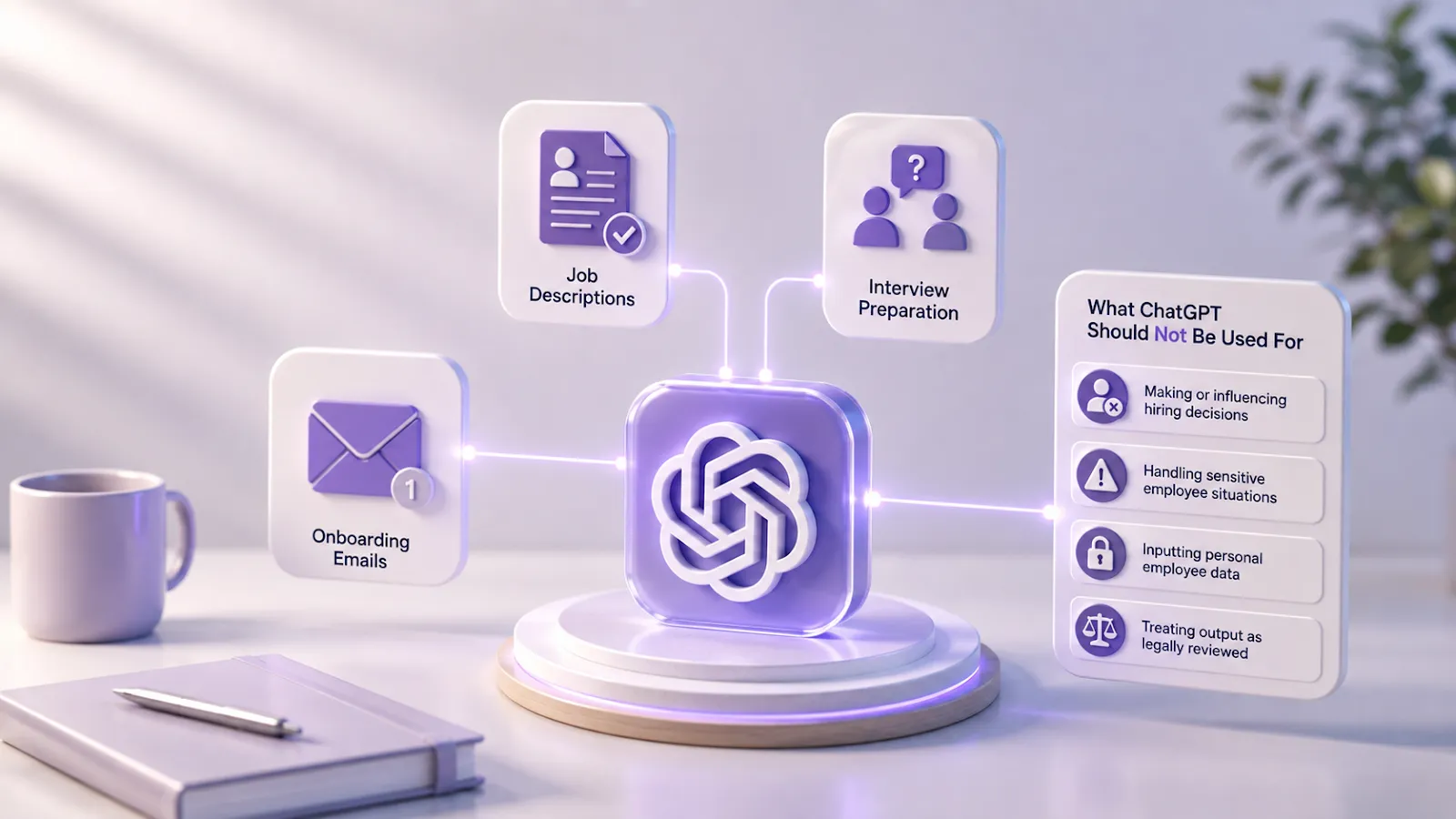
Do not use ChatGPT to make or influence hiring decisions. Not even to screen resumes, not even to rank candidates, not even to summarize applications for a hiring manager. AI systems – including ChatGPT – can reflect and amplify biases present in training data. The EEOC in the US has been increasingly clear that employers are responsible for AI-driven discrimination even when they didn’t build the tool themselves. This is not a theoretical risk.
Do not use it to handle sensitive employee situations. Terminations, disciplinary actions, harassment complaints, mental health disclosures – these require human judgment, legal awareness, and emotional intelligence that no language model has. If you’re using ChatGPT to draft a termination letter, fine. If you’re using it to decide who gets terminated, that’s a serious problem.
Do not input personal employee data into public ChatGPT interfaces. Names, salaries, performance ratings, medical information – none of this belongs in a chat window that could potentially be used for model training. This is both an ethical issue and, in most jurisdictions, a legal one. GDPR, CCPA, and equivalent regulations apply.
Do not treat its output as legally reviewed. ChatGPT can draft an employment contract template. It cannot tell you whether that contract complies with the employment law in your specific jurisdiction. Always have legal counsel review anything with compliance implications.
The framing that helps: ChatGPT is a very capable first-draft writer. It is not a decision-maker, a legal advisor, or a substitute for human accountability.
How ChatGPT Helps HR Specialists in Their Daily Workflows
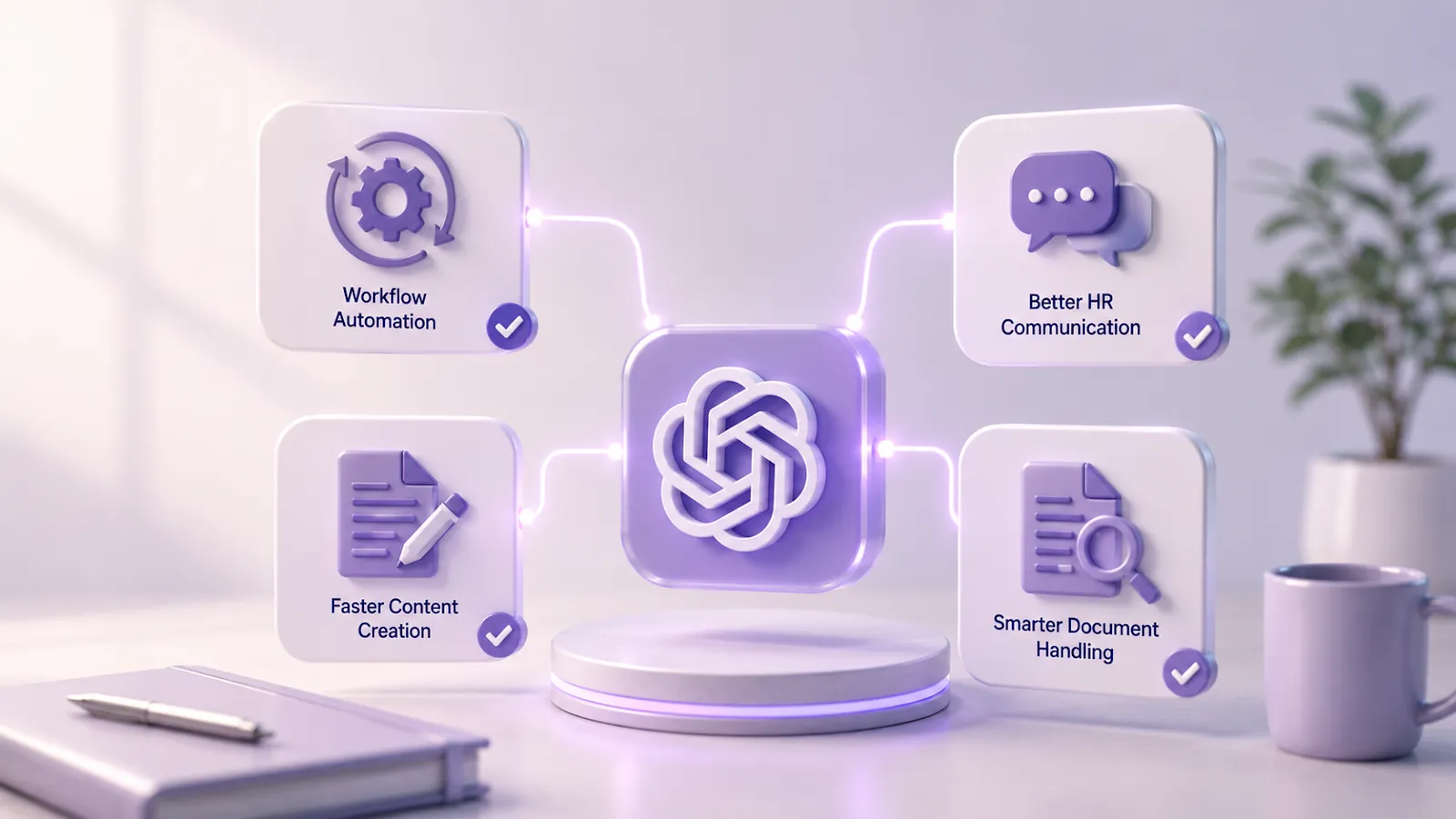
Workflow Automation
It is less robotic and more about eliminating friction out of repetitive processes. HR teams receive the same kind of requests on a regular basis: policy clarification requests, leave request confirmations, interview scheduling requests, and benefits enrollment requests.
Most of these responses can be written or generated automatically, with a human in the loop to review them, with ChatGPT built into internal applications (Slack bots and HRIS platforms and intranet systems). The HR professional is not taken out of the process; they are simply taken to the higher level, where he/she is reviewing and approving, instead of writing each time.
Some HR platforms in 2026 have native ChatGPT integrations. Others use API connections. Either way, the underlying principle is the same: reduce the time between a routine request and a useful response.
Better HR Communication
HR communication has a reputation for being dense, jargon-heavy, and – let’s be direct – often unread. Policy updates that no one absorbs. Benefits guides that get ignored. Survey invitations that feel like homework.
ChatGPT helps HR teams write more human communications. Not by removing the substance, but by adjusting the register. A prompt like “Rewrite this benefits enrollment reminder in a warmer, more conversational tone. Keep all the key dates and links.” produces something people might actually read.
This matters more than it sounds. Internal communication effectiveness directly affects things like benefits utilization rates, survey participation, and employee perception of HR as a resource rather than an administrative obstacle.
Faster Content Creation
HR teams produce a surprising volume of content: policy documents, training materials, manager guides, culture decks, newsletter sections, job posting copy. Most of it is written by people whose primary job is not writing.
ChatGPT compresses the production time significantly. A manager’s guide to running effective one-on-ones that might have taken an HR specialist three days to research and write can now be drafted in an afternoon and refined over a few hours. The specialist still provides the expertise and does the editing – but the blank page problem disappears.
This also helps smaller HR teams (or solo HR professionals at growing companies) punch above their weight. A one-person HR function can produce onboarding materials that look and read like they came from a 10-person team.
Smarter Document Handling
One of the less glamorous but genuinely useful applications: using ChatGPT to summarize, restructure, or extract information from long documents.
HR teams regularly work with lengthy legal documents, survey data exports, audit reports, and policy manuals. ChatGPT can summarize a 40-page employee handbook into a one-page quick reference. It can take raw survey responses and identify thematic patterns (with important caveats about data privacy, as noted above). It can restructure an outdated policy document into a cleaner, more navigable format.
This isn’t replacing analysis – it’s reducing the time it takes to make documents useful.
Course Advantages for HR Specialists
Knowing that ChatGPT exists and actually using it well in an HR context are two very different things. The gap between “I’ve tried it” and “I integrate it fluently into my daily work” is real, and it’s where a lot of the professional value gets left on the table.
This is exactly what Coursiv’s HR-focused AI training addresses.
The courses are built for working HR professionals – not tech enthusiasts, not AI researchers, but people who need to write better job descriptions by Thursday and build an onboarding sequence that doesn’t embarrass the company. The curriculum is practical by design: prompt engineering for HR-specific tasks, workflow integration without IT dependency, ethical boundaries and compliance awareness, and hands-on output review so learners can tell the difference between a good AI-generated draft and one that needs significant work.
What makes Coursiv’s approach different from a generic ChatGPT tutorial is context. General AI courses teach you how the tool works. Coursiv courses teach you how the tool works for HR – with the specific use cases, the specific risks, and the specific standards that the field requires.
HR professionals who complete the training consistently report the same shift: they stop thinking of ChatGPT as a curiosity or a shortcut and start treating it as a genuine part of their professional toolkit. One with clear capabilities, clear limits, and a learning curve that’s worth climbing.
For HR teams navigating 2026 – with its evolving AI regulations, tightening talent markets, and increasing pressure to do more with leaner teams – that kind of fluency isn’t a nice-to-have. It’s increasingly a baseline expectation.
The technology is moving fast. The professionals who understand how to use it responsibly, within the specific ethical and legal constraints of HR work, are the ones who will define what the function looks like in the next five years.
That process starts with practical knowledge. And practical knowledge, in this case, has a very specific address.