AI is unlikely to replace most teachers completely by 2030, but it will change many teaching tasks significantly. Lesson planning, quiz creation, grading support, feedback drafts, tutoring practice, and admin work will become more AI-assisted – that’s already happening now. Human teachers will still be needed for classroom management, motivation, emotional support, subject judgment, safeguarding, parent communication, and adapting lessons to real students in real time. Answering the question: Will teachers be replaced by AI? The role won’t disappear. It will shift – and probably faster than most educators expect.
Context note: This article discusses labor-market risk at a high level. Local policy, school funding, student age, subject area, and teacher responsibilities all affect how AI changes a specific role.
For adjacent reading, see ChatGPT for teachers, best AI tools for teachers, and best AI tools for education.
Will AI Replace Teachers?
Not wholesale. But the version of “teacher” that exists in 2026 won’t look the same in 2030.
Here’s the honest answer: AI won’t walk into a classroom and dismiss the teacher. What it will do is automate a significant chunk of the work that currently takes up a teacher’s day – the prep, the marking, the emails, and the resource-building. According to the U.S. Bureau of Labor Statistics, there were roughly 3.2 million public school teachers in the US alone as of recent data. That’s a massive workforce – and AI doesn’t need to replace most of them to reshape the profession dramatically.
The question isn’t “will AI replace teachers.” The more useful question is, “Which parts of teaching will AI handle, and what does that leave humans to do?”
Some tasks will be automated. Some will be augmented. The teacher role will shift more toward mentoring, judgment, and relationship-building and less toward producing content from scratch.
What Teaching Tasks AI Can Already Help With
This is where things get concrete. AI tools like Khan Academy’s Khanmigo, Google’s suite of education tools, and various LLM-powered platforms are already doing this – not in theory, but in classrooms right now.
Here’s a breakdown of where AI is making real inroads:
| Teaching Task | AI Impact | Replacement Risk | Human Teacher Role |
|---|---|---|---|
| Lesson planning | High – drafts in minutes | Moderate | Adapting to class context |
| Quiz generation | Very high – instant output | High | Reviewing accuracy, adjusting difficulty |
| Rubric drafts | High | Moderate | Final judgment, fairness check |
| Feedback drafts | High | Moderate | Adding personal context |
| Tutoring practice | High (1-on-1 AI tutors) | Moderate–High | Motivation, emotional check-ins |
| Admin emails | Very high | High | Tone, relationship management |
| Grading support | High | Moderate | Final call on edge cases |
| Content adaptation | High | Moderate | Knowing individual students |
| Classroom management | Very low | Very low | Irreplaceable human presence |
| Student wellbeing | Very low | Negligible | Emotional attunement, safeguarding |
The pattern is clear: anything that’s repetitive, text-based, or template-driven is fair game for AI. Anything that requires reading a room – literally or figuratively – is not.
What AI Cannot Replace in Teaching
Let’s not bury this.
A 14-year-old who’s struggling isn’t just struggling with algebra. They might be dealing with something at home, feeling invisible, or just having a terrible Tuesday. An AI tool can detect that a student answered five questions wrong. It cannot notice that the same student has been quieter than usual for two weeks.
That gap is enormous. And it’s not closing by 2030.
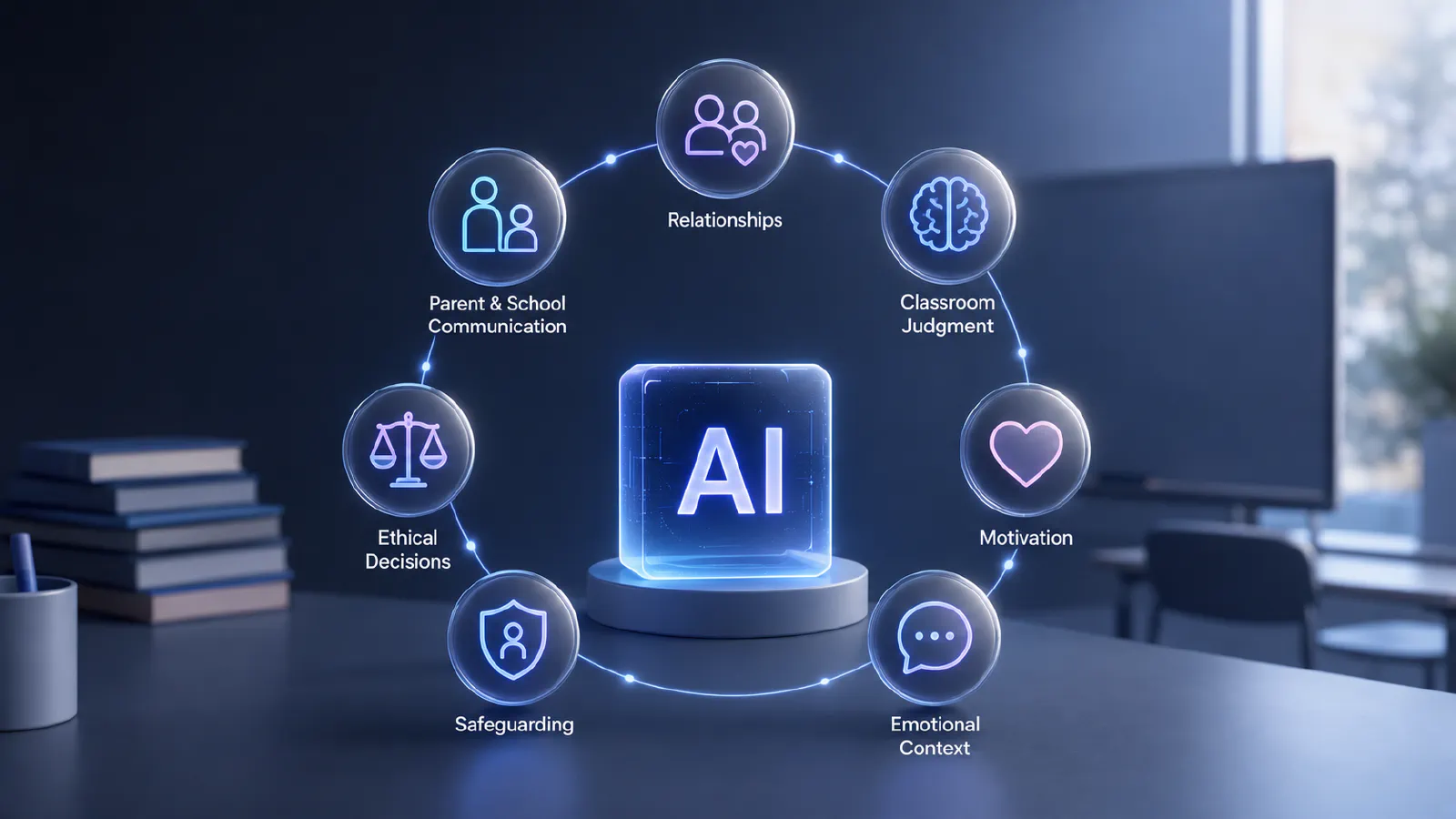
Here’s what remains firmly in human territory:
- Relationships – Students perform better for teachers they trust. That trust is built through years of human interaction, not chatbot sessions.
- Classroom judgment – Deciding in real time whether a disruption is a discipline issue or a cry for help requires experience and intuition that no model currently has.
- Motivation – “I believe in you” lands differently from a person who actually knows you.
- Emotional context – Mental health, family situations, trauma. Teachers navigate these situations constantly, often without explicit training.
- Safeguarding – Legal, ethical, institutional. No AI is making decisions about child protection.
- Ethical decisions – Grading disputes, academic integrity questions, accommodations for students with disabilities. These require human accountability.
- Parent and school communication – Especially when things go wrong. Nobody wants to hear difficult news from a chatbot.
Which Teachers Are Most Affected by AI?
Not all teachers face the same exposure. The impact depends heavily on what type of teaching you do.
Most affected:
- Online course creators – Content production is already highly automatable. Platforms are starting to use AI to generate first drafts of course materials.
- Test prep instructors – Drilling students with practice questions is exactly what AI tutors excel at. Companies like Duolingo have already replaced significant portions of their content team with AI-generated material.
- Teaching assistants – Especially those doing routine grading, answering repeat questions, or managing LMS platforms.
- Curriculum designers – First-draft generation, scope and sequence planning, resource building – all ripe for AI acceleration.
Less affected (but not untouched):
- K–12 classroom teachers – Core role stays human, but prep and admin tasks will shrink.
- College instructors – Lecturing and deep discussion still need human instructors. Grading and office hour-style support? AI will increasingly handle both.
- Special education teachers – Relationship and individualization are so central here that AI augments rather than replaces.
If you’re also curious how this plays out in other professions, it’s worth reading about will AI replace programmers, will AI replace doctors, and will AI replace lawyers – the patterns are similar: augmentation before replacement, and human judgment staying relevant longest.
How AI Will Change Classrooms by 2030
Four years isn’t a long time. But in AI terms, it’s multiple generations of capability.
Here’s what classrooms will likely look like by 2030 – based on current trajectories, not speculation:
More personalized practice. AI tutoring tools will handle a significant portion of individual drill-and-practice work. Students who need extra repetition on a concept will get it without waiting for teacher availability. This is arguably good.
Faster planning cycles. A lesson plan that takes 2 hours to build from scratch might take 20 minutes with AI assistance. Teachers who adopt these tools will have more time for the human parts of their job.
AI-generated materials everywhere. Worksheets, practice sets, reading comprehension passages – most of these resources will be AI-generated by 2030, reviewed and selected by teachers rather than built by them.
AI literacy as a core requirement. Schools and districts will need policies on AI use. Students and teachers will both need to understand what these tools can and can’t do – and that’s a new skill set for everyone.
More policy and privacy challenges. Student data, parental consent, algorithmic bias, and academic integrity – these are real problems that schools are only beginning to grapple with. Expect more regulation, not less.
Skills Teachers Should Build Now
This isn’t about becoming a tech expert. It’s about being a teacher who can use new tools without being blindsided by them.
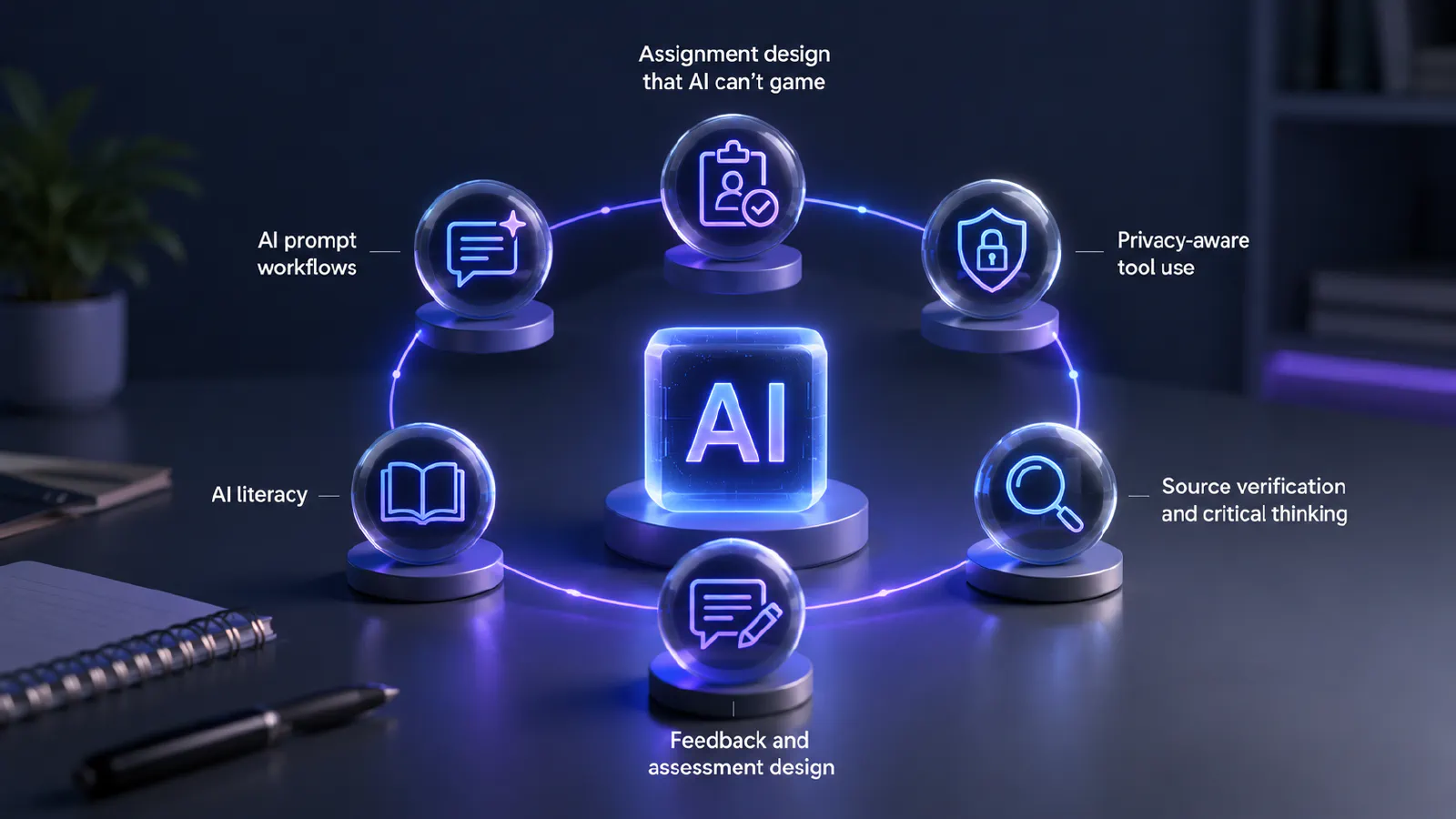
The most useful things to develop:
- AI prompt workflows – Knowing how to get useful output from tools like ChatGPT, Gemini, or education-specific platforms. See our guides on ChatGPT for teachers and the best AI tools for teachers as starting points.
- Assignment design that AI can’t game – Designing assessments around discussion, demonstration, and original thinking – not just written outputs that ChatGPT can complete.
- AI literacy – Understanding what AI gets wrong. Hallucinations, bias, outdated information. Teachers need to model healthy skepticism for students.
- Privacy-aware tool use – Knowing which tools your district has approved for FERPA/COPPA-related workflows, what data is being collected, and what’s appropriate to share with an AI system.
- Feedback and assessment design – If AI is generating first-draft feedback, the teacher’s job becomes editing and personalizing it. That’s a different skill than writing feedback from scratch.
- Source verification and critical thinking – Students will use AI constantly. Teachers who can teach students to evaluate AI output will be genuinely valuable.
How Teachers Can Use AI Without Being Replaced by It
The framing of “replaced vs. not replaced” is actually the wrong one. More useful question: how do you use these tools in a way that makes you better at your job?
Practically speaking:
Use AI to generate lesson plan drafts – then edit them to fit your actual students. You know them. The AI doesn’t.
Use AI to create differentiated examples – if you’re teaching fractions, ask an AI to generate five versions of the same problem at different difficulty levels. Takes 30 seconds instead of 20 minutes.
Use AI to draft rubrics – then review them carefully. AI rubrics tend to be generic. Your job is to make them specific to the assignment and your students.
Use AI to build quiz banks – but always review for accuracy, difficulty calibration, and whether the questions actually test what you want to test.
Use AI for admin support – routine parent emails, progress report templates, and meeting agendas. Free up that time for actual teaching.
What AI can’t do: decide when a student needs more challenge, when they need more support, or when something’s wrong that has nothing to do with the curriculum.
That last part? That’s still yours.
You can find more on this in our roundup of the best AI tools for education, as well as resources specifically for ChatGPT for students and Gemini for students, if you’re thinking about how your students are already using these tools.
Final Verdict
AI will replace repetitive tasks in teaching. Not teachers.
By 2030, the job will look different – more time spent on relationship-building and judgment, less time on content production and grading mechanics. Teachers who learn to use AI tools effectively will likely gain an advantage: more capacity, more time, and more ability to focus on what actually matters in a classroom.
Schools still need human educators. The evidence for this argument isn’t just philosophical – it’s developmental. Children need trusted adults. Adolescents need mentors. None of that changes because a chatbot can write a lesson plan.
The risk isn’t AI replacing teachers. The risk is that teachers who don’t engage with these tools get left behind by those who do – and that schools use AI as an excuse to underfund teaching rather than as a way to make teachers more effective.
Use it well, and keep investing in the human parts of teaching that matter most. And check our broader look at what jobs AI will replace by 2030 if you want to see how teaching compares to other professions.
FAQ