When you see headlines like “AI writes code,” your first thought might be: does it still make sense to learn programming as a reskilling path?
Last year’s surveys show that about 85 % of developers now use AI coding assistants daily. At the same time, entry‑level developer hiring fell 25 % in 2024, and employment for developers aged 22‑25 dropped nearly 20 %.
Learning to code still matters if you want to work closely with building software, but the way you learn should change. Programming is one of many professions being reshaped by AI — for the full picture, see what jobs AI will replace by 2030.
This article helps you decide whether to invest time and money in learning programming as a non-technical professional.
How AI Is Changing a Programmer’s Work (Not Replacing It)
In discussions about whether AI will replace software engineers in the future, a growing chorus of developers describes AI as an overconfident junior developer or a fast autocomplete tool. It can draft code quickly and provide suggestions, but it still needs context, direction, and review. Here is what AI handles well:
Syntax and boilerplate.
AI can generate a complete CRUD API in seconds, letting teams test ideas without hand-writing repetitive code. GitHub Copilot, Cursor, and similar tools excel at producing syntactically correct code and scaffolding. Generating controllers and models from database schemas is now nearly automatic.
Common patterns and frameworks.
Trained on extensive open-source codebases, AI models can replicate widely used design patterns. Developers use them to translate code between languages, draft documentation, retrieve API examples, and summarize diffs. They are particularly effective in prototyping and refactoring because they apply established conventions rapidly and consistently.
Basic operations and repetitive tasks.
The era of manually typing out repetitive operations is ending. AI generates complete screens and backend logic from database structures, letting engineers focus on business logic instead.
Real-world example: Spotify’s “zero-code” developers
In February 2026, Spotify revealed that some of its best developers haven’t written a line of code since December, thanks to AI. They are now focused on directing AI agents, reviewing output, making architectural decisions, and ensuring the code solves relevant business problems.
Which Programming Skills Matter Now?
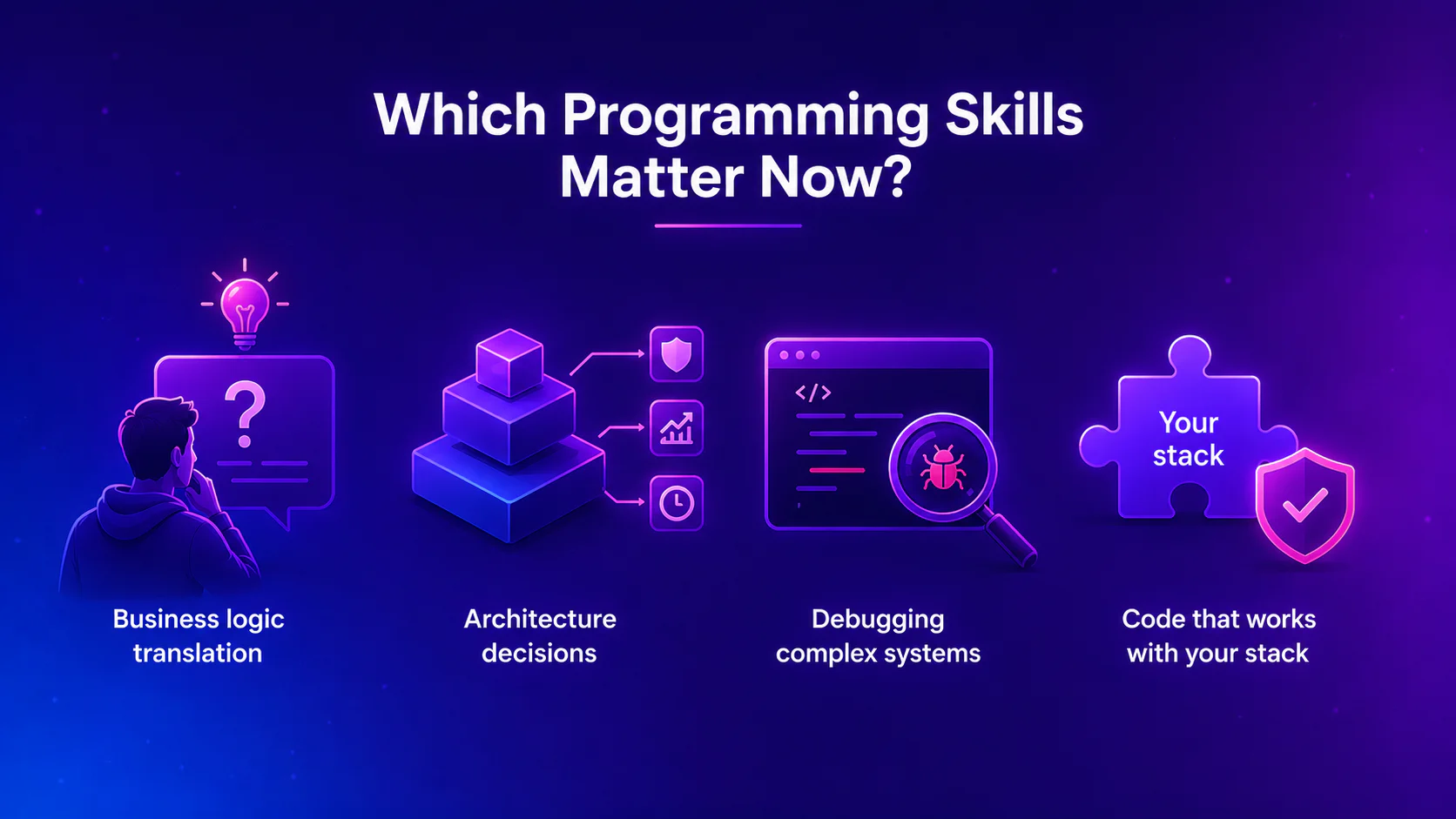
While AI automates some tasks, other skills become more valuable. The debate isn’t about whether AI will replace developers; it’s about which parts AI handles well and where humans still provide irreplaceable value. Here are the programming skills that matter even more right now.
Business logic translation.
Translating ambiguous requirements into precise specifications is a human domain. Someone still has to decide what the code should do and check whether the AI output aligns with business goals. AI can write the code, but it can’t know if it’s solving the right problem.
Architecture decisions.
Choosing the right architecture involves trade-offs around scalability, reliability, and security that AI cannot fully grasp. Human oversight is needed to connect design choices with business context.
Debugging complex systems.
AI performs well on straightforward problems but fails on tasks requiring experience — like debugging multi-service interactions, interpreting cryptic logs, or reasoning about concurrency issues. Developers still need to trace errors across services and understand how different parts of a system interact.
Code that works with your specific stack.
AI models are trained on public repositories and may not understand your proprietary frameworks or unique infrastructure. After generating code with AI, teams still have to rename functions, adjust parameters, and fix integration issues because AI solutions sometimes drift from project conventions. Unreviewed AI contributions can accumulate technical debt; teams need mandatory code review and quality checks.
Should you still learn to code in 2026?
It makes sense to learn coding if you’re genuinely interested in building complex projects and going deep on the technical side of product development. If you’re mostly motivated by a quick career change and a high salary, you’re better off learning how to use AI within the job you already like or have experience in.
Here’s why: there’s a strong opinion that non-technical folks can have more success with vibe coding than experienced software engineers. A professional at Lovable notes: “People without engineering experience don’t know what’s ‘supposedly hard,’ so they just ask for what they want.” Business Insider profiled four non-technical people who built functional apps: a product designer, a mother, an accountant, and an HR professional, all without traditional coding backgrounds.
If you are in this group, we genuinely recommend the Coursiv 28-Day AI Certificate Program Challenge built for short daily practice – not a long “learn to code” detour. Perfect for busy professionals. For more context on how software engineers and other technical roles are adapting to AI, see our broader analysis of which jobs are most affected.
If you’re in the first group (genuinely interested in technical depth), here’s how learning programming has changed:
Learn adjacent high-value skills.
AI tool usage (Copilot, Cursor, Claude Code), data fundamentals, SQL, APIs, system design, security basics, prompt engineering, and AI agent orchestration. If you’re deciding between AI assistants, our Claude vs ChatGPT comparison covers the key differences for coding workflows. For a deeper dive into best AI tools for coding, see our full comparison, and learn how Microsoft Copilot compares to ChatGPT for code generation.
Focus on problem-solving, not syntax memorization.
Focus on logic, algorithms, debugging strategies, and system design. You need to reason about problems and break them into steps.
Use AI as a learning tool, not a crutch.
Ask AI to explain concepts, offer hints, and validate solutions. Avoid generating code during your learning phase, even if AI delivers good results. Anthropic’s 2026 study shows that when beginners let AI write all the code, they learn less.
Develop “AI-resistant” soft skills.
Communication, requirements gathering, stakeholder management, creativity, critical thinking, ability to learn, and business context understanding.
The tools themselves matter too. When choosing between coding assistants, you’ll want to understand which offers the best performance for your tech stack. Check out the best AI chatbots in 2026 for a side-by-side breakdown of popular options for developers.
Frequently Asked Questions About AI Replacing Programming Jobs
