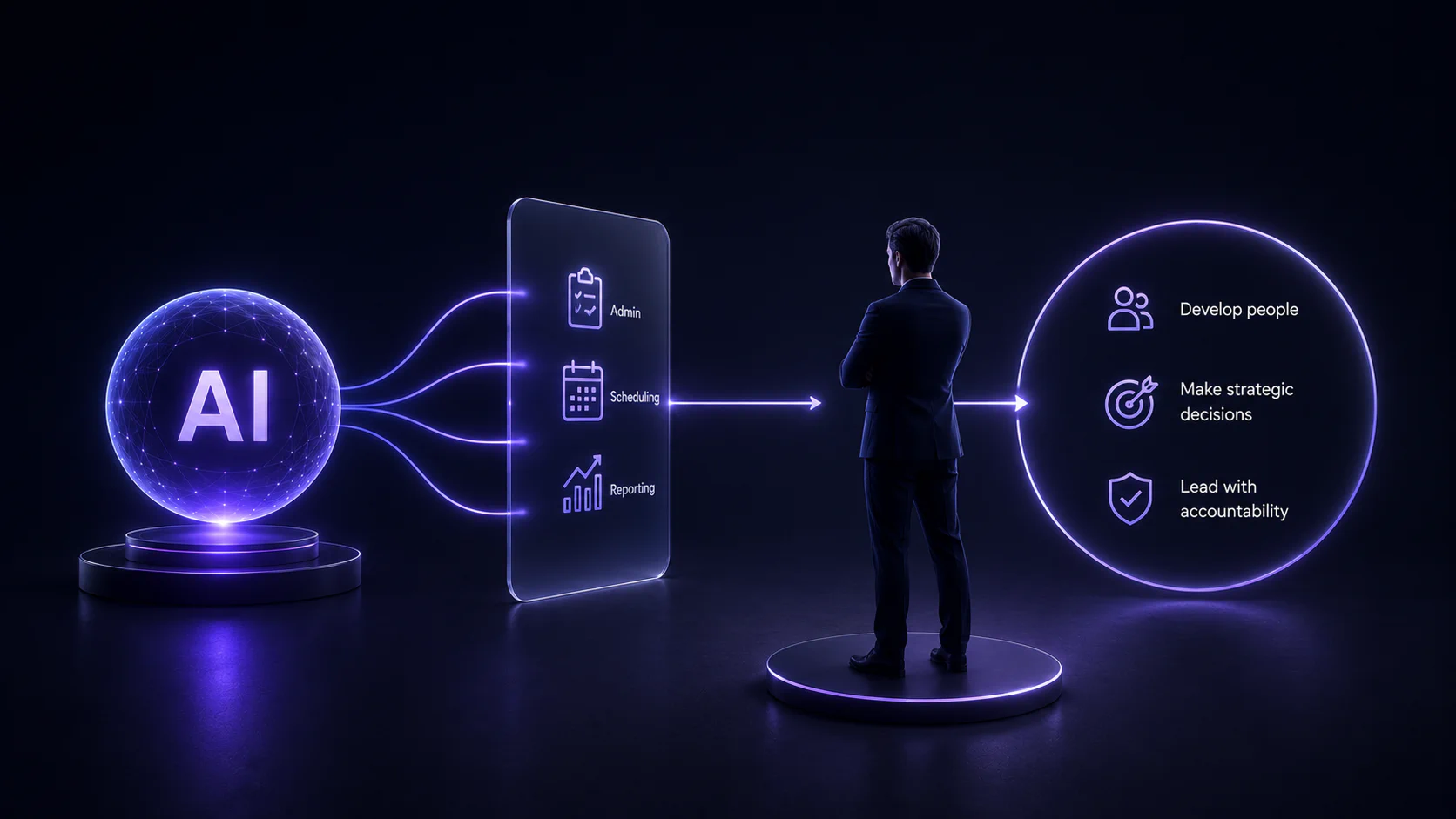
Managers will not disappear by 2030, but many management tasks will be automated or compressed. AI is already good at reporting, meeting summaries, scheduling, KPI analysis, forecasting, task routing, and first-draft communication.
Quick answer: AI will replace parts of management, not managers as a whole. Middle-management roles that are mostly reporting, coordination, and status tracking are the most exposed. Managers who lead people, resolve conflict, make tradeoffs, coach teams, own outcomes, and use AI to improve decisions become more valuable.
Management tasks AI will automate first
| Management task | AI impact by 2030 | Human role that remains |
|---|---|---|
| Meeting notes and action items | High | Decide priorities and follow through |
| KPI dashboards and reports | High | Interpret what the numbers mean |
| Scheduling and workload balancing | High | Handle exceptions and team context |
| Performance review drafts | Medium | Coach, calibrate, and own fairness |
| Hiring screen summaries | Medium | Interview, assess fit, reduce bias |
| Project risk alerts | Medium to high | Make tradeoffs under uncertainty |
| Budget variance summaries | Medium | Negotiate resources and strategy |
| Conflict resolution | Low | Build trust and handle emotion |
| Team motivation | Low | Lead humans through ambiguity |
Source check: this update uses current workforce context from the World Economic Forum Future of Jobs Report 2025, BLS architectural and engineering managers, and BLS computer and information systems managers.
For a broader view, see what jobs will AI replace by 2030. For practical tools, compare best AI project management tools, best AI productivity tools, and best AI agents for business.
Human Intelligence vs. Artificial Intelligence in Management
Here’s a tension worth sitting with. Human managers bring something that’s genuinely hard to replicate: the ability to read a room, sense when someone is burning out before they even say it, and make a call based on incomplete information – all while maintaining relationships that hold a team together.
AI, on the other hand, doesn’t get tired. It doesn’t have a bad Monday. It processes enormous volumes of structured data in seconds, finds patterns that would take a human analyst days to surface, and does it all without office politics clouding the picture.
But calling this process a competition misses the point. The more intriguing question is which aspects of management can AI genuinely own, and which ones require a human being in the room.
How AI is Transforming Managers’ Workplace
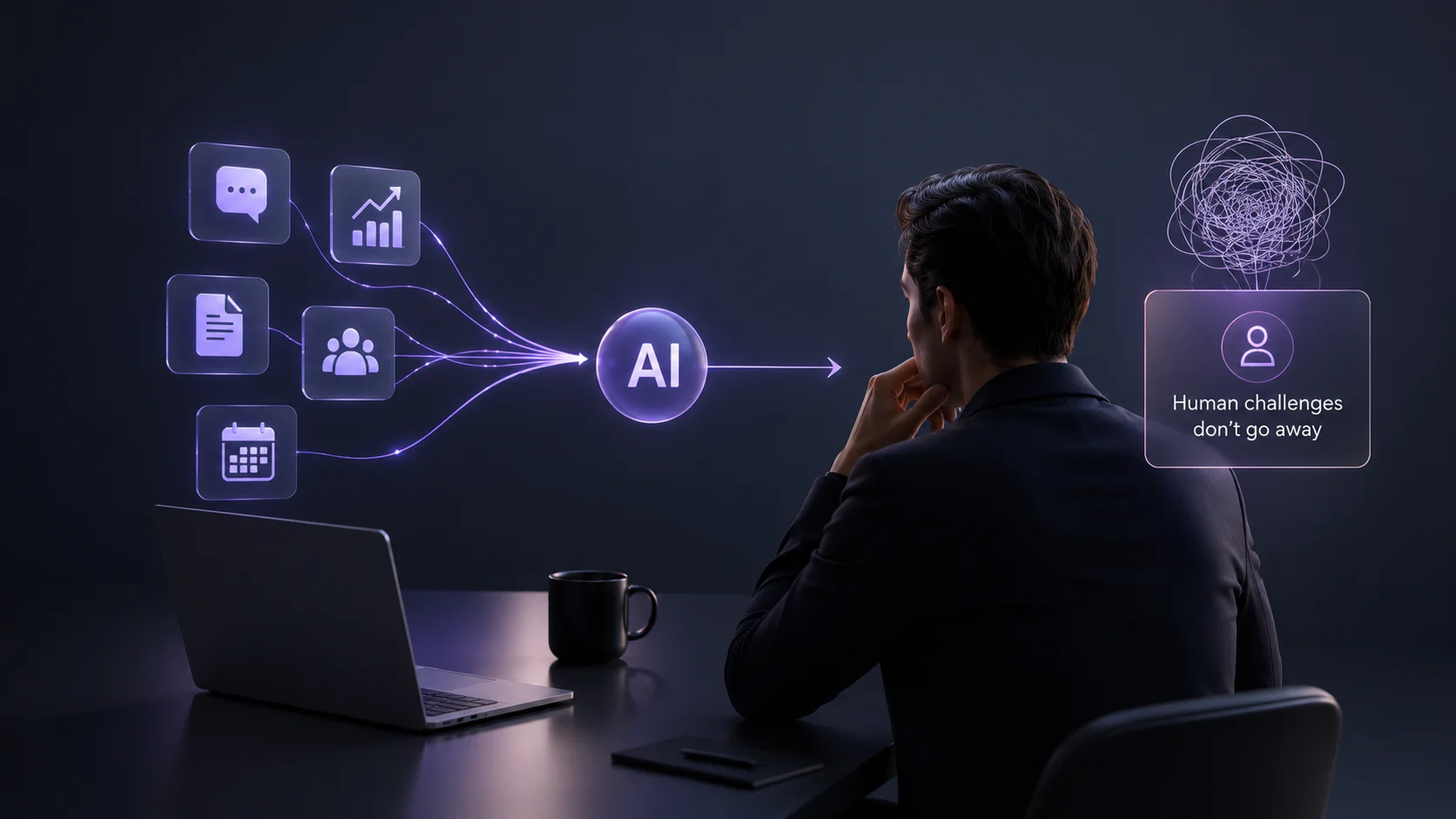
The transformation is already underway in the tools sitting open in browser tabs right now. Managers are using AI to draft performance reviews, summarize meeting notes, generate project timelines, analyze team productivity data, and flag risks in ongoing projects.
What’s changed isn’t that AI arrived, it’s that AI became usable. Tools like Microsoft Copilot embedded in Teams, Notion AI, and various BI dashboards have brought AI into the daily workflow without requiring a single line of code. Today’s average manager has access to more analytical power than a mid-sized consulting firm did fifteen years ago.
And yet, workloads haven’t disappeared. If anything, many managers report feeling more overwhelmed. Speed has increased, expectations have scaled with it, and the cognitive load of managing humans remains stubbornly human.
Administrative Tasks AI Can Automate
Let’s be concrete, because vague claims about “automation” don’t actually help anyone understand what’s changing.
AI can already handle, or substantially assist with, the following in a management context:
- Scheduling and calendar optimization – tools like Motion and Reclaim.ai now autonomously reschedule meetings based on priority, deadlines, and team availability
- Performance data aggregation – pulling together KPIs, OKR progress, and individual output into readable summaries, without a manager spending hours in spreadsheets
- Meeting summaries and action item extraction – tools like Otter.ai and Fireflies can transcribe a 60-minute meeting and produce a structured summary with decisions and next steps in under two minutes
- Budget tracking and variance reporting – AI can flag anomalies in project spend in real time, rather than waiting for end-of-month reviews
- Drafting routine communications – status updates, feedback templates, onboarding emails
None of this is speculative. These tools exist, are in use, and are genuinely saving managers hours each week. The more honest conversation is about what gets done with that time.
The Current Impact of AI on Management
The impact isn’t uniform across management roles. Let’s walk through the landscape because “management” covers an enormous range of actual work.
Project Managers
Right now, AI may be most visibly transforming the role of project management. Platforms like Asana, Monday.com, and Jira have incorporated AI features that predict task delays, automatically resurface blockers, and suggest workload rebalancing across teams. The same pattern is emerging in related roles like programmers and engineers where technical judgment increasingly combines with management oversight. The PM’s job is just shifting from tracking to judgment, deciding what the tool’s recommendations actually mean in context. Engineering managers, in particular, oversee teams whose core work is increasingly affected by AI tools.
Product Managers
Product managers deal in ambiguity by definition. AI assists in the generation of feedback on a large scale. As an illustration, AI-based tools such as Productboard can use thousands of responses to group them into themes. But what do we select for our roadmap priorities? That still requires a human with business context, user empathy, and stakeholder management skills.
Construction Managers
An interesting case. AI is being applied in construction through computer vision systems that monitor job site safety in real time, flagging PPE violations or unsafe conditions faster than any human supervisor could. Companies like Versatile have built AI systems that attach to cranes and track material movements to improve scheduling accuracy. The physical, contextual complexity of a construction site, however, still requires experienced human oversight.
Customer Success Managers
AI is changing how CSMs identify at-risk accounts – health scoring models that analyze product usage data, support ticket frequency, and engagement signals can surface churn risk weeks before a human would notice. But what about the actual conversation that retains a frustrated customer? That’s still very much a human interaction.
Wealth Managers
Robo-advisors, like Betterment and Wealthfront, have been operating at scale for over a decade, managing billions in assets for clients who don’t need (or can’t afford) human advisors. The broader question of whether AI will replace financial advisors mirrors this pattern: high-net-worth wealth management remains deeply relational. The conversations around inheritance, life transitions, and financial anxiety require trust that takes years to build and doesn’t transfer to an algorithm.
Program Managers
Program managers coordinate across multiple projects and stakeholders simultaneously. AI can maintain visibility across this complexity through dashboards that surface dependencies and conflicts automatically. But the political and strategic navigation of competing priorities across departments? Still human territory.
Portfolio Managers
In investment contexts, quantitative AI models now run large portions of certain hedge strategies – Renaissance Technologies’ Medallion Fund has been doing this for decades with extraordinary returns. In corporate portfolio management, AI helps analyze project investments against strategic objectives. Human judgment on strategic fit and organizational capacity remains essential.
Contract Managers
Contract review AI tools, like Ironclad and Kira, can analyze thousands of pages of legal documents in minutes, flagging non-standard clauses and compliance risks. This is genuinely transformative for contract management. Negotiation strategy and relationship management with vendors, however, stay human.
Hedge Fund Managers
Algorithmic trading has been part of hedge funds for decades. What’s changed is the sophistication – machine learning models now process alternative data sources like satellite imagery, credit card transaction patterns, and social media sentiment to generate trading signals. Human fund managers increasingly focus on strategy, investor relations, and the kinds of macro bets that require broad contextual reasoning.
Risk Managers
AI can be relevant to risk management: pattern recognition on large amounts of data, detection of anomalies, and stress testing. Banks apply AI to a great extent in credit risk and fraud detection. The governing and judgment layer, which determines the degree of risk an organization has to undertake, is a human consideration that has a legal and moral gravity.
HR Managers
This one is complicated. AI has entered HR through resume screening, engagement surveys analyzed for sentiment, and predictive attrition models. But AI in hiring has also produced well-documented bias issues – Amazon famously scrapped an AI recruiting tool in 2018 after discovering it penalized resumes that included the word “women’s”. HR’s human elements, like culture, belonging, and handling sensitive employee situations, are not going away.
Account Managers
AI helps account managers prioritize which clients need attention, surfaces renewal risk signals, and drafts personalized outreach. The actual relationship, being the person a client trusts and calls when something goes wrong, that’s not automatable in any meaningful sense.
Sales Managers
Sales managers use AI for pipeline forecasting (Clari being a notable example), call analysis (Gong), and coaching recommendations. Quota-setting, team motivation, and navigating the human dynamics of a sales floor are still firmly in human hands.
Marketing Managers
AI-generated content, dynamic ad optimization, audience segmentation, and personalization at scale – marketing has been one of the most AI-intensive disciplines. But creative strategy, brand voice, and campaign judgment still require human taste and market intuition.
Social Media Managers
Scheduling tools, trend detection, and even AI-generated post drafts are now standard. What is the appropriate message for a brand to convey during a particular cultural moment? Ask any social media manager, getting that wrong can be catastrophic, and AI doesn’t carry that accountability.
Construction Project Managers
Similar to general construction managers, but with added complexity around subcontractor coordination, permit management, and budget control across multi-year projects. AI tools are improving schedule optimization, but the human complexity of managing dozens of competing contractors on a live site isn’t going anywhere.
Middle Managers
Middle management may be the most interesting case in this whole debate. People often describe middle managers as the “disappearing layer” and frequently cite them as prime targets for automation. And there’s something to it. A lot of middle management work historically involved information relay: taking strategy from above, translating it, and monitoring execution below. AI does information relay extremely well. What it doesn’t do is provide psychological safety, advocate for a team’s interests, or handle the informal human dynamics that determine whether a team actually performs.
Pros of AI in Management
Quickly Analyzing Large Datasets
A human manager looking at a team’s quarterly output data might spend half a day pulling it together and another few hours making sense of it. An AI system does this in seconds and doesn’t just report the numbers but contextualizes them, identifies outliers, and surfaces the variables most correlated with performance. Tools in the best AI tools for business category now provide this type of system as a genuine superpower for data-heavy management roles. As these analytics capabilities expand, managers are increasingly relying on AI-powered data visualization to translate raw data into actionable insights.
Automating Routine Administrative Tasks
The average manager spends somewhere between 20-40% of their time on administrative tasks that require no real judgment: scheduling, status updates, formatting reports, and chasing approvals. Automating even half of that represents an enormous shift in how managerial time gets spent.
Forecasting Trends and Recommending Variants of Actions
Predictive analytics enables the organization to shift toward proactive decision-making. Rather than being aware of the fact that a project is late in the fourth month, AI systems identify the risk in the second month, based on early warning signs, such as a change in velocity, burn rate in the budget, and capacity signals from the team. Managers who succeed by using such tools are able to intervene at an earlier stage with improved information.
Cons of AI in Management
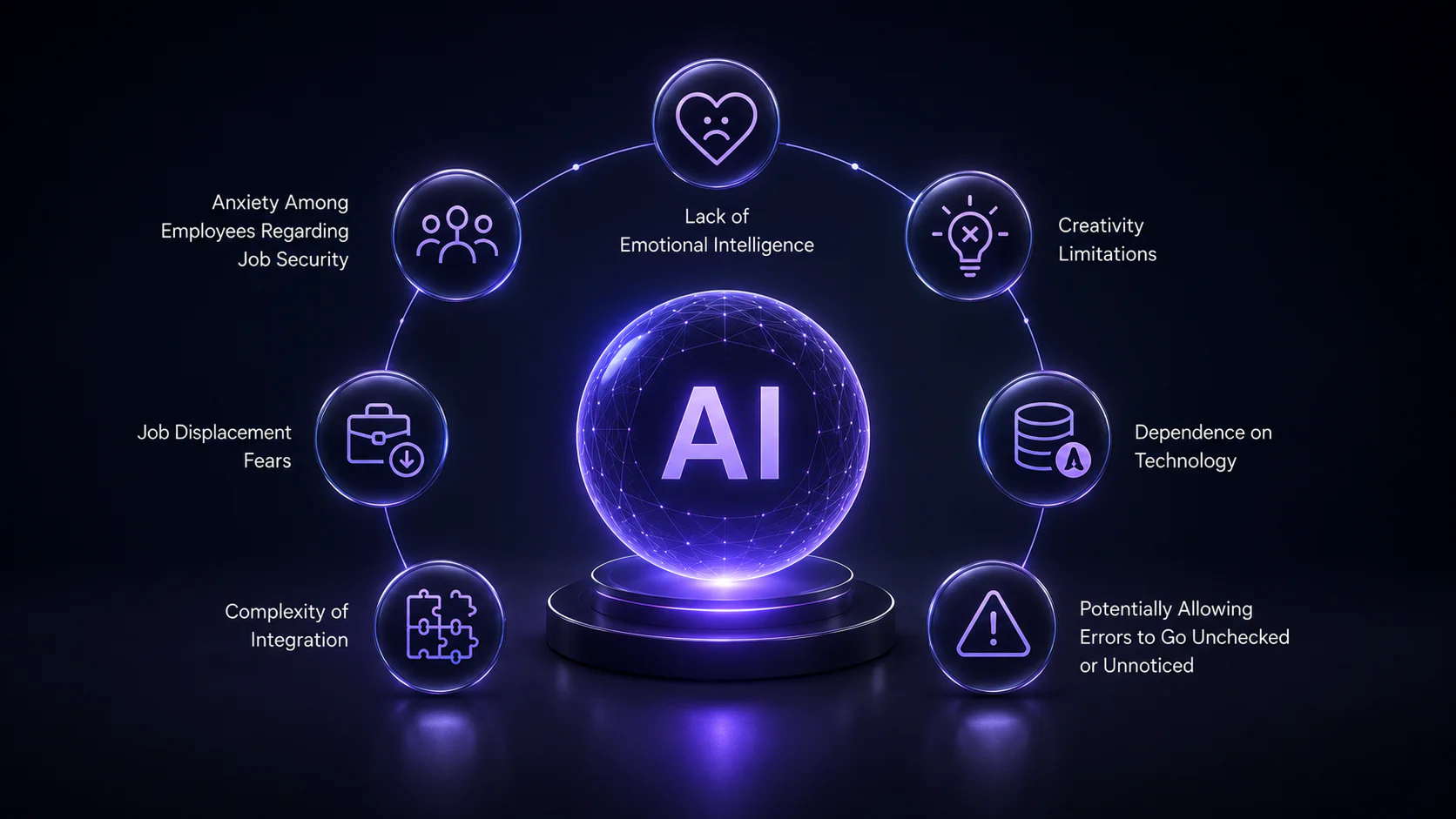
Lack of Emotional Intelligence
This one is structural, not a temporary gap. AI doesn’t understand what it feels like to receive difficult feedback, to be overlooked for a promotion, or to be dealing with something hard outside of work. Managing humans without emotional intelligence is just monitoring. The difference matters enormously for performance, retention, and culture.
Creativity Limitations
AI is exceptional at recombining existing patterns. It is not good at genuine creative leaps – the kind of strategic insight that comes from combining domain expertise, intuition, and a willingness to pursue something that doesn’t fit the existing data. Management at its best involves creative problem-solving that AI currently can’t replicate.
Dependence on Technology
Every AI system depends on data. And data can be wrong, biased, incomplete, or manipulated. Organizations that over-rely on AI decision-making without maintaining human judgment as a check are taking on a new category of risk that isn’t always visible until something goes badly wrong.
Job Displacement Fears
Whether or not AI actually replaces managers at scale, the fear that it might has real organizational consequences. Managers under existential threat from AI may resist adoption, hoard information, or disengage in ways that hurt team performance.
Complexity of Integration
Implementing AI tools throughout a management layer is not a straightforward process. It requires changes to workflows, training, data infrastructure, and cultural norms around how decisions get made. Many organizations underestimate this and end up with expensive tools that get used inconsistently.
Anxiety Among Employees Regarding Job Security
It is not only the managers who experience this. Once the employees notice that their manager’s job is partially automated, they draw their own conclusions regarding their job security. When left unaddressed, this anxiety diminishes the level of engagement, leads to higher turnover, and creates the exact type of human cost that AI was meant to help organizations to prevent.
Potentially Allowing Errors to Go Unchecked or Unnoticed
AI systems fail quietly. Unlike a human manager who might visibly struggle, an AI model can confidently produce wrong outputs – biased recommendations, incorrect forecasts, and flawed risk assessments. Those errors may propagate through an organization before anyone notices. The automation of oversight without maintaining human checkpoints is a legitimate organizational risk.
Review of Existing AI Decision-Making Tools
The market for AI management tools has exploded, and it’s worth knowing what’s actually out there. A few categories worth understanding:
- Workforce analytics: systems such as Workday Peakon and Glint interpret data on employee engagement and identify signs of flight risk, burnout, and team health. These do not eliminate the input of HR but enhance its information base in a huge way.
- Project intelligence: Asana Intelligence, the AI capabilities of Monday.com, and Forecast.app introduce predictive capabilities to project management – project timeline risk, project resource allocation, and project bottleneck detection.
- Revenue intelligence: Gong and Clari are the two biggest in AI-based sales management and use call data and pipeline signals to predict revenue and coach sales managers.
- Strategic decision support: Applications such as Quantive (previously Gtmhub) combine the data of the OKR with business intelligence to allow the business executives and managers to view where the strategy and execution are incompatible.
- Document and contract intelligence: Ironclad, Kira, and Luminance manage contract analysis on a scale that no human team could match.
None of these tools make decisions. They improve the quality of human decisions, which is, arguably, the most honest version of what AI in management actually does.
Performance Analytics: Human Intelligence vs. Artificial Intelligence in Management
Here’s where the comparison gets genuinely interesting. AI is objectively superior at tracking performance at scale – pulling together data from multiple systems, calculating KPIs without manual effort, and flagging statistical anomalies. No argument there.
But performance management is about interpretation, context, and the conversation that follows the data. A manager who sees that a previously high performer’s output has dropped in the last six weeks needs to know whether that’s a performance issue, a personal crisis, a workload problem, or a sign of disengagement. And the answer requires a human conversation, not an algorithm.
Speeding Up Management Tasks in Reporting and Forecasting
Reporting used to eat managers alive. Monthly reports, quarterly reviews, board decks – each one requiring hours of data gathering, formatting, and narrative construction. AI can now handle the assembly of these documents almost entirely, with humans reviewing and adding judgment rather than building from scratch.
Forecasting has evolved similarly. Traditional forecasting relied on historical trends and human intuition. AI-enhanced forecasting incorporates a wider range of variables, updates dynamically as new data comes in, and produces probabilistic ranges rather than single-point estimates. That’s a more honest representation of uncertainty, and, paradoxically, it forces managers to develop better judgment about how to act under uncertainty rather than false confidence in a precise number.
Instead of Administrative Tasks, People Can Now Focus on Strategic Roles
This is where the optimistic case for AI in management actually lives. If AI absorbs a large portion of the managerial time currently spent on administrative work, what will be done with the recovered capacity?
The answer, ideally, is the things that matter most and have historically been squeezed out: strategic thinking, developing people, building culture, navigating complexity, and driving genuine organizational change. Managers who make this shift effectively will be more valuable. The ones who don’t, who spend the recovered time on lower-quality administrative work or resist the tools, risk becoming the easiest case for organizations to make cuts.
The Role of Human Connection in Management
There’s a line of research in organizational psychology that doesn’t get enough attention in AI conversations: the degree to which team performance is driven by psychological and relational factors that are entirely invisible in productivity data.
Amy Edmondson’s work at Harvard on psychological safety, the belief that one can speak up without fear of punishment, shows that it’s one of the strongest predictors of team performance. Google’s Project Aristotle, which studied hundreds of internal teams, arrived at the same finding. Psychological safety is built through human behavior over time: consistency, vulnerability, empathy, and the specific way a manager responds when something goes wrong. This is why professional development through programs like the Coursiv 28-Day AI Certificate Program Challenge emphasizes human-centered skills alongside technical capability.
The Matter of Trust and Psychological Safety
Related but worth separating: trust between managers and employees is built through accumulated experience of reliability and authenticity. It’s built when a manager advocates for someone behind closed doors, admits they don’t know something, or has a difficult conversation with genuine care. These are acts that require a person.
When AI starts making decisions that affect people, for example, compensation recommendations, performance ratings, and promotion readiness assessments – employees want to know: who’s accountable? “The algorithm decided” is not an answer that builds trust. This same accountability challenge appears across professions where AI might replace lawyers or customer service roles. If anything, AI-driven management decisions without human accountability can erode trust faster than almost anything else.
How AI Enhances Data-Driven Decision Making
The final word on this: AI doesn’t replace managerial judgment. It elevates the standard of what “good judgment” means. A manager who makes a key decision without looking at available data, when AI tools make that data easily accessible, is now making a worse decision than they would have made ten years ago with the same behavior. The bar has moved.
The managers who thrive in the next decade will be the ones who develop genuine fluency with AI tools, not as technologists, but as professionals who know what questions to ask, which outputs to trust, and how to translate data-informed insight into human action.
By 2030, AI will not replace managers. But managers who use AI effectively will replace those who don’t. That distinction is worth taking seriously.
FAQ