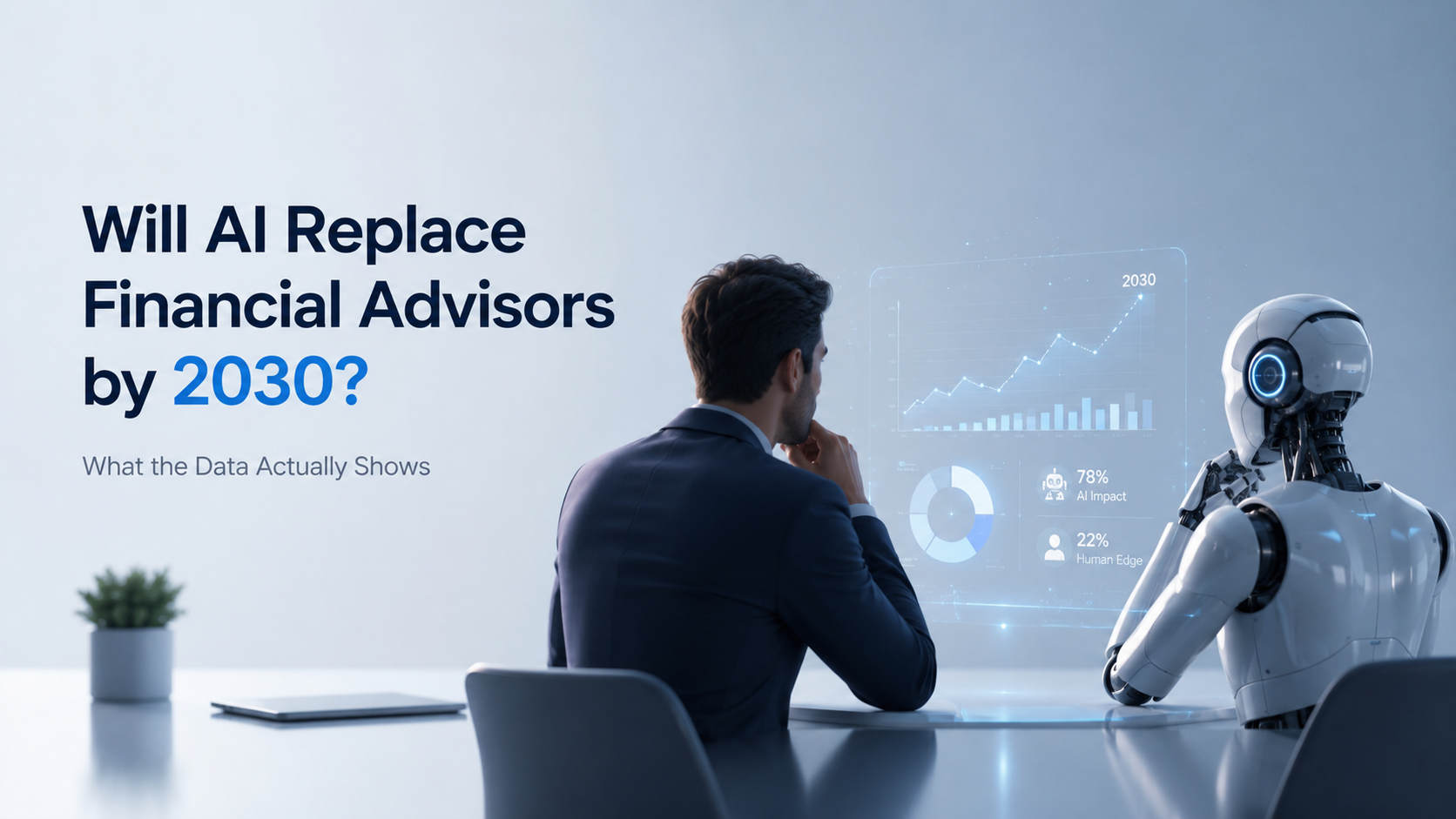
Let’s be direct: this question is no longer hypothetical. It’s something being debated in boardrooms, regulators’ offices, and kitchen tables, with people wondering whether the person managing their retirement savings will soon be an algorithm. The honest answer is complicated, and far more interesting than a simple yes or no.
If you want to build the AI research and analysis skills this shift demands, start with Coursiv’s AI for Investing course.
Human Intelligence vs. Artificial Intelligence in Management
There’s a fundamental tension at the heart of modern finance. On one side, you have decades of accumulated human wisdom – intuition built from navigating crises, understanding behavioral quirks, and reading the room when a client is terrified but pretending they’re fine. On the other, you have machine learning systems that can process in seconds what would take a human analyst weeks to digest.
Neither is winning outright. And that’s the whole point.
AI systems excel at pattern recognition, consistency, and processing enormous datasets without fatigue or bias (well, mostly – more on that later). Human advisors bring something harder to quantify: judgment under pressure, ethical reasoning in grey areas, and the ability to sit across from someone who just lost a spouse and understand that right now, they shouldn’t make any major financial decisions at all.
The world of financial management has already embraced a hybrid approach. Robo-advisors such as Betterment and Wealthfront began using algorithms to manage assets back in the early 2010s. As of 2023, these robo-advisors were overseeing more than $2.5 trillion in assets worldwide, and that figure keeps climbing. However, it’s important to acknowledge that most users still prefer human advisors when complex situations arise.
How AI Handles Data Gathering and Analysis?
Speed is where AI simply has no competition. A modern AI system can aggregate and analyze data from market feeds, economic indicators, portfolio positions, geopolitical signals, and client behavioral patterns – simultaneously, in real time. A human advisor doing the equivalent work manually would need days, a team, and several very strong coffees.
Machine learning, especially when applied to natural language processing and predictive analytics, offers the ability to sift through earnings reports, central bank pronouncements, and even the chatter on social media to forecast market shifts before they become apparent. Consider JP Morgan’s LOXM algorithm; it was designed to execute stock trades with greater efficiency than a human, drawing on the best strategies gleaned from tens of millions of historical data points.
AI doesn’t just gather data. It contextualizes it. In the modern systems, the correlations between asset classes can be identified, abnormalities in spending behavior can be detected, and risk profiles can be generated with a level of granularity that would not be feasible to create manually with each individual client.
AI-Driven Financial Planning Simulations and Projections

This is where things get genuinely fascinating. AI can run thousands, sometimes millions, of Monte Carlo simulations in the time it takes to read this sentence. Monte Carlo methods involve modeling thousands of possible future scenarios by randomly sampling variables (market returns, inflation rates, life events) to estimate the probability of various financial outcomes.
What used to take actuaries weeks of modeling can now be done dynamically, updated in real time as a client’s circumstances change. A client adds a baby to the family? The model recalibrates projected education costs, adjusts insurance recommendations, and reassesses retirement timelines automatically.
This functionality is not theoretical. Platforms like Empower (formerly Personal Capital) already use layered simulation engines that run continuous projections based on live account data. The result is financial planning that isn’t a static document updated once a year but a living model.
AI-Driven Financial Planning – How Experts Can Use AI for Analysis
Here’s a perspective that often gets lost in the “AI vs. humans” framing: the most powerful version of financial advisory might not be AI replacing advisors, but advisors using AI to become dramatically better at their jobs.
Think of it the way medical imaging transformed radiology. Radiologists didn’t disappear when AI diagnostic tools arrived – they became faster, more accurate, and able to handle higher patient volumes while focusing their human attention on complex, ambiguous cases.
Forward-thinking financial advisors are already using AI tools for:
- Automated portfolio rebalancing and tax-loss harvesting (tools like Wealthfront’s automated tax optimization save clients meaningful money without manual intervention)
- Client behavior analysis that flags when a client’s risk tolerance appears to be drifting based on their transaction patterns
- Generative AI to draft personalized financial summaries, scenario analyses, and regulatory disclosures, with the advisor reviewing and contextualizing rather than writing from scratch
The advisors who will struggle by 2030 aren’t those competing against AI. They’re the ones who refuse to learn how to work with it – much like what jobs will AI replace by 2030, this outcome is determined by adaptability, not inevitability. Other professional advisors, such as healthcare practitioners, face the same adaptive pressure.
The Importance of Human Experience in Financial Advisory
Numbers don’t cry. Software doesn’t feel the weight of telling someone their retirement plan needs to be pushed back by five years. And no algorithm, at least not yet, can genuinely hold space for a client who is making an emotionally catastrophic financial decision and needs to be talked down carefully, not just shown a chart.
The behavioral finance literature is clear: people make terrible financial decisions under emotional stress. Nobel laureate Daniel Kahneman spent decades documenting the ways cognitive biases distort our financial judgment. Loss aversion, recency bias, and overconfidence – these aren’t bugs in the human system that AI can simply patch. They’re deeply embedded responses, and managing them requires empathy, not just data.
A 2022 Vanguard study estimated that a human advisor adds what they call “Advisor’s Alpha”, roughly 3% in net portfolio returns annually, not through superior investment selection, but through behavioral coaching. Keeping clients from panic-selling during downturns. Preventing overconcentration in a single stock because a client is emotionally attached to it – the kind of emotional intelligence that upskilling in AI tools for advisors can enhance, not replace.
Step-by-Step Process and Logic of AI-Driven Financial Advisory
Understanding how AI actually makes financial recommendations demystifies a lot of the mystique, and exposes some of the real limitations.
Initially, the process begins with data acquisition. Artificial intelligence subsequently compiles the client’s financial information, encompassing income, assets, liabilities, expenditure patterns, insurance provisions, and tax circumstances. Risk assessment then ensues, generally employing a blend of questionnaire responses and behavioral data analysis. The system subsequently aligns the client’s objectives with their existing financial path, pinpointing discrepancies and formulating recommendations derived from optimization algorithms, which are informed by historical data.
Here’s the catch: AI is inherently backward-looking. It learns from historical patterns. This is great until something unprecedented happens: a pandemic, a regional banking crisis, a geopolitical shock. During the COVID-19 market crash in March 2020, many algorithmic models behaved unpredictably because their training data had never encountered a similar scenario. Human counselors who understood the qualitative nature of the shock—that it was temporary, not structural, were often in a better position to advise clients to continue moving in the same direction.
AI vs. Experts in Financial Problem-Solving

Let’s get concrete. In straightforward scenarios – index fund portfolio construction, basic retirement projections, and routine tax-loss harvesting – AI wins on cost, speed, and consistency. No question. A robo-advisor will construct a diversified, low-fee portfolio more reliably and cheaper than most human advisors, who charge 1% of assets under management (AUM).
But compound the problem. Add an inheritance, a divorce, a business sale, cross-border tax obligations, a family trust, and a disabled dependent – situations increasingly overlapping with areas like will AI replace lawyers – and suddenly the AI is out of its depth because it can’t weigh the human factors that determine which technically correct solution is actually the right one.
Transparency and Data Accuracy Concerns When Involving AI in Financial Advisory
This is one of the genuinely uncomfortable parts of the AI finance story, and it deserves more attention than it typically gets.
Many AI financial systems operate as what researchers call “black boxes.” The model produces a recommendation, but the logic path that generated it is opaque, even to the engineers who built it. In financial advisory, a serious problem arises because fiduciary duty requires an advisor to explain the reasons behind their recommendations.
Data quality is also an issue. It depends on its proper processing. AI models may inadvertently incorporate historical biases, discrimination in credit scoring, and demographic differences in lending practices, among other financial data. In 2019, a study of Apple Card’s credit algorithm revealed a significant gender imbalance in credit limit decisions, prompting a regulatory investigation. The algorithm wasn’t intentionally discriminatory; it was trained based on biased historical data.
Regulatory and Compliance Matters in Financial Advisory
Although the US Securities and Exchange Commission (SEC) has published principles for the use of AI in investment management, full regulation of AI-based advisory services has yet to occur. The EU’s AI Act, enacted in 2024, classifies some of the most dangerous uses of AI, such as credit ratings and insurance premiums, as subject to high-risk requirements. Financial AI operating at the level of personalized investment advice may be more likely to face similar criticism.
The fiduciary standard, the legal duty of an advisor to act in the best interests of their clients, is firmly established among human advisors. How it applies to AI systems is still under development. If an AI recommendation causes financial harm, the question of liability remains unclear. Is the platform liable? The developer? Is the organization responsible for its implementation?
Regulatory compliance is another layer. Anti-money laundering requirements, know-your-customer (KYC) regulations, and compliance assessments all require documentation, a chain of command, and accountability structures that AI systems are not always able to provide. Addressing this issue properly will require regulatory action, which has not yet been fully implemented.
Pros of AI-Driven Financial Advice
- Accessibility and cost: AI democratizes financial planning. Where a good human financial advisor typically requires $250,000+ in investable assets to make the fee structure worthwhile, robo-advisors have minimum investments. This opens sophisticated planning to people who were previously excluded from it.
- Consistency and emotion-free execution: AI doesn’t panic in a market crash. It doesn’t get overconfident after a bull run. It doesn’t have a terrible day and make a rash call. For systematic, rules-based investing, that emotional neutrality is genuinely valuable.
- Speed and scalability: Real-time monitoring, instantaneous rebalancing, 24/7 availability. A human advisor simply cannot provide that level of continuous attention to hundreds of clients simultaneously.
Cons of AI-Driven Financial Advice
- Inability to handle complexity and nuance: Divorce, estate planning, business succession, and cross-jurisdictional tax – these require judgment that current AI systems cannot reliably exercise.
- Opaque reasoning and accountability gaps: Clients deserve to understand why they’re being given specific recommendations. Many AI systems cannot explain themselves in ways that satisfy that basic requirement.
Beyond those two structural issues, there’s the brittleness problem. AI models trained on normal market conditions can fail spectacularly during abnormal ones. And financial life has a way of producing the abnormal with some regularity.
Pros of Financial Experts’ Advice
Human advisors bring something AI genuinely can’t replicate yet: contextual wisdom. An experienced advisor has personally navigated multiple market cycles, seen clients make the same mistakes, and developed pattern recognition that goes beyond what’s in any dataset. They understand that a client who says “I’m fine with risk” often isn’t. They can detect anxiety in a voice on a phone call.
They’re also accountable in ways AI isn’t. A licensed CFP (Certified Financial Planner) can lose their certification for bad advice. That accountability creates a real incentive for quality that shapes every recommendation.
Cons of Financial Experts’ Advice
The cost is real. A human advisor charging 1% AUM (Assets Under Management) on a $500,000 portfolio takes $5,000 a year. Over a 30-year retirement, accounting for compounding, that fee structure is significant.
Human advisors also vary wildly in quality. The credential landscape is confusing – “financial advisor” is not a protected title in the US, meaning anyone can use it. Not all advisors operate under a fiduciary standard. Some operate under a “suitability” standard that allows them to recommend products that are merely adequate rather than optimal – often products that happen to pay them a commission. Conflicts of interest in the industry are well-documented and ongoing.
Financial Institutions Adopting AI
The adoption is already here, and it’s moving faster than public discourse acknowledges.
Major Banks
JPMorgan Chase has invested billions in AI infrastructure, with over 300 AI use cases in production, according to recent reports – an example of the best AI tools for business transforming financial institutions. Their COiN (Contract Intelligence) platform analyzes legal documents in seconds – tasks that previously required 360,000 hours of lawyer time annually. Goldman Sachs uses machine learning across trading, risk management, and consumer banking. Bank of America’s virtual assistant Erica has handled over 1.5 billion client interactions since its launch.
Investment Firms & Asset Managers
BlackRock’s Aladdin platform, described by some as “the operating system of Wall Street”, uses AI to manage risk across over $20 trillion in assets under various degrees of oversight. Vanguard has integrated AI into both its robo-advisory services and its human advisor support tools. Bridgewater Associates, one of the world’s most influential macro hedge funds, has long used systematic algorithmic decision-making at its core.
Insurance Companies
Lemonade, the AI-native insurer, processes claims in seconds using AI. Their record: one claim paid in 3 seconds. Traditional insurers like Allstate and Progressive use machine learning for pricing, claims processing, and fraud detection. AI underwriting models analyze thousands of variables to price risk more granularly than traditional actuarial methods, sometimes raising serious questions about discrimination in protected classes.
Fintech & Lending Platforms
The lending platform Upstart uses artificial intelligence to assess creditworthiness, taking into account non-traditional variables such as education and work experience, and claims this approach approves significantly more applications than traditional FICO-based models while maintaining competitive loan default rates. Klarna, a giant in the buy-now-pay-later sector, replaced 700 customer service representatives with an AI assistant in 2024, claiming it does the work of 6,000 human operators.
AI Use Cases In Financial Industry
Fraud Detection
It’s perhaps in this area that AI is having its greatest impact and generating the least controversy. According to Visa, AI systems prevent over a billion dollars in fraud annually, nearly double the amount of just a few years ago. Machine learning models based on transaction history identify unusual patterns and trigger alarms to human analysts that would otherwise be ineffective even at scale. The shift from a rules-based fraud detection system (flagging transactions over $10,000) to a behavioral version of AI (that transaction pattern doesn’t correspond to a specific account at a specific time) has been revolutionary.
Customer Service
The 24/7 chatbot has become a standard feature of financial services. While early iterations were frustrating and limited, newer AI-powered customer service tools using large language models can handle genuinely complex queries, explaining mortgage terms, walking through account options, initiating claims, with a fluency that’s increasingly difficult to distinguish from human interaction. Customer handling costs at major banks have dropped significantly with AI deployment.
Underwriting & Risk
AI underwriting can assess risk across dozens of variables simultaneously – health history, behavioral data, geographic risk factors – and price insurance or credit more precisely than traditional models. The efficiency gains are real. So are the fairness concerns, which regulators in multiple countries are actively examining.
Process Automation
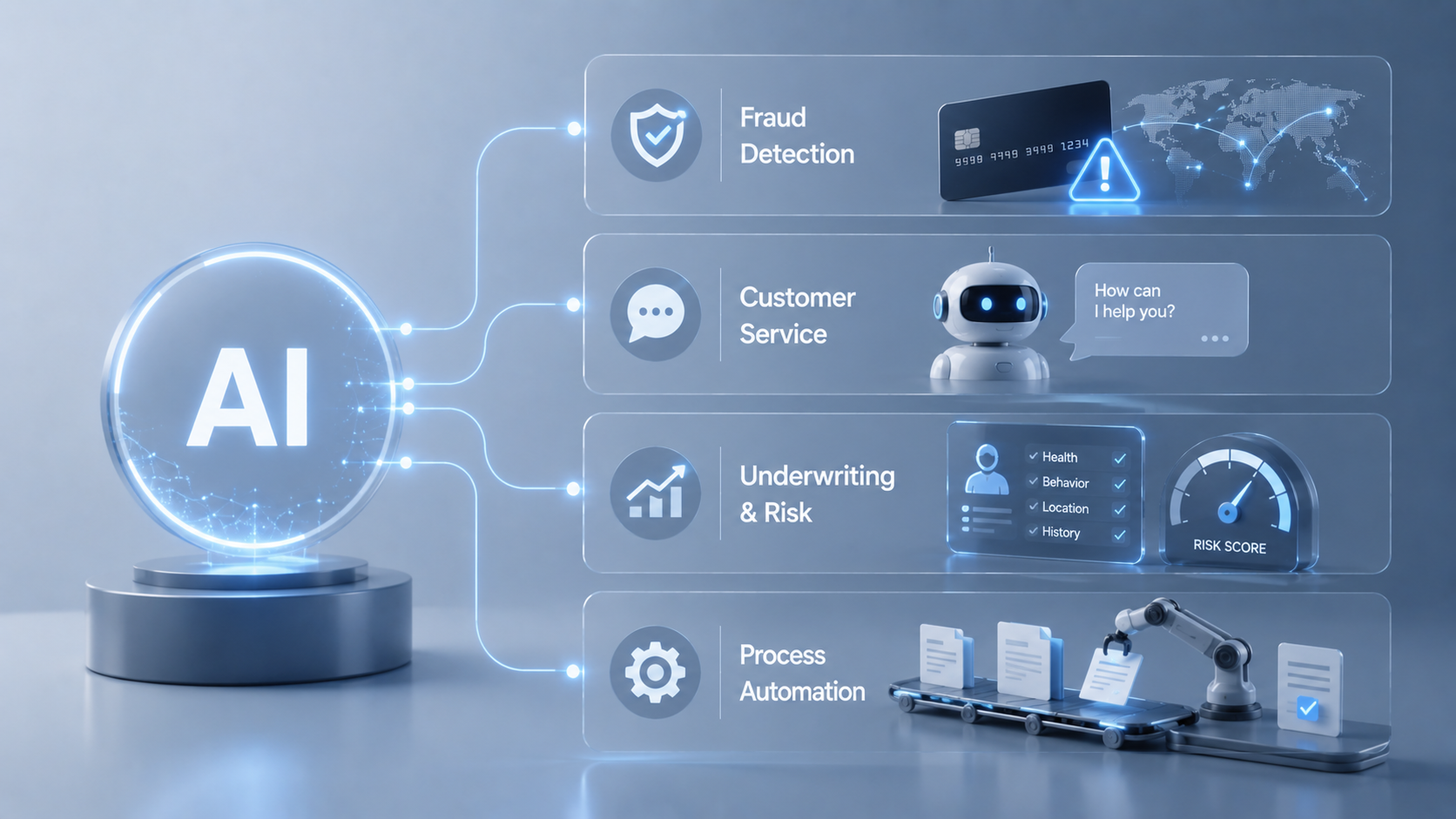
Back-office finance – compliance checking, document processing, regulatory reporting, reconciliation – is being automated at scale. Functions that required large analyst teams can now be managed by AI systems with minimal human oversight. This is where most job displacement is already occurring, quietly and with less public attention than consumer-facing AI receives.
Clients’ Satisfaction with AI vs. Human Financial Advisory
The generational split is real. 67% of Gen Zers already use AI tools for personal finance, compared to just 28% of baby boomers. But usage and trust aren’t the same thing, when real money is on the line, people still reach for the phone.
And the most telling insight: only 31% feel comfortable acting on AI financial advice, but that jumps to 52% when a human advisor reviews it first. One layer of human oversight results in 21 points of additional trust. That says everything.
The 2030 financial advisor isn’t the one who beat the machine. It’s the one who learned how to use it.
FAQ