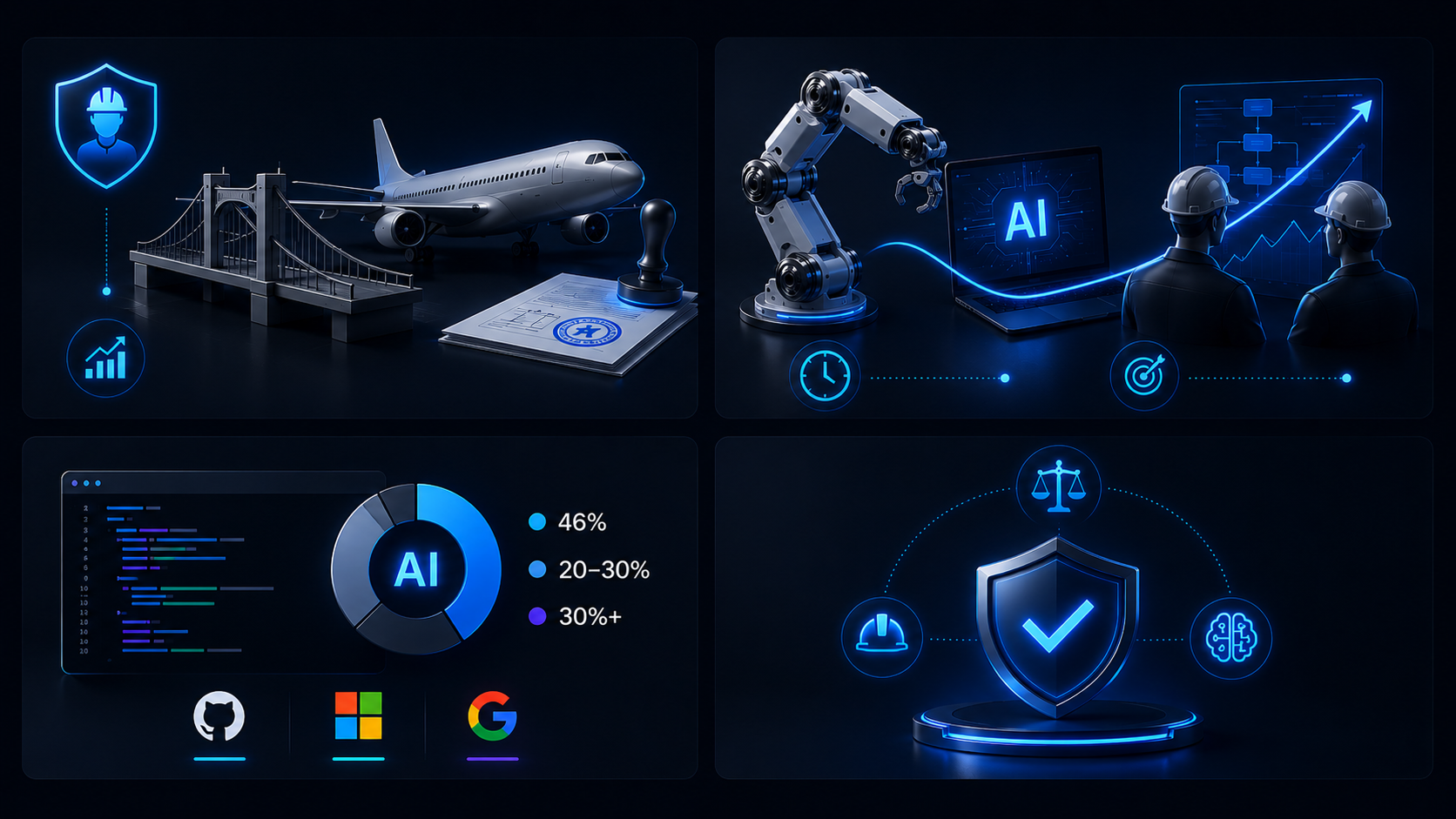
The short answer is no: AI is unlikely to replace engineers as a profession by 2030. It will replace and compress specific engineering tasks — drafting boilerplate code, generating design alternatives, running simulations, summarizing specs, checking calculations, and reviewing routine documentation.
Quick answer: software, data, and network engineering face the fastest task-level disruption because much of the work is digital. Civil, mechanical, electrical, chemical, aerospace, biomedical, and industrial engineering are more protected by physical-world constraints, regulation, safety, testing, and accountability. The safest engineers are the ones who can use AI while still owning judgment, verification, stakeholder tradeoffs, and real-world risk.
AI replacement risk by engineering field
| Engineering field | AI replacement risk by 2030 | What AI automates first | What stays human |
|---|---|---|---|
| Software engineering | Medium | Boilerplate, tests, code review, small fixes | Architecture, product judgment, production ownership |
| Data engineering | Medium | SQL drafts, pipeline checks, documentation | Data contracts, reliability, governance |
| Network engineering | Medium | Config drafts, monitoring summaries | Incident response, topology judgment, security risk |
| Mechanical engineering | Low to medium | CAD alternatives, simulations, calculations | Prototype validation, materials, safety, physical constraints |
| Civil engineering | Low | Drafting, estimates, document review | Permits, site judgment, liability, public safety |
| Electrical engineering | Low to medium | Circuit suggestions, calculations, test scripts | Hardware validation, compliance, failure analysis |
| Industrial engineering | Medium | Process modeling, optimization scenarios | Change management, operations judgment |
| Aerospace engineering | Low | Simulation setup, documentation | Certification, safety cases, systems integration |
| Chemical engineering | Low | Literature review, process models | Plant safety, scale-up, regulatory judgment |
| Biomedical engineering | Low | Research summaries, design variants | Clinical validation, safety, regulatory review |
Source check: this update uses current labor-market and skills context from the BLS architecture and engineering outlook, BLS mechanical engineers, BLS civil engineers, BLS architectural and engineering managers, and the World Economic Forum Future of Jobs Report 2025.
This article breaks down what AI is changing across 10 engineering fields, where human expertise remains essential, and what the adaptation path looks like for any professional watching this unfold.
The Role of AI in Engineering Automation
AI already handles much of the repetitive, data-heavy work that engineers used to do manually. It accelerates simulations, automates routine analysis, generates first drafts of code and designs, and processes volumes of data that would take human teams weeks to review.
AI coding assistants are now common in software teams, but adoption does not equal replacement: the harder work is deciding what should be built, validating the output, and keeping systems safe in production. For tool choices, compare best AI coding agents and Grok for coding.
AI excels when inputs are clear and outputs are predictable. It struggles when the work requires navigating ambiguity, weighing competing priorities, or bearing legal responsibility for what gets built.
Engineering is ultimately about judgment under uncertainty, accountability for outcomes, and creative problem-solving in messy real-world conditions.
That division of labor runs through every engineering discipline covered below.
Can AI Fully Replace Engineers?
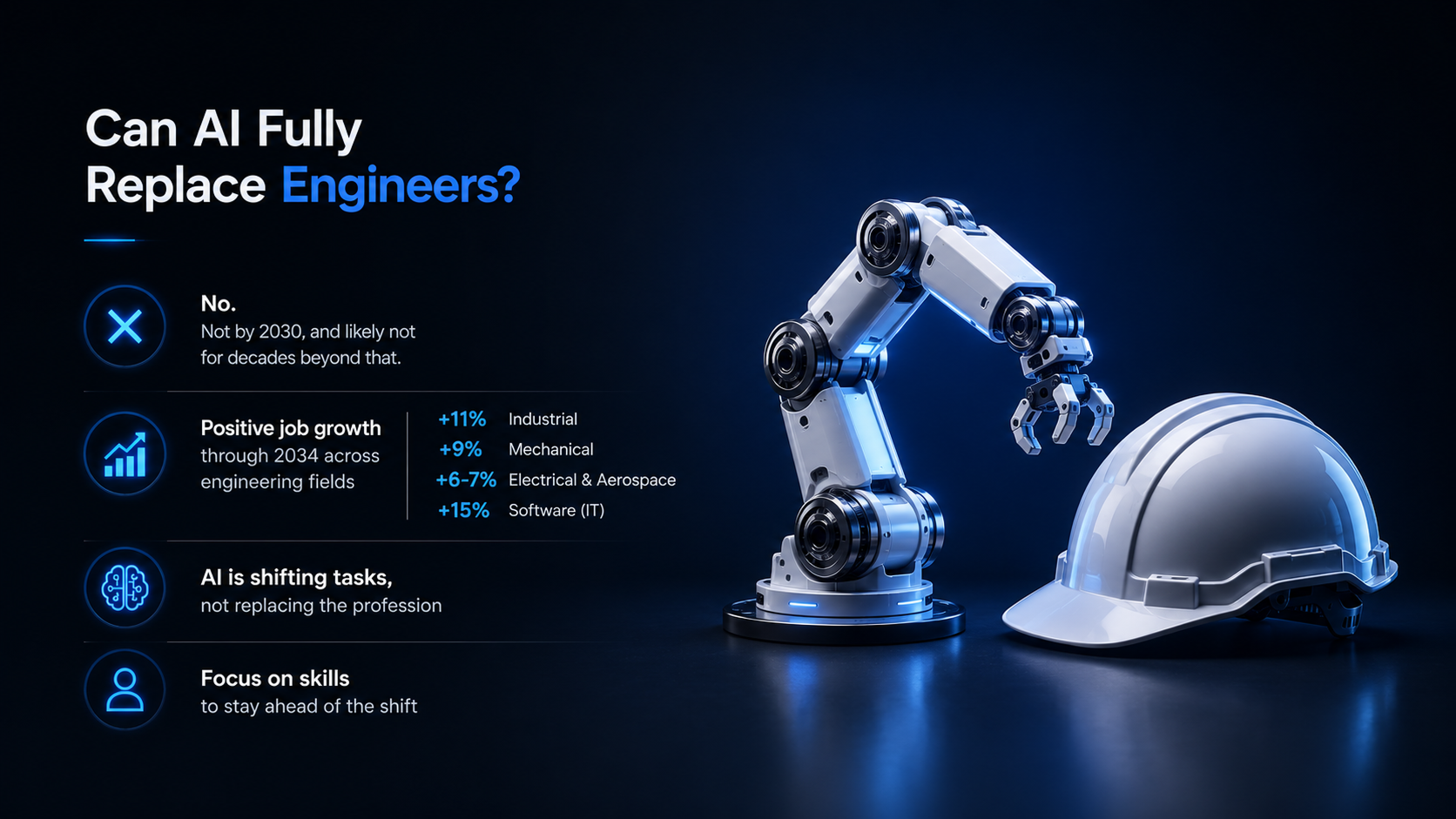
No. Not by 2030, and likely not for decades beyond that.
As we’ve mentioned, BLS projects positive job growth for every engineering category through 2034: industrial engineers at +11%, mechanical engineers at +9%, and even AI-exposed fields like electrical and aerospace engineering at +6% to +7%. Additionally, software engineers (classified under IT occupations rather than engineering) show the strongest growth at +15%.
The real question is which engineering tasks are shifting to AI, how fast, and what skills you need to stay ahead of that shift. See our breakdown of what jobs AI will replace by 2030 for a broader perspective across industries.
The Strengths and Limitations of AI in Engineering Roles
As you read through each engineering field below, you’ll see the same dynamic repeated. The specifics change, but the pattern holds.
AI performs well at data processing, pattern recognition, repetitive calculations, and simulation.
It underperforms at ambiguity, physical-world judgment, stakeholder communication, ethical decision-making, and novel problem-solving.
This reflects a fundamental characteristic of current AI systems: they’re excellent at tasks with clear inputs and predictable outputs, and unreliable at tasks requiring judgment under uncertainty.
Some engineering fields are more exposed to AI automation than others. It depends on how much of their work involves clear inputs vs. ambiguous judgment.
Here’s how it plays out across 10 specialties.
Will AI Replace Software Engineers?
Software engineering is where AI disruption is most visible and best documented. CEOs at Microsoft, Google, and Meta have confirmed that AI generates 25% to 50% of their companies’ new code.
Entry‑level developer hiring fell 25 % in 2024, and employment for developers aged 22‑25 dropped nearly 20 %.
At the same time, the BLS projects 15% job growth for software developers through 2034, with roughly 129,200 annual openings. While demand for AI engineers is exploding.
Will AI Replace Mechanical Engineers?
Mechanical engineering experiences some of the most visible AI advances. Generative design systems take inputs like loads, constraints and materials and output thousands of possible geometries. Engineers use these options to reduce weight and improve strength.
Siemens’ Designcenter NX now includes an AI copilot that translates plain-language instructions into CAD commands, and early adopters report 40%+ time savings on common design tasks. These kinds of AI tools for business are reshaping how engineering teams work.
The digital twin market, central to mechanical engineering simulation, is projected to grow from $21 billion in 2025 to nearly $150 billion by 2030.
But mechanical engineering requires physical-world understanding: material science judgment, hands-on testing, manufacturing oversight, and safety accountability. The BLS projects 9% job growth through 2034. AI makes mechanical engineers faster. It doesn’t make them unnecessary.
Will AI Replace Electrical Engineers?
AI has become a co‑engineer in electrical design.
For example, Quilter AI: Physics-driven AI delivers bring-up ready PCB designs within a single workday. It achieves 98% autonomous routing completion in 27 hours.
2025 research in American Journal of Advanced Technology and Engineering Solutions shows that AI-driven predictive maintenance now reaches 85% to 95% accuracy for electrical systems.
Electrical engineering still involves physical system integration, safety-critical design decisions, field troubleshooting in unpredictable conditions, and compliance with regulations that carry legal liability. No AI signs off on a safety certification or diagnoses an intermittent fault at a job site. The BLS projects 7% growth through 2034.
Will AI Replace Civil Engineers?
Civil engineers use AI for structural analysis, traffic flow modeling, environmental simulations, and construction scheduling. Alice Technologies, an AI scheduling platform, delivers 17% time savings and 14% labor cost reductions on complex builds, with users reporting millions saved on individual projects.
Yet the discipline moves slowly. A 2025 RICS survey of 2,200 professionals found 45% report no AI implementation at all.
But there’s a reason for that. Civil engineering involves public safety at massive scale, and licensed Professional Engineers bear personal legal liability when they sign and seal documents.
Will AI Replace Data Engineers?
Data engineering sits in a unique position: the work is entirely digital, making it highly automatable. AI tools already generate pipelines, monitor data quality, and optimize schemas. Fivetran’s intelligent selective execution cut compute costs by 29% on average through smarter SQL compilation that skips unnecessary model rebuilds.
But data engineers are also among the most in-demand roles in the AI economy. Every AI system depends on a well-engineered data infrastructure.
As dbt Labs founder Tristan Handy put it: data engineers “will have more work to do than ever, but it will be more strategic.”
Will AI Replace Network Engineers?
AI automates network monitoring, anomaly detection, traffic optimization, and routine configuration. The intent-based networking market is projected to reach $2.6 billion by 2027, and the results back up the investment.
The gains are already measurable. Apstra Data Center Director delivers 90% lower OpEx, 85% faster deployment (30 minutes vs 8-12 hours) and 70% MTTR reduction.
Still, network engineering involves physical infrastructure, security architecture, incident response under pressure, and vendor negotiations that no AI handles independently.
Will AI Replace Computer Engineers?
AI has reshaped how chip design works. Engineers no longer lay out circuits manually. Instead, they define constraints, validate AI-generated outputs, and make strategic decisions about architecture and performance trade-offs.
As early as 2024, Google DeepMind’s AlphaChip uses reinforcement learning to generate optimized chip layouts in hours instead of weeks or months of human effort.
But AI is creating more demand for computer engineers, not less. Every AI system runs on specialized hardware, and the race to build it is accelerating. The GPU market is projected to reach $65.5 billion by 2033. The semiconductor industry is approaching $1 trillion by 2032.
Will AI Replace Aerospace Engineers?
AI excels at aerodynamic simulation, flight path optimization, and predictive maintenance. Neural network surrogate models now run simulations 2 million times faster than traditional computational fluid dynamics, turning weeks of testing into hours.
Yet speed doesn’t reduce the stakes. Aerospace engineering involves safety-critical systems where failure costs lives. Boeing runs 70+ generative AI applications across its workflows, and human engineers remain accountable at every design and certification stage.
Will AI Replace Cloud Engineers?
Cloud engineering is highly automatable in its routine aspects. AWS, Azure, and GCP now embed AI into provisioning, scaling, monitoring, and cost optimization.
That’s where the role is headed: architecture and strategy. Cloud architecture decisions, security design, multi-cloud strategy, and incident response require human judgment about trade-offs across cost, performance, compliance, and vendor lock-in.
AI is also fueling demand for the engineers it supposedly threatens. The vast majority of AI and machine learning models are developed and hosted in the cloud. As companies race to integrate AI into their operations, they need engineers who can build and manage that infrastructure.
Will AI Replace Industrial and Robotic Engineers?
AI doesn’t make industrial engineers obsolete; it changes their focus. Engineers now design systems that integrate AI with human workers, troubleshoot robots in unpredictable environments and ensure safety. They need to bridge mechanical engineering, computer science and operations management—skills that align closely with what effective managers will need as AI evolves. The role is expanding, not disappearing.
Skills Engineers Need for the AI-Driven Era
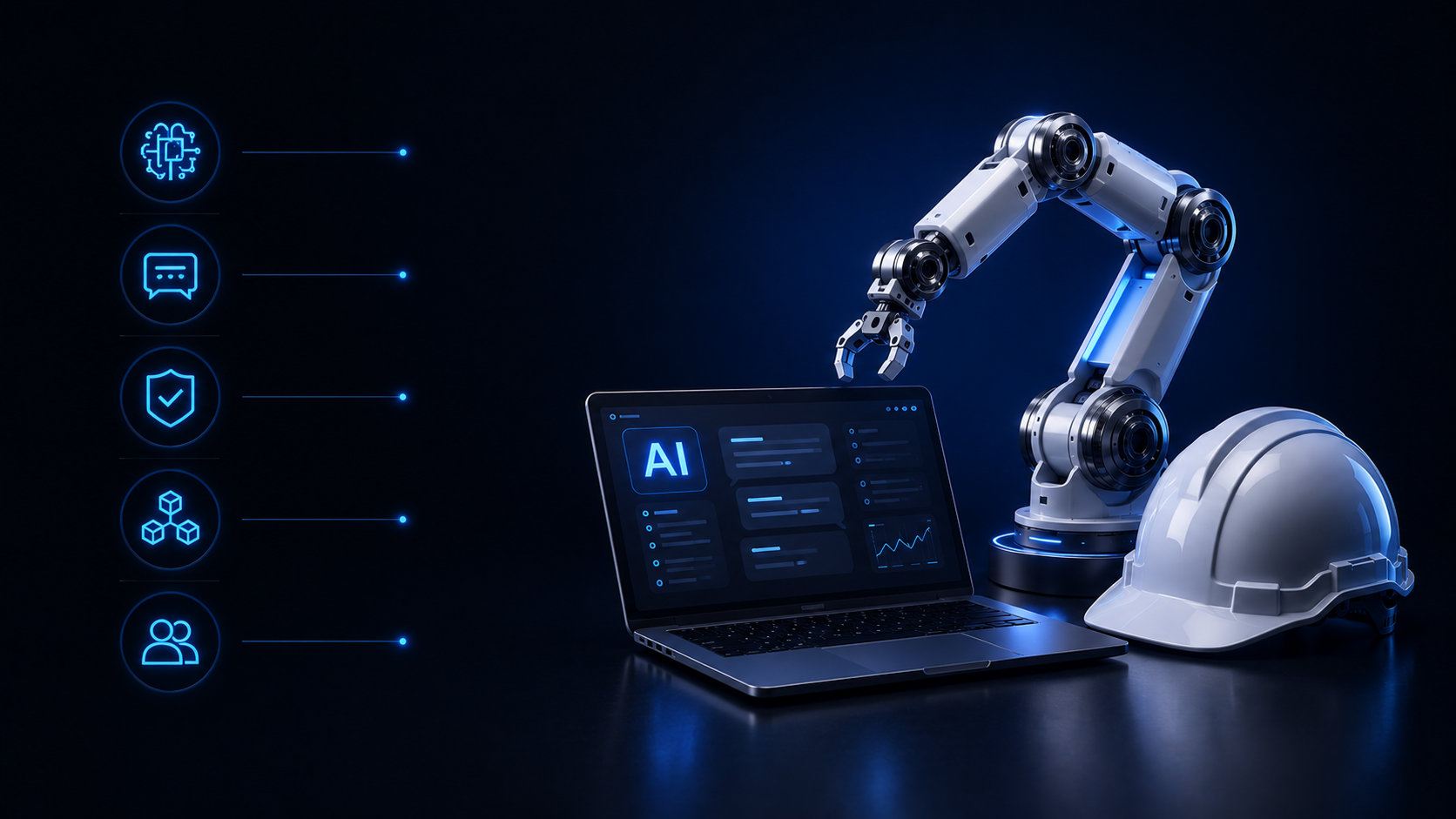
Engineers no longer just build solutions; they orchestrate AI‑assisted workflows.
The practical skills that matter now:
- AI tool fluency. Knowing how to use AI assistants effectively in your specific domain
- Prompt engineering. It mainly comes down to how well you frame questions and tasks based on your expertise. That’s what determines the quality of the AI-generated answer
- Output evaluation and correction. The ability to catch the errors AI produces, especially in safety-critical and complex work
- Systems thinking. Understanding how AI-generated components fit into larger projects
- Cross-functional communication. Explaining AI-assisted work to non-technical stakeholders, clients, and regulators
Note: Building AI fluency doesn’t require a sabbatical or a second degree. Coursiv is the world’s first AI Gym – a personalized training space where anyone can build, apply, and master most common AI tools through daily hands-on practice. Check out the Coursiv 28-Day AI Challenge to start building hands-on AI competency.

How Engineers Can Adapt to AI: Balancing Efficiency and Creativity in Engineering
The pattern across every discipline covered here is the same: AI absorbs the routine, humans retain the judgment.
Build AI tool fluency in your specific domain. You don’t need to become a data scientist. You need to know how to use AI assistants effectively for your work. Only 16% of workers had high AI readiness in 2025, according to Forrester. Getting ahead of that curve creates a career advantage that compounds over time.
Lean into skills AI struggles to replicate. Complex problem-solving, stakeholder communication, ethical judgment, and creative design thinking all remain firmly human. These are the skills that separate the professionals who direct AI from the professionals who compete with it. (This dynamic applies across roles—see how managers are adapting to AI for similar patterns.)
Get visible proof of your AI competency. Employers are verifying AI credentials. Professionals are posting AI certifications on LinkedIn to establish thought leadership and career credibility.
Frequently Asked Questions About AI Replacing Engineering Jobs