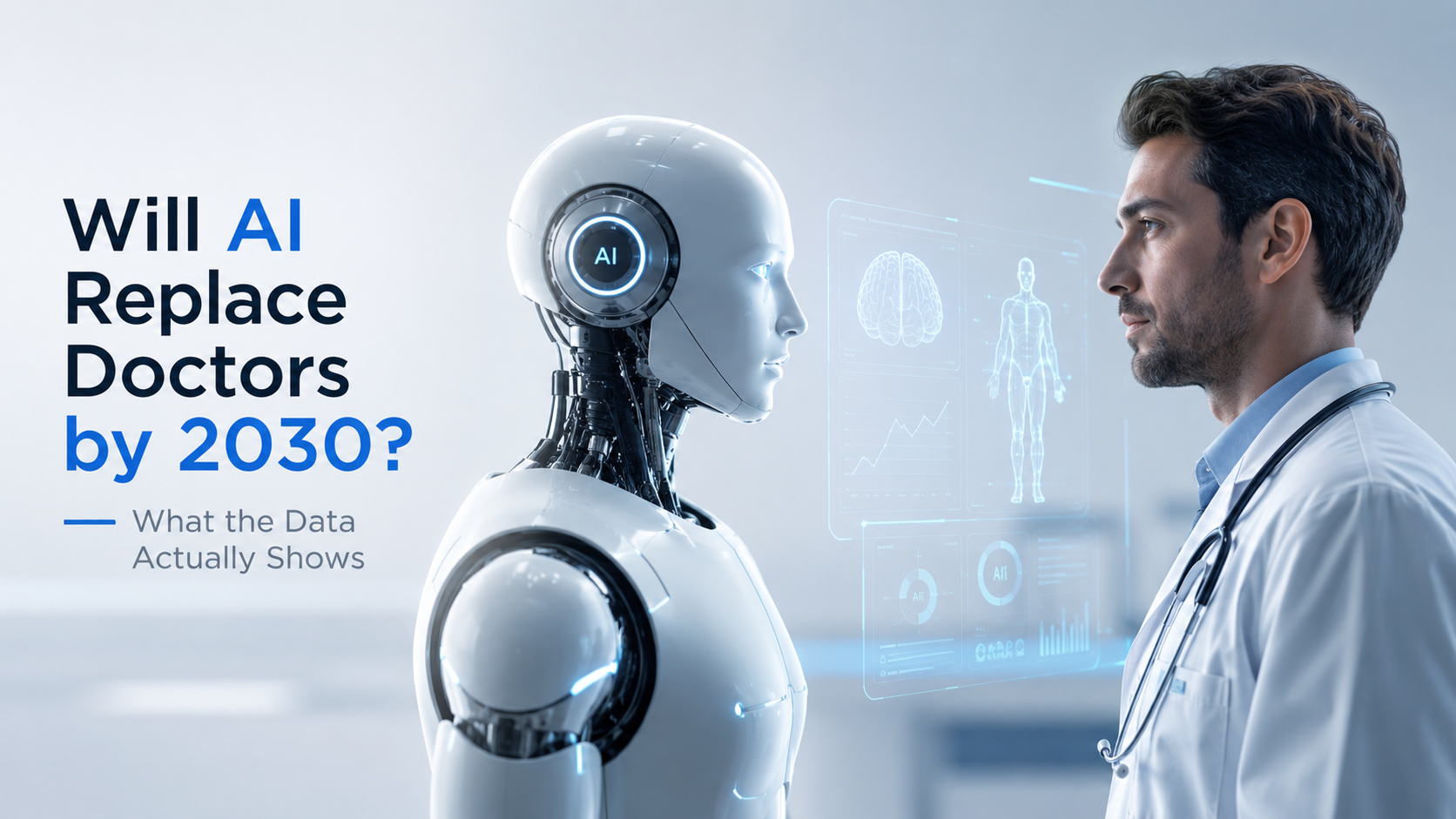
AI will change medicine by 2030, but it will not replace doctors as a profession. The near-term impact is strongest in documentation, imaging support, triage, research summarization, coding, prior authorization, and patient messaging. The physician remains responsible for examination, diagnosis in context, treatment decisions, consent, trust, liability, and care when the case is messy.
Important: this article is career and technology analysis, not medical advice. Patients should not use AI output as a substitute for a licensed clinician.
Quick answer: AI will replace some administrative and pattern-recognition tasks doctors do, not the doctor-patient relationship or the physician’s legal and clinical responsibility.
| Medical workflow | AI impact by 2030 | Why doctors still matter |
|---|---|---|
| Clinical documentation | High | Physician must verify and sign the note |
| Imaging triage and second reads | High | Radiologist/clinician owns interpretation |
| Literature review | High | Evidence must be applied to this patient |
| Differential diagnosis support | Medium | AI lacks exam, context, and accountability |
| Treatment planning | Medium | Shared decision-making and risk tradeoffs are human |
| Physical examination and procedures | Low | Requires embodied clinical skill |
| Breaking bad news and consent | Low | Requires trust, empathy, and ethical judgment |
Source check — June 4, 2026: BLS projects physician and surgeon employment to grow 3% from 2024 to 2034. The AMA now describes medical AI as “augmented intelligence” and says more than 80% of physicians report using AI professionally in 2026. The FDA maintains a public list of AI-enabled medical devices authorized for marketing in the U.S.; authorization of a device does not mean an AI chatbot can independently practice medicine.
For broader career comparisons, read what jobs AI will replace by 2030, will AI replace lawyers, and Claude vs ChatGPT.
Human Intelligence vs. Artificial Intelligence in Medicine
AI processes structured data at scale that no human brain can match.
For example, the MASAI trial across Sweden found AI-supported mammography screening delivered consistently better outcomes than standard double reading, including fewer interval cancers with unfavorable characteristics.
Where AI genuinely shines is in well-scoped visual tasks — flagging a suspicious mass on a mammogram, catching an abnormality in a retinal scan. The AMA actually stopped using the phrase “artificial intelligence” in its own policy work and switched to “augmented intelligence” — a small word change that signals something important: the technology is meant to sharpen human judgment, not sideline it. This mirrors patterns seen in other professional fields being reshaped by AI rather than eliminated by it.
Medicine is a relationship between a vulnerable patient and a professional who brings expertise, empathy, and judgment to every encounter. Pattern matching only scratches the surface. That relationship drives outcomes in ways no algorithm replicates.
The Essential Role of Empathy in Medicine

Empathy isn’t just good bedside manner — it’s clinically useful. Research following 891 patients with diabetes found something striking: those treated by doctors rated high on empathy had notably better blood sugar control (56% hitting target) compared to those with low-empathy doctors (40%). A separate study found that trust in a physician correlated with a 2.5x difference in whether patients actually followed through on treatment.
AI has made surprising progress here. There’s even some evidence that patients, when reading AI responses versus doctor responses side-by-side, rated the AI ones as warmer — especially when the physician in question seemed distracted or in a rush. That’s a real problem, but it’s a problem with exhausted clinicians, not proof that machines are more caring.
Aside from that, some patients also open up more easily to AI about sensitive topics like mental health or substance use, where the fear of judgment runs high.
The distinction is what happens next. A physician reads empathy signals in real time, adjusts their approach mid-conversation, and connects that emotional information to the full clinical picture. AI generates empathetic language. A doctor uses empathy as a living part of the diagnostic process.
As a UK general surgeon wrote on the Sermo physician community: “So much of medicine is an ‘art’ rather than pure science. It will be difficult for AI to pick up on all of the subliminal, particularly non-verbal messages that human clinicians collect subconsciously.”
Human Judgment in Medical Decision-Making
When symptoms conflict, experienced physicians draw on years of clinical pattern recognition to prioritize one signal over another. They weigh the patient’s history, social circumstances, psychological state, and personal preferences. AI flags anomalies. Doctors interpret what those anomalies mean in context, then make a judgment call.
That judgment is why a Sermo poll of over 1,000 physicians found 42% confident their core role endures even as AI transforms the tools around them. The remaining 58% acknowledged AI will change healthcare’s face, but the consensus points toward the transformation of the role, not the elimination of it—a pattern similar to other professions being reshaped by automation.
The Importance of Comprehensive Medical Training and Human Thinking in Treatment
Becoming a physician takes 11 to 16 years: four years of undergraduate study, four years of medical school, and three to eight years of residency. That training develops more than medical knowledge. It builds clinical reasoning, ethical judgment, and the ability to make decisions when the evidence points in multiple directions or nowhere at all—capabilities that remain uniquely human despite advances in AI tools and automation.
AI accesses medical literature faster than any human. But medical knowledge and medical judgment solve different problems. Knowledge answers “what does the research say?” Judgment answers “what should we do for this patient, given everything we know about their life?”
The Importance of Physical Examination. The Limitations of AI in Healthcare
AI lacks a body. This is a clinical limitation, not a philosophical one.
A physical exam is an interpretive act. Palpating an abdomen. Listening to heart sounds through a stethoscope. Observing how a patient moves across the room. Integrating sensory information in real time.
The initial clinical encounter, where a physician forms a first impression by reading context, body language, facial expressions, and subtle cues, often shapes the entire diagnostic path.
Two patients with identical lab results can require entirely different approaches based on what the physician observes in person:
- The patient who winces when shifting position
- The one whose skin color is slightly off
- The one who says “I’m fine” while avoiding eye contact
These signals turn data into a diagnosis. They require a human being physically present in the room.
As of mid-2025, over 1,250 FDA-approved AI medical devices exist. Not a single one performs a physical examination.
The Importance of Non-Linear Diagnostic Processes
Real-world diagnosis rarely follows a textbook path. One patient’s chest pain turns out to be cardiac. Another’s is anxiety. A third’s is a gallbladder issue presenting atypically. Patients arrive with overlapping symptoms, incomplete histories, and conditions that mimic each other. Only experience allows diagnoses to avoid dead ends, backtracks, and loops.
The thing is, AI learns from what’s already known. It trains on documented cases, labeled datasets, and structured patterns. Real clinical breakthroughs tend to come from the opposite direction — from a doctor who notices something doesn’t quite add up, who has a nagging feeling a case is being misread. That instinct comes from years of watching patients, not from statistical correlation. That instinct catches conditions data alone misses. The subtle behavioral change. The patient who “just doesn’t look right.” The gut call to order one more test.
The numbers support this gap. A meta-analysis published in npj Digital Medicine in 2025 pulled together 83 separate studies on generative AI in diagnosis. The headline number: AI hit 52.1% overall accuracy. That’s on par with a non-expert physician — but expert clinicians still beat it by nearly 16 percentage points.
A joint Stanford-Harvard report on clinical AI found the gap widened specifically when cases got messy: when doctors had to follow up with more questions, work with missing information, or change course as new details emerged. That’s basically every difficult case. On tests specifically designed to measure reasoning under uncertainty, AI performed closer to medical students than to experienced physicians — and tended to commit strongly to an answer even when ambiguity was high.
The gap comes down to non-linear reasoning that expert clinicians bring to ambiguous situations, not data access.
AI in Diagnostics

AI shines in pattern recognition in defined visual tasks. However, AI in diagnostics works best as a second pair of eyes, not a replacement for clinical judgment. Here’s how this plays out in actual practice:
- The MASAI trial in Sweden found that pairing radiologists with AI for mammography screening led to fewer missed cancers between screenings, consistently outperforming the standard approach of having two radiologists review every scan.
- A chest radiology study found that AI boosted pneumothorax detection sensitivity by 26% — and got reading time down by 31%.
- An ECG monitoring trial with close to 16,000 patients found the cardiac death rate fell from 2.4% to 0.2% among high-risk patients when AI alerts were part of the workflow.
- In emergency settings, when you put AI and a radiologist together on bone fractures, accuracy climbed to 97.6% — better than either AI alone (92.7%) or the emergency physician working without AI support (93%). The combination wins.
Where it goes wrong is when the physician stops thinking for themselves. A 2025 preprint on medRxiv looked at what happens when doctors receive deliberately wrong AI recommendations. The result was uncomfortable: experienced physicians showed a bigger accuracy drop (-16.6 percentage points) than less experienced ones (-9.1 pp). More experience didn’t protect against deferring to the machine.
AI’s Role in Administrative Efficiency
Where AI is making the biggest impact is paperwork. 57% of physicians say reducing this burden is AI’s single biggest opportunity:
- 60% of all healthcare AI investment since 2021 has gone toward administrative tools, including clinical note-taking, virtual assistants, and revenue cycle operations.
- AI-powered ambient scribes, which transcribe and organize notes during patient visits in real time, have reached 100% adoption across surveyed healthcare systems (J Am Med Inform Assoc. 2025).
The reason is straightforward. Physicians work a 57.8-hour workweek, spending 27.2 hours on direct patient care, 13 hours on indirect patient care and 7.3 hours on administrative tasks.
Early results back them up. A Mass General Brigham study published in JAMA Network Open documented a 21.2% absolute reduction in burnout prevalence at 84 days with ambient AI documentation.
Where to Start Building AI Skills
AI won’t replace doctors, but it’s already reshaping how they diagnose, document, and deliver care. The physicians seeing the biggest gains are the ones who’ve learned to work alongside the best AI tools available. The challenge is that most healthcare organizations don’t provide AI training. So where should you start?
With the most common AI tools you’ve probably already tried – for example, ChatGPT.
OpenAI launched ChatGPT for Healthcare in 2025. And it is widely used by healthcare professionals for clinical, research, and educational tasks, including documentation, discharge summaries, and decision support, and is already integrated into pilot and early production workflows in multiple settings. Understanding how ChatGPT stacks up against other leading AI tools can help healthcare professionals choose the right solution for their workflows.
Anthropic introduced Claude for Healthcare at the January 2026 J.P. Morgan Healthcare Conference, with ready-made connectors to CMS, ICD-10, PubMed, and NPI databases.
Coursiv’s 28-Day AI Challenge covers both ChatGPT and Claude for deeper reasoning and workflow building, designed specifically for healthcare professionals with full careers and limited time. Lessons average 10 minutes.

FAQ
Will AI replace doctors by 2030?
Which doctor tasks are most likely to be automated?
Will AI replace radiologists?
Is AI smarter than a doctor?
Can AI diagnose patients on its own?
What does BLS project for doctors?
How should doctors prepare for AI?
What medical work should AI not do without a doctor?
