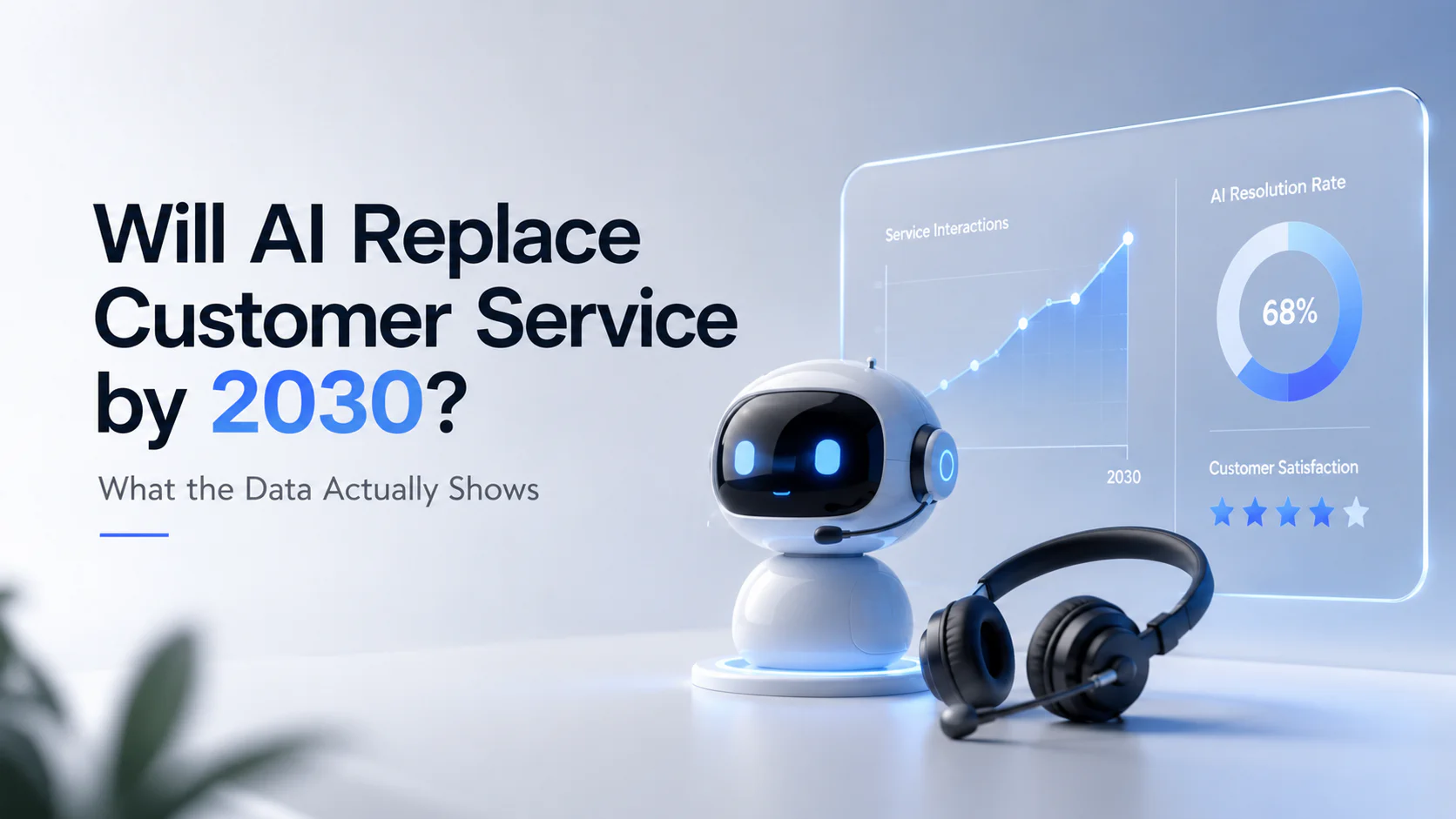
AI will replace parts of customer service, but it will not replace the whole function by 2030. The highest-risk work is repetitive, policy-based, and easy to verify: order status, password resets, refunds within rules, routing, FAQ answers, and ticket summaries. The safest work is emotional, complex, high-value, regulated, or relationship-based.
Quick answer: customer service jobs will shrink and change, not disappear. AI will handle more first-contact and self-service volume; humans will handle escalations, retention, exceptions, angry customers, sensitive issues, and quality control.
| Support task | Automation risk by 2030 | Why |
|---|---|---|
| Order status, password resets, FAQs | High | Clear intent, structured answer, low judgment |
| Ticket triage and summaries | High | AI is already good at classification and summarization |
| Basic refunds inside policy | Medium-high | Works if rules and permissions are strict |
| Technical troubleshooting | Medium | Needs diagnosis and escalation paths |
| Retention and angry customers | Low-medium | Tone, negotiation, and judgment matter |
| Regulated complaints and exceptions | Low | Requires compliance, audit trail, and accountability |
Source check — June 4, 2026: BLS projects customer service representative employment to decline 5% from 2024 to 2034, while still projecting about 341,700 openings per year from replacement needs. Qualtrics’ 2026 CX research says nearly one in five consumers saw no benefit from AI customer service, and Salesforce expects AI to resolve 50% of service cases by 2027. The combined signal: automation is real, but customer trust and escalation design decide whether it works.
For adjacent career risk, compare what jobs AI will replace by 2030, ChatGPT for customer service, and AI chatbots.
The Changes in Customer Service with the Growth of AI Integrations
The acceleration from 2023 to 2025 has been dramatic.
In customer service specifically, 82% of support teams invested in AI in 2025, per Intercom’s Customer Service Transformation Report.
On the ground, AI handles first contact, triages tickets, and resolves routine issues at a scale that would have been unthinkable two years ago. Modern AI chatbots in 2026 are doing this work across thousands of support operations. Salesforce’s 2025 State of Service report found that teams expect AI to resolve 50% of service cases by 2027.
This is real, and it’s worth paying attention to. But adoption and maturity are different things. Only 10% of support teams have reached mature AI deployment. Half remain stuck in pilot mode. Understanding what’s happening puts you ahead of most people.
The Role of Natural Language Processing (NLP) and Large Language Models (LLMs)
NLP is still the foundation underneath customer service AI, but in 2026, it’s really LLMs doing the heavy lifting.
The older NLP systems were quite literal: they’d chop up a customer message, figure out the intent, then route it to the right bucket. You type “Where is my order?” and it gets tagged as a Track Order request. Simple, predictable, limited. That pipeline is still running in a lot of systems, but it’s increasingly just the plumbing.
LLMs now sit on top of it, handling context, reasoning, and response generation in ways the older stack never could.
Does AI Actually Enhance Customer Experience?
The honest answer: for simple queries, yes. For anything complex, the results remain questionable.
Intercom’s Fin AI Agent averages a 66% resolution rate across 6,000 customers. That’s actually two out of three conversations handled start to finish without a human getting involved. For routine questions like “Where’s my order?” or “How do I reset my password?”, AI delivers speed that humans cannot match. Customers get answers immediately.
But the failure rate tells a different story. Nearly one in five consumers who used AI for customer service saw no benefits from the experience, according to Qualtrics’ 2026 Consumer Experience Trends Report. That failure rate is almost four times higher than for AI use in other tasks. Consumers rank AI customer service applications among the worst for convenience, time savings, and usefulness.
Klarna’s trajectory illustrates the gap between promise and reality. The Swedish fintech got a lot of press in 2024 when it rolled out an AI assistant and claimed it could replace 700 customer service agents. The coverage was breathless. So was the initial cost savings.
For basic questions like “Did I pay Klarna?” it worked well enough — volume went up, headcount went down. But the moment things got complicated, cracks appeared.
Within months, customer satisfaction dropped sharply.
Things got messy fast. Developers and designers got pulled into support just to keep things from falling apart — that’s not the efficiency story they were telling. This kind of organizational chaos is exactly what AI replacement of managers and team leads is supposed to prevent, yet it’s what happens without proper oversight. The CEO eventually admitted they’d put cost savings ahead of actually serving customers.
Klarna started rehiring human agents in 2025 and moved toward a model where AI handled the simple stuff, and people handled everything else.
The Pros and Cons of AI for Customer Conversations
The picture that emerges from current data is nuanced: AI genuinely improves some aspects of customer experience while creating friction in others. Before deciding how to position yourself in this landscape, it helps to see the trade-offs laid out clearly.
Pros
Cost efficiency. AI-powered interactions cost a fraction of what human agents charge. At any significant scale, the math starts to look pretty compelling, especially for the kind of repetitive volume most support teams deal with.
Speed and availability. Resolution times shrink dramatically. Customers get answers in seconds rather than waiting in queues, and the system works 24/7 across time zones.
Volume handling. AI can manage conversation volumes that would require hundreds of full-time agents to match. Scalability happens without proportional increases in headcount.
Consistent responses. No one’s having a bad day, no one misremembers the policy, no one gives a different answer than their colleague did yesterday.
Continuous improvement. Each model upgrade improves performance without retraining staff. Systems available today resolve significantly more queries than versions from 12 months ago.
Query deflection. The routine tickets never reach a human agent. That frees your experienced people up for the stuff that actually needs them.
Cons
Emotional nuance failures. Customers consistently report that human agents show more empathy. Sarcasm, frustration, and emotional subtext remain largely unreadable.
Context retention problems. Multi-turn conversations degrade quickly. Customers report repeating information, and when complexity increases, the AI loses track of earlier context.
Hallucination risk. AI sometimes makes things up, and it does it confidently. In April 2025, a Cursor support bot invented a company policy that didn’t exist. Customers started canceling their subscriptions before anyone caught it.
Escalation failures. The handoff from AI to humans is still pretty rough in most implementations. Few customers experience a seamless transition, and re-explaining problems after AI failure makes the experience worse.
Customer resistance. Most customers still prefer human support. Many believe AI is deployed to save money, not to help them.
Hidden costs. The cost advantage may narrow. In January 2026, Gartner analysts predicted that by 2030, the cost of running GenAI might actually exceed what companies would have spent on human agents, once you factor in all the infrastructure and maintenance.
The Long-Term Viability of Human Agents in Customer Support
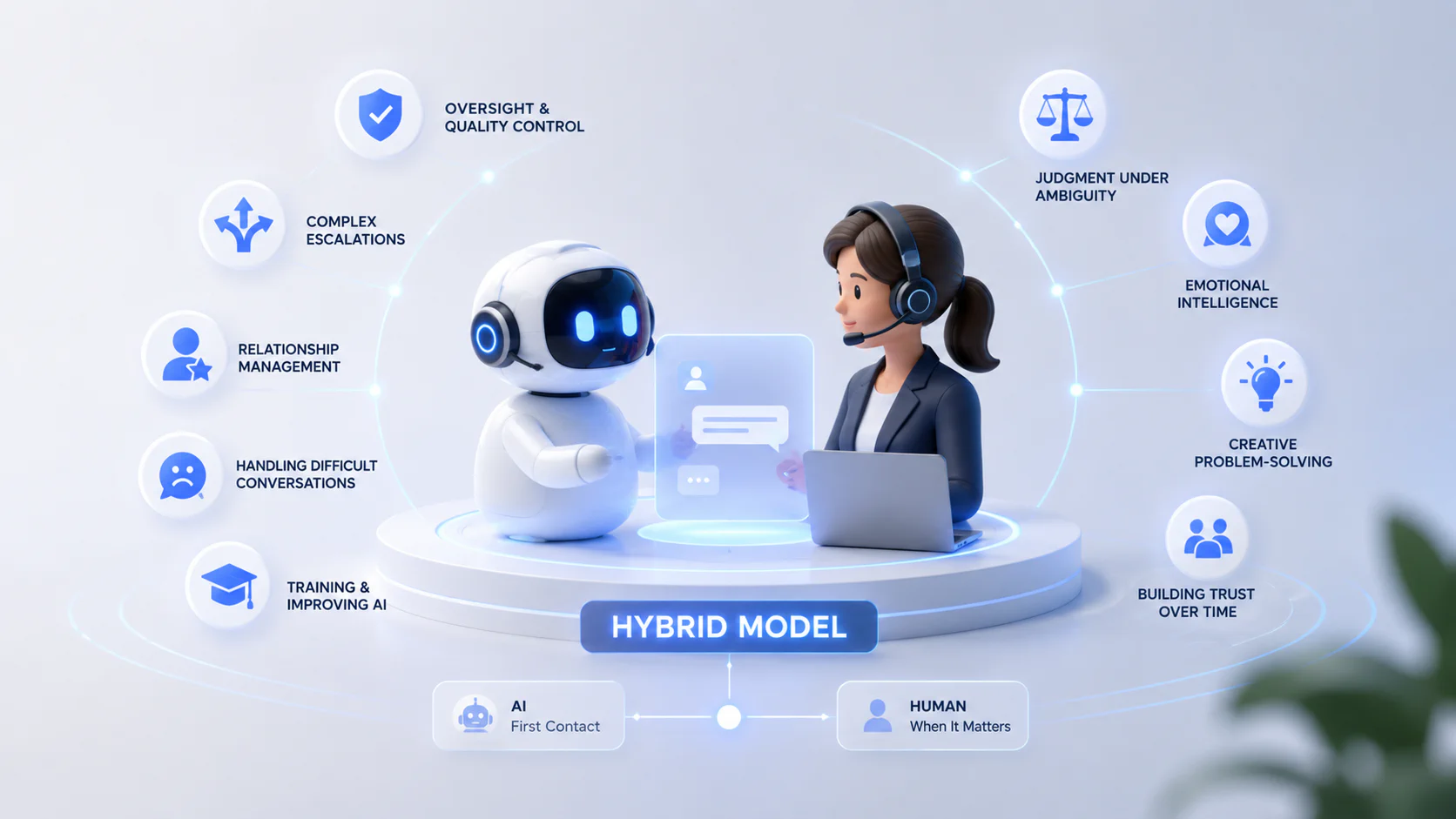
The hybrid model is where most serious companies are landing. AI takes first contact, and a human steps in when the situation calls for it.
Gartner’s research confirms this trajectory. In a March 2025 poll of 163 customer service leaders, 95% said they plan to keep human agents around specifically to set the guardrails for AI — not just to handle overflow.
What human roles look like in this setup is different from what we’re used to:
- Oversight and quality control. Someone has to watch what the AI is putting out, catch the errors, and make sure nothing embarrassing or wrong gets sent to customers.
- Complex escalations. Problems that require judgment, context, or creative solutions route to humans.
- Relationship management. Premium accounts aren’t just bigger, they’re more complicated. These clients have years of history, multiple contacts, ongoing disputes, and a relationship that goes beyond any single interaction. You can’t hand that off to a bot and expect it to go well.
- Handling difficult customer conversations. An upset customer doesn’t want efficiency. They want to actually be heard by someone who can do something about it.
- Training and improving AI. The professionals who understand customer needs best are often the ones teaching AI systems what good service looks like.
Judgment under ambiguity, real emotional intelligence, creative problem-solving, knowing how to build trust with someone over time — those become more valuable as AI absorbs the routine stuff.
That may change soon, too, though. Recently, for example, AI resolved my request properly when I reached Claude support. I never heard back from a human agent.
It means you shouldn’t ignore AI. Instead, go as deep as you can in understanding it and integrating it into your work.
How Customer Service Professionals Can Adapt
Understanding AI’s trajectory matters. But understanding alone doesn’t change your career. Action does.
Start using AI tools now. If you tested AI in 2023, things look very different now. Matt Shumer put it well — what exists today is basically unrecognizable compared to what it was even six months ago. The free versions are over a year behind what paying users have access to. For $20/month, you can access the best AI chatbots of 2026 like Claude or ChatGPT’s top models and start using them in your actual work — not as a search engine, but as a collaborator.
Try using AI tools in your actual work:
- Test complex scenarios. Give it a difficult customer situation and see how it handles the nuance.
- Draft and refine responses. Write a first draft and have AI improve it, or vice versa.
- Summarize complaint histories. Let it condense long case notes into actionable summaries.
- Practice de-escalation. Role-play difficult conversations to prepare for real ones.
- Translate communications. Use it for multilingual support or internal documentation.
Be the person who gets this. Most people in your organization aren’t paying close attention yet. That gap is yours to use. If you’re the one who can explain what AI handles well, where it breaks down, and how to make the handoff smoother — that’s a genuinely valuable position to be in.
Explore new careers. Salesforce identified 10 new job categories emerging from AI in customer service, including AI Customer Experience Strategist, Conversational AI Designer, and AI Trainer. These roles didn’t exist three years ago. Understanding what jobs will AI replace by 2030 helps you spot where the growth opportunities actually are.
Build the habit of learning. The AI tools will keep changing every week. Even one hour a day experimenting gets you ahead of most of your peers. Get comfortable adapting repeatedly — that’s the new normal.
Coursiv’s 28-Day AI Certificate Program Challenge is built for exactly this — practical AI skills for professionals who want to stay ahead without wading through theory. Bite-sized lessons you can apply at work tomorrow, designed to fit into a busy schedule.

FAQ