Last updated: July 24, 2026
July 24, 2026 update: Sakana released Fugu-Ultra v1.1, and the Fugu Ultra model ID is now versioned:
fugu-ultra-v1.1is current, and the originalfugu-ultra-20260615is formalized asfugu-ultra-v1.0. If your Codex or Cursor config pins a specific Fugu Ultra model ID, update it to the versioned name. Setup paths below are unchanged.
Sakana Fugu is getting search interest from developers because the launch page and GitHub repository make it look like a model endpoint, an agent framework, and a coding-tool integration all at once. The clearest coding queries are Codex Fugu, codex-fugu, Sakana Fugu Cursor, Sakana Fugu API, and Sakana Fugu GitHub.
Quick answer: Sakana’s public GitHub README lists a one-line installer that can install Fugu into Codex and then launch it with codex-fugu. Cursor usage is less direct: Sakana Fugu is exposed through an OpenAI-compatible API, so Cursor support depends on whether your current Cursor setup supports the required custom endpoint, API key, and model ID. Claude Code is not the same integration path because Claude Code is Anthropic-oriented, while Fugu is accessed through Sakana’s API.
For the broader model review and Fable 5 comparison, start with the Sakana AI Fugu review. This page focuses on setup and tool-fit questions.
What is codex-fugu?
codex-fugu is the launcher name Sakana lists in the public SakanaAI/fugu GitHub repository. The README says users can install Fugu into Codex with:
curl -fsSL https://sakana.ai/fugu/install | bash
Then launch it with:
codex-fugu
The repository also links to a command reference and notes that the one-line install supports Ubuntu and macOS. On Windows, Sakana points users to a manual setup guide.
Security note: a curl | bash installer can be convenient, but teams should review the script and repository before running it on machines with sensitive code, secrets, or production credentials.
Sakana Fugu and Codex
Codex is the most direct coding-tool story because Sakana’s README explicitly mentions installing Fugu into Codex. The intended workflow is:
- get Sakana API access;
- install or configure the Fugu integration;
- launch
codex-fugu; - use Fugu as the model layer inside a coding-agent workflow;
- monitor latency, token usage, and output quality.
This can be useful if you already use terminal-based coding agents and want to test whether Fugu’s orchestration helps with code review, repo navigation, test debugging, or longer planning tasks.
Start with non-sensitive repositories. Do not test a new third-party model integration on private production code until your team has reviewed data handling, secrets exposure, logs, and billing.
Sakana Fugu and Cursor
Searchers are already asking about Sakana Fugu Cursor, but the safer wording is: Fugu may fit Cursor-style workflows only if your current Cursor setup supports the required custom OpenAI-compatible connection.
Sakana says Fugu is available through an OpenAI-compatible API. Cursor and similar coding tools often support custom or OpenAI-style providers, but support can vary by app version, plan, endpoint behavior, model ID validation, and whether the tool uses Chat Completions or Responses-style calls.
A cautious Cursor checklist:
| Step | What to verify |
|---|---|
| API access | You have a Sakana API key and know the current endpoint/model ID from Sakana’s console/docs. |
| Custom provider support | Your Cursor version supports the needed custom OpenAI-compatible base URL and model ID. |
| Endpoint compatibility | The tool sends requests in a format Sakana’s API supports. |
| Small test | Run a tiny non-sensitive prompt before using repo context. |
| Logs and billing | Check whether usage appears as expected in Sakana’s console. |
| Repo safety | Exclude secrets, .env files, credentials, and sensitive customer data. |
If Cursor rejects the model ID or endpoint, that does not necessarily mean Fugu is broken. It may mean the coding tool’s custom-provider implementation is incompatible with the current API behavior. In that case, test the Sakana API directly or use the official Codex path first.
Sakana Fugu and Claude Code
Sakana Fugu Claude Code is a natural search query, but it is not the cleanest integration path.
Claude Code is Anthropic’s coding-agent product for Claude models. Sakana Fugu is a Sakana API product exposed through an OpenAI-compatible interface. Those are different provider stacks. Unless a tool explicitly supports custom OpenAI-compatible providers in the right place, you should not assume Fugu can be dropped into a Claude Code workflow.
If your goal is simply to compare coding agents, use separate evaluations:
- Claude Code with the Claude models available to your account;
- Codex or another OpenAI-compatible coding harness with Sakana Fugu;
- Cursor with its native models or a supported custom provider, if compatible;
- the same repo tasks, tests, and scoring rubric across all tools.
Which Fugu model should coding teams test?
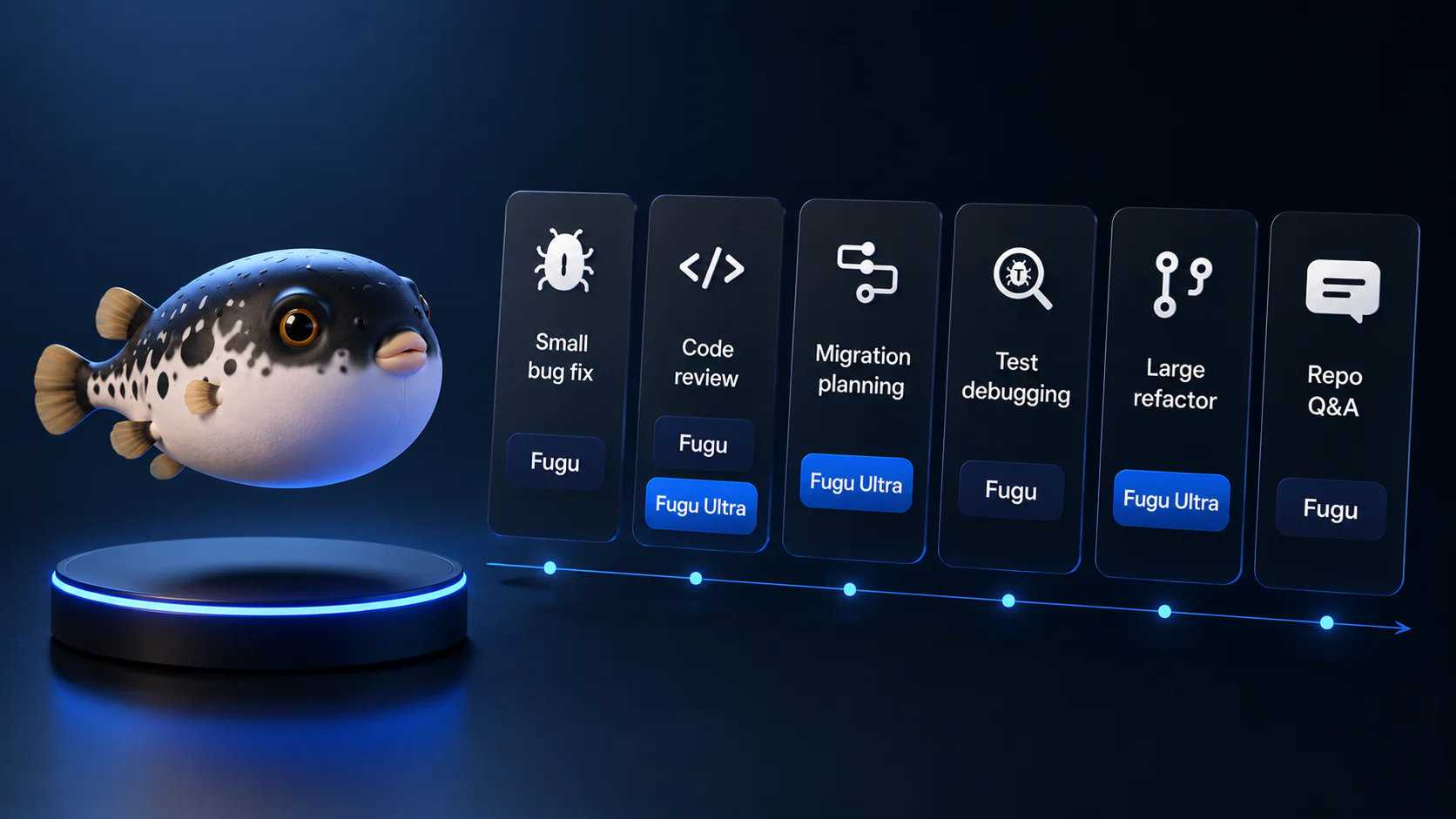
For coding workflows, start with standard Fugu unless the task is clearly complex.
| Coding task | Suggested starting point | Why |
|---|---|---|
| Small bug fix | Fugu | Lower-latency default is usually enough |
| Code review | Fugu, then Fugu Ultra for hard reviews | Compare whether deeper orchestration changes findings |
| Migration planning | Fugu Ultra | Planning and verification may matter more |
| Test debugging | Fugu | Fast iteration matters |
| Large refactor | Fugu Ultra | Longer planning and multi-step validation may help |
| Repo Q&A | Fugu | Usually interactive and latency-sensitive |
For more on the higher-quality variant, see Fugu Ultra.
Cost and safety checks for coding workflows
Coding agents can use many tokens because they read files, inspect logs, run tools, generate patches, and revise outputs. Before rolling Fugu into a real workflow, track:
- tokens per task;
- orchestration usage for Fugu Ultra;
- latency per step;
- number of retries;
- whether tests pass;
- whether the patch is smaller or larger than expected;
- human review time;
- any data that leaves the local environment.
Also use a standard agent safety checklist:
- remove secrets from the repo;
- avoid production credentials;
- keep destructive commands disabled unless explicitly reviewed;
- review generated code before merge;
- run tests locally;
- check licensing if generated code includes unfamiliar snippets;
- keep an audit trail for compliance-sensitive work.
Is Sakana Fugu open source?
Sakana has a public GitHub repository for Fugu materials, but the hosted Fugu API and exact orchestration behavior are not the same as a fully open-source model release.
| Item | Status |
|---|---|
| GitHub repository | Public |
| README and setup docs | Public |
| Technical report | Public |
| Hosted Fugu API | Sakana product |
| Full orchestration/routing internals | Not exposed as open-source code |
| Underlying worker model details per request | Not normally visible to users |
This is important for teams evaluating Fugu for sensitive repositories. Public setup materials help with inspection, but they do not remove the need for API, privacy, and vendor review.

Sources checked
FAQ
What is codex-fugu?
codex-fugu is the launcher Sakana lists for using Fugu with Codex after installing the Fugu configuration from the public SakanaAI/fugu repository.