Last updated: July 24, 2026
July 24, 2026 update: Sakana shipped Fugu-Ultra v1.1, a drop-in refresh of Fugu Ultra with newer frontier models in the agent pool. Sakana claims up to 7.9 benchmark points over v1.0, with the strongest gains on ProgramBench and Terminal Bench 2.1, at unchanged pricing. The Fugu family also now includes a third model, Fugu Cyber, for cybersecurity work. The review below covers the June 2026 launch; the v1.1 update post covers what changed.
Sakana AI is getting attention because it is taking a different approach from simply training another large chatbot. Its latest launch, Sakana Fugu, is a model interface designed to coordinate other models. That makes the natural comparison Fugu Ultra vs Claude Fable 5: one is a multi-model orchestrator, the other is Anthropic’s high-end Mythos-class model for long-horizon work.
On June 22, 2026, the Tokyo AI lab released Fugu and Fugu Ultra, described by Sakana as a multi-agent orchestration system delivered through a single model API. Instead of asking developers to manually pick between Claude, GPT, Gemini, open models, custom agents, verification passes, and retry loops, Fugu tries to decide that internally.
Quick answer: Sakana Fugu is an OpenAI-compatible API that behaves like one model, but behind the scenes it can route, delegate, verify, and synthesize work across a pool of specialist AI agents. The standard Fugu model is built for everyday latency-sensitive work. Fugu Ultra is positioned for harder tasks where quality matters more than speed. Sakana reports strong Fugu Ultra results on coding, reasoning, science, and agentic benchmarks — including comparisons to Claude Fable 5 and Mythos Preview — but those results should be read as vendor-published evidence, not independent proof.
Review verdict: Fugu may be worth evaluating if your team needs a multi-model AI layer for coding, research, or difficult analysis. It should not be treated as a one-to-one substitute for Claude Fable 5, because Fable 5 is a single premium base model with clearer model identity, while Fugu is an orchestration system with less visible routing. The main reason to test Fugu Ultra is not to declare a universal winner; it is to see whether learned orchestration changes outcomes on your own workload while reducing dependence on a single model provider.
If you are choosing AI tools for coding, research, product analysis, or long-horizon agent work, Fugu matters because it points to a broader shift: the product may no longer be one model. The product may be the orchestrator that knows which model, agent, tool, and verification path to use.
What is Sakana AI?
Sakana AI is a Tokyo-based frontier AI research and product company founded in 2023 by David Ha, Ren Ito, and Llion Jones. The company describes itself as focused on nature-inspired intelligence, collective intelligence, evolutionary optimization, automated science, and AI systems tailored to Japan.
That founder mix is part of why the lab gets attention:
- David Ha, CEO, previously worked at Google Brain and is known for research on self-organizing systems and evolutionary approaches to AI.
- Ren Ito, chairman, has a background spanning Japan’s Ministry of Foreign Affairs, Mercari, and Stability AI.
- Llion Jones, CTO, is one of the co-authors of the 2017 Transformer paper, Attention Is All You Need.
Sakana has also raised substantial capital for that strategy. In November 2025, TechCrunch reported that Sakana closed a ¥20 billion, approximately $135 million, Series B round at a $2.65 billion post-money valuation. That funding context matters because Sakana is not just publishing research demos; it is trying to turn orchestration, automated research, and Japan-focused enterprise AI into products.
Sakana has been building a research story around models that collaborate, evolve, and improve rather than relying only on brute-force scale. Notable examples include:
- The AI Scientist, an agentic research system that can generate research ideas, run experiments, write papers, and review outputs.
- AI Scientist-v2, which Sakana says produced the first fully AI-generated paper to pass a human peer-review process at a top AI workshop.
- The Darwin Gödel Machine, a self-improving coding-agent system that rewrites its own code and validates changes on benchmarks.
- Sakana Marlin, a long-horizon autonomous research product positioned as a “virtual CSO” for deep strategy research.
- Sakana Fugu, the new multi-agent model-orchestration API.
That is the through-line: Sakana is less interested in a single chat interface and more interested in systems where many agents search, critique, combine, and improve.

Why Sakana AI is getting attention right now
The current spike in attention is mostly about Sakana Fugu, launched publicly on June 22, 2026. It follows several months of Sakana announcements that all point in the same direction.
The timing also matters for search demand. Claude Fable 5 launched on June 9, then Anthropic announced a government-directed access suspension on June 12. That made “Fable 5 alternative,” “Fugu Ultra vs Fable 5,” and “AI model access restrictions” more commercially relevant than a normal model benchmark story.
| Date | Sakana AI milestone | Why it mattered |
|---|---|---|
| March 25, 2026 | Mitsubishi Electric announced an investment in Sakana AI | Signaled demand for enterprise AI in manufacturing, infrastructure, and Japan-specific industrial use cases. |
| March 26, 2026 | The AI Scientist work was published in Nature | Put automated AI research into a mainstream scientific venue. |
| April 24, 2026 | Sakana opened Fugu beta | Previewed Fugu as a commercial multi-agent orchestration system. |
| June 5, 2026 | Sakana announced its Recursive Self-Improvement Lab | Connected AI Scientist, Darwin Gödel Machine, and self-improving agents into one research agenda. |
| June 15, 2026 | Sakana Marlin launched | Turned long-running autonomous research into a paid product for strategy work. |
| June 22, 2026 | Sakana Fugu launched | Productized learned model orchestration as a single API. |
The headline is not just “new model.” The headline is that Sakana is packaging multi-agent coordination as something developers can call like a normal model.
For broader context on agent tools, compare this with AI agents for business and AI agents for coding. Fugu sits in a different category: it is not just an app, and not exactly a raw model. It is an orchestration layer sold as a model endpoint.
What is Sakana Fugu?
Sakana Fugu is a multi-agent system that behaves like a single model.
You send a request to one endpoint. Fugu decides whether to answer directly, route the task to one underlying worker, or coordinate multiple agents. The system can handle model selection, delegation, verification, and final synthesis internally.
Sakana’s product page describes the pitch in three parts:
- One API for multiple models. Developers call one OpenAI-compatible API instead of writing their own router or agent workflow.
- Complex-task support. Fugu is aimed at coding, reasoning, research, and other work where a single model pass may be insufficient.
- Configurable agent selection. For the standard Fugu model, teams can opt out of specific models or providers for privacy, compliance, or organizational constraints.
The important nuance: Fugu is not simply another LLM competing head-to-head with Claude or GPT as a standalone model. It is closer to a learned conductor. The intelligence is in deciding how to use the model pool.
That distinction matters because benchmark results from an orchestrator are not the same thing as benchmark results from a single base model. If Fugu calls other frontier models under the hood, then part of the capability comes from those workers. Sakana’s claim is that the coordination layer adds value beyond simply calling one worker directly.
Is Fugu AI an LLM?
Searchers often use phrases like Fugu AI, Fugu LLM, or Fugu AI model. The clean answer is: Sakana Fugu is presented as a model endpoint, but it is better described as a learned orchestration model rather than a single standalone LLM.
From the developer’s point of view, you call Fugu like a model. From the system-design point of view, Fugu can select or coordinate workers from a model pool. That is why the wording matters:
| Query wording | Practical meaning |
|---|---|
| Fugu AI | The product name people use for Sakana’s Fugu system |
| Fugu LLM | A reasonable shorthand, but incomplete because Fugu is an orchestrator |
| Fugu AI model | Useful for API buyers comparing model endpoints |
| Sakana Fugu | The official product name |
| Sakana Fugu Ultra | The higher-quality, slower variant for harder tasks |
For a narrower explanation of the Ultra variant, see the dedicated Fugu Ultra guide.
Sakana Fugu vs Claude Fable 5: quick comparison
One important comparison is Sakana Fugu vs Claude Fable 5, because both products target similar high-difficulty workflows: long-horizon coding, agentic work, research, analysis, and multi-step reasoning.
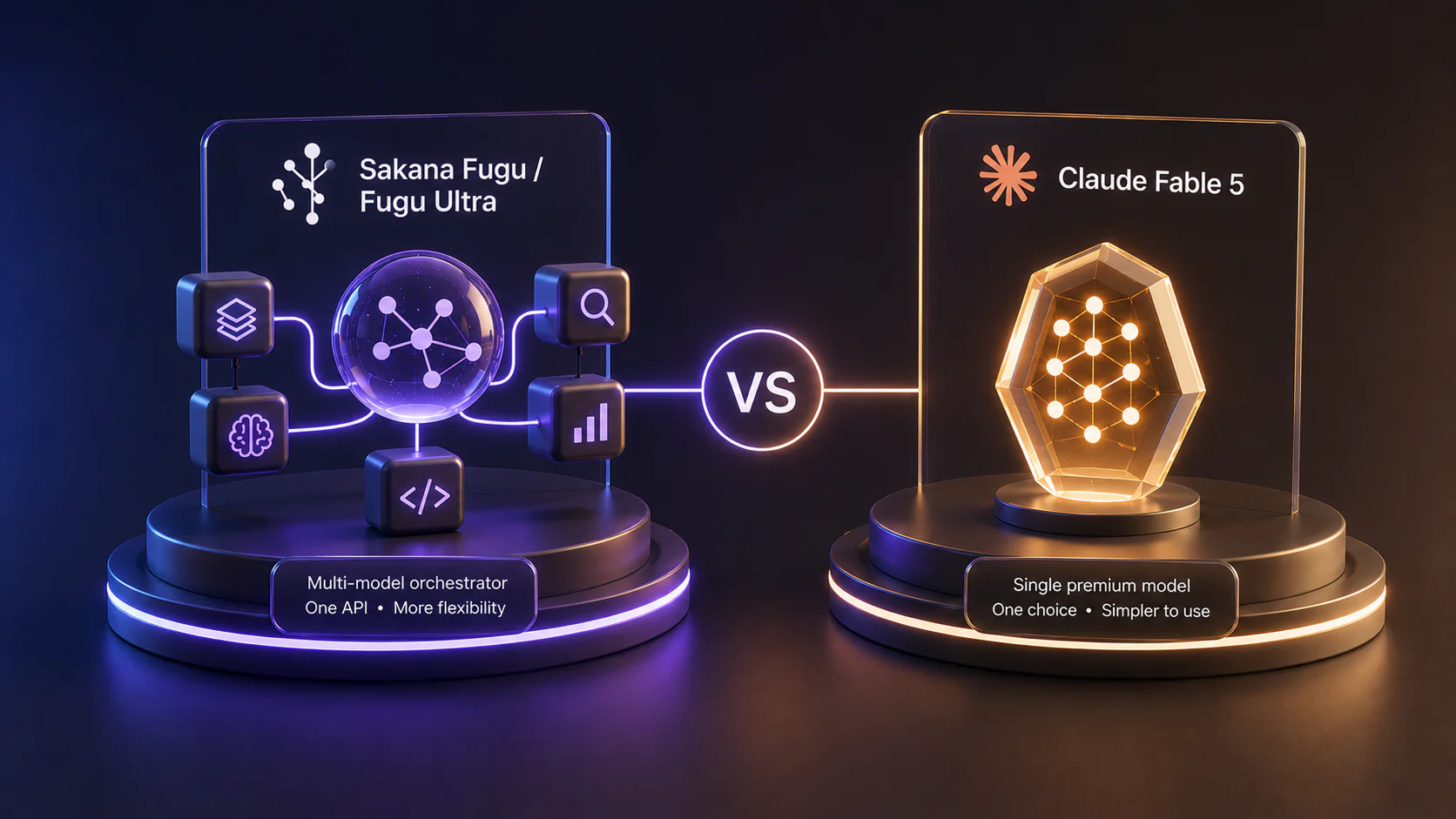
They are not the same kind of product. Claude Fable 5 is Anthropic’s premium Mythos-class model for difficult coding, agents, knowledge work, vision, and long-running tasks. Sakana Fugu is a model orchestration layer that can coordinate multiple models behind one API. A simple analogy: Fable 5 is a single model choice, while Fugu is a system for deciding how multiple model choices should be used.
As of June 22, 2026, this comparison also has an availability and compliance angle. Anthropic’s Claude Fable 5 page lists Fable 5 access as unavailable, and Anthropic’s June 12 statement says a U.S. government directive led it to suspend Fable 5 and Mythos 5 access for foreign nationals and then disable access more broadly to ensure compliance. Sakana positions Fugu around multi-provider flexibility, which may help some teams reduce reliance on a single restricted model.
| Comparison | Sakana Fugu / Fugu Ultra | Claude Fable 5 |
|---|---|---|
| Product type | Learned multi-agent orchestrator exposed as one API | Single Anthropic Mythos-class model |
| Main promise | Coordinate multiple models to improve difficult workflows and reduce single-vendor dependency | Premium long-horizon reasoning, coding, agents, and knowledge work |
| API style | OpenAI-compatible API; Chat Completions and Responses support listed in the Fugu repo | Claude API model ID claude-fable-5 |
| Current access context | Sakana says Fugu is available outside the EU/EEA, subject to account access and local restrictions | Anthropic’s Fable page listed access as unavailable in the June 22 source check |
| Pricing headline | Fugu Ultra: $5 input / $30 output per 1M tokens; orchestration tokens can also count | $10 input / $50 output per 1M tokens when available |
| Transparency | Exact worker models and routing are not exposed | Clear model identity, but safeguards can route flagged domains to Opus 4.8 |
| Likely fit | Teams that want a model-agnostic agent layer, code review, research, and provider flexibility | Teams that want one Anthropic model for hard work, if/when access is restored |
| Watch-outs | Opaque routing, hidden orchestration cost, vendor-published benchmarks | Access changes, regulatory restrictions, 30-day retention, safeguard behavior |
Review take: Fugu Ultra should not be framed as the universal winner against Fable 5. It is more relevant when your real problem is vendor dependency, access variability, or the operational burden of building your own multi-agent router. Fable 5 is simpler to reason about when you want a single known model and Anthropic access is available. Fugu is more relevant when you want the model-selection problem abstracted away.
For the dedicated Anthropic model guide, see our Claude Fable 5 overview and Claude Fable 5 vs Opus 4.8 comparison.
Fugu vs Fugu Ultra
Sakana launched two Fugu variants.
| Model | Good fit | Tradeoff | What it does |
|---|---|---|---|
| Fugu | Everyday coding, code review, chatbots, interactive workflows | Lower latency, less deep coordination | Balances performance and response time. In the technical report, Sakana says this version is optimized for speed and selects a single worker per input. |
| Fugu Ultra | Hard multi-step reasoning, research, security analysis, Kaggle-style tasks, paper reproduction, patent/literature work | Slower and more expensive | Uses deeper orchestration over a larger expert-agent pool to maximize answer quality. |
The simplest mental model:
- Fugu = learned low-latency router/conductor for everyday work.
- Fugu Ultra = deeper multi-agent orchestration for hard tasks.
If you are writing a customer-support chatbot or doing routine code review, the base Fugu model may be more practical. If you are asking the system to reproduce a paper, analyze a security target within scope, or solve a difficult engineering problem, Fugu Ultra is the one Sakana is positioning for that job.
What is Fugu Ultra?
Fugu Ultra is Sakana’s quality-first Fugu variant. Sakana says it coordinates a deeper pool of expert agents and is aimed at complex, multi-step work where response time is less important than answer depth. On the official product page, Sakana lists example uses such as Kaggle competitions, paper reproduction, cybersecurity analysis, and literature or patent investigations.
That does not mean every team should default to Fugu Ultra. For most production systems, the choice is closer to this:
| Use case | Better starting point | Why |
|---|---|---|
| Interactive coding help | Fugu | Lower-latency default is usually easier to use repeatedly |
| Long code review or migration planning | Fugu or Fugu Ultra | Test both; longer tasks may benefit from deeper orchestration |
| Paper reproduction | Fugu Ultra | Sakana positions Ultra for long multi-step research workflows |
| Patent/literature analysis | Fugu Ultra | More synthesis and verification may be useful |
| Chatbot or support assistant | Fugu | Latency and cost usually matter more than maximum depth |
| Simple summaries | Neither may be necessary | A single cheaper model may be enough |
For the standalone SEO page targeting this query cluster, read Fugu Ultra: model, pricing, benchmarks, and use cases.
How Fugu works under the hood
Sakana says Fugu is grounded in two ICLR 2026 research papers: TRINITY and Conductor.
TRINITY: an evolved coordinator
The TRINITY paper describes a lightweight coordinator that orchestrates multiple LLMs over multiple turns. It assigns roles such as Thinker, Worker, and Verifier, then delegates work across coding, math, reasoning, and knowledge tasks.
The key idea is that the coordinator does not need to be the smartest model in the room. It needs to know who should do what, when to ask for verification, and how to use the group.
Conductor: learned natural-language orchestration
The Conductor paper focuses on training a model with reinforcement learning to discover agent coordination strategies. Instead of hard-coding a fixed agent workflow, Conductor learns communication patterns, worker prompts, and recursive structures that help a pool of models outperform individual workers on difficult reasoning benchmarks.
This is why Sakana calls Fugu an orchestration model rather than a classic router. A router typically picks a model. A conductor can design a mini-workflow.
Why this is different from a normal multi-agent app
Traditional multi-agent systems often require developers to write the system by hand:
- choose the models;
- write agent roles;
- decide when agents talk to each other;
- add critique and retry loops;
- build verification steps;
- manage tool use;
- choose a final answer.
Fugu tries to make that invisible from the outside. You call one API, and the orchestration happens inside the model product.
That is the part developers are reacting to. If it works reliably, it reduces the engineering burden of building agent systems from scratch.
Sakana Fugu benchmark claims
Sakana published benchmark results comparing Fugu and Fugu Ultra with frontier baselines including Opus 4.8, Gemini 3.1 Pro, and GPT-5.5. Sakana also compares against Fable 5 and Mythos Preview in some charts, while saying those models are not in Fugu’s agent pool because they are not publicly accessible.
Here are the main scores from the Sakana Fugu product page and technical report:
| Benchmark | Fugu | Fugu Ultra | Opus 4.8 | Gemini 3.1 Pro | GPT-5.5 |
|---|---|---|---|---|---|
| SWE Bench Pro | 59.0 | 73.7 | 69.2 | 54.2 | 58.6 |
| TerminalBench 2.1 | 80.2 | 82.1 | 74.6 | 70.3 | 78.2 |
| LiveCodeBench | 92.9 | 93.2 | 87.8 | 88.5 | 85.3 |
| LiveCodeBench Pro | 87.8 | 90.8 | 84.8 | 82.9 | 88.4 |
| Humanity’s Last Exam | 47.2 | 50.0 | 49.8 | 44.4 | 41.4 |
| CharXiv Reasoning | 85.1 | 86.6 | 84.2 | 83.3 | 84.1 |
| GPQA-D | 95.5 | 95.5 | 92.0 | 94.3 | 93.6 |
| SciCode | 60.1 | 58.7 | 53.5 | 58.9 | 56.1 |
| τ³ Banking | 21.7 | 20.6 | 20.6 | 8.4 | 20.6 |
| Long Context Reasoning | 74.7 | 73.3 | 67.7 | 72.7 | 74.3 |
| MRCRv2 | 86.6 | 93.6 | 87.9 | 84.9 | 94.8 |
Read this table carefully. It is useful early signal, but it is not a final verdict.
Sakana notes that the non-Fugu baseline scores are provider-reported. The Fugu results are Sakana’s own evaluation. That does not make them useless, but it does mean buyers should wait for independent replication, especially for production decisions.
The more interesting signal is not any single score. It is that learned orchestration may add value on tasks where planning, verification, coding loops, and multi-step decomposition matter.
Why Fugu matters
Fugu is interesting because it turns an engineering pattern into a product.
For the past two years, many advanced AI teams have been building internal systems that look like this:
- send the prompt to one strong model;
- ask another model to critique or verify;
- route coding subtasks to a coding-specialized model;
- use a cheaper model for summarization;
- run tools or tests;
- ask a final model to synthesize the answer.
That works, but it can be expensive to build and maintain. Every time a new model launches, teams often need to retest routing logic. Every time a provider changes pricing, latency, policy, or availability, the workflow may need tuning.
Fugu says: let the orchestration model learn that.
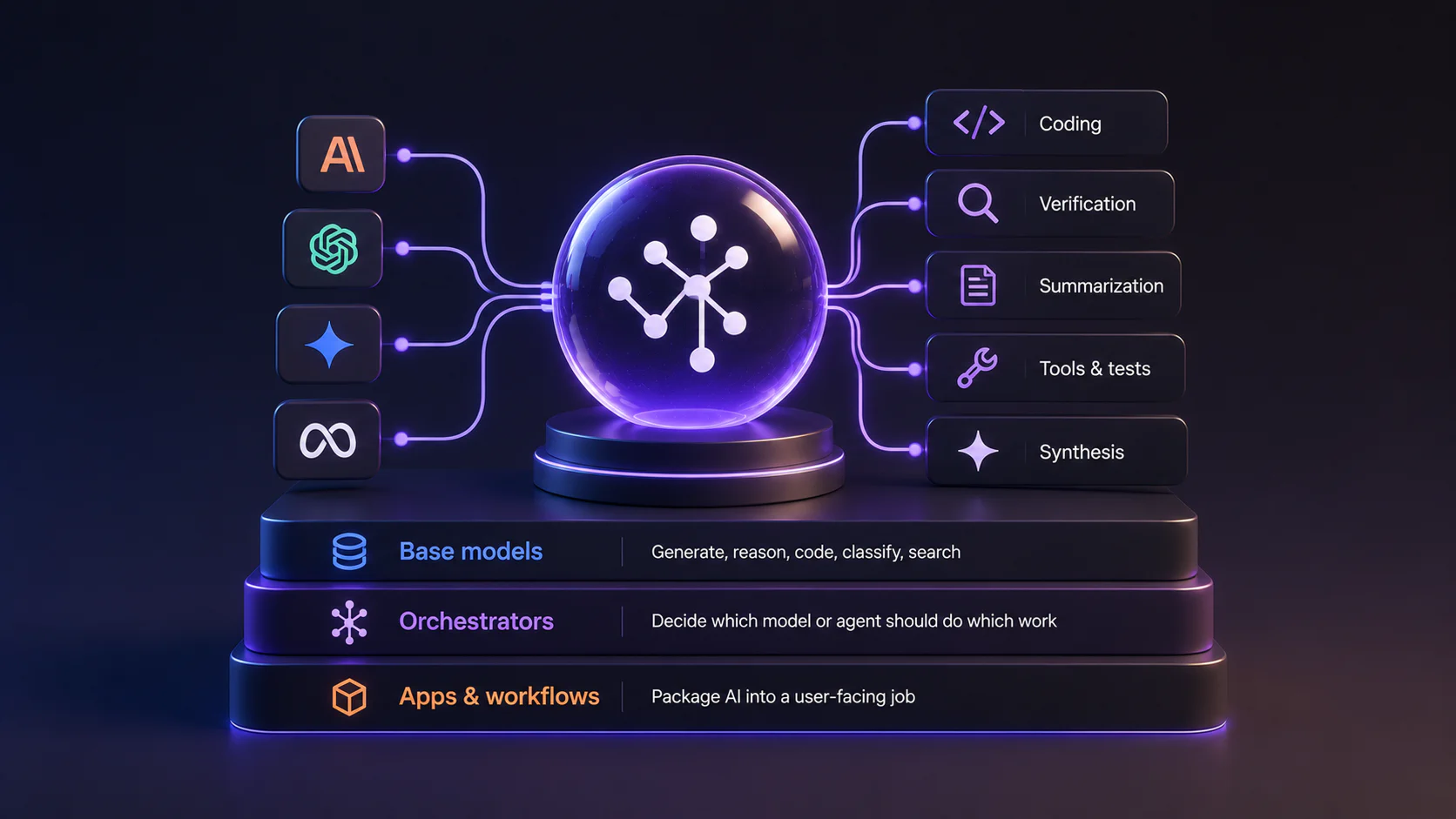
If this approach keeps improving, the AI stack may split into three layers:
| Layer | What it does | Example |
|---|---|---|
| Base models | Generate, reason, code, classify, search | Claude, GPT, Gemini, open models |
| Orchestrators | Decide which model or agent should do which work | Sakana Fugu, learned routers, agent conductors |
| Apps and workflows | Package AI into a user-facing job | coding agents, research assistants, analysts, customer-support systems |
That is why Fugu is not only a model launch. It is a bet on where value moves next.
Pricing: how much does Sakana Fugu cost?
Sakana lists both pay-as-you-go and subscription pricing.
Fugu pay-as-you-go pricing
For the standard Fugu model, pricing depends on the active agent pool:
- If one agent is active, you pay the standard rate for that specific underlying model.
- If multiple agents are active, Sakana says it does not stack model fees. You pay a single rate based on the top-tier model involved.
That is useful because naive multi-agent systems can become expensive fast. If every internal agent call is billed separately at full price, costs can explode. Sakana’s stated pricing model is meant to make orchestration more predictable.
Fugu Ultra pricing
For fugu-ultra-20260615, Sakana lists fixed pricing per 1 million tokens:
| Token type | Standard price | Context over 272K |
|---|---|---|
| Input | $5 | $10 |
| Output | $30 | $45 |
| Cached input | $0.50 | $1.00 |
One caveat: Sakana’s pricing page says Fugu Ultra usage fields separate visible model work from orchestration work, and orchestration tokens still count toward final pricing. In plain English: the final answer is not the only token cost. The hidden orchestration can add billable usage.
Subscription plans
Sakana’s product page also lists monthly subscription plans:
| Plan | Price | Fit |
|---|---|---|
| Standard | $20/month | Occasional API calls, small experiments, personal workflows |
| Pro | $100/month | Regular coding, review, research, and analysis sessions |
| Max | $200/month | Heavier long-running workloads |
Sakana says every subscription tier includes both Fugu and Fugu Ultra, with higher tiers offering more usage. It also lists a promotion for users subscribing before the end of July 2026.
Pricing and cost checklist
If you are comparing Sakana Fugu price, Sakana Fugu cost, or Fugu Ultra pricing, do not look only at the final answer length. Track four things in a real test:
- Input tokens — especially for long codebases, papers, or document sets.
- Output tokens — reports and code reviews can become long.
- Cached input tokens — useful if your workflow reuses the same context.
- Orchestration usage — Fugu Ultra may do work behind the visible response, and Sakana says orchestration tokens can count toward pricing.
A safe evaluation should compare cost per completed task, not just price per million tokens. For example, if one model is cheaper per token but fails more often, the apparent savings may disappear after retries and human review. Conversely, if Fugu Ultra is slower or uses more orchestration than expected, a cheaper single-model workflow may be easier to justify.
How to use Sakana Fugu
Sakana says Fugu is available through an OpenAI-compatible API, so existing clients can point to the Fugu endpoint without a full SDK migration. The GitHub README says the API supports both Chat Completions and Responses endpoints.
For Codex users, Sakana also provides a one-line installer in the Fugu repository:
curl -fsSL https://sakana.ai/fugu/install | bash
Then:
codex-fugu
As with any curl | bash installer, you should review the script and repository before running it on a machine with sensitive credentials. The convenience is real, but so is the security responsibility.
Sakana Fugu with Codex, Cursor, and coding tools
The search data already shows interest in Codex Fugu, codex-fugu, and Sakana Fugu Cursor. These are related but not identical workflows:
| Tool/query | What to know |
|---|---|
codex-fugu | Sakana’s GitHub README lists this launcher after the one-line Codex install. |
| Sakana Fugu Codex | Good fit if you want Fugu inside a terminal coding-agent workflow. |
| Sakana Fugu Cursor | Possible only if your Cursor setup supports the required custom OpenAI-compatible endpoint and model ID; validate with a small test first. |
| Sakana Fugu Claude Code | Not a direct Claude Code model swap. Claude Code is Anthropic-oriented, while Fugu is exposed through Sakana’s OpenAI-compatible API. |
For the practical setup-focused page, see Sakana Fugu with Codex and Cursor.
Is Sakana Fugu open source?
Sakana has a public SakanaAI/fugu GitHub repository, but that does not mean the full Fugu service or all underlying model orchestration is open source. The repository includes the README, installer/config materials, documentation, assets, and the technical report. The hosted Fugu system itself is a Sakana API product.
A practical way to phrase it:
- GitHub repo: public.
- Technical report: public.
- Installer/config tooling: public in the repo.
- Hosted Fugu model/orchestration service: proprietary API product.
- Exact worker routing: not exposed to users in normal API usage.
This distinction matters for procurement and compliance. A public GitHub repo can make setup easier to inspect, but it does not provide full visibility into the hosted model pool or routing decisions.
What does “Fugu” mean?
“Fugu” commonly refers to pufferfish in Japanese. In this product context, Sakana Fugu is simply the name of Sakana AI’s multi-agent model orchestration product. It should not be confused with unrelated uses of “Fugu” in food, biology, or other software projects.
Where Fugu could be useful
Fugu is most compelling when the task benefits from multiple viewpoints or staged verification.
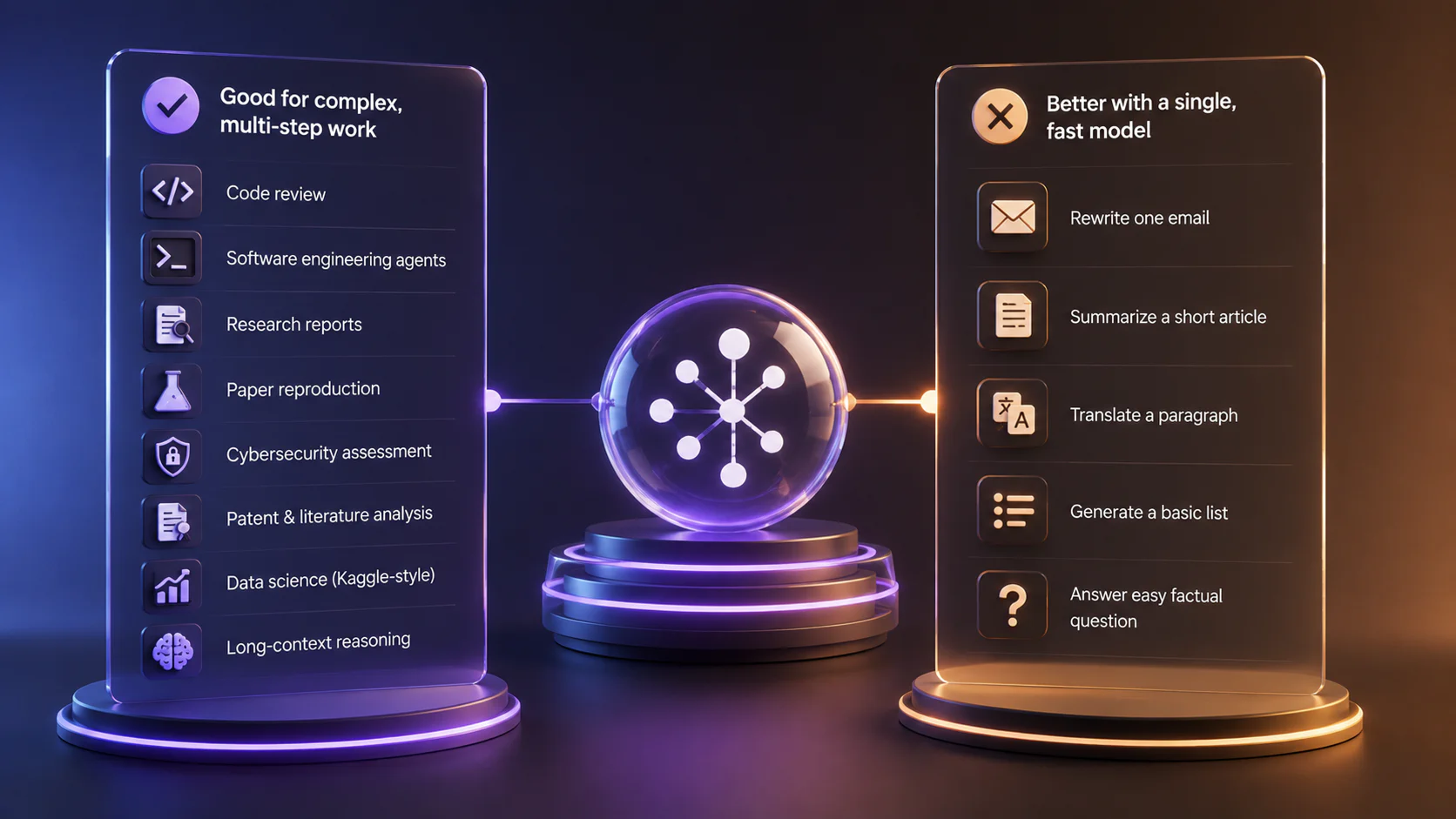
Good use cases include:
- code review, where one model can inspect architecture while another checks bugs and edge cases;
- software engineering agents, where the system needs to plan, edit, test, and revise;
- research reports, where retrieval, contradiction checking, and synthesis matter;
- paper reproduction, where models need to read, implement, run, debug, and interpret;
- cybersecurity assessment, when work is scoped, authorized, and evidence-driven;
- patent and literature analysis, where recall, structure, and judgment all matter;
- Kaggle-style data science, where search, experiments, and validation loops are useful;
- long-context reasoning, where a system may need to break the problem into smaller passes.
Fugu is less necessary for simple tasks:
- rewriting one email;
- summarizing a short article;
- translating a paragraph;
- generating a basic list;
- answering an easy factual question.
For those jobs, a single fast model is usually cheaper and simpler.
The caveats: what to watch before trusting Fugu
Fugu is interesting, but it introduces new review questions.
1. It is not fully transparent
Sakana says users cannot see which exact underlying models Fugu used for each query. The routing and coordination are proprietary by design.
That may be acceptable for many workflows. But regulated teams may need detailed logs, model provenance, and data-flow visibility. If you need to prove which model saw which data, hidden orchestration is a serious governance question.
2. Fugu Ultra’s pool is fixed
Sakana says standard Fugu lets users opt out of specific models from the console settings. Fugu Ultra, however, relies on the full agent pool to deliver maximum performance, so its pool is fixed.
That means privacy and compliance teams may prefer standard Fugu even if Ultra scores higher.
3. Cost can include orchestration usage
Fugu Ultra’s visible answer may be short while the internal orchestration is long. Sakana says orchestration tokens count toward billing. For long, hard tasks, you need usage monitoring rather than assuming cost from the final output alone.
4. Benchmark results need independent validation
Sakana’s published numbers are impressive. They are also vendor-published. Treat them as a reason to test Fugu, not as a reason to skip your own evaluation.
A good internal benchmark should include:
- your real prompts;
- your real documents or repos;
- latency tracking;
- token-cost tracking;
- failure-mode review;
- human evaluation;
- comparison with your current model or agent stack.
5. EU/EEA availability is restricted
Sakana says Fugu is not currently available in the EU/EEA while the company works toward GDPR and EU-specific compliance. It is available from outside Japan, but local regulations and network conditions may affect access.
Sakana Fugu review scorecard
This is a source-based launch review, not a private hands-on benchmark. The verdict below is based on Sakana’s official product pages, technical report, pricing page, GitHub materials, and the current Anthropic Fable 5 access context.
| Review category | Assessment | Why |
|---|---|---|
| Performance potential | Promising, needs validation | Sakana’s published Fugu Ultra numbers are strong across coding, reasoning, science, and agentic benchmarks, but they still need independent replication. |
| Ease of integration | Favorable | OpenAI-compatible API support and the Codex installer may lower migration friction for developers. |
| Fable 5 alternative value | Context-dependent | Fugu is not the same as Fable 5, but it may be worth evaluating when Fable 5 access is unavailable or when single-provider dependency is a concern. |
| Cost clarity | Needs workload testing | Token pricing is published, but orchestration tokens can add billable usage, so teams need real workload tests. |
| Transparency | Limited | Fugu hides exact model routing and coordination details, which is convenient for developers but may be difficult for audit-heavy teams. |
| Governance and compliance | Mixed | Standard Fugu offers some agent opt-out controls, but Fugu Ultra uses a fixed pool and EU/EEA access is restricted. |
| Provider flexibility | Potential advantage | The main strategic argument for Fugu is the possibility of reducing exposure to changes in model availability, policy, pricing, or provider access. |
Overall review: Sakana Fugu is one of the more notable AI infrastructure launches of 2026 because it addresses the model-selection problem directly. If your team only needs one high-quality model call, Fable 5, Opus 4.8, GPT-5.5, or Gemini may be simpler. If your team is already building routers, critic loops, multi-agent scaffolds, or model fallback logic, Fugu deserves a controlled evaluation.
Sakana Marlin: the other product to watch
Fugu is the developer-facing orchestration story. Sakana Marlin is the business-research story.
Sakana Marlin is positioned as a “virtual CSO” for ultra-deep strategy research. Instead of generating a quick chat response, it can run up to eight hours of autonomous reasoning: forming hypotheses, gathering information, browsing the web, checking contradictions, and producing detailed reports and slides.
The product is aimed at executive research and strategy work: market maps, policy changes, financial scenarios, regulation, industrial shifts, and similar topics where the value is not just summarization but decision-ready structure.
The connection to Fugu is obvious. Sakana is turning long-horizon agent research into products:
- Marlin packages autonomous research for business users.
- Fugu packages multi-agent orchestration for developers.
Both assume that serious AI work is not a single chat turn. It is a process.
The AI Scientist and Darwin Gödel Machine: why Sakana’s research matters
Fugu also makes more sense if you look at Sakana’s earlier research.
The AI Scientist
Sakana’s AI Scientist-v2 paper describes an end-to-end agentic system that can formulate hypotheses, design and execute experiments, analyze data, create figures, and write manuscripts. Sakana says one fully autonomous manuscript exceeded the average human acceptance threshold in an ICLR workshop review process.
On March 26, 2026, Sakana announced that the broader AI Scientist work was published in Nature. The company also openly lists limitations: weak ideas, methodological gaps, hallucinated citations, mistakes, and the broader risk of overwhelming scientific review systems.
That balance is important. The system is impressive, but it is not magic. It automates parts of the scientific workflow and exposes both the promise and the governance problem.
Darwin Gödel Machine
The Darwin Gödel Machine paper describes a self-improving coding-agent system that iteratively modifies its own code and empirically validates changes on coding benchmarks. The reported results improved from 20.0% to 50.0% on SWE-bench and from 14.2% to 30.7% on Polyglot, with safety precautions such as sandboxing and human oversight.
This fits Sakana’s broader theme: use evolution, search, feedback, and agent loops to improve AI systems without relying only on bigger base-model training runs.

How Sakana AI could affect OpenAI, Anthropic, and Google
Not in a simple “new chatbot displaces old chatbot” sense.
Sakana’s strategy is different. It depends on the existence of many strong models. Fugu becomes more valuable if the model ecosystem remains diverse: some models may be stronger at coding, some at math, some at long context, some at cost efficiency, some at regional availability, and some at Japanese language or enterprise constraints.
The competitive implication is more subtle:
- If orchestration becomes a common interface, users may care less which base model is underneath.
- If a learned conductor can swap providers, single-vendor lock-in becomes weaker.
- If agent systems outperform single calls, foundation-model companies may need to compete at the workflow layer, not just the base-model layer.
- If sovereign AI buyers want resilience, a model-agnostic orchestrator becomes strategically attractive.
That does not mean base models stop mattering. Fugu still needs strong workers. But it suggests that part of the next AI platform competition may shift toward who controls the coordination layer.
When should you evaluate Sakana Fugu?
Evaluate Fugu if you already spend time manually comparing models, building agent workflows, or routing hard tasks between tools.
Fugu is especially relevant to test if you:
- run code reviews or coding agents;
- need more reliable results on hard reasoning tasks;
- want one API that can use multiple models;
- care about reducing single-vendor dependency;
- have long research or analysis workflows;
- are building products where model choice changes by task.
Wait or test cautiously if you:
- need full model-level audit logs;
- operate in the EU/EEA;
- cannot tolerate opaque routing;
- need deterministic latency;
- have strict data-residency or model-provider rules;
- already have a mature internal router that works well.
The safest practical move is to benchmark it against your own workflow. Do not ask whether Fugu is universally superior in the abstract. Ask whether it changes outcomes on your hardest 20 prompts enough to justify cost, latency, and governance tradeoffs.
Bottom line
Sakana AI is trending because Fugu turns a real pattern in advanced AI use into a product: do not bet everything on one model; coordinate many models intelligently.
That may sound obvious, but productizing it as a single OpenAI-compatible API is the important step. If Fugu works as advertised, developers get a simpler path to multi-agent intelligence without hand-building the whole orchestration layer.
The caveat is that this is still an early, proprietary, vendor-evaluated system. The benchmark claims are promising, not conclusive. The hidden routing is convenient, but it creates governance questions. Fugu Ultra may be useful for hard workflows, but its orchestration tokens and latency need real testing.
Still, the direction is worth watching. Sakana’s bet is that future AI capability may come not only from bigger models, but also from models that know how to use other models.
Sources checked
- Sakana Fugu launch announcement
- Sakana Fugu product page
- Sakana Fugu GitHub repository and technical report
- Sakana AI pricing page
- TRINITY: An Evolved LLM Coordinator
- Learning to Orchestrate Agents in Natural Language with the Conductor
- The AI Scientist in Nature announcement
- The AI Scientist-v2 paper
- Darwin Gödel Machine paper
- Sakana Marlin product page
- Mitsubishi Electric investment announcement
- Sakana AI company information
- TechCrunch funding report
- Anthropic Claude Fable 5 page
- Anthropic Fable 5 and Mythos 5 announcement
- Anthropic statement on Fable 5 and Mythos 5 access
- Claude API models overview
- Claude API pricing
- SakanaAI/fugu GitHub repository
FAQ
What is Sakana AI Fugu?
Is Fugu a single AI model or a router?
What is the difference between Fugu and Fugu Ultra?
What is Fugu Ultra?
Is Sakana Fugu open source?
Does Sakana Fugu work with Codex or Cursor?
codex-fugu launcher for Codex after installation. Cursor usage depends on whether your Cursor setup supports the needed custom OpenAI-compatible endpoint and model ID; teams should verify with a small non-sensitive test before using it on real repositories.How does Sakana Fugu compare with Claude Fable 5?
Can Fugu Ultra be an alternative to Claude Fable 5?
How much does Sakana Fugu cost?
Can I use Sakana Fugu with OpenAI-compatible tools?
Is Sakana Fugu available in the EU?
Are Sakana Fugu’s benchmark results independently verified?
Why is Sakana AI important?