Technical note: Training or fine-tuning a model can create privacy, copyright, security, and quality risks. Use only data you have the right to use, and evaluate outputs before deployment.
For adjacent reading, see prompt engineering, building a personal AI assistant, and AI training career guide.
There’s a weird gap in how people talk about AI. On one side, you have researchers publishing dense papers nobody outside academia reads. On the other, you have Twitter threads promising you can “build your own ChatGPT in a weekend.” Neither is particularly useful.
This guide sits somewhere in between. It’s for people who actually want to understand how to train AI model – not just use the tools, but know what’s happening under the hood. Whether you’re a developer, a product person, or just someone who refuses to stay on the surface level of things.
What is AI model training and why you need to know the basics if you want to become an AI prompt engineering expert?
Here’s something counterintuitive: the best prompt engineers aren’t just people who write clever instructions. They’re people who understand why a model responds the way it does. And that understanding starts with knowing how to train your own AI model.
How AI models learn patterns from data
A model doesn’t “think.” It learns statistical relationships between inputs and outputs by processing enormous amounts of data. Feed it millions of sentences, and it figures out that certain words tend to follow other words in certain contexts. That’s the whole trick, more or less.
The key insight: the model is always approximating. It’s not retrieving facts from a database – it’s generating the most statistically likely next token given everything it’s seen.
The difference between using AI and training AI
Using AI means giving it a prompt and getting a response. Training AI means showing it thousands (or millions) of examples and adjusting its internal parameters so it gets better at predicting the right output. One is a conversation. The other is education.
Core concepts: inputs, outputs, and predictions
The key components of the training examples are the input, the output, and the prediction. Training is learning the steps to close the distance between prediction and target – again and again and again.
What are epochs and iterations in training
An epoch is one full pass through your entire training dataset. An iteration is a single update step – typically processing one small batch of examples. If you have 10,000 training examples and use a batch size of 32, one epoch is about 312 iterations. More epochs generally means more learning, but past a certain point you start memorizing rather than generalizing. That’s called overfitting, and it’s a real problem.
The training loop explained simply
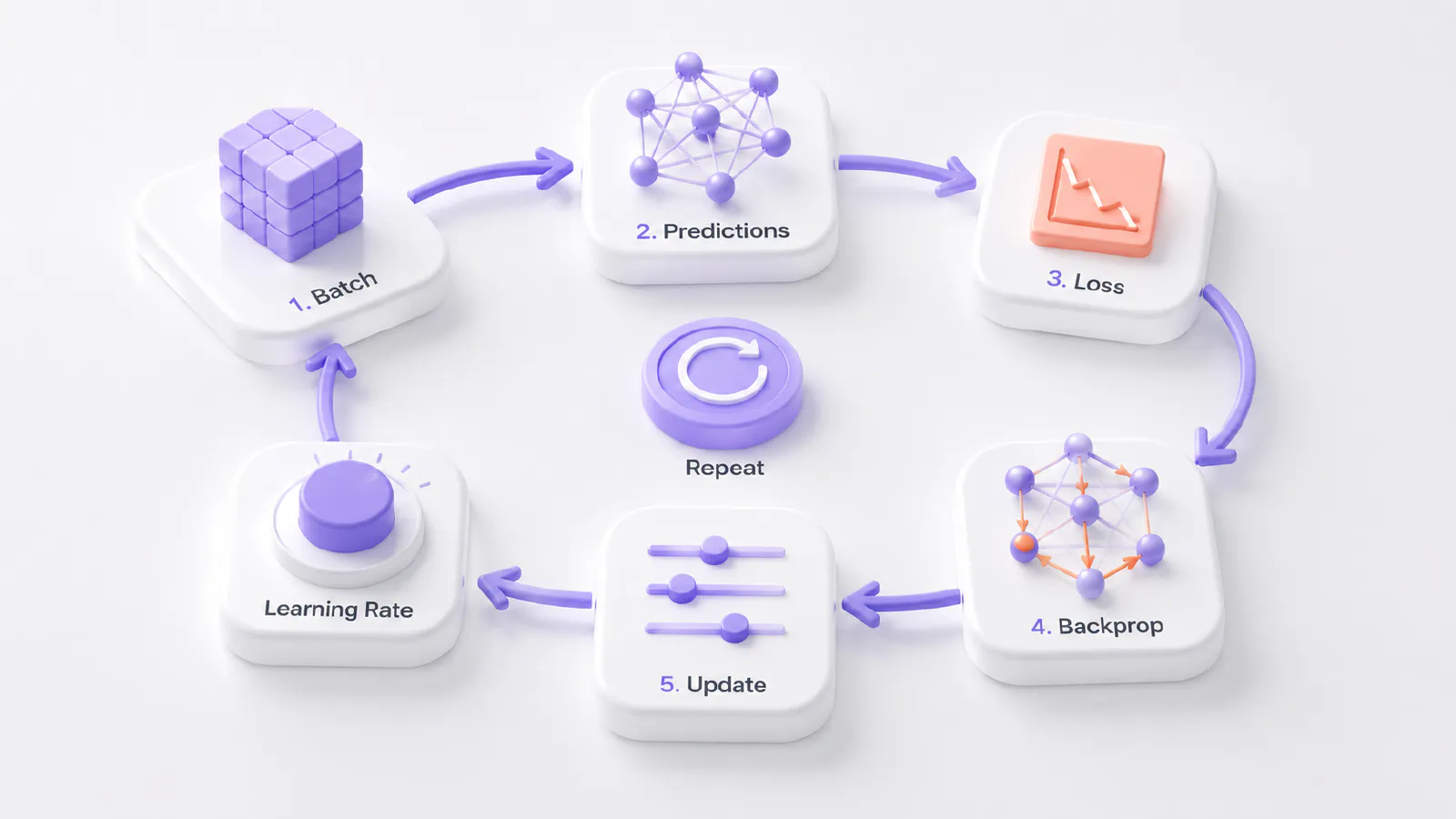
The loop goes like this: feed in a batch → model makes predictions → calculate the error (loss) → use backpropagation to figure out which parameters caused the error → adjust those parameters slightly using a gradient descent optimizer → repeat. Millions of times. The size of those adjustments is controlled by the learning rate – one of the most consequential hyperparameters you’ll tune.
Approaches to Training AI Models
Not all training is the same. The method you choose depends on what you have: data, compute, and time.
Training from scratch vs fine-tuning vs RLHF
To train AI model from scratch means starting with randomly initialized weights and learning everything from data. It requires massive computation. GPT-3’s original training reportedly cost over $4 million in compute alone. Fine-tuning means taking a pre-trained model and continuing to train it on your specific data. RLHF (Reinforcement Learning from Human Feedback) is the technique that turned raw language models into the helpful assistants we use today – it’s how OpenAI shaped ChatGPT’s behavior.
When to train from scratch and when not to
Unless you work at a well-funded lab with a dedicated GPU cluster, you almost never need to train from scratch. Pre-trained models already contain extraordinary general knowledge. Your job is usually to redirect that knowledge toward a specific domain or behavior.
Fine-tuning pre-trained models for specific tasks
Fine-tuning works by updating all or some of a model’s weights using your task-specific dataset. A medical company might fine-tune a general model on clinical notes. A legal firm might fine-tune contracts. The result: a model that speaks your domain’s language without starting from zero.
Low-Rank Adaptation and efficient fine-tuning techniques
LoRA (Low-Rank Adaptation) is a technique developed by Microsoft researchers that dramatically reduces the compute needed for fine-tuning. Instead of updating all model weights, LoRA injects small trainable matrices into specific layers. The full model stays frozen. The result: you can fine-tune a large model on a single consumer GPU. In practice, LoRA-trained models are often within a few percentage points of full fine-tune quality.
Quantized Low-Rank Adaptation for resource-constrained training
QLoRA takes this further. Developed by researchers at the University of Washington and published in 2023, it combines LoRA with 4-bit quantization – compressing the model’s weights to use less memory. With QLoRA, you can fine-tune a 65-billion parameter model on a single 48GB GPU. That’s the kind of efficiency shift that changed who could practically train models.
Reinforcement Learning from Human Feedback explained
RLHF is a three-step process. First, you fine-tune a base model on demonstrations of good behavior. Second, you train a reward model – a separate model that learns to predict which responses humans prefer. Third, you use reinforcement learning (typically PPO – Proximal Policy Optimization) to push the original model toward generating outputs the reward model scores highly. It’s indirect. It’s complex. And it’s what makes the difference between a model that can predict text and one that actually tries to be helpful.
Supervised learning for labeled data scenarios
You have inputs, you have correct labels and the model learns what maps to what. This is the most common setup. Image classifiers, spam filters, sentiment analyzers – all supervised learning. It’s straightforward but requires high-quality labeled data, which is usually the bottleneck.
Unsupervised learning for pattern discovery
No labels needed. The model finds structure in raw data – clusters, themes, anomalies. Topic modeling and word embeddings (like Word2Vec) are classic examples. Large language model pre-training is technically unsupervised: the model just learns to predict the next word, which forces it to understand language.
Reinforcement learning for dynamic environments
RL is for situations where the right action depends on a sequence of decisions, not a single input-output pair. Think robotics, game-playing agents, or – as noted above – aligning language models. The model learns by trial and error, receiving rewards for good outcomes and penalties for bad ones.
How to decide if you need to train a model at all
Seriously. Ask yourself this before spending a single dollar on compute.
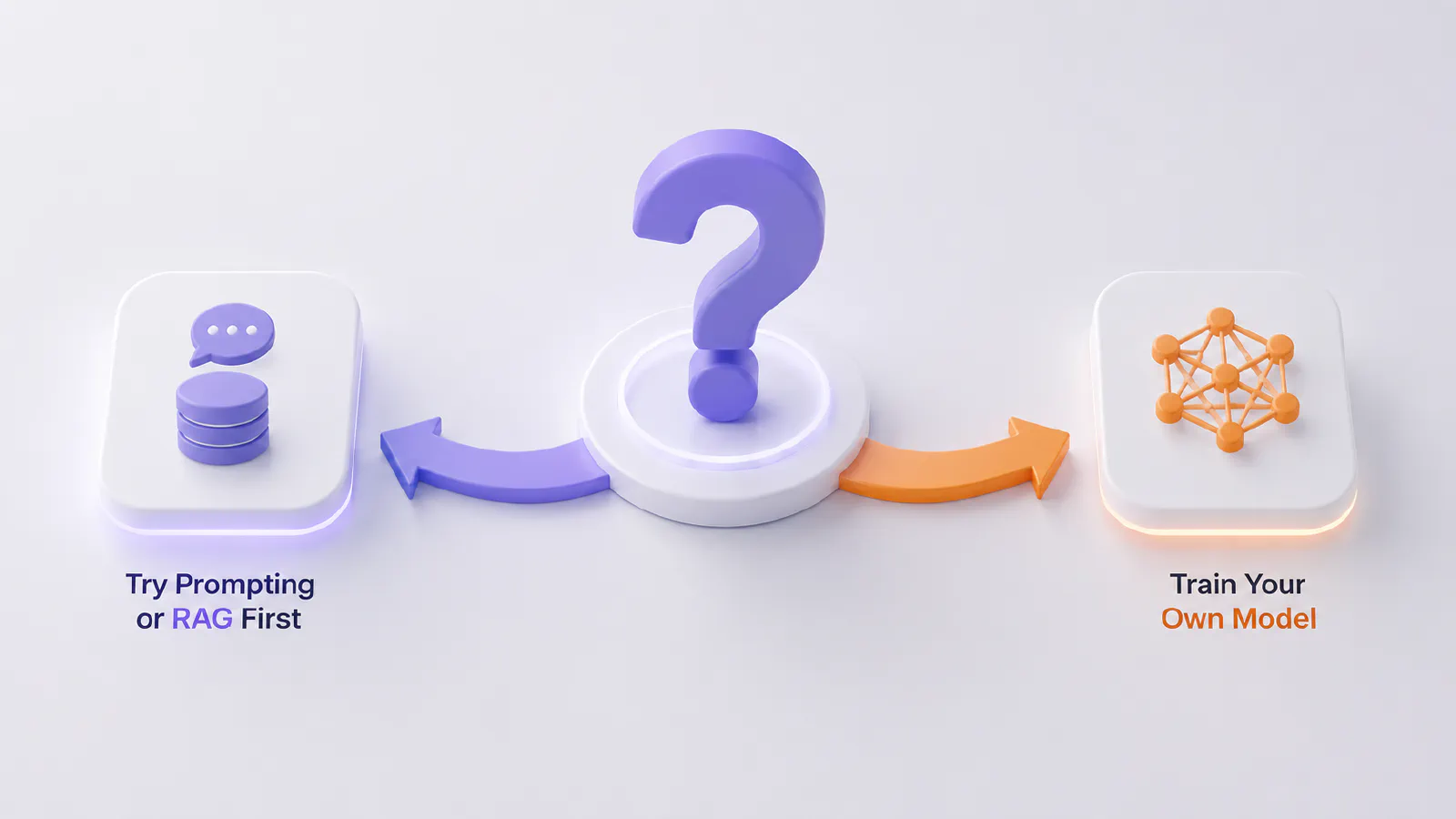
Most problems people think require training actually don’t. If your use case involves retrieving information, summarizing documents, reformatting data, or generating content in a specific style – there’s a good chance prompt engineering or retrieval-augmented generation (RAG) will do the job without any training at all. RAG, which grounds model responses in a live document database, has become the practical solution for the majority of enterprise AI use cases in 2025-2026.
Training makes sense when the model consistently fails on your domain even with good prompts, you need faster inference (smaller fine-tuned models can beat larger general models on specific tasks), or you have proprietary data that genuinely can’t be captured in a prompt context window.
Start with prompt engineering before training
This isn’t just advice for beginners. Even teams with serious ML infrastructure start here.
Before you build a training pipeline, spend a week on systematic prompt engineering. Try few-shot examples. Try chain-of-thought. Try system prompts that set context and constraints. Document what works and what doesn’t. You’ll either solve your problem – which happens more often than expected – or you’ll generate the clearest possible specification of what your fine-tuned model needs to learn.
The failure mode to avoid: spending weeks training a model because prompting “felt hacky,” then discovering the trained model has the same problems plus new ones you didn’t anticipate.
Data Collection and Preparation Strategy
This is where most projects actually fail. Not the architecture, not the training loop – the data.
Understanding your data needs before collecting
Start with a question: what does a good example look like? Write down 10 of them by hand. This forces you to define your task precisely. Vague task definitions produce inconsistent data. Inconsistent data produces unpredictable models.
Sourcing data from public datasets and APIs
You don’t always need to collect from scratch. There are thousands of high-quality public datasets covering text, images, code, tabular data, and more. Before building a scraper, check what already exists.
Using Hugging Face Kaggle and open government databases
- Hugging Face Datasets hosts over 100,000 datasets across dozens of modalities and languages, with direct Python loading
- Kaggle has strong labeled datasets for classification, NLP, and structured data tasks
- Open government databases (data.gov, EU Open Data Portal, UK’s data.gov.uk) offer reliable, often legally unambiguous sources for specific domains like healthcare, finance, and transportation
Generating synthetic training data programmatically
When real data is scarce or expensive to label, synthetic data is a legitimate option. Using a capable general-purpose model to generate labeled examples for a more specific task – sometimes called “knowledge distillation via data generation” – has become standard practice. The key risk: if your synthetic data has systematic biases, your trained model inherits them. Always validate synthetic data against real-world examples.
Why quality matters more than quantity in training data
The scaling laws research (Hoffman et al., “Chinchilla,” 2022) showed that many large models are actually undertrained relative to their size – meaning more high-quality data, not more parameters, was often the right lever. One clean, well-labeled example is often worth more than ten noisy ones.
The critical importance of clean well-labeled data
Garbage in, garbage out is a cliché because it’s true. Inconsistent labels, mislabeled examples, and duplicate data are the three main culprits. A dataset with 5% label noise can degrade model accuracy noticeably in classification tasks. Deduplication is particularly useful for textual information and can be trained to memorize information instead of learning it.
Organizing data in consistent formats like CSV and JSON
Pick a format and stick to it. CSV works for simple structured data. JSON is better for nested or variable-length fields. The most important thing: define your schema before you start collecting, not after. Retrofitting schema onto 50,000 inconsistently formatted records is a genuinely painful afternoon.
Creating balanced datasets that represent real-world scenarios
Imbalanced classes are a classic trap. If 95% of your examples are “Class A” and 5% are “Class B,” a model that always predicts Class A gets 95% accuracy while being completely useless for detecting Class B. Techniques like oversampling the minority class, undersampling the majority, or using weighted loss functions help – but the best fix is collecting more diverse data to begin with.
Conclusion
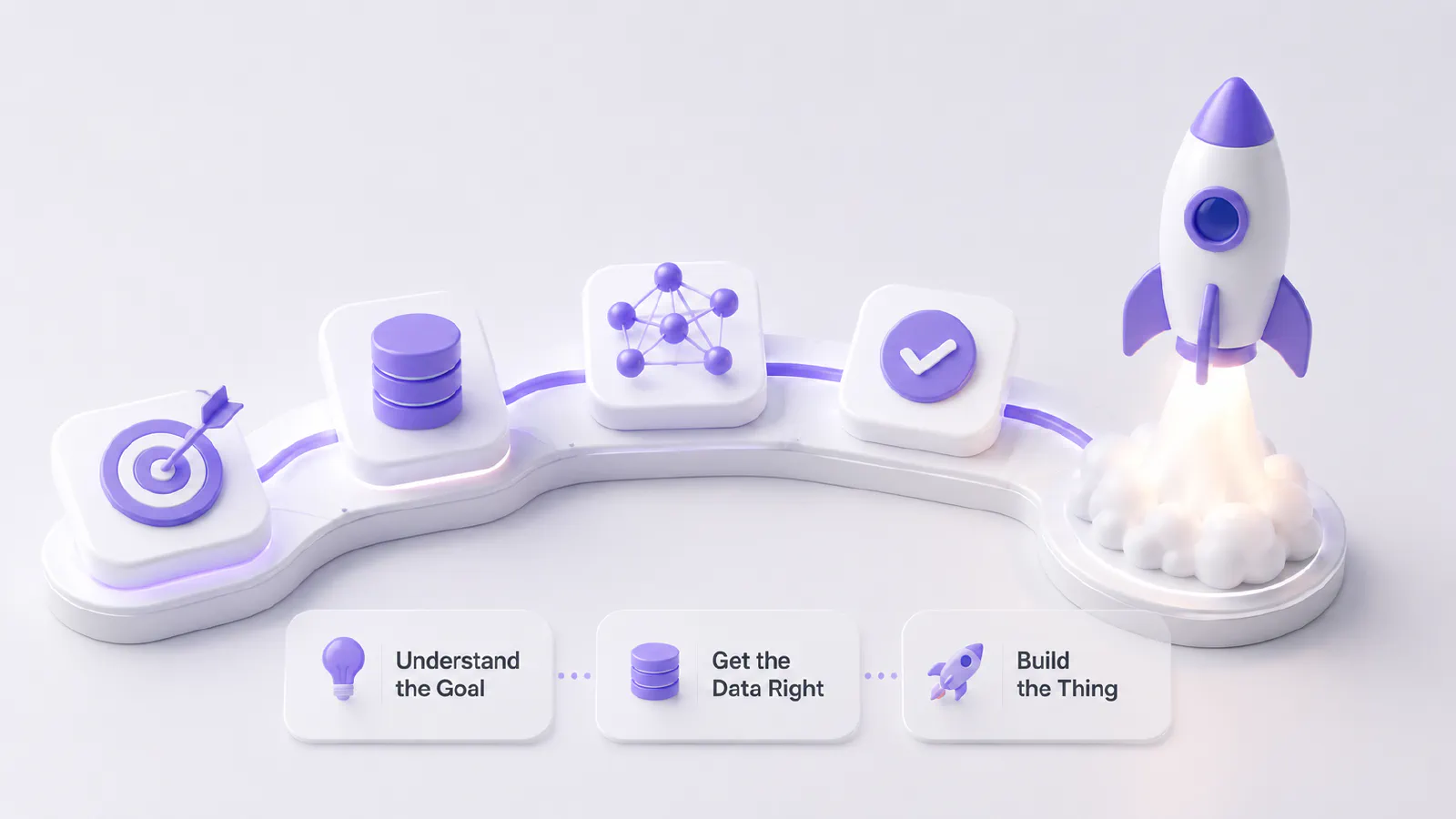
Training your AI model in 2026 is more accessible than ever. The tooling is better, the pre-trained models are stronger starting points, and the community knowledge is deeper. But the fundamentals haven’t changed: understand what you’re trying to learn, get the data right, and don’t reach for training when prompting will do.
Start simple. Stay skeptical of complexity. And build the thing.