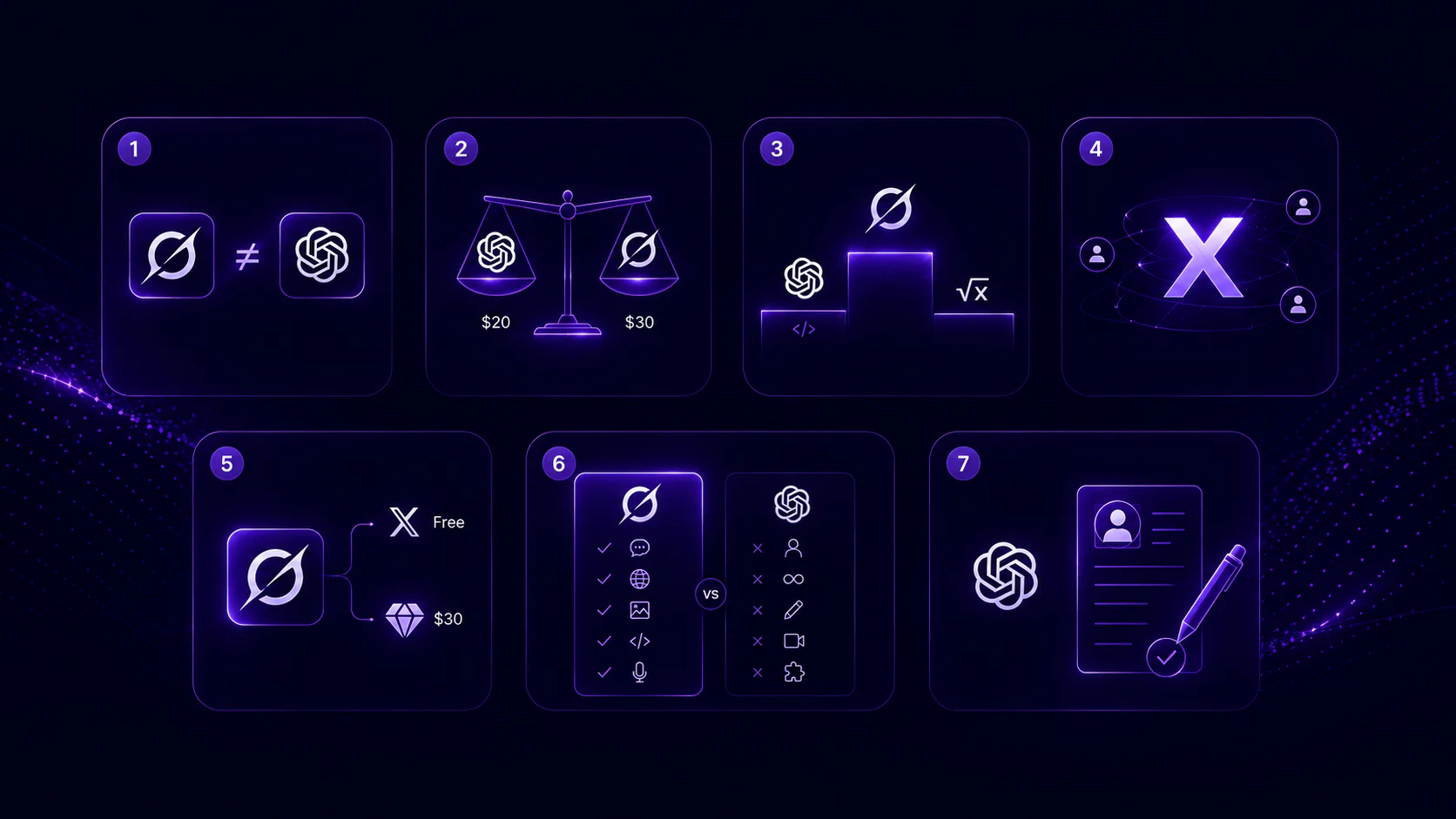
Grok vs ChatGPT in 2026 is not just a question of which AI chatbot is smarter. The real difference is workflow fit: Grok is stronger for real-time X/social analysis, fast technical exploration, and less filtered creative work, while ChatGPT is stronger for polished output, integrations, production coding, and predictable business use.
Quick verdict: choose ChatGPT if you need reliable writing, coding, research, and enterprise workflows in one mature ecosystem. Choose Grok if you need live market signals, trend monitoring, STEM problem-solving, API experimentation, or a more direct conversational style. For a broader look at all the leading options, see our review of the best AI chatbots in 2026.
Grok vs ChatGPT quick comparison
| If you need… | Better choice | Why |
|---|---|---|
| A default AI assistant for work | ChatGPT | More mature integrations, memory, structured output, and business workflows |
| Real-time X/social trend monitoring | Grok | Native access to live X context and a more trend-reactive style |
| Production coding and multi-file work | ChatGPT | Stronger ecosystem, coding integrations, and more predictable output |
| High-volume API experimentation | Grok | Better fit when speed, cost, and technical exploration matter most |
| Polished writing and client-ready drafts | ChatGPT | Cleaner structure, safer tone, and less editing for business content |
| STEM, math, or exploratory reasoning | Grok | Strong benchmark profile and more willingness to challenge the prompt |
| Regulated or enterprise workflows | ChatGPT | More predictable behavior, governance options, and integrations |
Use this table as the shortcut: ChatGPT is the safer default for most users and teams; Grok is the sharper specialist when real-time context, X-native research, technical exploration, or a less filtered style matters more than polish.
Grok vs ChatGPT in 2026: Key Differences
At their core, these two tools are built around completely different philosophies, and that shapes everything from their tone to their pricing.
ChatGPT is OpenAI’s flagship conversational model, running on the GPT-5 family (as of early 2026, GPT-5.2 powers the standard tier). It’s built on the premise of broad, reliable helpfulness, tuned through years of Reinforcement Learning from Human Feedback (RLHF) to produce structured, safe, and consistent outputs. Think of it as a polished all-terrain vehicle: it doesn’t always go the fastest, but it rarely breaks down.
Grok, built by xAI and fueled by the Grok 4 model family, takes the opposite bet. It was designed around what xAI calls “maximum curiosity” – fewer content restrictions, native real-time data from the X (formerly Twitter) platform, and an explicitly personality-driven voice. If ChatGPT is a consultant in a button-down shirt, Grok is the brilliant, slightly unpredictable colleague who has every trending topic open in another tab.
Let’s take a closer look at the pros and cons of both platforms to understand the differences between them.
Pros of Grok
Quick answer: Grok’s biggest advantages are real-time X context, speed, STEM-heavy reasoning, a more direct tone, and stronger fit for trend monitoring or technical experimentation. It is most compelling when freshness and exploration matter more than polished business output.
Grok’s strengths aren’t evenly distributed, they cluster hard around speed, raw technical power, and an unusually open personality. If any of the following land in your daily workflow, the case for Grok gets real fast.
- Real-time X integration: Native access to live social media data without any third-party workaround. For trend analysts, journalists, and social media managers, this alone can be a dealbreaker.
- Benchmark performance in STEM: Grok 4 scored 95% on AIME 2025 math benchmarks and 87.5% on GPQA scientific reasoning tests, outpacing competing models on raw technical horsepower.
- Grok 4.1 topped LMArena: In blind preference testing, Grok 4.1 scored the highest of any model, suggesting users genuinely enjoy interacting with it.
- Fewer content refusals: In independent tests, Grok refuses approximately 20% fewer “edgy” queries than ChatGPT, which matters for researchers, creatives, and anyone who’s tired of being gently redirected.
- Open-source components: Grok-1’s code was released publicly, giving developers a degree of transparency unavailable with most competitors.
- Speed: On optimized hardware, Grok’s inference reaches roughly 1,200 tokens per second, while GPT-5.2’s ~900 tps.
Cons of Grok
Quick answer: Grok’s main drawbacks are ecosystem dependency, less predictable business output, a smaller integration network, and trust concerns around some creative features. It can be powerful, but it is not always the safest default for client-facing or regulated work.
No model earns a 95% math score without making trade-offs somewhere else. Grok’s weaknesses are real, and a few of them carry reputational weight that’s hard to ignore.
- X ecosystem dependency: Grok’s real-time advantage is inseparable from the X platform. X outages (there were at least three notable ones in 2025) take Grok’s live features offline with them.
- Benchmark-to-reality gap: Early testing of Grok 4 found it “overcooked for benchmarks” but only middling in open-ended user queries. Raw scores don’t always translate to everyday usefulness.
- Image generation security concerns: Grok’s image generation tools were used to create malicious content in late 2025 and January 2026, leading to investigations in seven countries, though the incident raised serious concerns about trust. xAI has since limited image generation to paid subscribers.
- Smaller ecosystem: Grok is growing, unlike ChatGPT, which has over 500 app interactions and a well-developed API platform. Developers accustomed to a broad plugin ecosystem will notice the difference.
Pros of ChatGPT
Quick answer: ChatGPT’s biggest advantages are reliability, integrations, polished writing, production coding support, memory, multimodal depth, and predictable workflows. It is the better default if you need one AI assistant for everyday professional work.
Three years of iteration and the largest AI user base in the world have produced something genuinely mature. ChatGPT’s advantages aren’t flashy, they’re the kind that compound quietly over months of regular use.
- Ecosystem maturity: Automatically connects to Google Workspace, Microsoft 365, Slack, and 500 other third-party apps via Zapier. Organizations can create custom GPTs to create specific workflow versions.
- Intersession memory: GPT-5.1/5.2 has long-term memory, which is invaluable for constantly evolving projects, client-facing work, or any tasks that span days or weeks.
- Reliable enterprise-grade performance: ChatGPT has a 12 percent lower error rate than Grok in independent testing on tasks involving long reasoning chains. This reliability gap is significant for business-critical content.
- Multimodal depth: Can support to 10 images per message, create video using Sora 2 and has one of the largest context windows in the consumer market (1 million tokens on GPT-5).
- SWE-bench Test Score: 74.9% on SWE-bench Verified, compared to Grok’s 43.6%, a significant edge for production-grade software development.
- Security and predictability: It is consistently reliable in regulated environments such as healthcare, legal, and education, where unpredictable results have real consequences.
Cons of ChatGPT
Quick answer: ChatGPT’s main drawbacks are over-caution, slower real-time trend discovery, and continued hallucination risk on complex tasks. It is more polished than Grok, but not always better when you need raw live context or a less filtered creative response.
ChatGPT’s downsides tend to be the direct inverse of its strengths, and they show up most painfully when you need the tool to move fast or take risks.
- Over-caution: ChatGPT refuses roughly 20% more sensitive queries than Grok. Useful in enterprise environments, annoying for legitimate edge cases that simply get stonewalled.
- Real-time lag: Web browsing in ChatGPT feels curated and structured compared to Grok’s raw live feed. If you need right now rather than well-researched, ChatGPT feels slower.
- Hallucinations persist: An 8% hallucination rate on complex tasks in independent tests. Better than many competitors, but still a real problem for high-stakes fact-checking work.
Popular Use Cases for Grok
Grok hits its stride in environments where real-time information and a conversational, low-friction interaction style matter more than structured output. Social media managers use it to monitor and respond to trends as they emerge – Grok’s X integration delivers a 25% edge in timeliness for market research compared to tools relying on crawled data alone. Journalists on deadline use its DeepSearch and DeeperSearch modes to rapidly orient themselves on breaking stories.
STEM students and researchers reach for Grok when they need computational horsepower. Its performance on AIME and GPQA benchmarks reflects a model architecture that genuinely handles abstract reasoning and multi-step mathematical problems well.
Popular Use Cases for ChatGPT
ChatGPT’s natural habitat is structured, production-ready work. Marketing teams use it to produce client-ready copy, email campaigns, and brand-consistent content. Its polished output and consistent tone make it the de facto tool for anything customer-facing. It is used by the developers to review and refactor code, as well as document it, particularly in existing pipelines connected to GitHub, VS Code, or Cursor through the codex of OpenAI. For developers looking at the best AI tools for coding, ChatGPT remains the industry standard for production work.
Businesses rely on ChatGPT to run their business internally: writing proposals, reading uploaded files and creating specific GPTs that are based on a particular department or process.
Its Deep Research mode, which crawls the web methodically over several minutes to produce structured analysis, has become a go-to for consultants and analysts who need synthesis rather than just a snapshot.
Grok AI vs ChatGPT Comparison Features
Quick answer: ChatGPT has the broader general-purpose toolkit; Grok has the sharper real-time and X-native feature set. The best choice depends on whether your workflow values integrations and polish or freshness and speed.
Feature sets tell you what a tool can do. They don’t always tell you what it’s like to actually use it, but they’re a decent starting point. Here’s what each platform brings to the table in 2026.
ChatGPT Features and Capabilities
Best for: users who want one mature assistant for writing, coding, research, file work, voice, images, video, custom GPTs, and repeatable business workflows.
ChatGPT’s toolkit is wide by design. The Canvas interface turns a chat window into a collaborative writing and coding environment. Deep Research crawls multiple sources methodically and synthesizes them into structured reports. GPT-Image-1.5 handles image generation; Sora 2 handles video. Advanced Voice Mode supports natural back-and-forth conversations on both web and mobile. The GPT Store offers thousands of community-built custom models for specific tasks. And persistent memory means the model carries context across sessions.
The headline number: GPT-5’s context window sits at 1 million tokens, enough to load an entire codebase or a book-length document into a single conversation.
For tactical examples beyond the model comparison, see how teams use ChatGPT for marketing, ChatGPT for data analytics, and ChatGPT for sales prospecting.
Grok Features and Capabilities
Best for: users who care most about live X context, fast trend discovery, technical exploration, direct answers, and less polished but more reactive idea generation.
Grok’s feature set is narrower but more focused. Its live X integration is genuinely unique, no other major AI has direct pipeline access to a social platform in real time. DeepSearch and DeeperSearch modes crawl both the web and X simultaneously. Aurora generates photorealistic images in under 5 seconds. Grok Code Fast 1, released in September 2025, is a dedicated coding agent with support for Python, TypeScript, Java, Rust, Go, and C++, available through GitHub Copilot, Cursor, Windsurf, and Cline. Grok’s coding capabilities make it one of the best AI tools for coding for algorithmic and experimental development.
The context window is 256,000 tokens – large, but less than a quarter of ChatGPT’s. Grok Heavy’s multi-agent swarm mode is powerful for complex tasks, though it comes with a 4-7x processing overhead that makes it impractical for quick queries.
Speed of Responses: Grok vs ChatGPT
Quick answer: Grok is usually the better pick when speed and live trend reaction matter, while ChatGPT is better when a slower but more structured answer is worth the wait.
Speed is one of Grok’s genuine advantages, and the numbers are clear. Grok’s inference runs at approximately 1,200 tokens per second on optimized hardware, about 33% faster than GPT-5.2. In practice, for simple queries, ChatGPT’s “Instant” mode delivers responses in roughly 550ms. Grok can be slower on complex tasks because of its swarm processing overhead in Heavy mode.
When you need to make a quick conversation query or to research something trendy, Grok is more effective. For in-depth studies or complex tasks where quality is more important than time, the difference in speed becomes much less important, and the advantage of ChatGPT in terms of error rate begins to be significant.
Depth and Accuracy of Natural Language Understanding by Grok & ChatGPT
Quick answer: ChatGPT is usually better for structured explanations and polished synthesis, while Grok is better for exploratory conversation and technical prompts where a more direct style is useful.
Both models are strong at natural language understanding, but in different ways. ChatGPT gives more structured, careful, and polished answers and is especially good at combining ideas into clear explanations. Grok is more conversational and exploratory, which can help it catch subtle points but also makes it more prone to tangents.
In structured tasks like question answering and instruction following, ChatGPT scores about 86.4% on MMLU. Grok stands out more on reasoning-heavy benchmarks. Tests from early 2026 generally show ChatGPT leading in multi-step reasoning and polished writing, while Grok is competitive and often quicker at grasping complex technical topics.
Grok vs ChatGPT in Coding Capabilities
ChatGPT is the daily driver in the case of production code, debugging, and multi-file projects. Grok scores well on algorithmic tasks: with a HumanEval score of 72-75% (beating ChatGPT by 67%), and a LiveCodeBench score of 90-100% on unseen competitive problems is actually good. Both tools are industry leaders when evaluating best AI tools for coding, but they shine in different contexts.
If your comparison is specifically about developer workflows, read Claude vs ChatGPT for coding and Claude Code vs Codex next; both go deeper on repository-level agents and coding assistants.
Grok vs ChatGPT in Problem-Solving Skills
ChatGPT’s 12% lower error rate in long-chain reasoning tasks makes it the more reliable tool for structured problems – business logic, legal reasoning, multi-step analysis. Grok’s Heavy mode can surprise you with lateral approaches its internal debate architecture generates, but that exploratory style cuts both ways: unexpected insights one minute, verbose tangents the next. If predictability matters, ChatGPT. If you want the AI to challenge your framing, Grok.
Grok vs ChatGPT in Creative Writing
Grok 4.1 scored a record 1,586 on EQ-Bench, a benchmark for emotional intelligence, and it shows in the writing: more visceral, more willing to commit to an aesthetic, less likely to hedge toward the safest interpretation of a prompt. ChatGPT produces technically cleaner output that fits brand voice and professional constraints better. Use Grok when you want to be surprised. Use ChatGPT when the output needs to be client-ready.
ChatGPT vs Grok in Mathematical Problem Solving
Grok wins this one on raw numbers. Grok 4 hit 95% on AIME 2025; ChatGPT’s o3 model scored 86%. More strikingly, Grok 4 Heavy was the first model ever to break 40% on Humanity’s Last Exam, a benchmark designed by academics to be nearly AI-proof, reaching 44.4%. For mathematicians, quant researchers, and engineers working on optimization problems, that gap it’s a real capability difference.
ChatGPT vs Grok: Real-Time vs. Static Data Access
Grok lives inside a live information stream – its native X integration means breaking news, market moves, and viral moments register immediately, giving it a significant edge in timeliness for market research. ChatGPT browses the web too, but more deliberately: it cross-references sources and flags uncertainty rather than surfacing raw feeds. One is a colleague who’s been scrolling all morning; the other is a researcher who actually checks their sources. For speed and social-native work, Grok. For accuracy and regulated industries, ChatGPT.
Pricing Models Comparison. What Do ChatGPT and Grok Offer in Cost vs Value?
Pricing is where the comparison gets genuinely lopsided, at least on the surface. ChatGPT is cheaper at every consumer tier, but the story flips entirely once you move to the API.
| Plan | ChatGPT | Grok |
|---|---|---|
| Free | Limited GPT-5.2 access | Limited, requires X account |
| Standard paid | Plus – $20/month | SuperGrok – $30/month |
| Team / social bundle | Team – $25/user/month | X Premium+ – $40/month |
| Power tier | Pro – $200/month | SuperGrok Heavy – $300/month |
| API cost advantage | Higher per-token pricing | Grok 4.1 saves $1,000+/month at 100M tokens vs GPT-5.1 |
At the consumer level, the math is uncomfortable for Grok: SuperGrok costs almost 50% more than ChatGPT Plus for a narrower general-purpose toolkit. At the top end, the $100 gap between SuperGrok Heavy and ChatGPT Pro widens that further. For most individuals and small teams, ChatGPT Plus at $20 is the stronger value.
The API is a different conversation entirely. Developers building at scale, processing hundreds of millions of tokens monthly, can save over $1,000 per month on Grok 4.1 vs GPT-5.1. That’s the number that changes the calculus for startups and product teams. The Grok premium at the consumer level makes sense for three profiles: API-scale developers, professionals anchored to social media trend analysis, and researchers who need the STEM benchmark advantage and know they’ll use it.
Application of Both in Various Industries
Neither tool dominates across every field, the winner tends to shift depending on whether the industry values speed and raw power or consistency and compliance.
- Marketing: Grok for trend-reactive content – 30% faster at social analysis. ChatGPT for structured campaign copy and brand-consistent long-form work.
- Software development: ChatGPT is the daily driver (74.9% vs 43.6% on SWE-bench); Grok for algorithmic brainstorming.
- Finance and research: Grok Heavy handles PhD-level synthesis and complex scenario analysis; ChatGPT delivers cleaner, more consistent client-ready outputs.
- Education and healthcare: ChatGPT by default – predictable, auditable, and safe for institutional deployments.
When to Choose Grok: Situational Use Cases
Choose Grok if your work lives close to real-time information: breaking news, social trend analysis, market monitoring, or if you’re doing serious STEM work. Developers building at API scale will also find Grok’s per-token pricing significantly cheaper. And if you want creative output that actually takes risks rather than plays it safe, Grok is the more interesting collaborator.
When to Choose ChatGPT: Situational Use Cases
Choose ChatGPT when the output needs to be reliable and ready to share. Client work, production code, research others will review — ChatGPT’s lower error rate and structured outputs reduce editing friction. Its 1 million-token context window handles entire codebases in one conversation. Enterprise teams in regulated industries get predictability and safety that Grok simply doesn’t guarantee. And if you’re running multi-week projects, persistent memory across sessions means you’re not re-briefing the model every time.
Is Grok or ChatGPT Better for Writing?
For professional content: client copy, reports, marketing materials – ChatGPT. More consistent, less cleanup, and Canvas makes iterative drafting genuinely smooth. For creative writing where you want the AI to surprise you: fiction, brand voice exploration, brainstorming – Grok, backed by its record EQ-Bench score of 1,586.
The smartest workflow in 2026 uses both: Grok for raw ideation and emotionally alive first drafts, ChatGPT to structure and refine. That’s $50/month for a combination that handles work that used to cost multiples of that per hour. Neither model is universally better, the question is whether you know which one to reach for and when. If you want to build that skill systematically, the Coursiv 28-Day AI Certificate Program Challenge teaches you how to match tools to tasks through daily practice. You can also explore best AI tools for business to see how these platforms fit into your broader workflow stack.
FAQ