GPT-5.6 Sol and Claude Fable 5 do not have one honest universal winner. Sol has the lower headline API price, broader OpenAI product integration, and an approved path to Zero Data Retention. Fable 5 has a major lead on one demanding software-engineering benchmark and fits naturally into Claude Code. On other coding and professional evaluations, Sol leads or the result is close.
The choice changes again at long context. Sol starts at $5 input / $30 output per million tokens, compared with $10/$50 for Fable 5, but OpenAI applies higher rates to the entire request above 272K input tokens. Anthropic keeps Fable’s full 1M context at its standard rate.
Verified July 12, 2026
- OpenAI: GPT-5.6 launch and benchmark table, GPT-5.6 Sol model specs, API pricing, and API data controls
- Anthropic: Claude Fable 5, current model overview, API pricing, and the July 1 access-restoration update
Access, plan credits, rate limits, safety behavior, and prices can change. The comparisons below reflect the official pages available on July 12, 2026.
GPT-5.6 Sol vs Claude Fable 5 at a glance
| Feature | GPT-5.6 Sol | Claude Fable 5 |
|---|---|---|
| Provider position | GPT-5.6 flagship | Anthropic’s most capable widely released model |
| API model ID | gpt-5.6-sol; gpt-5.6 aliases to Sol | claude-fable-5 |
| Standard input / output | $5 / $30 per MTok | $10 / $50 per MTok |
| Long-context pricing | $10 / $45 when input exceeds 272K | $10 / $50 across the full context window |
| Context / max output | 1.05M / 128K tokens | 1M / 128K tokens |
| Reasoning control | Configurable effort; higher settings available by surface | Adaptive thinking, always on |
| Main products | ChatGPT reasoning, Work, Codex, OpenAI API | Claude.ai, Claude Code, Cowork, Claude API |
| Data-retention option | 30-day abuse monitoring by default; eligible approved API orgs can configure ZDR | Mandatory 30-day retention for safety monitoring; no ZDR |
| Best first test | Tool-heavy work, terminal tasks, professional workflows, short-context cost | Long-running coding, large migrations, Claude-native agent workflows |

This comparison uses GPT-5.6 Sol, not the whole GPT-5.6 family. Sol is the fair counterpart to Fable 5 because both providers position these models for their hardest generally available work. GPT-5.6 Terra and Luna target lower-cost workloads and need a separate routing decision.
Benchmark comparison: the winner changes by test
OpenAI’s live GPT-5.6 announcement includes a same-table comparison with Claude Fable 5. That makes it more internally consistent than combining isolated numbers from different pages, but it is still vendor-published testing. Treat the results as routing signals, not proof that one model will win your workload.
| Evaluation | GPT-5.6 Sol | Claude Fable 5 | Leader in OpenAI’s table |
|---|---|---|---|
| Agents’ Last Exam | 52.7% | 40.5% | Sol |
| Artificial Analysis Intelligence Index v4.1 | 58.9 | 59.9 | Fable 5 |
| Artificial Analysis Coding Agent Index v1.1 | 80.0 | 77.2 | Sol |
| SWE-bench Pro | 64.6% | 80.0% | Fable 5 |
| DeepSWE v1.1 | 72.7% | 69.7% | Sol |
| Terminal-Bench 2.1 | 88.8% | 83.1% | Sol |
| GDPval-AA v2 | 1,747.8 Elo | 1,759.6 Elo | Fable 5 |
The table tells a more useful story than a single composite score:
- Fable 5 has the strongest repository-issue signal. Its SWE-bench Pro result is far above Sol’s in this comparison.
- Sol leads the terminal and broader coding-agent signals. It is ahead on the Coding Agent Index, DeepSWE, and Terminal-Bench in OpenAI’s table.
- General intelligence is effectively close. Fable leads the broad Intelligence Index by one point, while Sol leads Agents’ Last Exam by a wider margin.
- Professional work is not settled. Sol leads one long-horizon professional evaluation, while Fable slightly leads GDPval-AA.
There is an important configuration warning. Anthropic’s own launch materials report 88.0% for Fable 5 on Terminal-Bench 2.1, while OpenAI’s cross-model table reports 83.1%. Anthropic also reports 80.3% rather than 80.0% on SWE-bench Pro. Different harnesses, reasoning settings, dates, or scoring runs can move headline results. Do not mix the most favorable number from each provider and call the result apples-to-apples.
Which model is better for coding?
Choose Fable 5 as the first challenger when your workload looks like SWE-bench Pro: resolving difficult repository issues, planning a large migration, or sustaining a long implementation across many files. Its published advantage is too large to ignore, and Anthropic specifically positions the model for multi-day autonomous work in Claude Code and agent harnesses.
Choose GPT-5.6 Sol as the first challenger when the workflow is terminal-heavy, uses many tools, mixes coding with browsing or computer use, or needs a polished frontend and iterative visual inspection. OpenAI’s model page lists function calling, structured outputs, web and file search, hosted shell, apply patch, skills, computer use, MCP, and tool search as supported Responses API capabilities.
Neither conclusion should be promoted directly to production. A model can top a coding benchmark and still lose on your repository because of language mix, test quality, tool descriptions, context packing, safeguards, or the amount of human correction required.
For an ecosystem-level comparison rather than a model-only one, see Claude Code vs Codex and Claude vs ChatGPT for coding.
Pricing: Sol is cheaper until long context changes the math
Headline standard rates are simple:
| API rate per 1M tokens | GPT-5.6 Sol | Claude Fable 5 |
|---|---|---|
| Input | $5.00 | $10.00 |
| Cached input read / cache hit | $0.50 | $1.00 |
| Output | $30.00 | $50.00 |
| Batch input | $2.50 | $5.00 |
| Batch output | $15.00 | $25.00 |
For requests with more than 272K input tokens, OpenAI charges Sol’s entire request at $10 input / $45 output per MTok. Anthropic says Fable 5 includes its full 1M-token context window at the standard $10/$50 rate.
Worked cost examples
Example 1: 200K input + 20K output
- Sol:
(0.2 × $5) + (0.02 × $30) = $1.60 - Fable 5:
(0.2 × $10) + (0.02 × $50) = $3.00
Sol costs about 47% less for this short-context request.
Example 2: 500K input + 50K output
- Sol long-context rate:
(0.5 × $10) + (0.05 × $45) = $7.25 - Fable 5:
(0.5 × $10) + (0.05 × $50) = $7.50
At this shape, the price gap falls to $0.25. Fable is not suddenly cheaper, but Sol’s apparent 50% input discount has disappeared.
Tokenizers, hidden reasoning, retries, tool calls, cache behavior, and successful completion rates can all change real cost. The metric that matters is cost per accepted task, not the rate-card price alone.
Context window and reasoning controls
The raw limits are almost tied:
- GPT-5.6 Sol: 1,050,000-token context and 128,000 max output.
- Claude Fable 5: 1M-token context and 128K max output.
The operational difference is billing and control. Sol offers configurable reasoning effort across supported surfaces. Fable 5 uses adaptive thinking that is always on. With Fable, you guide the effort rather than disabling thinking entirely.
Do not fill either context window just because it exists. Large prompts increase cost, can bury the important evidence, and may reduce reliability. Retrieve the relevant files or document sections, cache stable context, and measure whether the extra input improves accepted results.
Data retention and safeguards may decide before benchmarks do
Claude Fable 5 requires 30-day retention for safety monitoring across first- and third-party surfaces. Anthropic says the retained data is not used to train new Claude models, but the requirement means Fable is not a ZDR model.
OpenAI’s default is not automatically zero retention: its API data guide lists 30-day abuse-monitoring retention for Chat Completions and Responses. However, eligible customers can apply for and configure Zero Data Retention, and the guide lists GPT-5.6 models among supported models on the eligible endpoints. ZDR approval and endpoint limitations still matter.
The practical compliance rule is:
- if mandatory 30-day retention is prohibited, Fable 5 is excluded;
- if OpenAI ZDR has not been approved and configured, do not describe Sol as zero retention;
- review tool-specific storage too, because files, background mode, hosted containers, remote MCP servers, and other capabilities can have separate behavior.
Safeguards also change output behavior. Anthropic says many Fable requests flagged for cybersecurity or biology are routed to Opus 4.8 on supported products; API customers must configure the fallback experience. OpenAI says higher-risk cyber and biology requests may be refused or require additional checks, with some defensive capability available through trusted access. If your workload approaches these boundaries, test refusal rate and fallback identity explicitly.
Access: both are live, but the product paths differ
Fable 5 was suspended on June 12 after a US government directive, then restored globally on July 1, 2026 after the export controls were lifted. Anthropic currently lists Fable on Claude.ai, Claude Code, Claude Cowork, the Claude API, and supported cloud marketplaces. For Pro, Max, Team, and selected Enterprise plans, the temporary included allowance ended after July 7 and continued use may require usage credits.
GPT-5.6 became generally available on July 9. In standard ChatGPT, Sol powers Medium and higher reasoning options on eligible paid plans while GPT-5.5 Instant remains the everyday default. Sol is also available through supported tiers in ChatGPT Work, Codex, and the OpenAI API. See the current GPT-5.6 access guide for the product-by-plan matrix.
| If your team already works in… | Lower-friction first test |
|---|---|
| ChatGPT, Work, Codex, Responses API | GPT-5.6 Sol |
| Claude.ai, Claude Code, Cowork, Claude API | Claude Fable 5 |
| AWS, Google Cloud, or Microsoft Foundry | Verify both model and regional availability with the marketplace |
| A strict ZDR environment | GPT-5.6 Sol only after OpenAI approval, configuration, and endpoint review |
Which should you choose?
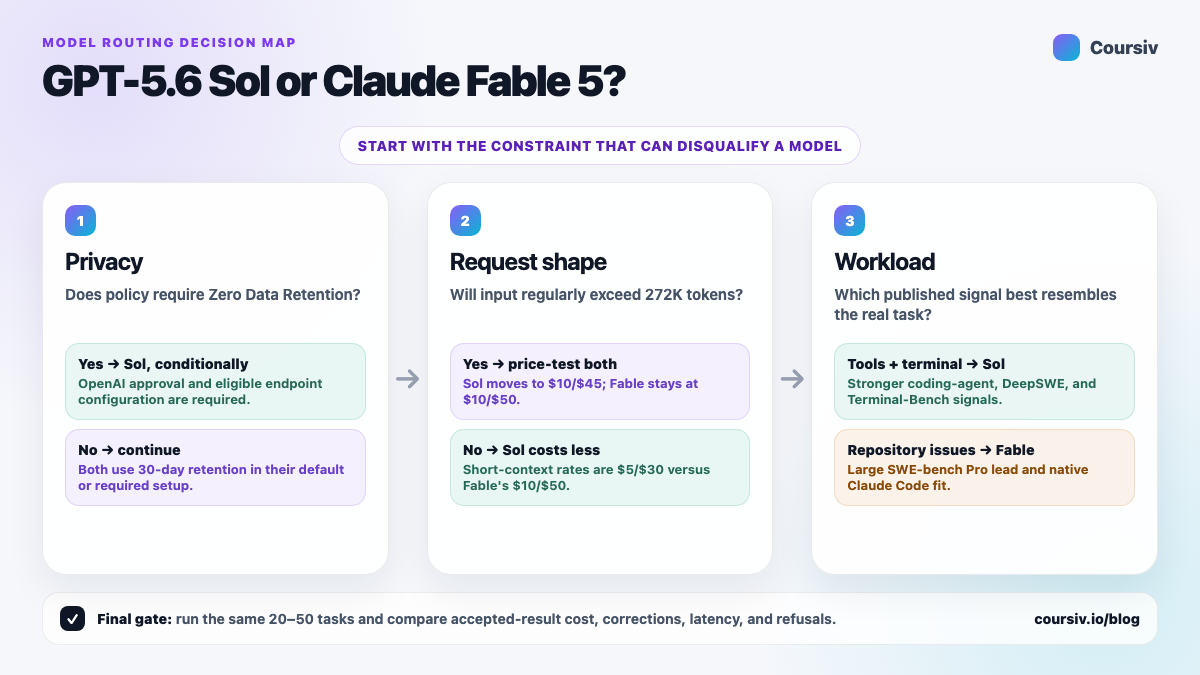
| Scenario | Start with | Why |
|---|---|---|
| Short-context API workload under a strict budget | GPT-5.6 Sol | Lower standard input, output, cache-read, and batch rates |
| Request regularly exceeds 272K input tokens | Test both | Sol’s long-context surcharge makes token cost nearly equal |
| Difficult repository issue or large migration | Claude Fable 5 | Strong SWE-bench Pro signal; validate in your codebase |
| Terminal-heavy, tool-rich coding agent | GPT-5.6 Sol | Stronger Terminal-Bench and coding-agent signals in OpenAI’s table |
| Claude Code is already your operating environment | Claude Fable 5 | Native model and product fit |
| ChatGPT, Codex, or OpenAI tools are already integrated | GPT-5.6 Sol | Lower migration and orchestration friction |
| Zero Data Retention is mandatory | GPT-5.6 Sol, conditionally | Requires OpenAI approval and correct endpoint configuration; Fable mandates retention |
| Cybersecurity or biology near safeguard boundaries | Neither by benchmark alone | Test refusals, fallbacks, and trusted-access requirements |
| No internal evaluation set exists | Neither for production yet | Build the eval before paying flagship rates |
A practical evaluation before switching
Run both models on the same 20–50 representative tasks. Keep the prompts, tools, context, time limits, and review rubric fixed. Track:
- accepted result rate without a retry;
- tests passed and regressions introduced;
- human correction time after the model stops;
- input, output, cached, and reasoning tokens;
- wall-clock latency and tool-call count;
- refusals, safety reroutes, and incomplete tasks;
- cost per accepted result, including retries;
- retention and data-flow compliance for every tool used.
Use a cheaper fallback for routine tasks. Even if Sol or Fable wins the flagship evaluation, it should not automatically handle renames, extraction, classification, or boilerplate that a lower-cost model completes reliably.
Bottom line
GPT-5.6 Sol is the stronger default economic choice for short-context work, and its current published results are strong across terminal use, coding agents, and professional workflows. It also has the more flexible compliance path when an organization qualifies for OpenAI ZDR.
Claude Fable 5 remains a serious coding winner, not an also-ran. Its SWE-bench Pro result is the clearest reason to test it on difficult repository work, and Claude Code users get a natural product fit. Its mandatory 30-day retention and higher short-context price are the main disqualifiers.
If your requests exceed 272K input tokens, recompute cost before choosing: the two flagship models become almost equally priced. If the task is important enough to justify either model, it is important enough to run a controlled evaluation.