Last updated: July 21, 2026
Google has started training Gemini 4. In its July 21 model announcement, the Gemini team said it had begun its “most ambitious pre-training run yet” and was excited by the progress. Google AI Studio product lead Logan Kilpatrick repeated the milestone on X.
That is the entire confirmed product story for now. There is no release date, preview, API model ID, benchmark table, pricing, context-window specification, model-size disclosure, or confirmed Gemini 4 lineup.
Posts predicting a late-2026 launch are making an inference from previous development cycles. TestingCatalog, for example, suggested a roughly six-month cycle and a possible year-end arrival. Google did not make that promise. Pre-training is a major milestone, but it is only one stage between a model plan and a safe, stable public product.
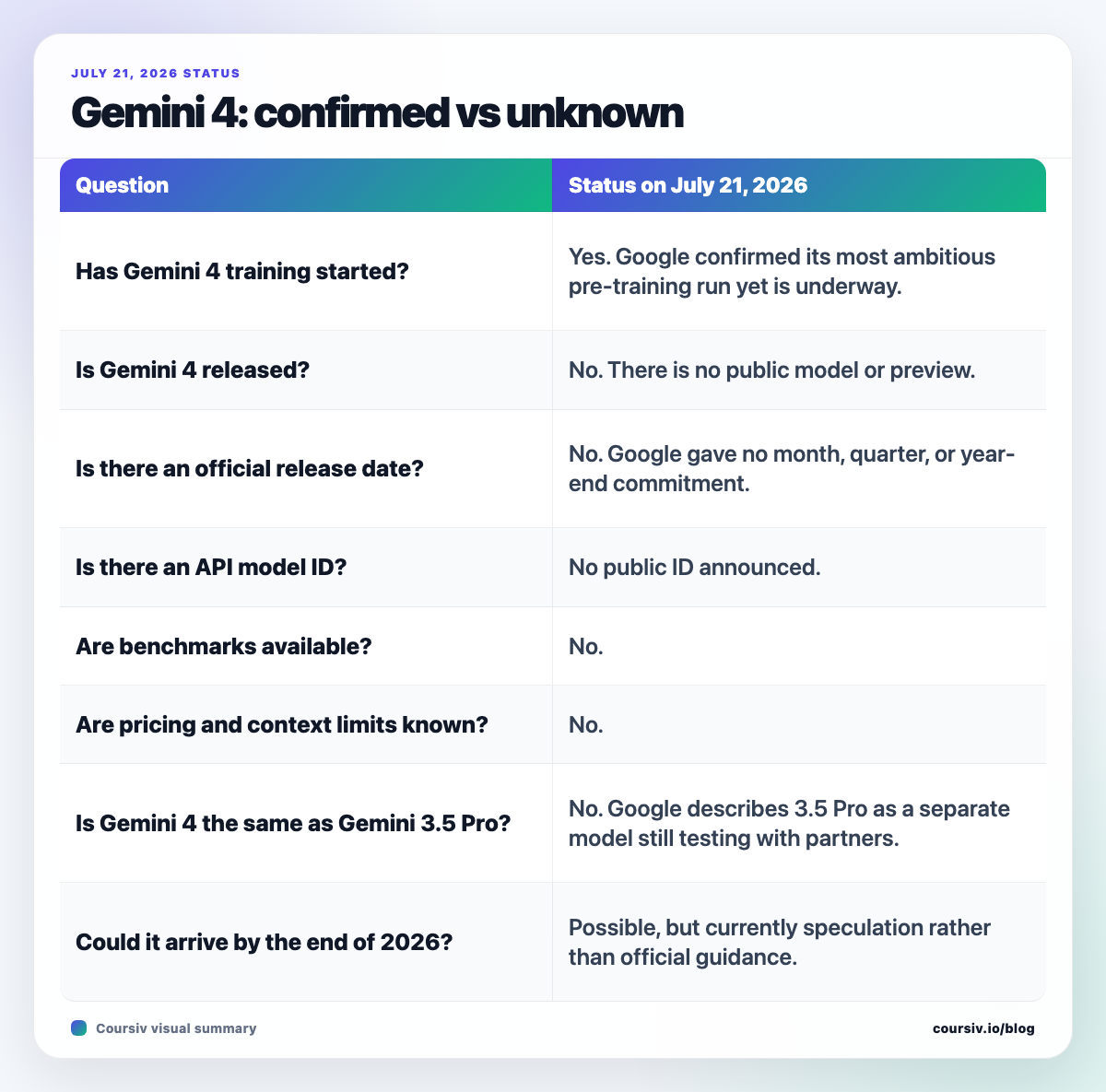
| Question | Status on July 21, 2026 |
|---|---|
| Has Gemini 4 training started? | Yes. Google confirmed its most ambitious pre-training run yet is underway. |
| Is Gemini 4 released? | No. There is no public model or preview. |
| Is there an official release date? | No. Google gave no month, quarter, or year-end commitment. |
| Is there an API model ID? | No public ID announced. |
| Are benchmarks available? | No. |
| Are pricing and context limits known? | No. |
| Is Gemini 4 the same as Gemini 3.5 Pro? | No. Google describes 3.5 Pro as a separate model still testing with partners. |
| Could it arrive by the end of 2026? | Possible, but currently speculation rather than official guidance. |
Verified July 21, 2026
- Official confirmation in Google’s launch article: Introducing Gemini 3.6 Flash, 3.5 Flash-Lite, and 3.5 Flash Cyber
- Direct statement from Google AI Studio’s Logan Kilpatrick: Gemini 4 pre-training post on X
- Third-party timing hypothesis, clearly labeled as speculation: TestingCatalog’s report
- Current-generation context: Gemini 3.6 Flash model card
This article intentionally keeps unconfirmed fields marked unknown. Search summaries and social posts can turn a training milestone into a supposed release date; Google has not done so.
What exactly did Google announce about Gemini 4?
Google placed the Gemini 4 news at the end of a broader announcement for Gemini 3.6 Flash, Gemini 3.5 Flash-Lite, and Gemini 3.5 Flash Cyber. The company said three things:
- its team is already focusing on the next generation of models;
- it has started its most ambitious pre-training run yet;
- that run is for Gemini 4 and is showing progress.
The wording confirms the generation name and an active training milestone. It does not confirm how many Gemini 4 models are being trained, whether the first public release will be Pro, Flash, Ultra, Nano, or another variant, or whether different versions will share the same base checkpoint.
It also does not mean that the model is ready for partner testing. In the same article, Google separately says Gemini 3.5 Pro is currently testing with partners. That contrast matters: Google explicitly describes partner testing when it is happening. For Gemini 4, the disclosed stage is pre-training.
What does pre-training mean?
Pre-training is the large foundational training phase in which a model learns broad patterns across its training data. For a frontier multimodal system, the run can require a large distributed computing cluster, extensive data preparation, monitoring, failure recovery, and repeated checks that learning is progressing as expected.
Starting pre-training means the project has moved beyond architecture planning and small experiments into an expensive main run. It is meaningful evidence that Gemini 4 development is active.
It is not the final step. A simplified path from pre-training to launch can include:
- Finish and stabilize the base run. Training can encounter hardware failures, numerical instability, data problems, or disappointing scaling behavior.
- Evaluate checkpoints. Teams test reasoning, coding, multimodal ability, long context, tool use, memorization, bias, safety, and reliability.
- Post-train the model. Instruction following, preference optimization, tool behavior, refusal policy, and product-specific behavior are developed after base pre-training.
- Build variants. A provider may derive Pro, Flash, Lite, or specialized models with different cost and latency targets.
- Red-team and mitigate risk. Frontier-capability and product-safety evaluations can reveal issues that require more training or stricter safeguards.
- Optimize serving. The model must run at acceptable latency, capacity, and cost across the intended products.
- Test with partners and products. APIs, apps, agents, and internal Google services need integration testing.
- Decide rollout and naming. A successful checkpoint can still be delayed, revised, restricted, or released under a different product plan.
This is why “training started” and “release is six months away” are not equivalent claims.
When will Gemini 4 be released?
There is no official Gemini 4 release date. Google has not announced a quarter or even promised a 2026 launch.
The year-end estimate circulating on X comes from a third-party assumption that Google often operates on roughly six-month training cycles. Even if the approximate historical pattern is correct, several variables can move a release:
- the duration of the main pre-training run;
- whether Google extends or restarts the run;
- post-training and safety work;
- the number of variants being prepared;
- serving cost and hardware availability;
- benchmark results relative to internal targets and competitors;
- integration schedules for the Gemini app, Search, Workspace, Cloud, and developer APIs;
- a strategic decision to release a Flash model before a Pro model, or the reverse.
A reasonable label is therefore possible but unconfirmed for late 2026. Treat any more precise date as speculation unless Google publishes it.
- Google has started Gemini 4 pre-training
- Development is active
- The run is described as Google’s most ambitious yet
- A late-2026 release is possible
- Gemini 4 may inherit current Gemini tools and multimodality
- A confirmed December launch
- Invented benchmark scores, prices, context limits, or API IDs
What does “most ambitious” tell us?
It signals that the run is larger or more technically demanding by at least one dimension important to Google, but the phrase is not a specification.
“Most ambitious” could refer to:
- more training compute;
- more or higher-quality data;
- a larger or different architecture;
- stronger native multimodality;
- longer-horizon agent training;
- better tool-use or computer-use objectives;
- broader multilingual coverage;
- more complex distributed-training infrastructure;
- a run designed to support several downstream variants.
Google did not say which interpretation is correct. It would be a mistake to translate the phrase into an invented parameter count or assume that raw scale alone will determine product quality. Recent model launches increasingly compete on token efficiency, agent reliability, latency, tool use, and cost—not only benchmark intelligence.
What Gemini 3.6 Flash suggests about Google’s priorities
The same-day Gemini 3.6 Flash launch provides context, not confirmed Gemini 4 specifications.
Google emphasized that its current workhorse model:
- completes tasks with fewer output tokens;
- uses fewer reasoning steps and tool calls;
- makes fewer unwanted code changes;
- reduces execution loops;
- improves native computer use;
- handles multimodal documents and visual tasks;
- supports a 1M context window and built-in tools;
- lowers the cost of completed agentic work.
Those priorities will likely continue to matter for Gemini 4 because they are product-level requirements for agents. That is an inference, not a promise that Gemini 4 will have the same context window, tools, pricing structure, or model tiers.
The launch also shows that Google is willing to advance the Flash line while a Pro model remains in partner testing. Do not assume the next public Gemini 4 product must be the largest version.
Gemini 4 vs Gemini 3.5 Pro
The names refer to different milestones:
| Model | Current status | What Google says |
|---|---|---|
| Gemini 3.5 Pro | Testing with partners | Broad availability is planned when the model is ready. |
| Gemini 3.6 Flash | Generally available | New production workhorse for coding, agents, knowledge, and multimodal tasks. |
| Gemini 4 | In pre-training | The most ambitious pre-training run yet has begun. |
Gemini 3.5 Pro could launch before Gemini 4, overlap with early Gemini 4 development, or influence product decisions for the next generation. Google has not announced a cancellation or replacement of 3.5 Pro.
For users, the practical choice remains between models that exist today. Gemini 4 should not delay a useful 3.6 Flash evaluation or a planned migration unless a future Google roadmap announcement provides a concrete reason.
What remains unknown about Gemini 4?
Nearly every product-level detail:
- architecture and parameter count;
- training compute and data composition;
- context window and maximum output;
- text, image, audio, video, robotics, or real-time modalities;
- knowledge cutoff;
- Pro, Flash, Lite, Nano, Ultra, or specialized variants;
- benchmark scores and evaluation methodology;
- safety classification and deployment safeguards;
- API model IDs and SDK requirements;
- consumer and enterprise availability;
- pricing, rate limits, caching, and batch rates;
- partner-testing schedule;
- preview and general-availability dates.
Any article or social post that fills these gaps today is predicting, leaking unverified information, or fabricating details. The honest version of a Gemini 4 specification table is mostly “not announced.”
What should developers and businesses do now?
Do not architect a 2026 production system around an unavailable model. Instead:
- Benchmark the models that are GA. Gemini 3.6 Flash and 3.5 Flash-Lite are production-ready and have documented pricing and limits.
- Keep the model layer replaceable. Isolate model IDs, request conversion, tool schemas, and evaluation thresholds so a future migration does not require an application rewrite.
- Stop relying on deprecated sampling controls. Google’s new API rules remove
temperature,top_p, andtop_kfor the latest models and future generations. - Preserve evaluation data. Save representative prompts, tool traces, expected outputs, and human-review scores so Gemini 4 can be tested fairly when it exists.
- Budget by completed task. Track total tokens, tool calls, retries, latency, and corrections—not only price per token.
- Watch official sources. A model card, API documentation, or Google launch post is stronger evidence than a trend summary.
Final verdict
Gemini 4 is real enough to name and train, but not real enough to buy, benchmark, or schedule.
Google’s confirmation is a significant roadmap signal: its next generation has entered the costly foundational training phase, and the company describes the run as its most ambitious yet. That supports the expectation of a major future model family, not a specific launch month or a guaranteed performance leap.
For now, the most useful conclusion is disciplined: pre-training has begun; everything else—from December timing to model sizes, prices, context limits, and scores—remains unconfirmed.
FAQ
Has Google started training Gemini 4?
Is Gemini 4 released?
What is the Gemini 4 release date?
Will Gemini 4 launch by the end of 2026?
What are Gemini 4’s benchmarks and context window?
Is Gemini 4 replacing Gemini 3.5 Pro?
Can developers use a Gemini 4 API model ID?
gemini-3.6-flash and gemini-3.5-flash-lite.