Claude Fable 5 and Claude Opus 4.8 are both high-end Anthropic models, but they sit in different tiers. Fable 5 is the first generally available Mythos-class model — a capability level above Opus in Anthropic’s published positioning — while Opus 4.8 remains an Opus-class model for complex reasoning and agentic coding.
Quick answer: On Anthropic’s published benchmarks, Claude Fable 5 scores above Claude Opus 4.8 on the reported tests, with the biggest gap on long-horizon agentic coding: 80.3% vs 69.2% on SWE-bench Pro and 29.3% vs 13.4% on FrontierCode Diamond. The trade-off is cost and compliance: Fable 5 is priced at $10/$50 per million input/output tokens (double Opus 4.8’s $5/$25) and carries a 30-day data-retention requirement, while Opus 4.8 supports zero data retention. Treat the benchmark gap as directional and switch only after validating your own workload.
This is the deep-dive companion to our full Claude Fable 5 guide, which covers release details, API access, safeguards, and use cases.
Source check — June 12, 2026: this comparison was checked against Anthropic’s Claude Fable page, Fable/Mythos API docs, Claude pricing docs, and Claude plan documentation.
Fable 5 vs Opus 4.8 at a Glance
| Comparison | Claude Fable 5 | Claude Opus 4.8 |
|---|---|---|
| Model class | Mythos-class (tier above Opus) | Opus-class flagship |
| Release date | June 9, 2026 | May 27, 2026 |
| API model ID | claude-fable-5 | claude-opus-4-8 |
| Input price | $10 / MTok | $5 / MTok |
| Output price | $50 / MTok | $25 / MTok |
| Context window | 1M tokens by default | Up to 1M tokens on eligible API tiers/configurations |
| Max output | Up to 128k tokens per request | Check current model/plan limits |
| Thinking mode | Adaptive thinking, always on (effort parameter) | Configurable thinking |
| Safeguard fallback | Flagged cyber/bio/chem/distillation requests route to Opus 4.8 | No routing layer |
| Data retention | Covered model, 30-day retention | Zero data retention available |
| Best fit | Harder long-horizon, agentic, long-context work after validation | Complex reasoning where cost and ZDR matter |
Benchmarks: Fable 5 vs Opus 4.8
Anthropic published a launch-day benchmark table comparing the new Mythos-class models against Opus 4.8 and competing frontier models. The deltas over Opus 4.8 are large in Anthropic’s published table, but they should be read with benchmark caveats.
| Benchmark | Claude Fable 5 | Claude Opus 4.8 | Delta |
|---|---|---|---|
| SWE-bench Pro (agentic coding) | 80.3% | 69.2% | +11.1 pts |
| FrontierCode Diamond (Cognition) | 29.3% | 13.4% | +15.9 pts (2.2×) |
| Terminal-Bench 2.1 | 88.0% | 82.7% | +5.3 pts |
| GDPval-AA (knowledge-work Elo) | 1932 | 1890 | +42 Elo |
| SWE-bench Verified | 95.0% | approaching ceiling | — |
Benchmark disclaimer: Benchmark results are based on published vendor / third-party testing and should be treated as directional. Actual performance may vary depending on the task, prompt, implementation, data, safeguards, and review process. Teams should validate results on their own workloads before switching models.
A few notes on reading these numbers correctly:
- SWE-bench Pro is the headline. SWE-bench Verified is close to saturation across frontier models, so the +11-point gap on the harder Pro variant — end-to-end resolution of real GitHub issues — may be the more meaningful coding signal in Anthropic’s table.
- FrontierCode Diamond measures maintainable code, not just passing tests. Fable 5 scores more than twice Opus 4.8 here in the published table, and Anthropic reports strong results even at medium reasoning effort — relevant if you plan to run the
effortparameter below maximum to control cost. - Token efficiency matters as much as raw scores. Anthropic and selected partner/customer reports say Fable 5 can complete some equivalent agentic coding work with fewer tool calls and lower token consumption than Opus-tier models. On agentic workloads, fewer turns may partially offset the 2× per-token price, but verify this on your tasks.
- The safeguard asterisk. For safeguarded domains such as cybersecurity, biology, chemistry, and some distillation-related requests, user-visible Fable 5 behavior may differ from raw benchmark expectations because flagged requests can refuse or route to Opus 4.8. Outside safeguarded domains, Anthropic says Fable 5 and Mythos 5 share the same underlying model family.
Vendor-published customer anecdotes also support the direction of the benchmarks, including a Stripe migration example from Anthropic’s launch materials. Treat all vendor-published results as directional and validate on your own tasks before changing production routing.
Pricing: What the 2× Premium Actually Costs
Fable 5 doubles Opus 4.8 on every line of the rate card:
| Rate | Claude Fable 5 | Claude Opus 4.8 |
|---|---|---|
| Base input | $10 / MTok | $5 / MTok |
| Output | $50 / MTok | $25 / MTok |
| Batch API input | $5 / MTok | $2.50 / MTok |
| Batch API output | $25 / MTok | $12.50 / MTok |
| Cache hits | $1 / MTok | $0.50 / MTok |
The naive read is “Fable costs twice as much.” The realistic read depends on workload shape:
- Single-shot, short tasks: the 2× premium is often pure overhead. Opus 4.8 (or Sonnet 4.6) is usually more cost-effective for routine work.
- Multi-turn agentic tasks: if Fable 5 finishes in fewer turns with fewer tool calls and less repeated exploration, total tokens per completed task may land closer to parity — and the success rate is part of the math. A failed Opus run that needs human rescue costs more than its token bill.
- Long-context analysis: a near-1M-token prompt at $10/MTok is a $10 input bill per call before output. Use prompt caching aggressively for repeated context, and reserve full-context calls for work where missing a detail is expensive.
The rational routing rule: start with the cheapest model that reliably completes the job under your review process, and promote tasks to Fable 5 only when Opus 4.8 demonstrably fails, loses the plan mid-task, or burns more total tokens through retries.
Data Retention: The Hidden Switching Cost
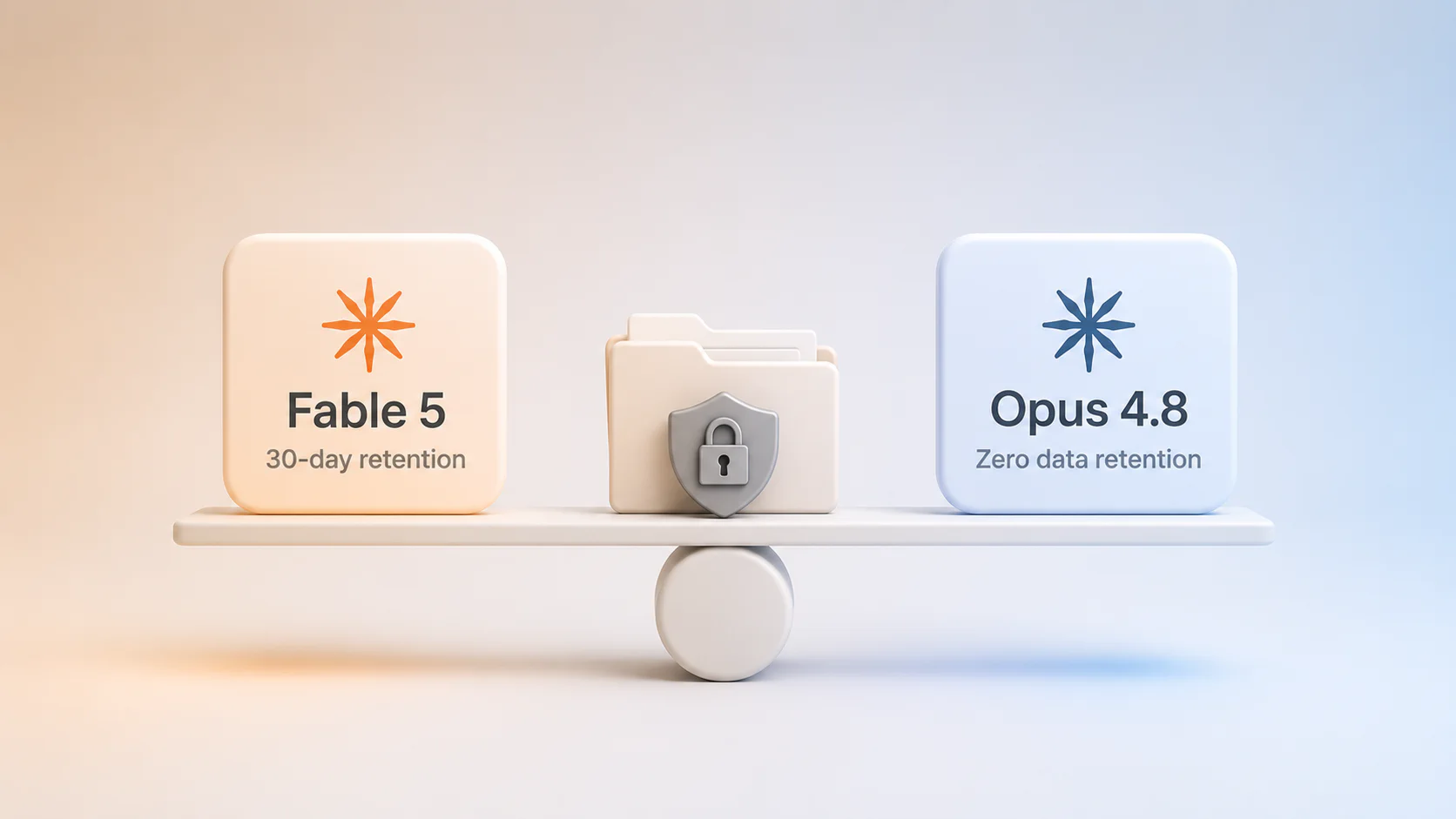
This is the difference most comparison tables miss. Claude Opus 4.8 is available under zero data retention (ZDR). Claude Fable 5 is a covered model with a 30-day data-retention requirement, because Anthropic needs retained prompts and outputs to operate the safety classifiers. Retained data is not used to train Anthropic’s models, but it is retained.
For individual developers this may be a non-issue. For enterprises it can be a procurement gate: if your contracts, regulators, or clients require ZDR for source code, personal data, or confidential material, Fable 5 may be blocked regardless of benchmark results. The same constraint can matter in hosted integrations, so verify the current product-specific retention terms before rollout.
Behavior Differences That Affect Production Code
Swapping claude-opus-4-8 for claude-fable-5 is not a drop-in change. Three behaviors differ:
- Adaptive thinking is always on. You cannot disable thinking on Fable 5; you control depth with the
effortparameter. Budget for thinking tokens in cost projections. - Refusals arrive as HTTP 200. A safeguard-flagged request can return a successful response with
stop_reason: "refusal", or be answered by Opus 4.8 via fallback. Production code must check stop reasons instead of treating every 200 as a completed Fable answer. Anthropic says fallback is intended for a small minority of typical sessions, and Opus-fallback responses are not billed at Fable prices. - Raw chain-of-thought is not returned. If any Opus-era tooling parsed reasoning text, migrate it to summarized thinking before switching.
When to Use Which
| Scenario | Pick | Why |
|---|---|---|
| Routine code edits, helpers, explanations | Opus 4.8 or Sonnet 4.6 | Fable 5 is overkill at 2× the price |
| Large codebase migration or multi-repo refactor | Fable 5 | Largest measured capability gap in published benchmarks, pending your validation |
| Long-running supervised agent tasks | Fable 5 | May require fewer turns and preserve plans better in some workloads |
| Budget-capped, high-volume pipelines | Opus 4.8 | Per-token economics dominate |
| ZDR-mandated data | Opus 4.8 | Fable 5 requires 30-day retention |
| Work near cyber/bio boundaries | Opus 4.8 (or vetted Mythos access) | Fable 5 routes those requests to Opus anyway |
| 1M-token document or research analysis | Fable 5 or eligible Opus configuration | Choose based on current context limits, ZDR needs, and measured output quality |
Migration Checklist: Opus 4.8 → Fable 5
- Benchmark 10–20 of your real tasks on both models with identical prompts; score completion rate, edits required, turns, tool calls, and total cost per completed task — not vibes.
- Confirm 30-day retention is acceptable for every data category in the workload.
- Add refusal and fallback handling (
stop_reason: "refusal", fallback metadata) before flipping traffic. - Re-tune the
effortparameter; medium effort may already beat Opus on your tasks at lower cost. - Route by task class: keep Sonnet/Opus for routine work, send only the failure-prone tail to Fable 5.
FAQ
Is Claude Fable 5 better than Opus 4.8?
How much more does Claude Fable 5 cost than Opus 4.8?
Does Claude Opus 4.8 support zero data retention while Fable 5 does not?
Why did my Claude Fable 5 request get answered by Opus 4.8?
Should I migrate my Opus 4.8 workloads to Fable 5?
For the full picture — release details, API specs, safeguards, and use cases — go back to the main Claude Fable 5 guide. For coding-workflow context, see Claude Code vs Codex and Claude vs ChatGPT for coding.