The Claude Certified Architect is Anthropic’s proctored certification for people who design and build solutions with Claude – prompts, tool use, agents, Claude Code and the API. Unlike the free Claude Academy courses, which give a certificate of completion, it’s an exam-based credential with a verifiable badge. It’s most useful for developers, solution architects and consultants who already build with Claude; beginners should start with the free courses first. Below: what the exam covers, levels, cost and format, who it’s worth it for, and a 4-6-week prep plan.
Key terms used in this guide: model context protocol, AI agent, and prompt engineering.
Claude Certified Architect exam facts
Before anything else, check whether you can book it at all. As of October 2026, Anthropic opens its exams only to people who work at organizations in the Claude Partner Network, and registration requires a company email on a domain listed in that partner record. Personal addresses such as Gmail are rejected. If your employer isn’t a partner, the public route is the free Claude Academy catalog, that we covered before, which ends in quizzes and certificates of completion rather than a proctored exam.
Anthropic now runs four exams across three roles: Associate, Developer and Architect. The architect track has two levels, Foundations and Professional. Every Anthropic certification exam is delivered by Pearson VUE, either online with a live proctor or at a test center, and is scored on a scale of 100 to 1,000 with 720 needed to pass.
| Level | Who it’s for | Format | Length | Cost | Prerequisites | Validity / renewal |
|---|---|---|---|---|---|---|
| Architect - Foundations (CCAR-F) | Solution architects and engineers who build production apps with Claude Code, the Claude Agent SDK, the Claude API and MCP | 60 multiple-choice and multiple-response items; 4 scenarios drawn at random from a bank of 6; closed book | 120 minutes (about 135 minutes of total seat time) | $125 | No mandatory courses; Anthropic recommends 6+ months of hands-on building; you must work at a Claude Partner Network organization, be 18+ and bring a government-issued ID | 12 months; free, non-proctored renewal assessment if you renew on time |
| Architect – Professional (CCAR-P) | Mid- to senior-level architects, AI/ML engineers and tech leads who design and govern Claude solutions at enterprise scale | 63 multiple-choice and multiple-response items; closed book | 120 minutes | $175 per attempt | Foundations not required; recommended 3+ years in systems architecture and 6+ months with Claude or a comparable LLM system in production; same partner and ID rules | 12 months; same renewal rules |
Last verified: October 17, 2026, against Anthropic Partner Academy’s certification pages, the certification FAQ and the official exam guides.
A few policies are worth knowing before you pay. Partners at the Select, Preferred and Global Premier tiers get 50% off at checkout, and Global Premier partners pay nothing through December 31, 2026. A retake costs the full fee. After a failed attempt you wait 14 days, then 30 days after a second, then 90 days after a third, with a cap of four attempts per rolling 12 months. The exam and all prep content are in English only.
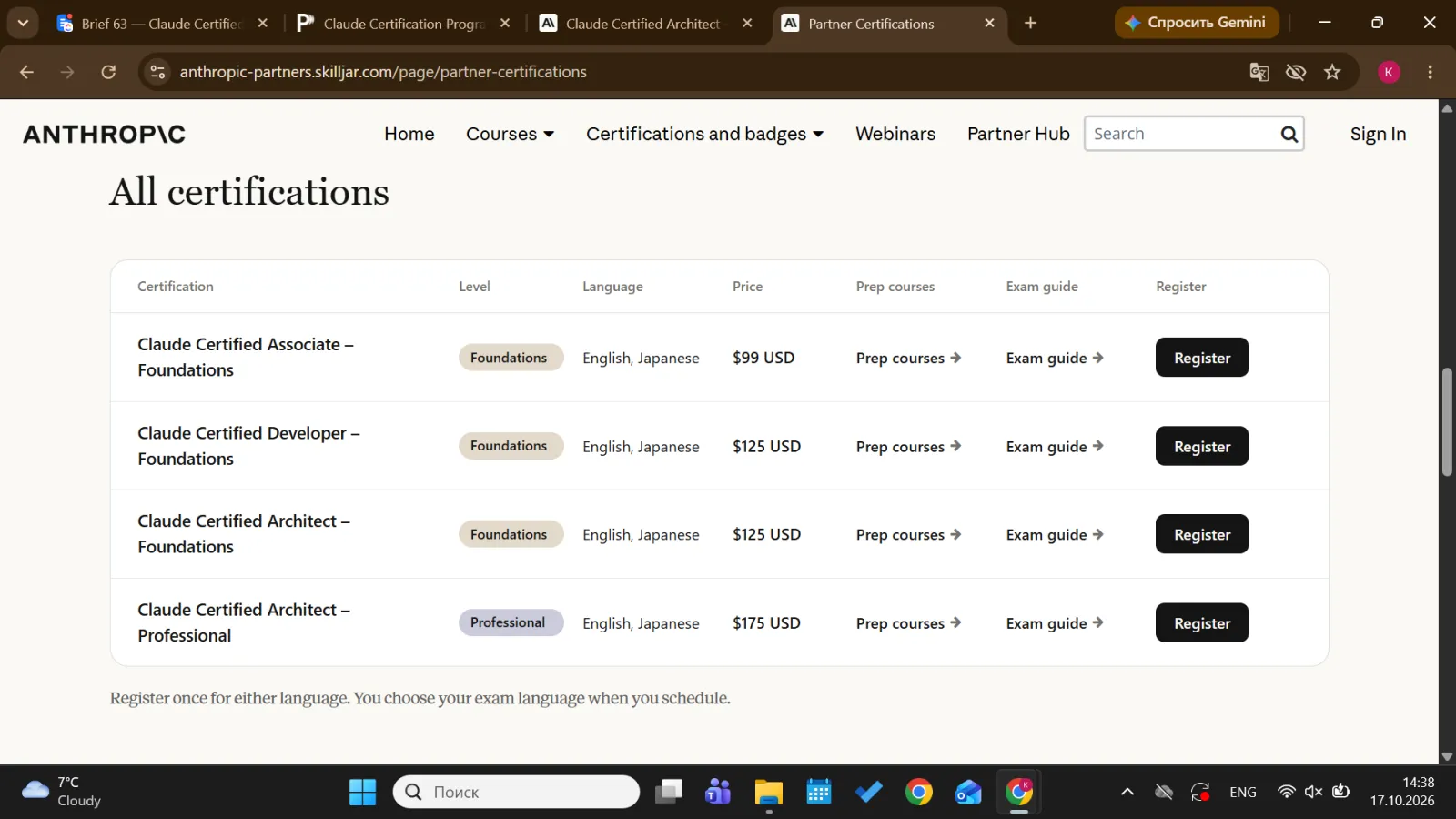
Anthropic Partner Academy table listing four Claude certification exams and their prices
Source: Anthropic Partner Academy, “Earn your Claude certification” page (anthropic-partners.skilljar.com/page/partner-certifications), accessed October 17, 2026.
What a Claude Certified Architect actually does
The title sounds grand, but the official exam guide describes a practical job: taking a business process and turning it into a Claude system that behaves predictably in production. Typical work looks like this:
- Designing a customer support agent that looks up orders, issues refunds within set limits and hands off to a human with a clear summary when the policy doesn’t cover the case.
- Setting up Claude Code for a whole engineering team, with shared CLAUDE.md files, project slash commands, path-specific rules and MCP servers that everyone gets when they pull the repo.
- Building a coordinator agent that splits a research question across subagents and keeps source attribution intact all the way to the final report.
- Running Claude Code inside CI so it reviews pull requests and writes tests in non-interactive mode, returning JSON that the pipeline can post as inline comments.
- Extracting fields from messy documents with JSON schemas, validation and retries, then deciding which results still need a human check.
If none of that sounds familiar yet, start with our guide on what an AI agent is and how it differs from a chatbot. The exam assumes that foundation.
What the exam covers
The Foundations exam is built on six scenarios taken from real customer use cases: a customer support resolution agent, code generation with Claude Code, a multi-agent research system, developer productivity tools, Claude Code in continuous integration, and structured data extraction. You get four of them at random. Each one frames a set of questions, so you’re choosing the best fix for a described production problem rather than recalling syntax.
| Domain | Weight | What it means in plain language |
|---|---|---|
| Agentic architecture and orchestration | 27% | Agent loops that stop at the right moment, coordinator and subagent designs, hooks that enforce business rules, task decomposition, and resuming or forking sessions |
| Tool design and MCP integration | 18% | Tool descriptions that prevent misrouting, structured error responses, giving each agent only the tools it needs, and configuring MCP servers |
| Claude Code configuration and workflows | 20% | The CLAUDE.md hierarchy, custom commands and skills, path-scoped rules, plan mode versus direct execution, and Claude Code in CI pipelines |
| Prompt engineering and structured output | 20% | Explicit review criteria, few-shot examples, tool use with JSON schemas, validation-retry loops and the Message Batches API |
| Context management and reliability | 15% | Keeping key facts through long sessions, escalation rules, error handling between agents, human review workflows and source provenance |
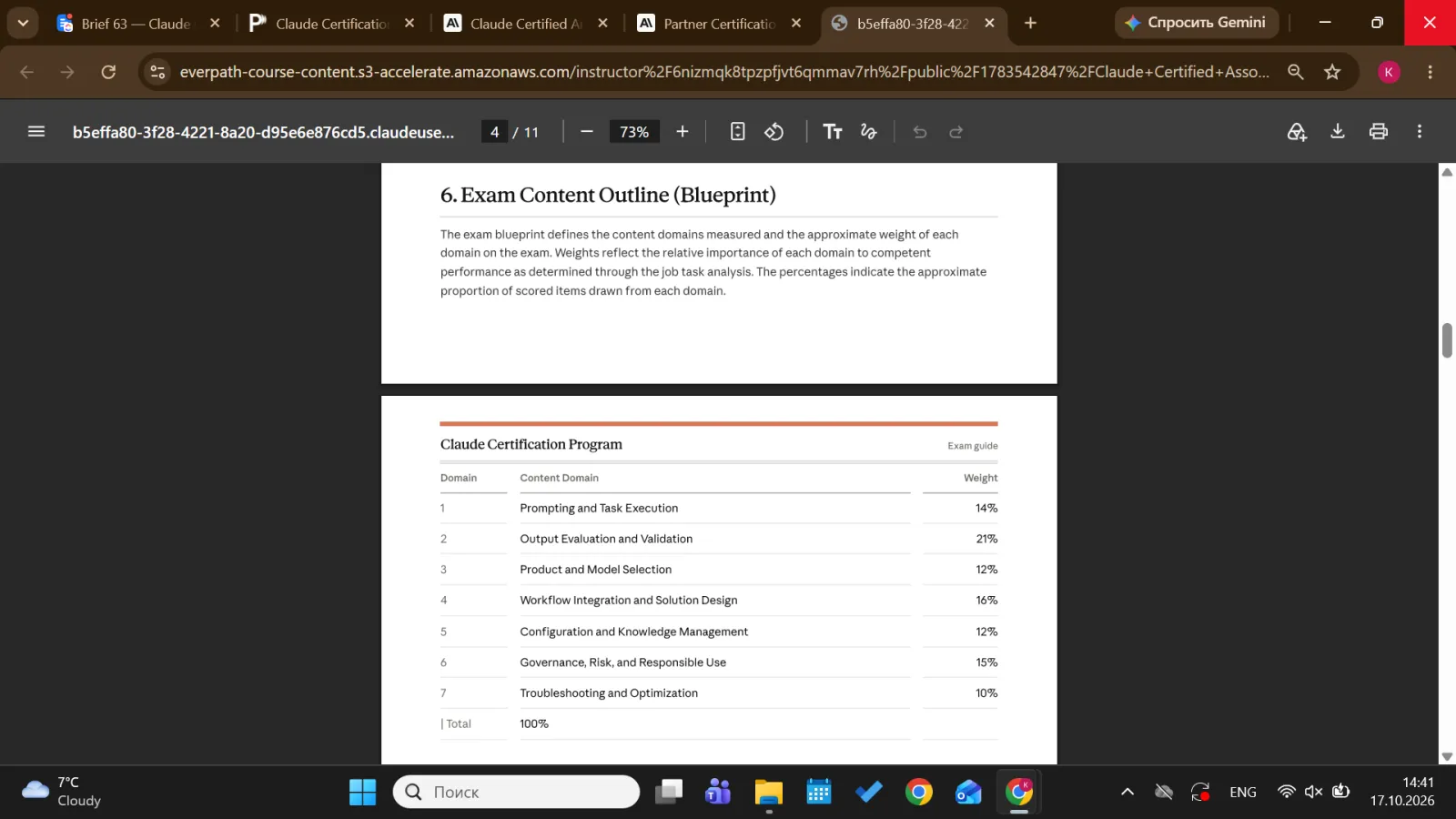
Claude Certified Architect – Foundations exam blueprint with domain weights.
Source: Anthropic, Claude Certified Architect – Foundations Exam Guide, version 1.0 (July 2026), section 4 “Exam Content Outline (Blueprint)”.
Two patterns run through the whole blueprint. When a rule has to hold every time, such as verifying a customer before a refund, the guide prefers code-level enforcement like hooks over prompt instructions, because prompts fail some share of the time. And it favors the proportionate first fix: clearer tool descriptions before a routing classifier, explicit criteria before a bigger model. If subagents are new to you, our explainer on Claude Code subagents shows how they keep context isolated, and an MCP course fills in the tool-design side. The guide also names what won’t appear: fine-tuning, API billing and authentication, hosting MCP servers, computer use, vision, streaming, and setup on specific cloud providers.
The Professional exam is broader. Its 63 items span seven domains, from solution design and integration (including RAG pipelines) to evaluation, governance and stakeholder communication. It reads closer to a consulting exam: choosing models, spotting security gaps, meeting rules such as GDPR and HIPAA, and explaining trade-offs to non-technical decision-makers.
Is it worth it?
The Claude architect certification pays off in a fairly narrow set of situations, and eligibility decides more than skill does. Inside partner firms, Developer and Architect credentials count toward the company’s tier in the Claude Partner Network, which gives employers a direct reason to pay for them. Outside the network, you can’t register for now.
| Your role / experience | Recommendation | What to do first |
|---|---|---|
| Engineer at a partner firm with 6+ months on the API, Agent SDK or Claude Code | Worth it | Read the exam guide, build the four practice projects below, then book |
| Consultant or solution architect delivering Claude projects for clients | Worth it, it’s a signal clients look for | Start with Foundations and plan Professional after you’ve led a full deployment |
| Senior architect with 3+ years in systems design | Consider going straight to Professional | Rate yourself against the seven Professional domains before choosing |
| Developer at a partner firm with under 6 months on Claude | Not yet | Spend a month on the Academy’s API and Claude Code courses and ship one working agent |
| Seller, delivery lead or other non-developer at a partner | Not this exam | Look at the $99 Associate = Foundations exam, which doesn’t require coding |
If you’re outside the network, or want something vendor-neutral on your CV, our roundup of the best AI certifications compares credentials anyone can take. If you’re still early with Claude, a structured Claude AI course will do more for you this month than any badge.
Academy certificates vs. the architect exam
When people search for a Claude certification, they usually find two different things with similar names. Anthropic’s eligibility page separates them plainly: a certificate of completion records that you finished a course and passed its quiz, while a certification is a proctored exam.
| Claude Academy certificate of completion | Claude Certified Architect - Foundations | |
|---|---|---|
| Who can get it | Anyone | Employees of Claude Partner Network organizations |
| Cost | Free | $125 per attempt |
| How you earn it | Finish a course and pass its end-of-course quiz | Score 720 or higher on a 120-minute proctored exam |
| What you get | A shareable certificate | A Credly badge and a downloadable certificate, valid for 12 months |
| Best for | Learning the tools and showing initiative | Proving architecture judgment to employers and clients |
What some people call a Claude 101 certification is the certificate you earn after the free Claude 101 course: 13 lessons, one quiz and about two and a half hours. It’s a sensible first step and sits on Anthropic’s prep list for the architect exam, but nobody will read it as exam-verified. The same caution applies to any Claude AI certification sold by a third party. Anthropic’s proctored credentials come only from its own program.
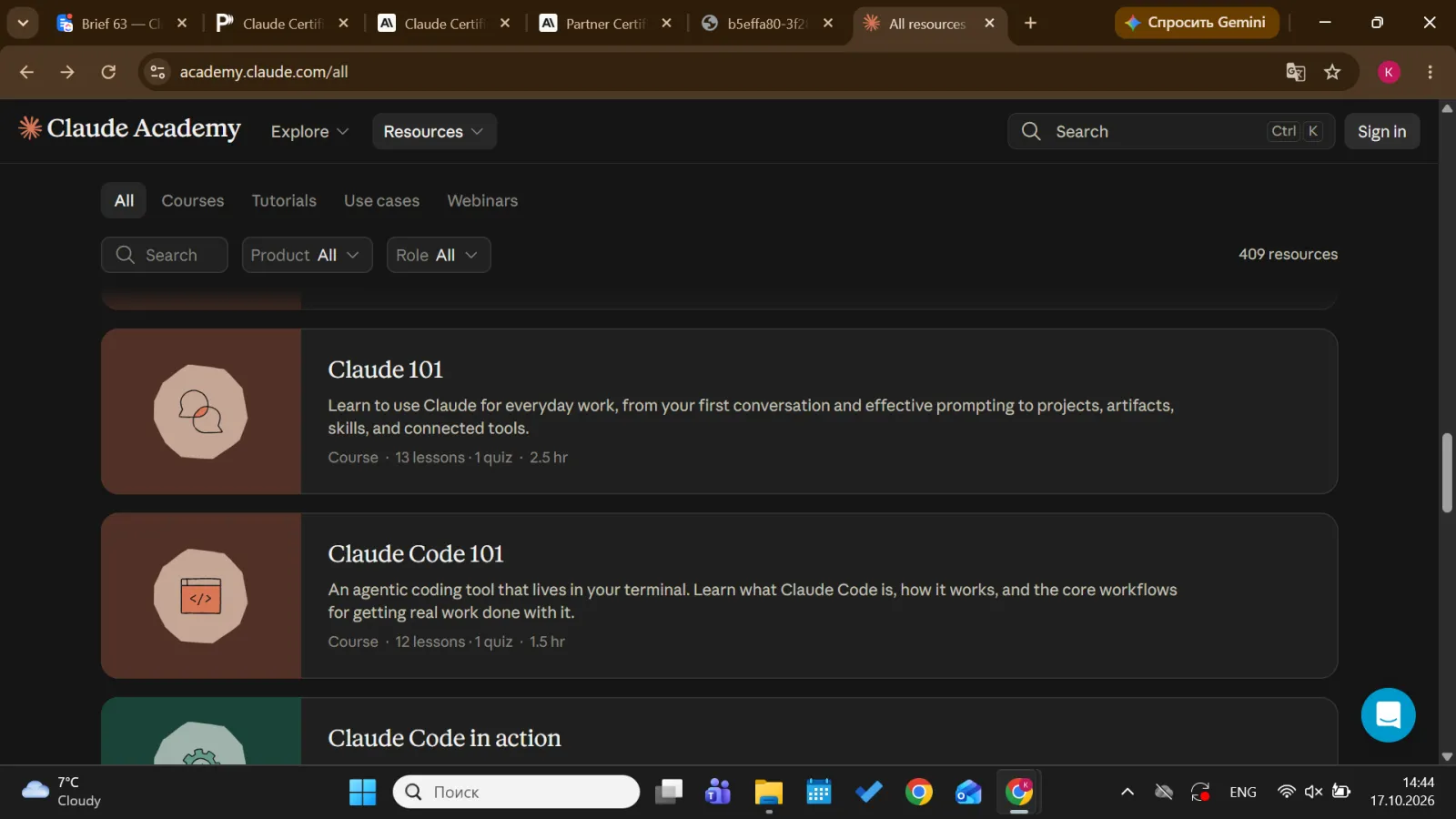
Claude 101 course card on Claude Academy
Source: Claude Academy by Anthropic, “All resources” page (academy.claude.com/all), accessed October 17, 2026.
How to prepare: a 4-6-week plan
There’s no single required Claude certification course. Anthropic calls the exam guide the authoritative source for what’s tested, and the practice exam from the old platform was retired when delivery moved to Pearson in June 2026. What remains free and official: the exam guide with 12 sample questions and four hands-on exercises, the Claude Academy courses, and Anthropic’s documentation. The plan assumes you already write code and can study 6-8 hours a week. Weeks 5 and 6 are buffer for any domain that still feels weak.
| Week | Focus | What to do |
|---|---|---|
| 1 | Map the scope | Read the Architect - Foundations exam guide in full, mark every task statement you’ve never done yourself, and work through the 12 sample questions and their explanations. Start Building with the Claude API on Claude Academy. |
| 2 | API, tool use, structured output | Finish the API course sections on tool use and agents. Write a small extraction tool with a JSON schema and a validation-retry loop. Read the docs on tool_choice and the Message Batches API. |
| 3 | Claude Code | Take Claude Code 101 and Claude Code in action. Set up a repo with a project CLAUDE.md, a .claude/rules/ file scoped by path, a project slash command and a skill. Try plan mode on a multi-file change. |
| 4 | MCP and multi-agent design | Take Introduction to Model Context Protocol, Introduction to subagents and Introduction to agent skills. Build a coordinator with two subagents and configure an MCP server in .mcp.json. |
| 5 (optional) | Reliability and context | Rework your projects for error propagation, escalation rules and long sessions: a persistent case-facts block, scratchpad files, /compact. |
| 6 (optional) | Review and book | Re-read the task statements, answer the sample questions again without notes, run Pearson’s system test if you’ll test online, then schedule. |
If Claude Code is new to you, our guide on how to use Claude Code for beginners covers installation and first sessions, and our Claude Code course guide points to more structured options.
Independent study guides, mock exams and paid prep courses exist too. Anthropic doesn’t endorse any of them, and the official guide remains the reference for scope. Avoid anything sold as “real exam questions” – every candidate accepts a non-disclosure agreement, and Anthropic can revoke credentials and ban candidates for leaked content.
Practice projects to build before the exam
The exam guide includes four preparation exercises that line up with the scenarios. Treat them as portfolio projects you could walk an interviewer through:
A support agent with escalation logic. Three or four MCP tools, two of them deliberately similar, an agent loop that checks stop_reason, structured errors with a retryable flag, and a hook that blocks refunds above a threshold and routes them to a human. Our tutorial on how to build an AI agent works as a scaffold.
A team-ready Claude Code repo. A project CLAUDE.md, path-scoped rules for tests and API code, a skill that runs in a forked context with restricted tools, and one shared plus one personal MCP server running side by side.
A document extraction pipeline. A JSON schema with nullable fields, a retry loop that feeds validation errors back to the model, few-shot examples for inconsistent formats, a 100-document run through the Message Batches API, and low-confidence results routed to human review.
A multi-agent research pipeline. A coordinator that spawns subagents in parallel, passes findings to them explicitly, keeps source URLs and dates attached to every claim, and reports coverage gaps when a subagent times out.
Write down why you chose each design. Scenario questions reward exactly that reasoning.
After you pass
Your score appears on screen when you finish. If you pass, Credly emails you an invitation to accept your badge, usually within minutes for online exams. From Credly you can share the badge to the Licenses & certifications section of your LinkedIn profile and download a PDF certificate. Add a personal email to your Credly profile so the badge stays with you if you change employers.
In interviews, the badge opens the conversation and your projects carry it. Describe a trade-off you made, such as choosing a hook over a prompt rule, and what failed before you made that call. Don’t discuss exam content, since the NDA covers questions, answer options and scenarios. Whether employers weigh credentials heavily is a fair question, and our piece on whether you need a certificate to get an AI job looks at what hiring managers check instead.
The credential lasts 12 months. Renewing on time is free – you review what has changed and complete a non-proctored assessment on Anthropic Partner Academy. If it lapses, you pay for the full exam again, and Anthropic may require a full retake if exam content changes significantly.
Build your Claude skills first
If you are not ready for a proctored exam yet, then build daily Claude and Claude Code skills first: short lessons, with a CPD-accredited certificate at the end. Claude and Claude Code are both in the catalog of Coursiv’s AI Certificate Program. Coursiv isn’t affiliated with Anthropic, and the program doesn’t prepare you for or replace the architect exam. It’s a way to make the tools part of your everyday work before you go deeper. Check out the 28-DayAI Certificate Program by Coursiv.