Claude AI is a strong AI writing assistant in 2026 when you need long-form drafting, editing, tone control, brand voice, research summaries, academic-style explanations, or careful rewriting. It is especially useful for writers who want a collaborative editor rather than a tool that only generates generic first drafts.
Quick answer: Claude is well suited to writing tasks that require nuance, long context, careful editing, and a consistent voice. Use it for blog outlines, SEO drafts, academic summaries, fiction feedback, brand copy, email rewrites, and manuscript editing. Use ChatGPT when you need faster ideation, broader tool integrations, image generation, or rapid variations at scale.
Claude AI for writing by task
| Writing task | How Claude helps | Best model choice | Human check needed |
|---|---|---|---|
| Blog posts and SEO articles | Outlines, briefs, drafts, subheadings, meta descriptions, editing | Claude Sonnet for most tasks; Opus for complex strategy pieces | Fact-check claims, stats, and search intent |
| Academic and research writing | Summaries, literature notes, argument structure, plain-English explanations | Sonnet or Opus depending on complexity | Verify citations and never submit AI text as your own where prohibited |
| Marketing copy | Landing pages, product copy, email drafts, ad angles, brand voice variants | Sonnet for drafts; Opus for high-stakes campaigns | Check claims, offers, compliance, and tone |
| Creative writing | Plot ideas, character consistency, scene feedback, line edits | Opus for deeper critique; Sonnet for drafting | Preserve your own voice and originality |
| Business writing | Memos, reports, executive summaries, meeting follow-ups, proposals | Sonnet for everyday work; Opus for complex documents | Review decisions, numbers, and legal/financial claims |
| Editing and rewriting | Copyediting, clarity passes, tone matching, structure improvements | Sonnet for most editing; Haiku for simple rewrites | Approve final wording before publishing |
If you are still choosing a writing assistant, compare this guide with best AI chatbot for writing, Claude vs ChatGPT, and Grammarly vs ChatGPT. If you need a broader production stack beyond writing, use the best AI tools for content creation guide to compare text, image, video, and workflow tools together.
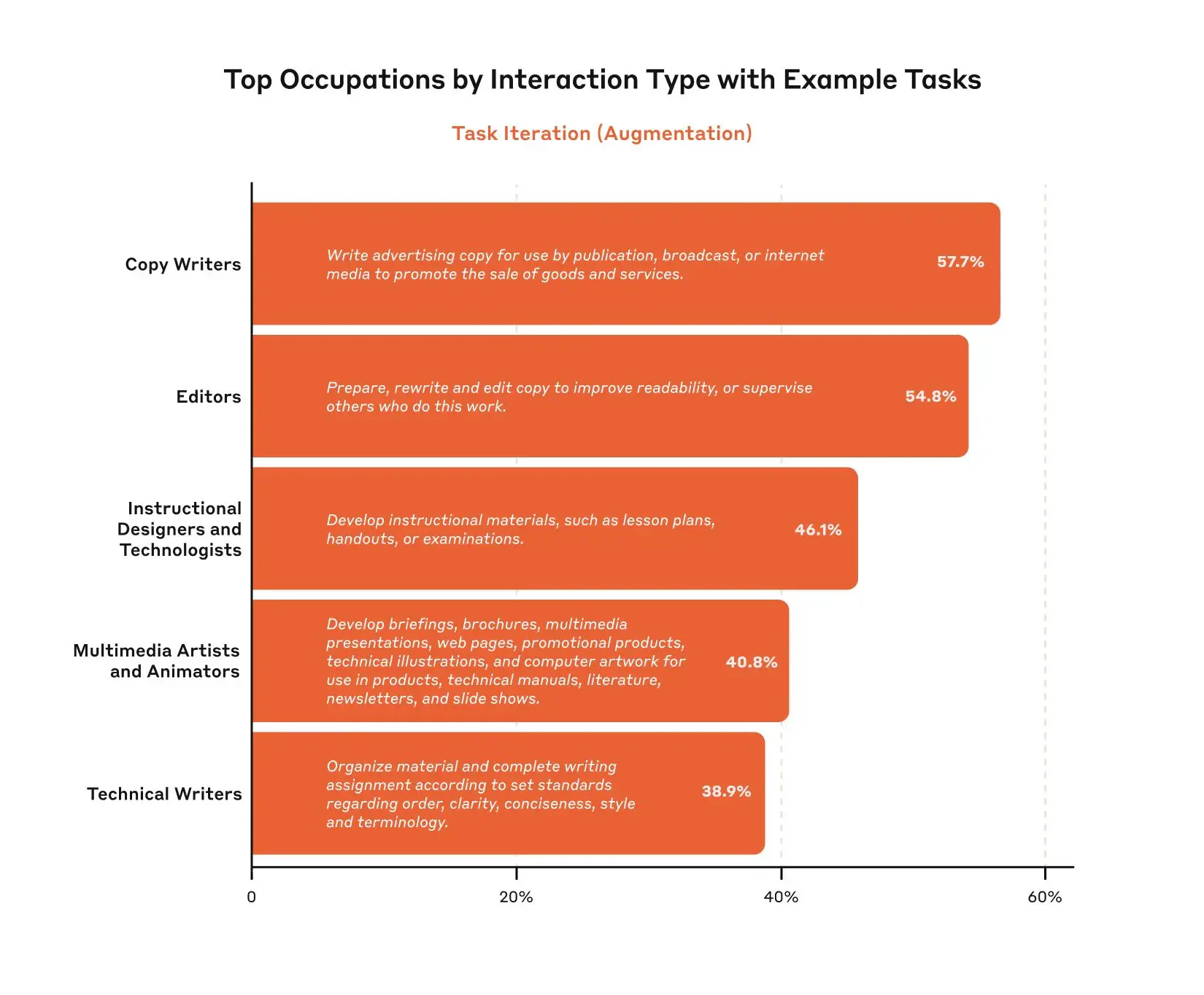
Source check — June 12, 2026: Anthropic’s Economic Index report supports the writing use case: it found that Arts, Design, Entertainment, Sports, and Media usage on Claude.ai rose from August to November 2025, driven partly by copyediting and fiction-writing/refinement conversations. For current plan limits and prices, check Claude’s plan documentation and Anthropic’s API pricing/model docs.
Natural Language Capabilities for Content Creation
Quick answer: Claude is strong for writing because it follows tone instructions well, handles long context, and tends to produce less formulaic prose when you give it examples, constraints, and a clear audience.
Text generation is one of the most critical functions of any AI model, and every company tests new versions every day. Initially, AI-generated texts stood out immediately – they were perfectly structured, polished, and technically sound. It was easy to spot phrases that the AI used repeatedly as patterns. It was noted that AI-generated texts lacked human depth and emotion.
But the gap is narrower now. With a strong prompt, examples, and human editing, AI-assisted drafts can be difficult to distinguish from ordinary professional drafts. Claude AI from Anthropic may stand out for writers who value language nuance, careful editing, and coherent logic, though results still depend on the prompt, source material, model, and human review.
Claude can follow rhetorical intent, style examples, and the big picture of a draft when given enough context. In creative work such as poetry or fiction feedback, it can help connect ideas, propose layers, and critique structure, but the writer still owns the voice and final artistic judgment.
Key Features of Claude AI for Writers and Content Creators
Quick answer: the most useful Claude writing features are long-context editing, tone control, style adaptation, document analysis, structured feedback, and the ability to revise text iteratively with the writer.
What sets Claude apart from other models when used for creative purposes – specifically when writing text?

Long-Form Content Generation and Context Understanding
The most important feature of Claude for long-form writing is its extended context window. Exact limits depend on the model, plan, and API configuration: Sonnet models are commonly used with large 200K-token contexts, while the newer Opus 4.8 API pricing docs list 1M-token context support. In practice, this means Claude can work with long briefs, research notes, draft chapters, transcripts, style guides, and source documents without losing the thread as quickly as shorter-context tools.
This depth of context provides several important capabilities that are indispensable for professionals when creating content:
- Claude can maintain consistent terminology throughout a 5,000-word technical manual
- Another example: when writing a conclusion, it can reference an argument presented to the user at the beginning
- When asked to restructure an article, it doesn’t lose sight of the main points and ideas written in other inactive sections. You’ve likely encountered the fact that many AI models, when given such a request, end up changing other parts as well. This does not happen here, which is undoubtedly important for journalists, writers, and many others who work on long and extensive texts
Tone Control, Style Adaptation, and Brand Voice Matching
When it comes to controlling tone, style, and brand voice matching, Claude AI can be a strong option. Once the model receives precise instructions on style and tone, Claude can switch between different registers – such as formal and authoritative for serious analytical texts, or conversational and warm for lifestyle blogs. If you’re creating ad copy, Claude can adapt to your requests and draft energetic or dramatic options. Providing a sample of the text whose style you want to follow usually makes the draft closer to what you want to achieve.
Nowadays, many content creators who write for brands use the term “brand voice.” Brand voice is a consistent and recurring style in communications with the audience that aligns with the brand’s philosophy and positioning. Many marketing teams provide Claude with a style guide that includes elements of brand voice along with a content brief and get results that meet their expectations.
In addition, Claude responds positively to requests such as “write as if you were writing for The New Yorker, but without excessive formality.” The AI model also easily understands tone instructions. These might include, for example: “Write in a confident, accessible, optimistic tone.”
What’s important to note about all these features is that Claude can also challenge or question your prompt. In a way, it acts as a co-author of the text rather than a passive executor. This prevents the writing process from becoming one-sided and allows you to view texts from different angles, which is undoubtedly a plus for creative professionals.
Accuracy, Reasoning, and Research Assistance
What many users in 2026 still find challenging in AI models is accuracy in handling data. Claude can be useful when you ask it to reason from supplied sources, separate evidence from inference, and flag uncertainty. However, no model should be treated as the final authority on facts.
If a user needs to understand a complex topic, Claude primarily constructs logical arguments and leaves room for doubt and follow-up questions, making it particularly useful for researchers. When working on a research project, Claude can help familiarize you with an unknown topic, summarize large amounts of material and highlight key points, create sections that capture the essence of the material, and more.
It’s worth noting that Claude works particularly well with primary sources. Like all AI models, when sources are provided, the information should be double-checked.
Claude AI for Writing Use Cases in 2026
Quick answer: Claude works best as a co-writer and editor for blogs, SEO briefs, marketing copy, business communication, academic summaries, creative writing, and long-document rewrites.

Working with text is ubiquitous. From marketing campaigns to business communications, from scientific research to the craft of writing – in all these cases, Claude AI can be a useful tool. Below are the most common use cases for the AI model in text writing:
Blogging and SEO Article Writing
One of the most obvious is blogging. Claude AI can create blog-post drafts based on a brief provided by the user, generate several versions of content based on a cluster of keywords, and adapt your drafts to the blog’s style and audience. Final posts still need editing, fact-checking, and publication review.
For those who write SEO-focused content, Claude can be useful during the planning and structuring stages. It can generate a list of keywords, highlight particularly important ones, and suggest semantically related subtopics that enhance the topic’s authority. In addition, the AI model can suggest headlines that reflect likely search queries and write subheadings that have the potential to draw readers’ attention to the article. The latter is considered an indicator that search engines often treat as a ranking signal.
It is worth noting that texts may require human editing, especially regarding facts and claims. Using Claude AI for writing may reduce drafting time, but the actual savings depend on topic complexity and review effort.
Marketing Copy and Advertising Content
The marketing and advertising sector can use AI models to draft more variants and speed up review cycles, but productivity gains should be measured in each workflow. Marketing texts need emotional impact, clear calls to action, accurate offers, and claim substantiation. Claude can draft persuasive options when given audience context, proof points, and constraints, but a specialist should still review the final copy.
Marketers and PR professionals can use Claude to write product descriptions, email newsletters, landing page copy, captions for social media posts, and to generate ideas for advertising creatives.
If you’re worried about or don’t want to lose the human element and creative judgment, you can use Claude to generate several ideas – such as headlines or calls to action – and then handpick the best ones yourself and develop that creative concept on your own.
In marketing, people often work on creating compelling, authoritative long-form content. These can be case studies, articles about the history of brands and people – texts aimed at winning the audience’s trust and building a strong connection, rather than simply prompting an action like a purchase or viewing a product. Claude also handles such tasks well, adapting to the desired tone and style.
Business Communication and Professional Writing
It would be a mistake to assume that Claude AI is only for creative writing. By 2026, many fields can benefit from using AI. In business communications, Claude can help draft a wide variety of documents – from professional resumes to meeting presentations, from internal memos to policy-adjacent drafts. AI can also help create reports, meeting summaries, statements, and more, but sensitive business, legal, financial, or regulatory documents need human review.
Claude excels at transforming raw information – such as meeting minutes, data tables, and lists of bullet points – into professionally structured text. Teams can use Claude as a tool for the preliminary preparation of documents that previously required significant time investment.
Academic and Research Content Summarization
For academics, Claude can be a useful tool for summarizing provided literature, organizing research notes, and defining the structure of academic work. It can help explain complex literature to a non-specialist audience and draft clear explanations of one’s own work for fellow researchers, but it should not replace database search, citation verification, or institutional AI-use rules.
When presented with existing research papers, Claude can summarize them, identify central arguments, and outline methodology. Upon request, it can also look for possible contradictions between sources. For science communication specialists, political analysts and commentators, and educators, Claude can accelerate first drafts of explanations, but scientific accuracy still requires expert verification.
Creative Writing and Storytelling
Although an AI model for creative writing might be perceived as the least in demand – since writing is traditionally considered a purely human craft that necessarily involves an element of spirituality and authorship – by 2026, neural networks had found their place there as well.
Claude stands out among AI writing tools because it handles narrative structure, character consistency, dialogue feedback, genre expectations, and descriptive prose better than many generic writing assistants.
For fiction writers, it can serve as a brainstorming partner for generating ideas or resolving plot issues. It can also act as a screenwriter or editor, identifying structural flaws in a manuscript. The best approach is to view Claude as a tool for collaboration rather than a complete replacement for your own voice. This is also consistent with Anthropic Economic Index findings: writing and editing often look like augmentation, where the human and model iterate together, rather than one-click automation.
Claude AI vs ChatGPT for Writing: Key Differences in 2026
Quick answer: Claude is usually better for nuanced long-form writing and editing; ChatGPT is often better for fast ideation, rapid variations, multimodal workflows, and broad integrations.

Currently, some of the most popular neural networks on the market are Claude from Anthropic and ChatGPT from OpenAI. These two companies are improving their AI models every day, adding more and more capabilities, including for writing processes. A comparison of the two models is provided below:
Writing Quality and Creativity Comparison
Claude stands out primarily for its ability to generate text that feels less formulaic and more thoughtful. It maintains a tone that is closer to that of a human. Sentences are more varied in structure, transitions are often more purposeful, and arguments are more coherent and developed across several paragraphs.
ChatGPT is particularly good at rapid iteration and, as a rule, is more willing to experiment with non-traditional formats upon request. For creative tasks that require a wide variety of brainstorming and concept generation, ChatGPT’s openness to risk can be an advantage.
ChatGPT for writing:
- writes clearly and correctly
- structures well and follows formatting instructions
- starts with a thesis paragraph that summarizes the main ideas and only then moves on to the main content
- uses transition phrases quite often
- often adds caveats and disclaimers without being asked
Claude for writing:
- varies sentence length and structure more naturally
- uses fewer filler phrases and transition words
- better matches the requested tone and stays within that tone
- less often adds unsolicited caveats and clarifications
- is more straightforward in evaluating text when the task requires it
In summary, Claude can be a strong option for creative tasks where natural style, nuance, and human editing matter. If your text requires elements such as emotional resonance, nuance, and a specific style, then Claude may be a good fit.
Consequently, for marketing texts, essays, and fiction, Claude is often a strong choice when style and nuance matter.
If your tasks are related to informational content such as guides, documentation, and explanations, ChatGPT will be a good solution. With these types of texts, emotional tone and style are not as important, but structure and clarity are essential. ChatGPT is exactly about that.
SEO Content Performance and Structuring
If your goal is to use AI models for SEO, then both of these neural networks are good choices. However, they tackle this task differently.
Claude can produce structured hierarchies with semantic links between different segments. With strong prompts and human editing, Claude drafts may read naturally and support E-E-A-T-style editorial goals (Experience, Expertise, Authoritativeness, and Trustworthiness), but the model cannot provide real-world experience or authority by itself.
ChatGPT most often generates content that scores well on keyword density at a superficial level, making such results less in-depth and less logically sound. However, speed and versatility are ChatGPT’s strengths. The tool can deal with high-throughput iterative processes, such as numerous meta descriptions, title tags, and a great variety of long-tail keywords from a primary keyword. Moreover, the OpenAI model has excellent knowledge about on-page SEO factors such as meta descriptions, keywords, subheadings, and structure.
Reliability, Accuracy, and Suitability for Use Cases
Claude is often valued for careful reasoning and instruction-following, particularly when logic and accuracy matter. It can provide a logical rationale for statements when prompted, but it can still hallucinate or miss context. Differences versus ChatGPT depend on the model versions, prompt, and task.
When it comes to accuracy, the level of hallucinations and the correctness of facts still depends on the model, prompt, sources, and task. Claude is useful when you ask it to reason from supplied sources and flag uncertainty, but writers should still verify factual claims before publishing.
As for use cases, Claude is better suited for working with long texts, whether it’s
creative writing or simply specialized text-based tasks. Claude is also an excellent choice for coding. If you need a multimodal assistant capable of image generation, broad tool integrations, and fast brainstorming variants, ChatGPT can be the better choice. If your main priority is long-form prose, careful editing, and style consistency, Claude is often the stronger writing partner.
Claude AI for SEO Content Writing and Optimization
Quick answer: Claude can help with SEO outlines, search-intent mapping, semantic subtopics, H2/H3 structure, meta descriptions, and readability edits, but humans should still own keyword research and fact-checking.

For professionals working with SEO content, Claude can become an indispensable assistant. These days, SEO isn’t just about keywords and headings, but about the precision of phrasing and the ability to engage the reader – so that Google takes notice.
Keyword Integration and Semantic SEO
One of the most crucial points about Claude from the perspective of SEO is its ability to distinguish between keyword stuffing and keyword optimization. This is vital for SEO-related writing because the text needs to be accepted favorably both by the target audience and by the search engine algorithms. With a technical briefing provided to Claude, the program will integrate the keywords into the text naturally.
What is more, Claude’s programming includes the basics of semantic SEO. The program understands the importance of creating topic clusters and taking into account the search intent of the user rather than simply matching the query. From the perspective of the professional user, this implies that Claude may help authors create a content strategy.
Content Structuring for Rankings
Properly structured content generally ranks better in search results. This includes clear hierarchical headings, a logical information structure, content that answers follow-up questions, and much more.
Claude can take a rough outline and develop it into a full-fledged article structure, identify issues, and suggest optimizations for rich snippets, presenting key answers in an accessible format.
Writing High-Quality Blog Posts with Claude AI
Claude AI can act as your helper for writing blog posts, but the strongest workflow is still human-led: use Claude for outlines, drafts, rewrites, and editing, then verify and polish the final piece yourself.
Firstly, describe the task that needs to be fulfilled for Claude with the maximum level of details by specifying the keyword, audience, tone of voice, word count, and information.
Afterwards, ask Claude to provide an outline prior to starting to write the text.
It is better to write each part separately if the text is long.
Once the text is ready, you can ask Claude to make edits where necessary. If there are any questionable arguments, you can also clarify the information.
As previously noted, Claude is excellent for collaborative work, and it works best when you break the work into stages and track the process.
Prompt Engineering for Better Writing Results with Claude AI
Quick answer: the best Claude writing prompts include audience, goal, tone, source material, structure, examples of style, constraints, and a revision instruction such as “ask clarifying questions before drafting.”

Of course, the foundation of working with any AI model is a well-written prompt. A properly structured prompt can save time and produce stronger drafts with less cleanup in some cases.
Effective Prompt Structure for Articles and Blogs
Effective prompts for writing articles share several common features:
- they clearly define the target audience and purpose
- define the tone and style of writing using examples or comparative references, rather than just descriptive words
- provide structural guidelines regarding the text outline
- set limits on word count and text complexity, and also include information on what to emphasize and what to avoid
Example of a strong prompt for writing an article:
“Write a 500-word introduction and the first two sections of an article targeting [keyword] for [audience]. Tone: reliable and serious but accessible, like Harvard Business Review writing for practitioners. Structure: open with a concrete scenario that illustrates the problem, then define the concept precisely, then overview the three main approaches. Avoid passive voice and filler phrases like ‘in today’s world.’”
SEO-Focused Prompt Templates
Prompts aimed at SEO content should ideally include the following elements:
- the main keyword and a list of semantically related terms to use
- the search intent the article should address (e.g., informational, commercial, etc.)
- the desired meta description and title tag
- requirements for rich snippet formatting
- providing examples of competitors with a request to fill in the gaps
Improving Output Quality Through Iteration
As noted above, Claude is often most useful in a collaborative writing workflow. Upon receiving the first response, it’s worth fine-tuning the text – pointing out specific shortcomings and requesting alternative options for sections or chapters. This collaborative process can improve the draft and move it closer to the desired result.
Claude AI Writing Strengths and Limitations
Quick answer: Claude is strong at long-form structure, style matching, and thoughtful edits, but it still needs human review for facts, citations, legal/medical/financial claims, originality, and brand judgment.
Claude is strong for writing, but every AI model has tradeoffs depending on the workflow.
Strengths for Long-Form and Structured Content
For extensive, long-form texts, Claude is a strong option because it offers advanced context processing, logical coherence in long documents, and flexibility in tone. It may be suitable for texts over 2,000 words, analyses, and literature reviews, but editing needs vary by task, source quality, and model version.
Regarding editing, Claude is not just excellent in creating new content but is equally good at analyzing pre-existing texts. It can identify logical gaps, tone inconsistencies, and structural flaws, and provide valuable feedback on all these points.
Limitations in Real-Time Data and Fact Accuracy
The limitation of Claude’s knowledge base is one of the main drawbacks when writing texts. Claude access to current information depends on product features, connectors, and whether you provide sources. For tasks requiring up-to-date data — such as market research, trend analysis, or commentary on current events — provide the source material yourself and ask Claude to separate evidence from inference.
Claude also gets factual errors, especially with highly specialized information. This generally applies to any AI model and requires independent verification.
Pricing, Access, and Best Plans for Writers
Quick answer: start free if you only test short drafts, upgrade to a paid Claude plan for regular writing and higher limits, and use Team or Enterprise when writers need shared projects, admin controls, and privacy workflows.
The available plans and their costs are described below:
Free vs Paid Usage for Content Creation
Claude AI is available to users for free via Claude.ai with limited functionality. For those who need to create short texts that don’t require a large dataset, the free plan will suffice. It is also a good choice for you if your goal is to explore and evaluate Claude’s capabilities to determine whether it’s right for you.
Who Should Upgrade to Claude Pro
The main reason writers consider upgrading to Claude Pro is higher usage capacity and better access to paid-product capabilities. If you work in content creation regularly and use Claude to create or edit many articles each week, then you should consider a paid plan.
For big teams and organizations, there are Claude for Teams and Enterprise plans, which include collaboration features, high privacy, and administrative capabilities for professional environments.
FAQ
Is Claude AI good for writing?
Is ChatGPT or Claude better for writing?
Which Claude model is best for writing?
Can Claude AI learn my writing style?
Is Claude good for academic writing?
Can Claude write SEO blog posts?
What are the best Claude prompts for writing?
What should writers not use Claude for?