ChatGPT’s individual plan costs $20/month. Jasper starts at $69/month for a single seat. Both tools produce quality content. So why does Jasper charge more than triple the price?
The short answer: specialization. ChatGPT is a general-purpose assistant that handles everything from email drafts to code debugging to research reports.
Jasper is a marketing-specific platform with 100+ purpose-built agents, brand voice enforcement, and workflow automation designed for teams producing content at scale. You’re paying for guardrails and consistency, not raw capability.
Whether that specialization is worth the premium depends on how you actually work.
This comparison breaks down the real differences so you can make a confident decision. If you are building a complete content operation rather than choosing between two writing tools, compare the full AI content creation tools shortlist as well.
Whether that price gap is justified comes down entirely to how you actually use the tool day-to-day.
I put both through their paces to show you where each one actually shines.
The Quick Verdict: When to Choose Each Tool
![][image1]
Pick ChatGPT if you:
- Bounce between all sorts of tasks — writing, research, coding, images — rather than staying in one lane
- Care about building actual AI skills, not just clicking templates
- Working solo or on a small team, and $49/month in savings genuinely matters
- Like having blank-canvas freedom instead of guardrails
Pick Jasper if you:
- Your whole job is marketing content
- You run a team where everyone needs to sound like the same brand
- You’re cranking out the same content formats day after day
- The price difference doesn’t sting when it means less time fighting with prompts
Alright — let’s get into the details.
The Real Tradeoffs (Quick Look)
ChatGPT
What it does well:
- Switches between writing, research, coding, analysis — basically anything you throw at it
- Won’t break the bank at $20/month for the full feature set
- Connects to 119+ external apps
- Deep Research and Agent Mode handle the heavy-lifting on complex tasks
Where it falls short:
- Nothing is built in for keeping your brand voice consistent
- Not developed for marketing workflows — you’re setting those up yourself
- Results vary quite a bit depending on how well you write your prompts
Jasper
What it does well:
- Brand Voice means every output sounds like your brand
- 100+ templates and agents purpose-built for marketing
- Grid handles bulk content production without breaking a sweat
- Plugs into Semrush and Surfer for SEO
- Less time fussing with prompts on stuff you do repeatedly
Where it falls short:
- You’re paying $69/month minimum — and the real power features like Agents, Grid, and Studio sit behind an even pricier Business plan
- Doesn’t play well outside of marketing use cases
- Brand Voice and Knowledge Base setup takes real effort to get right
Key Features of ChatGPT
ChatGPT runs on OpenAI’s GPT-5.2 model family and has expanded well beyond text generation. (Interested in newer models? Check out our guide to GPT-5.4.) Current capabilities include image generation (DALL-E 3), voice conversation, video creation, code execution, and file analysis.
Writers tend to get the most mileage out of these:
- Canvas: a collaborative editing space where you and the AI work on a document together
- Deep Research: pulls from multiple sources and hands you a summary with citations
- Agent Mode: browses the web, runs code, handles files — basically a multi-step assistant
- Custom GPTs: save your setup for tasks you run on repeat
- Projects: keeps your work organized with shared files, context, and team knowledge all in one place
The platform connects to 60+ apps, including Google Drive, Slack, Notion, HubSpot, and Figma.
Key Features of Jasper
Jasper has repositioned itself as a “multi-agent marketing platform” serving over 100,000 businesses, including 20% of the Fortune 500. The architecture centers on marketing-specific capabilities:
- Jasper IQ: Brand Voice (tone and formatting rules), Visual Guidelines, Style Guide, and a Knowledge Base accepting text, video, images, and data
- AI Agents: 100+ specialized marketing agents including Optimization, Personalization, and Research Agents (Business plan only)
- Content Pipelines: Automate the entire content lifecycle from strategy to execution
- Jasper Grid: Spreadsheet-like interface for systematic content at scale (Business plan only)
- Canvas and Chat: Document editor with conversational AI and marketing domain expertise
- Image Suite: Image generation, editing, background removal, and product photography compositing
A browser extension brings Jasper into Gmail, WordPress, Google Docs, HubSpot, LinkedIn, and Facebook.
Jasper vs ChatGPT: Pricing Breakdown
ChatGPT Pricing
OpenAI offers five tiers:
- Free: GPT-5.2 Instant (10 messages per 5 hours), basic voice, limited image generation
- Go: $8/month. 160 Instant messages with GPT‑5.2 every 3 hours, 10 Thinking messages every 5 hours, extended access to image creation, file uploads, and advanced data analysis
- Plus: $20/month. 160 Instant messages per 3 hours, 3,000 Thinking messages per week, agent mode, canvas, projects, custom GPTs, video creation, Codex agent, apps to connect with
- Pro: $200/month. Unlimited everything, GPT-5.2 Pro access, priority traffic
- Business: $30/seat/month (annual). SSO, SAML, shared projects, company knowledge, MCP developer mode
For most content writers, Plus at $20/month delivers the full feature set. If you’re comparing multiple options, our best AI chatbots 2026 guide covers other competitive tools.
Jasper Pricing
Jasper offers two plans:
- Pro: $69/month ($59/month annual). Single seat, 2 Brand Voices, 5 knowledge assets, 3 audiences, limited app access, basic image suite, email support
- Business: Custom pricing (12-month minimum). Multiple seats, unlimited Brand Voices and knowledge assets, Grid, Agents, Studio, API access, priority support
A 7-day free trial is available on Pro (credit card required, auto-converts).
Value Comparison
The math is pretty blunt. Jasper Pro runs 3.5x what you’d pay for ChatGPT Plus. And if you want the flagship features (Agents, Grid, Studio), those are Business-only, so add a custom quote on top.
For most people doing varied content work, ChatGPT Plus wins on value. More flexible, cheaper, and the skills you build carry over to every other AI tool out there. Want to explore how ChatGPT compares to other top AI tools? See our comparison of Claude vs ChatGPT.
Jasper starts making sense when the volume gets serious: marketing teams cranking out brand-consistent content at scale, orgs that need to lock down style guide compliance across a writing team, or businesses already deep in the Jasper ecosystem.
Jasper AI vs ChatGPT: Content Quality and Performance
Output Quality Comparison
Both tools produce competent marketing copy. The real difference is in consistency and customization.
ChatGPT produces varied outputs that reflect your prompting style. With practice, you can achieve high-quality results across technical documentation, email sequences, and research reports with equal flexibility. (For broader business use cases, see our best AI tools for business guide.)
Jasper outputs have a certain flavor to them — polished, on-brand, unmistakably marketing. The templates and Brand Voice settings actively push everything in that direction. That’s a real plus when you’ve got a team all writing the same kinds of things. But once you need to step outside the marketing bucket, it starts to feel like the tool is working against you rather than with you.
Speed and Workflow Efficiency
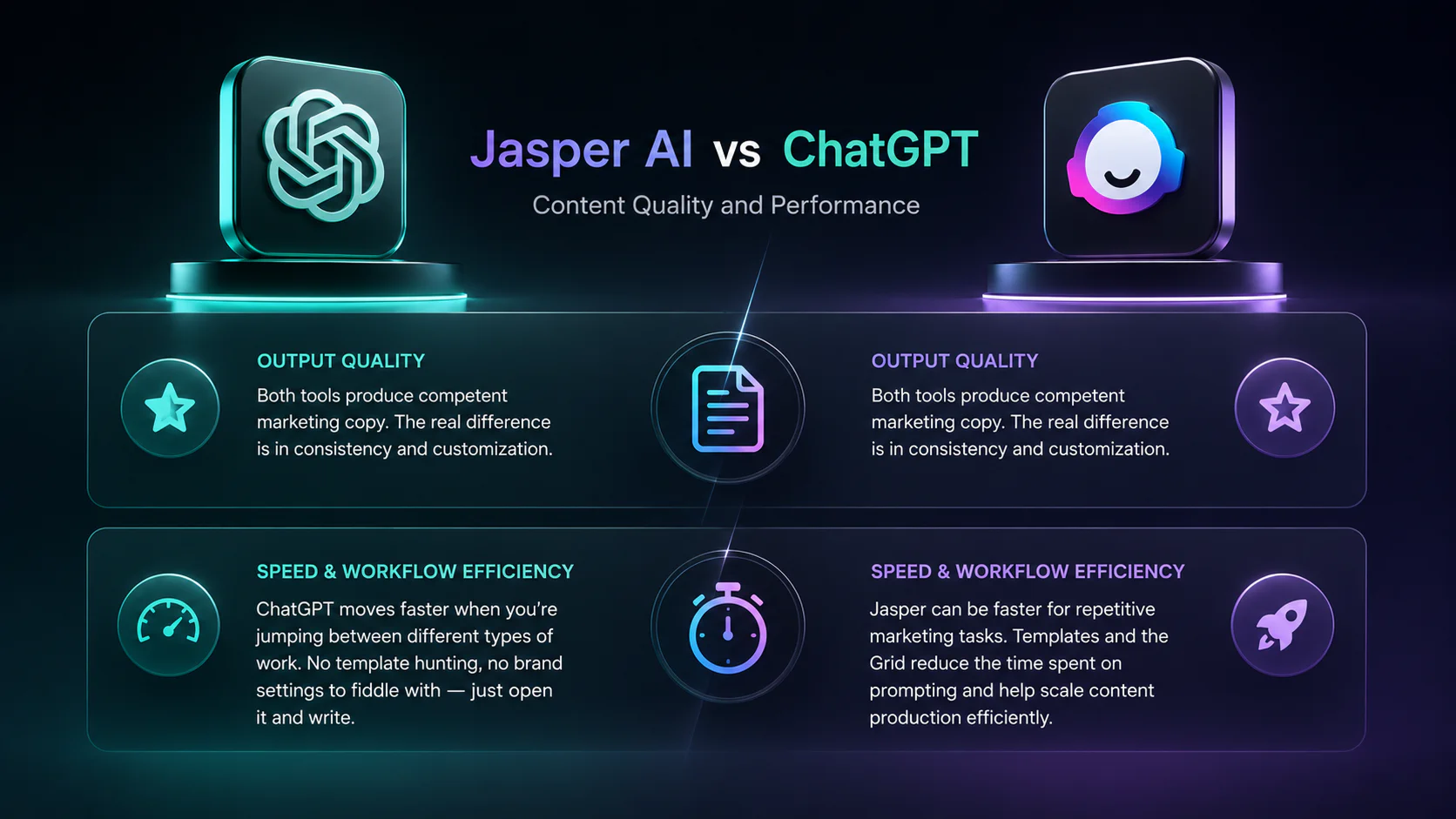
Jasper can be faster for repetitive marketing tasks. If you produce hundreds of product descriptions or ad variations, templates reduce the time spent on prompting. The Grid is built specifically for churning out large amounts of content.
ChatGPT moves faster when you’re jumping between different types of work. No template hunting, no brand settings to fiddle with — just open it and write. For anyone juggling different content formats throughout the day, that simplicity tends to win.
ChatGPT vs Jasper: Integration and Automation Capabilities
ChatGPT plugs into 119+ apps — Microsoft 365, Google Workspace, Atlassian, Slack, Salesforce, Notion, Figma, you name it. Business and Enterprise plans can build custom MCP apps with read/write capabilities. Company Knowledge automatically pulls organizational context for company-specific answers with citations.
Jasper has built out a solid integration library aimed specifically at marketing teams. Native add-ins for Google Docs, Google Sheets, and Microsoft Word let you pull Jasper’s features into the tools you’re already using, and the Chrome extension works across virtually any website.
On the development and CMS side, connections to Webflow and Google BigQuery let teams push out on-brand content at scale. And if you need a custom setup, Zapier, Make, and Pabbly Connect give you plenty of room to wire Jasper into your existing workflows.
You can also submit a request if you need an integration that isn’t listed yet.
Who Should Choose Which Tool
ChatGPT is the better fit if you’re:
- A freelancer or generalist juggling different content types on any given day
- Someone who wants to get genuinely good at AI — skills you build with ChatGPT carry over to basically every other tool out there
- Working solo or on a lean team where spending $69/month instead of $20 actually matters
- The type of person who’d rather figure out the best approach themselves than follow a template
Jasper makes more sense if you’re:
- Running a marketing team that pumps out the same types of content — ads, product copy, social posts — week after week
- Managing multiple writers who all need to sound like the same brand
- Happy to pay more upfront if it means less time wrestling with prompts
- Laser-focused on marketing and advertising work. Need to produce a lot of content every day.
Getting Started with Your Chosen Tool
Now comes the fun part — learning how to get the most out of your chosen tool.
For ChatGPT: Start with the free tier to learn prompting fundamentals. Experiment with different approaches. Spend time learning Canvas for editing workflows, Projects for keeping related work organized, and Custom GPTs for anything you’re doing on repeat.
OpenAI has solid documentation, and there’s no shortage of YouTube tutorials, but the honest truth is that free resources leave you to figure out the sequence yourself. What to learn first, when you’re ready to move on, and how to stay consistent. That’s all on you. A lot of people start off motivated and then slowly lose steam.
Coursiv’s ChatGPT guide (12 hours across two courses) takes a different approach. Short lessons (usually about 10 minutes) that fit into a real schedule.
The structure is already laid out for you: start with the fundamentals, move into advanced prompting, then Custom GPTs and automation.
Daily practice challenges help things actually stick instead of just sliding off after a passive watch-through.
You show up, knock out the next lesson, and keep moving forward. Simple as that.
For Jasper: Try the 7-day Pro trial first — pay attention to whether the templates actually map to how you work, and put real effort into the Brand Voice setup since that’s what determines output quality. Jasper’s own academy is fine for covering the basics.
Coursiv’s Jasper guide (6 hours) goes further. Instead of scattered tutorials, you get a structured path through templates, Brand Voice configuration, and marketing workflow integration. Same deal as the ChatGPT guide: short daily lessons, hands-on challenges, clear progression.
The point isn’t to learn a tool. It’s to build workflows that make you noticeably faster and harder to replace.
Frequently Asked Questions

Can Jasper Replace ChatGPT Entirely?
No. Jasper excels at marketing content but lacks ChatGPT’s versatility for research, coding help, data analysis, and general tasks. Most professionals benefit from having access to both tools or choosing ChatGPT for broader capability. If coding is a priority, check our best AI tools for coding.
Notably, Jasper’s MCP server now works with ChatGPT, letting you use ChatGPT while maintaining Jasper’s brand intelligence. The tools are increasingly complementary.
Is ChatGPT Good Enough for Professional Marketing Content?
Yes, with proper prompting. ChatGPT produces marketing content comparable to Jasper. The difference: Jasper’s templates and Brand Voice reduce the effort required to produce consistent outputs.
If you’re willing to develop prompting skills and create your own Custom GPTs for repeated tasks, ChatGPT handles marketing content well at a lower price.
Which Tool Is Better for Someone Learning AI?
ChatGPT. Its flexibility forces you to develop prompting skills that transfer everywhere. You learn how to frame requests, iterate on outputs, and build workflows from scratch.
Jasper’s template-first approach can limit skill development. You learn to use Jasper, but those skills don’t transfer as cleanly to other tools.
Is Jasper Worth the Higher Price?
What Changed in Early 2026?
Both tools got meaningful updates heading into early 2026. OpenAI launched a new $8/month Go plan for people who didn’t need all of Plus, started quietly testing ads on cheaper tiers, and swapped GPT-4o out as GPT-5.2 became the default across the board.
Jasper’s changes were mostly feature additions - an SEO Optimization Agent, a Research Agent for setup tasks, and Knowledge Base Connectors that pull directly from SharePoint. Content Pipelines and Grid also finally graduated from “preview” to actual shipped products.