A practical breakdown of ChatGPT for real estate agents and realtors: which tasks save the most time, where AI still falls short, how to prompt it for client-ready listing copy, client emails, market summaries, and whether the free plan is enough. Based on 2025/2026 industry data, practitioner workflows, and head-to-head tool comparisons.
This page is intentionally agent-specific. For full-stack software beyond ChatGPT, compare best AI tools for real estate agents.
Where ChatGPT Saves Real Estate Agents the Most Time
Market Reports and Document Analysis
Upload MLS exports, RPR reports, or offering memorandums as PDFs and get a client-ready summary with charts, pricing strategy, and flagged inconsistencies in minutes.
Time saved: 30 minutes to 2 hours per analysis session.
Listing Descriptions and Ad Copy
It takes time to write a compelling, optimized property description. ChatGPT can generate multiple versions of a property based on a couple of property details and a prompt.
Time saved: 20 to 30 minutes per listing.
Scaling a Solo Agent’s Operations
Produce personalized client emails, social content calendars, and follow-up sequences at a volume that normally requires a marketing assistant.
Time saved: 5 to 10 hours weekly
Where ChatGPT Falls Short for Real Estate Professionals
Negotiations and Complex Client Situations
As Ryan Fitzgerald of Raleigh Realty put it, “AI cannot read the room in a heated negotiation. It cannot help a first-time buyer who is nervous.”
In March 2026, Ryan Serhant reported a $50M deal nearly collapsed after both buyer and seller consulted ChatGPT at the last moment. Both were advised to walk away. ChatGPT had no context about deal terms, relationship history, or concessions already made.
Local Market Knowledge
ChatGPT’s training data has a cutoff. It cannot tell you which streets flood, which builders cut corners, or which HOAs measure your grass with a ruler.
Brett Furman (38 years in Main Line PA real estate) notes two homes on the same street can sell for very different prices based on factors no AI assesses from data alone.
Building Trust and Personal Relationships
Trust is built in moments ChatGPT never sees. The conversation in the parking lot after a tough showing. The text at 10pm when a buyer gets cold feet. Knowing when to call instead of email.
How to Use ChatGPT for Real Estate: Prompt Engineering Tips for 2026
![][image1]
- Set up custom instructions in Settings so ChatGPT remembers your market, tone, and formatting rules across every conversation.
- When you’re not sure how to start, reverse the process. Ask AI to interview you first: “Ask me 5 questions before you write the copy.”
- Start with examples. Feed ChatGPT 2 to 3 listing descriptions you like before asking it to write one.
- Set the role and job in the first line: “You are a real estate copywriter. Write an MLS description for…”
- Add constraints up front: word count, MLS rules, Fair Housing compliance, phrases to avoid.
- Upload samples of your own writing so the output matches your voice.
- After prompting, ask, “What assumptions are you making about my audience, budget, and goals?” to catch blind spots.
- Ask ChatGPT to critique its own work: “Give me suggestions to improve the prompt I just gave you.”
- For document analysis, create a Project per deal and drop in all files so ChatGPT can query across them.
- Assume it can hallucinate. Double-check facts. Ask for sources.
Weak prompt: “Write a property description.”
Strong prompt: “You are a real estate copywriter for a boutique agency in the Noosa hinterland. I’m listing a four-bedroom family home on a half-acre lot backing onto bushland. Write a warm, story-driven listing description in 150 words. Target: families upgrading from their first home. Avoid ‘stunning,’ ’nestled,’ and ’entertainer’s dream.’ No emojis. End with a CTA to schedule a private showing.”
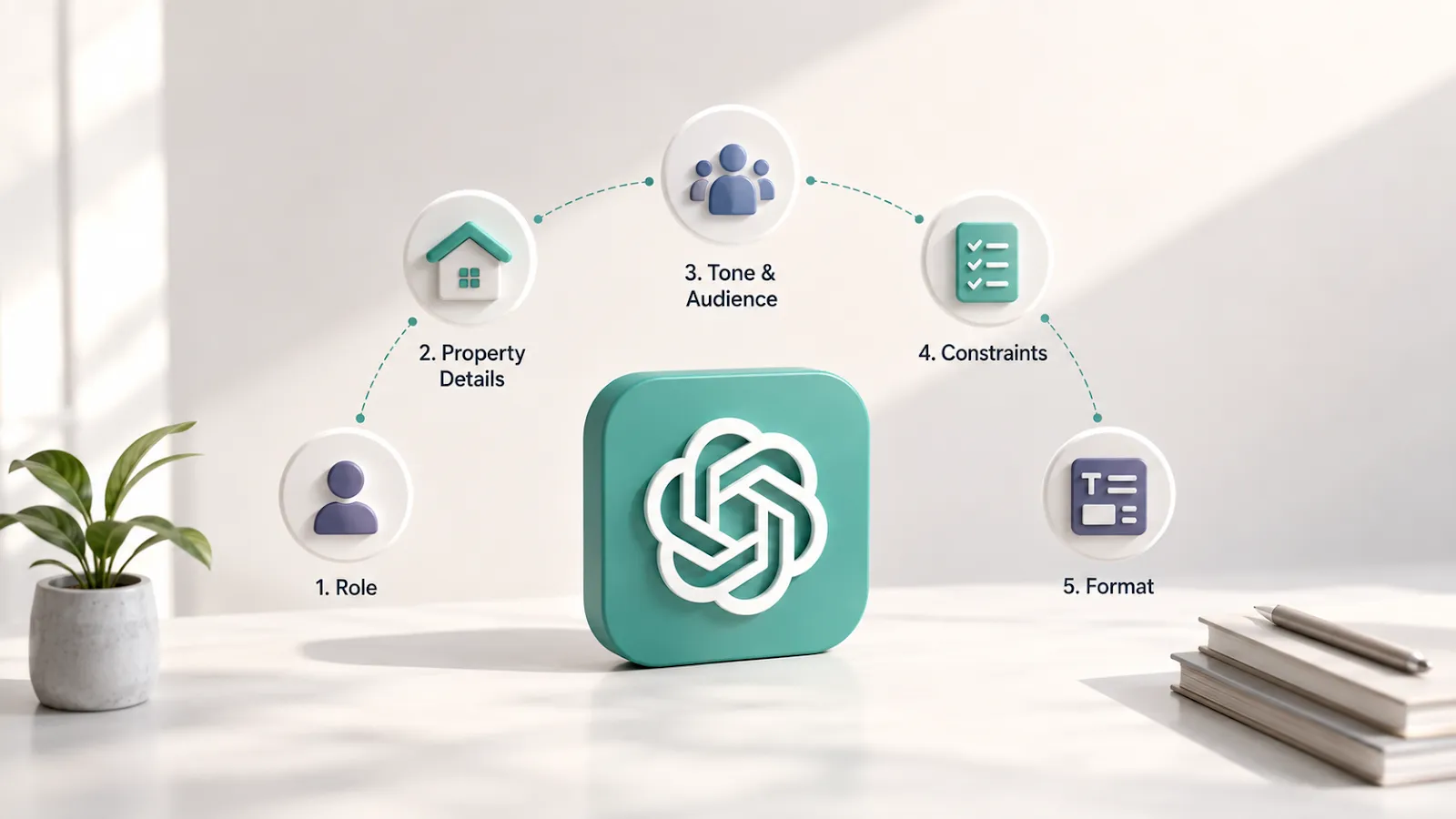
Five elements change the output: role assignment, property specifics, tone and audience, constraints, and format.
Free vs. Plus: Which ChatGPT Version is Enough for Real Estate Agents?
| Free | Plus ($20/mo) | |
|---|---|---|
| GPT-5.3 (best model) messages | ~10 per 5 hours | 160 per 3 hours |
| File uploads | Limited | Expanded |
| Deep Research | Limited | Expanded |
| Custom GPTs | Only use GPTs created by someone else | Create your own GPTs, too |
| Projects | Yes | Yes |
| Memory across sessions | Limited | Expanded |
| Ads | Yes | No |
Eugene Eisenberg (DailyAICoach, licensed CA agent) ran a 30-day test: Plus cut listing description time from 13 to 15 minutes down to 6 minutes. For 10+ listings per month, the ROI is clear. For one or two listings, the free tier works.
What Other AI Tools Work for Real Estate?
Besides ChatGPT, real estate professionals use a mix of general-purpose AI and industry-specific tools. Here are the ones worth knowing:
General-purpose AI
- Google Gemini. Integrates natively with Gmail, Docs, Sheets, and Drive. Strong fit for agents who already work in Google Workspace.
- Claude. Its 200,000-token context window, roughly 500 pages, can handle long contracts, leases, and due diligence packages. It also tends to rank highest for writing quality.
Lead generation and nurturing
- Ylopo AI Voice. Calls leads up to 14 times across 90 days. Qualifies them. Live-transfers warm prospects.
- Fello. Connects to your CRM. Scores contacts by likelihood to sell. Automates outreach.
- ManyChat. Turns Instagram and Facebook comments into automated DM conversations that capture leads.
Marketing and listings
- Canva AI. Helps with background removal. Text-to-image. Magic Write for flyers, social posts, and listing decks.
- Write.homes. MLS-connected listing description generator with multi-language support.
Virtual staging
- REimagineHome. Creates photorealistic staging from room photos in under a minute.
- Matterport. Builds 3D virtual tours with Dollhouse view and AI-generated floor plans.
Valuation and market data
- HouseCanary. Provides AI property valuations and comps. Scores properties from 1 to 100 across 136M+ U.S. properties.
- Zillow Zestimate. Gives instant ballpark estimates on 118M+ homes.
Transaction management
- ListedKit AI. Reads contracts, including handwritten ones. Extracts dates. Calculates timelines. Fills checklists.