Last updated: July 12, 2026
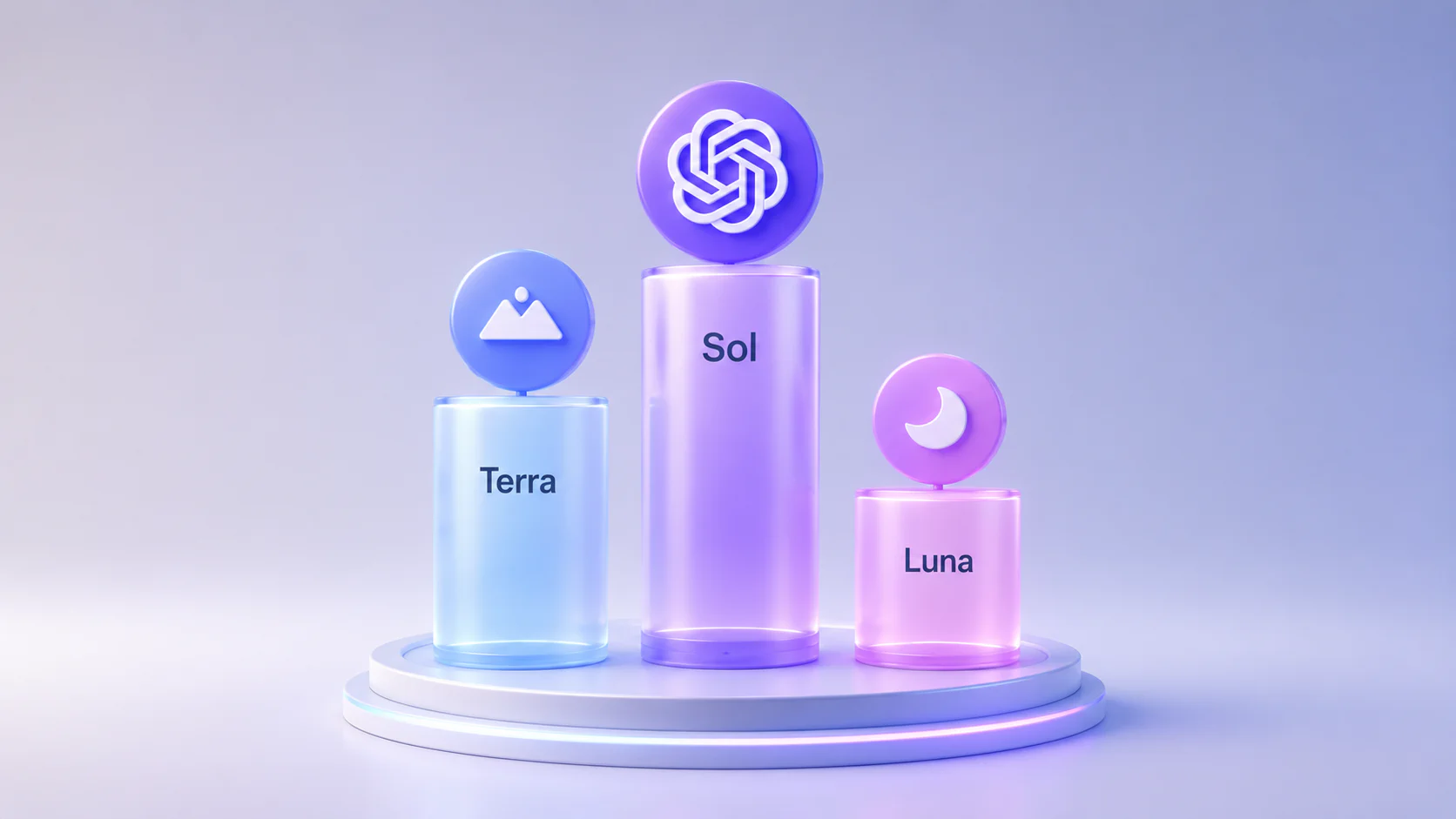
ChatGPT 5.6 is out. OpenAI released the GPT-5.6 family on July 9, 2026, following a limited preview that began on June 26. The family has three models: Sol for the hardest work, Terra for balanced everyday work, and Luna for fast, cost-sensitive workloads.
The important access detail is that “available in ChatGPT” does not mean all three models appear in every model picker. In standard ChatGPT conversations, eligible paid plans get GPT-5.6 Sol through reasoning settings, while GPT-5.5 Instant remains the default for fast everyday responses. Terra and Luna are available in other surfaces depending on plan.
Verified July 12, 2026
- Official launch: GPT-5.6: Frontier intelligence that scales with your ambition
- Current plan access: GPT-5.6 in ChatGPT
- Model IDs and limits: OpenAI API models
- Current rates: OpenAI API pricing
- Safety details: GPT-5.6 System Card
- Release timeline: OpenAI product release notes
This page reflects OpenAI’s current documentation as of July 12. Rollout timing, workspace policies, usage limits, and product entitlements can still differ by account.
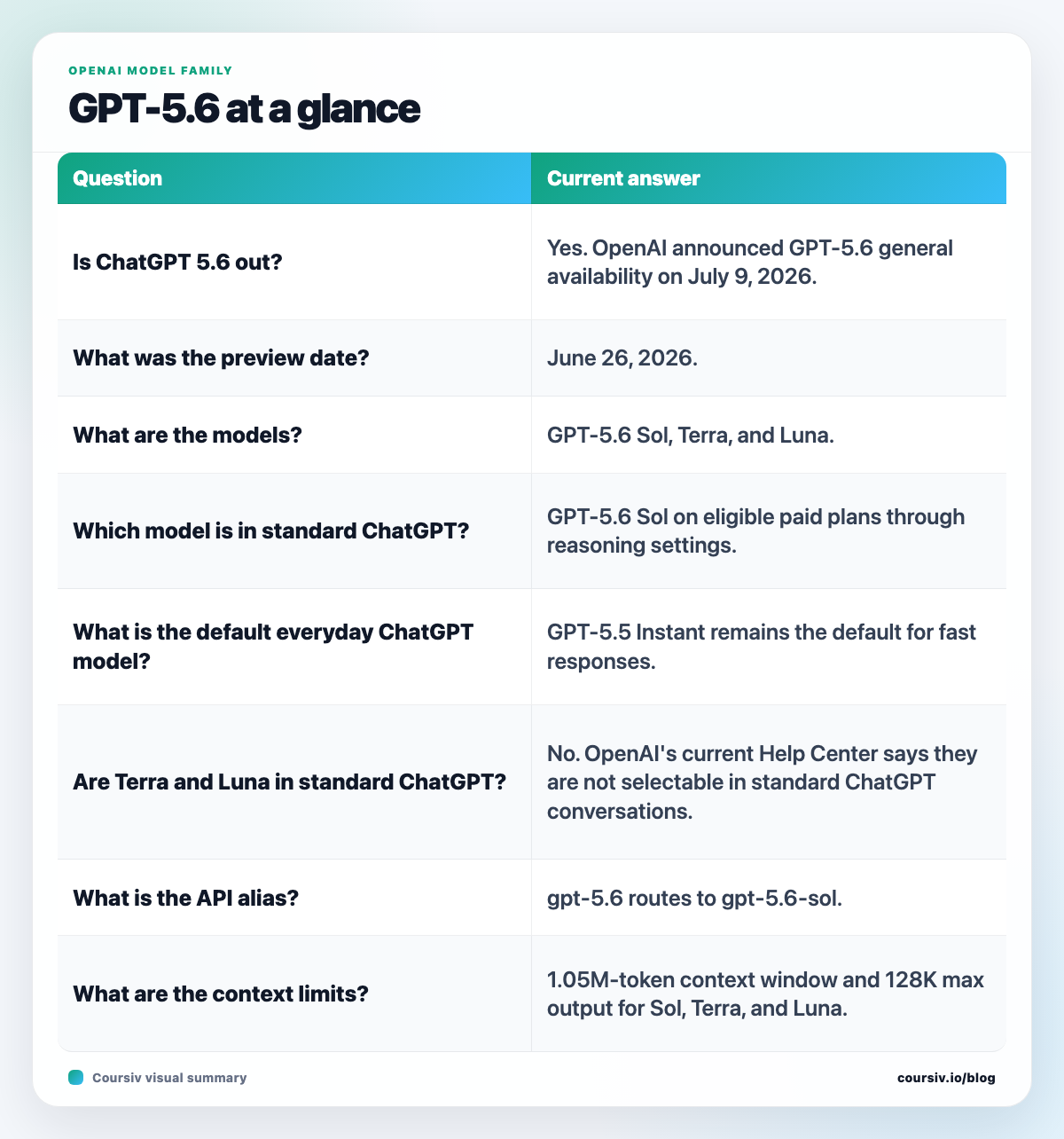
ChatGPT 5.6 at a glance
| Question | Current answer |
|---|---|
| Is ChatGPT 5.6 out? | Yes. OpenAI announced GPT-5.6 general availability on July 9, 2026. |
| What was the preview date? | June 26, 2026. |
| What are the models? | GPT-5.6 Sol, Terra, and Luna. |
| Which model is in standard ChatGPT? | GPT-5.6 Sol on eligible paid plans through reasoning settings. |
| What is the default everyday ChatGPT model? | GPT-5.5 Instant remains the default for fast responses. |
| Are Terra and Luna in standard ChatGPT? | No. OpenAI’s current Help Center says they are not selectable in standard ChatGPT conversations. |
| What is the API alias? | gpt-5.6 routes to gpt-5.6-sol. |
| What are the context limits? | 1.05M-token context window and 128K max output for Sol, Terra, and Luna. |
“ChatGPT 5.6,” “Chat GPT 5.6,” and “GPT 5.6” are common search variations. The official family name is GPT-5.6.
How to access ChatGPT 5.6
Access depends on both your plan and the product surface you are using.
| Product surface | Current GPT-5.6 access |
|---|---|
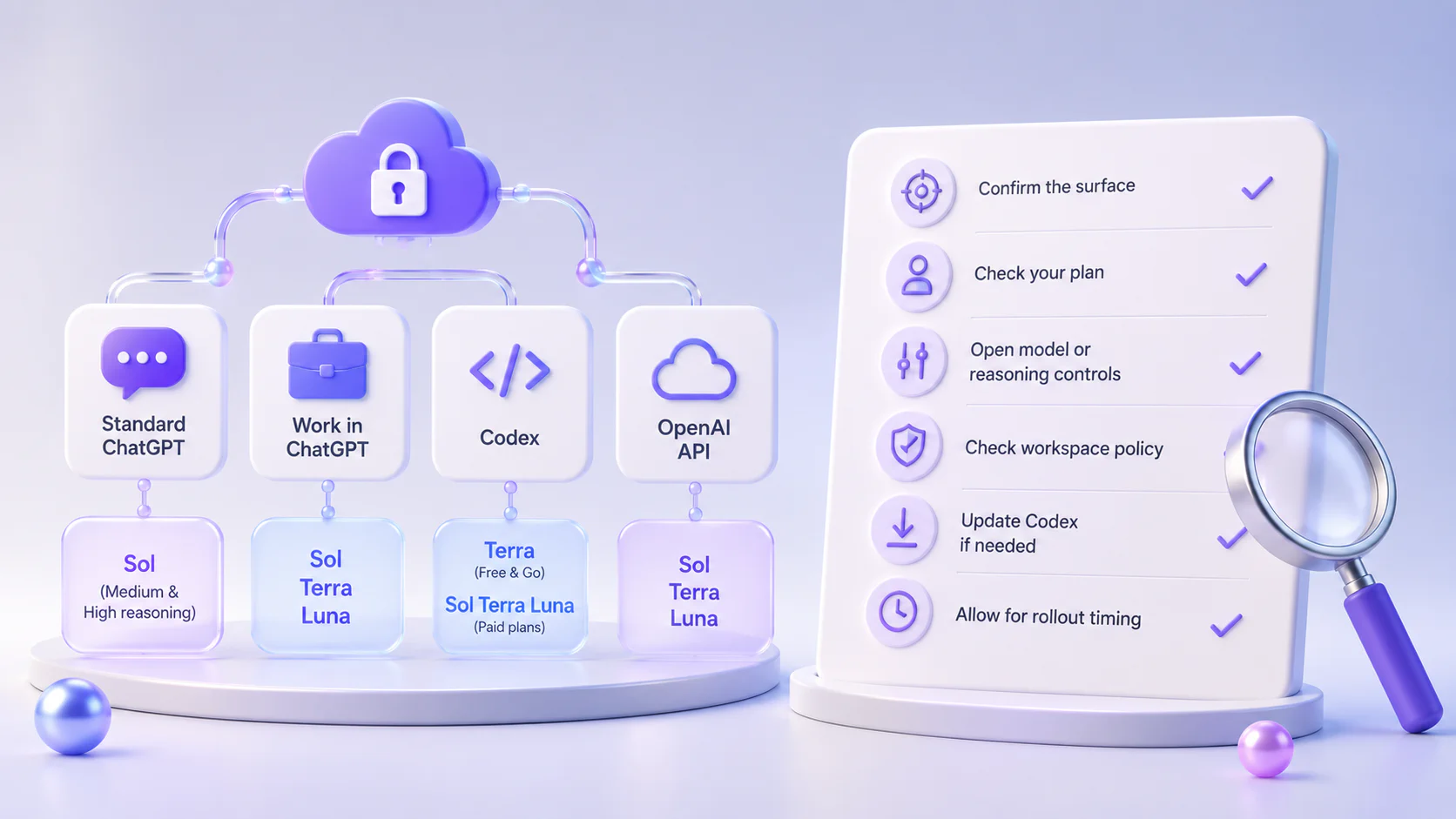
| Standard ChatGPT conversations | Sol through Medium and High reasoning on Plus; the current Help Center also lists Extra High and Pro on eligible higher plans. Free, Go, and logged-out users do not get Sol in standard chat. |
| Work in ChatGPT | Sol, Terra, and Luna for Plus, Pro, Business, and Enterprise, subject to workspace controls. |
| Codex | Terra for Free and Go; Sol, Terra, and Luna for Plus, Pro, Business, and Enterprise. |
| OpenAI API | Sol, Terra, and Luna through their explicit model IDs. |
To check access:
- Confirm the surface. Standard ChatGPT, Work, Codex, and the API do not expose the same model choices.
- Check your plan. GPT-5.6 Sol is not included in standard ChatGPT conversations for Free, Go, or logged-out users.
- Open the model or reasoning controls. On eligible paid ChatGPT plans, Sol powers Medium and higher reasoning options rather than replacing Instant.
- Check workspace policy. Business and Enterprise administrators can control which models members use.
- Update Codex if needed. OpenAI’s Help Center lists minimum supported Codex versions for GPT-5.6 access.
- Allow for rollout timing. OpenAI still describes availability as gradual, so an eligible account may not show Sol immediately.
If GPT-5.6 does not appear, that does not automatically indicate an account problem. Plan eligibility, the selected workspace, administrator controls, app version, and rollout timing are the first things to verify.
GPT-5.6 Sol vs Terra vs Luna
The model family is designed for routing different workloads rather than sending everything to the flagship tier.
| Model | Model ID | Role | Standard input/output price | Best fit |
|---|---|---|---|---|
| GPT-5.6 Sol | gpt-5.6-sol or gpt-5.6 | Flagship | $5 / $30 per 1M tokens | Complex reasoning, coding agents, science, cybersecurity, computer use, and high-value knowledge work |
| GPT-5.6 Terra | gpt-5.6-terra | Balanced | $2.50 / $15 per 1M tokens | Everyday professional work, analysis, routine coding help, and balanced production routing |
| GPT-5.6 Luna | gpt-5.6-luna | Fast and low-cost | $1 / $6 per 1M tokens | Extraction, classification, drafts, routing, and easy-to-check high-volume work |
Use the explicit API ID when you need predictable routing. The plain gpt-5.6 alias points to Sol, not to an automatic Sol/Terra/Luna router.
For model-specific detail, see the GPT-5.6 Sol review, GPT-5.6 Terra guide, and GPT-5.6 Luna guide.
If you are choosing between provider flagships rather than GPT-5.6 tiers, use the separate GPT-5.6 Sol vs Claude Fable 5 comparison. It compares coding signals, short- and long-context cost, safeguards, and data-retention options without duplicating this release-and-access guide.
GPT-5.6 vs GPT-5.5: what changed?
GPT-5.6 does not simply replace every GPT-5.5 experience. OpenAI’s current Help Center says GPT-5.5 Instant remains the default in ChatGPT, while GPT-5.6 Sol powers the reasoning options on eligible plans.
The broader changes are:
- three durable capability tiers: Sol, Terra, and Luna;
- more capability per dollar: OpenAI positions Terra as competitive with GPT-5.5 at a lower price;
- stronger agentic work: coding, professional knowledge work, computer use, design, science, and defensive security;
- more reasoning control: including
maxfor difficult single-agent work; - multi-agent orchestration: available in beta through the Responses API and exposed as
ultrain supported products and plans; - Programmatic Tool Calling: GPT-5.6 can coordinate eligible tools and process intermediate results in-memory;
- more explicit prompt caching: cache breakpoints, a 30-minute minimum cache life, and discounted cache reads.
OpenAI’s launch evaluations show improvement on several tasks, but no public benchmark proves that Sol is the best choice for every workload. For example, the launch table reports 52.7% for Sol versus 46.9% for GPT-5.5 on Agents’ Last Exam, while results on other evaluations are closer or vary by model. Treat those numbers as vendor-reported signals and run your own task-level evaluation before migrating production traffic.
Early verdict
If you mainly want fast everyday chat, the practical answer is not “switch everything to GPT-5.6”: GPT-5.5 Instant remains the default. GPT-5.6 becomes more relevant when a task benefits from deeper reasoning, tools, long context, computer use, or a higher-quality final artifact.
For API workloads, start with Terra as a balanced baseline, test Luna on cheap and verifiable work, and reserve Sol for cases where better results or fewer retries justify the higher price.
GPT-5.6 pricing and context limits
All three GPT-5.6 models have a 1.05M-token context window, 128K max output, and a February 16, 2026 knowledge cutoff in the current API model catalog.
Standard short-context API pricing per 1M tokens is:
| Model | Input | Cached input read | Cache write | Output |
|---|---|---|---|---|
| GPT-5.6 Sol | $5.00 | $0.50 | $6.25 | $30.00 |
| GPT-5.6 Terra | $2.50 | $0.25 | $3.125 | $15.00 |
| GPT-5.6 Luna | $1.00 | $0.10 | $1.25 | $6.00 |
Prompts above 272K input tokens are priced at 2x the input rate and 1.5x the output rate for the full request. That produces long-context rates of $10/$45 for Sol, $5/$22.50 for Terra, and $2/$9 for Luna per 1M input/output tokens.
Cache writes cost 1.25x the uncached input rate, while cached-input reads receive a 90% discount. Batch, Flex, Priority, data residency, and tool calls can change the final cost, so use the current pricing page rather than treating the headline rates as a complete bill estimate.
The useful metric is cost per successful task, not price per token alone. Sol can be cheaper when one high-quality run replaces repeated failed attempts; Luna can be dramatically cheaper when the work is simple and easy to verify.
Codex, Work, and the ChatGPT desktop app
“Codex 5.6” usually means GPT-5.6 inside Codex, not a separate Codex-only model.
In Codex, OpenAI currently lists:
- Free and Go: Terra;
- Plus, Pro, Business, and Enterprise: Sol, Terra, and Luna;
max: available to users with GPT-5.6 access;ultra: available in Codex for Plus and higher plans.
OpenAI also merged the Codex app into the new ChatGPT desktop app while keeping Codex as a dedicated coding experience. The app brings Chat, Work, and Codex into one desktop surface, but the app shell does not remove the plan and product restrictions described above.
For the app migration details, read the Codex and ChatGPT desktop app guide.
Which GPT-5.6 model should you use?
| Question | Start with | Reason |
|---|---|---|
| Is the task difficult and expensive to get wrong? | Sol | Capability and verification can matter more than token price. |
| Is it normal professional or coding work? | Terra | It is the balanced quality/cost tier. |
| Is the work simple, high-volume, and easy to check? | Luna | It has the lowest GPT-5.6 token price. |
| Do you need a fast everyday ChatGPT answer? | GPT-5.5 Instant | It remains the standard ChatGPT default. |
| Do you need deep single-agent reasoning? | Sol with higher effort or max | More reasoning can help, but raises latency and cost. |
| Can independent workstreams run in parallel? | Sol with ultra or an evaluated multi-agent workflow | Parallel work can help complex tasks, but adds compute and coordination overhead. |
Do not choose by model name alone. Compare quality, retries, latency, tool behavior, and total task cost on a representative evaluation set.
Limits and rollout caveats
- Availability is product-specific. Standard ChatGPT, Work, Codex, and the API have different model choices.
- GPT-5.6 is not the standard ChatGPT default. GPT-5.5 Instant still handles fast everyday responses.
- Terra and Luna are not in standard ChatGPT conversations. They are available through other supported products and the API.
- Workspace controls matter. Managed accounts can restrict models, tools, connectors, and usage.
- Long context costs more. The headline $5/$30, $2.50/$15, and $1/$6 prices are the short-context rates.
- Higher effort is not free quality.
max, Pro,ultra, and multi-agent workflows can increase latency, tokens, and coordination cost. - Safety checks can affect legitimate work. Higher-risk cyber and biology requests may be refused or require additional checks.
- Benchmarks are not your production workload. Validate prompts, tools, safety behavior, and cost before routing real traffic.
Bottom line
GPT-5.6 is a three-model family released on July 9, 2026:
- Sol for the hardest, highest-value work;
- Terra for balanced everyday professional tasks;
- Luna for fast, low-cost, high-volume workflows.
In standard ChatGPT, the key distinction is that eligible paid users get Sol through reasoning settings while GPT-5.5 Instant remains the default. In the API, use explicit model IDs when you need predictable routing and test each tier on your own workload before migrating.
FAQ
What is ChatGPT 5.6?
What is the ChatGPT 5.6 release date?
Is GPT-5.6 available in ChatGPT?
Why do I not see GPT-5.6 Sol?
What are the GPT-5.6 API model IDs?
gpt-5.6-sol, gpt-5.6-terra, and gpt-5.6-luna. The gpt-5.6 alias routes to gpt-5.6-sol.How much does GPT-5.6 cost?
Can I use GPT-5.6 Terra or Luna in normal ChatGPT conversations?
Which GPT-5.6 model should I choose?