Last updated: July 12, 2026
ChatGPT 5.6 Sol is the common search name for GPT-5.6 Sol, OpenAI’s flagship GPT-5.6 model. Sol is built for difficult professional work: coding agents, long research, computer use, cybersecurity, science, design, and workflows that must coordinate several tools.
The most important developer facts are straightforward. Use gpt-5.6-sol as the model ID, or use gpt-5.6, which currently aliases to Sol. The model supports a 1,050,000-token context window, up to 128,000 output tokens, and standard short-context rates of $5 input / $30 output per million tokens.
This page is the Sol-specific deep dive. For the overall family release, plan-access map, and a compact Sol vs Terra vs Luna comparison, use our ChatGPT 5.6 guide. For a full rival-model decision, see GPT-5.6 Sol vs Claude Fable 5.
Verified July 12, 2026
- OpenAI: GPT-5.6 launch and benchmark table
- OpenAI Developers: GPT-5.6 Sol model specifications, GPT-5.6 model guidance, and API pricing
- OpenAI Help Center: GPT-5.6 in ChatGPT
- OpenAI Deployment Safety: GPT-5.6 System Card
Prices, plan entitlements, usage limits, safeguards, and beta features can change. The facts below reflect OpenAI’s live documentation on July 12, 2026.
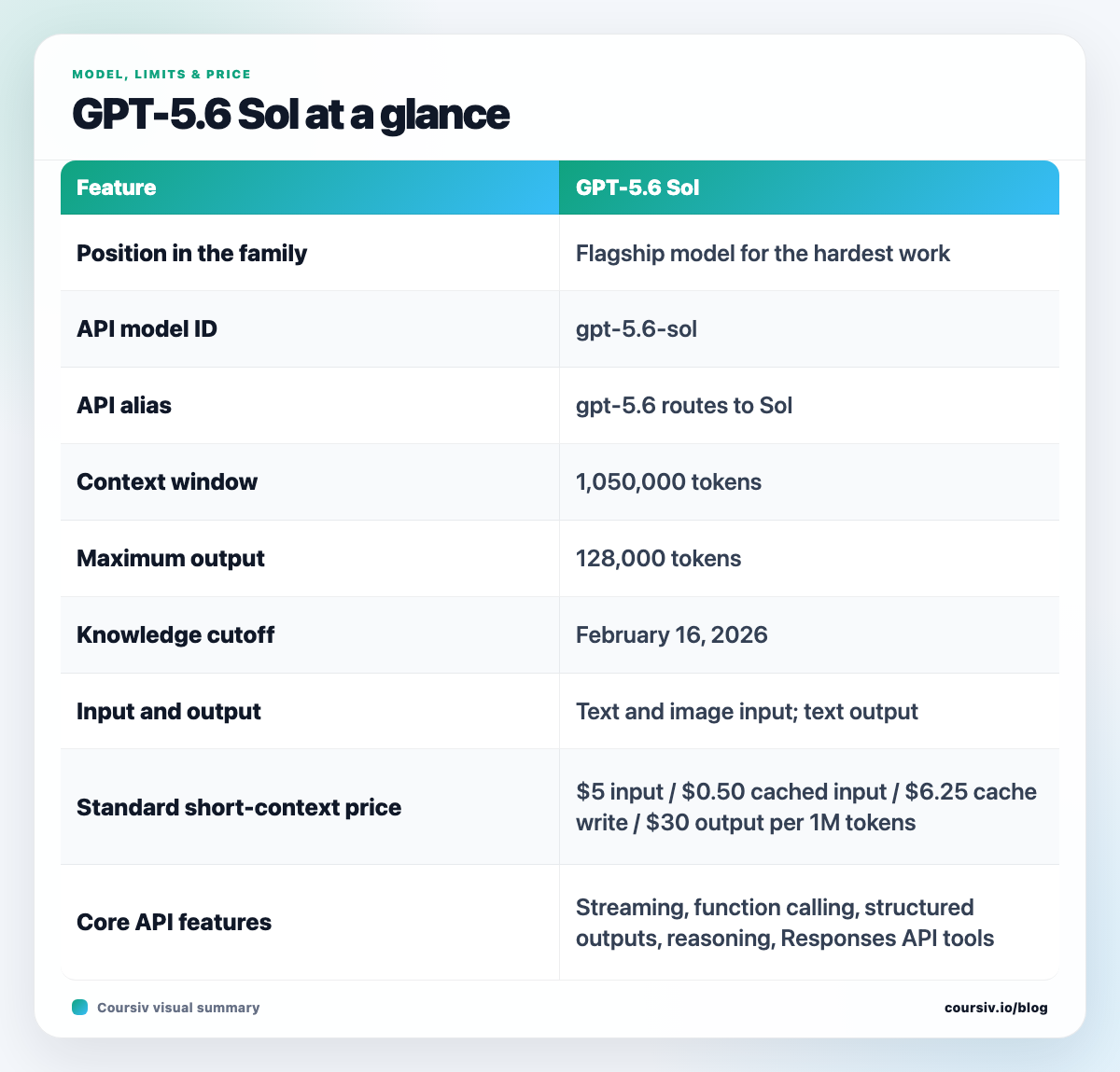
GPT-5.6 Sol at a glance
| Feature | GPT-5.6 Sol |
|---|---|
| Position in the family | Flagship model for the hardest work |
| API model ID | gpt-5.6-sol |
| API alias | gpt-5.6 routes to Sol |
| Context window | 1,050,000 tokens |
| Maximum output | 128,000 tokens |
| Knowledge cutoff | February 16, 2026 |
| Input and output | Text and image input; text output |
| Standard short-context price | $5 input / $0.50 cached input / $6.25 cache write / $30 output per 1M tokens |
| Core API features | Streaming, function calling, structured outputs, reasoning, Responses API tools |
The official name matters because Sol is one member of a three-model family. GPT-5.6 Terra is the balanced capability-and-cost tier, while GPT-5.6 Luna is the fast, low-cost tier. Sending every request to Sol can improve the quality ceiling, but it can also waste money and time when a smaller model already passes the task.
What is GPT-5.6 Sol?
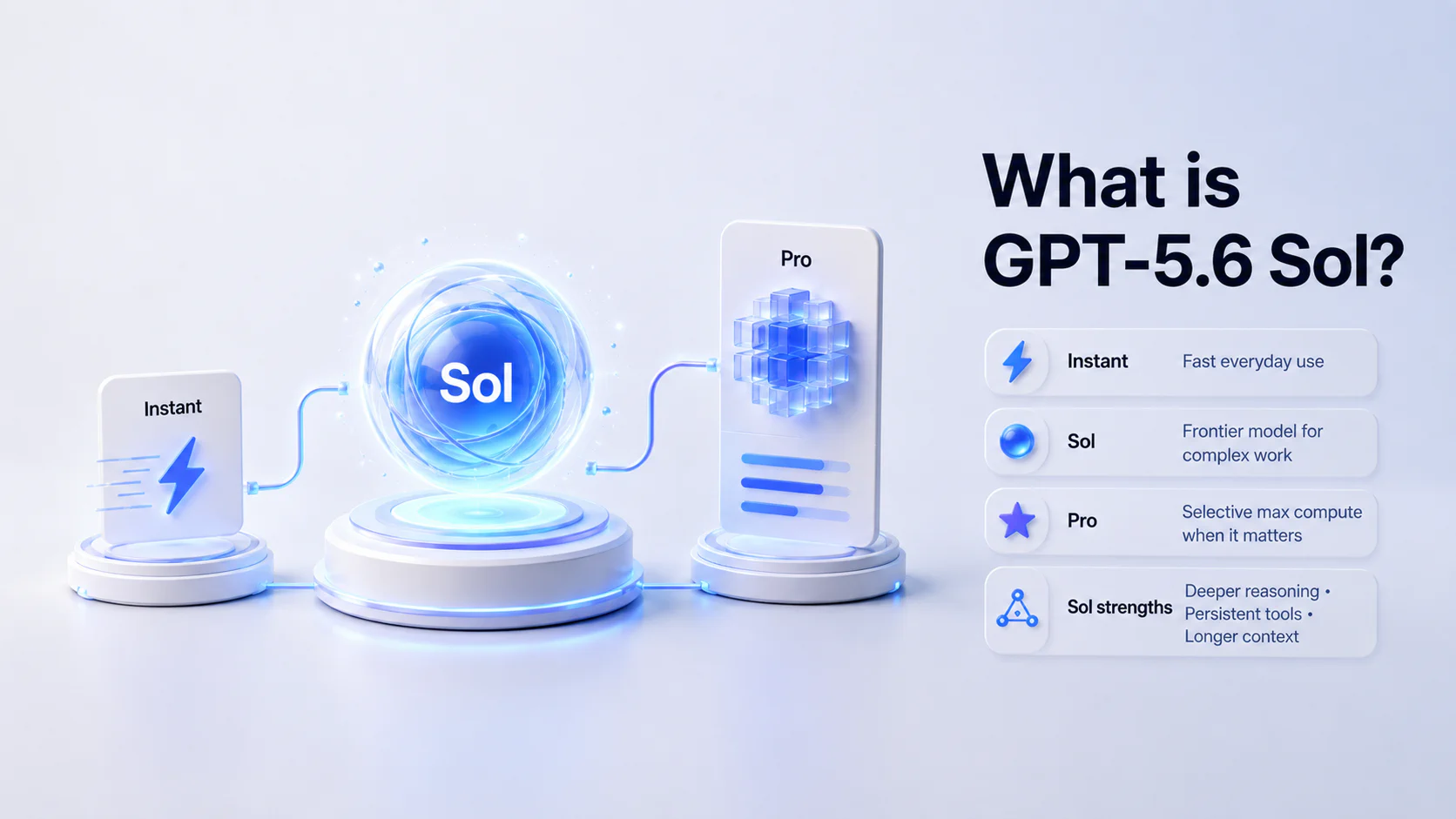
GPT-5.6 Sol is OpenAI’s frontier model for complex work. It roughly occupies the place that an unsuffixed flagship GPT model held in earlier families. That is why the unsuffixed API alias gpt-5.6 routes to gpt-5.6-sol.
Sol is not simply “the default ChatGPT model with a new number.” OpenAI’s current Help Center says GPT-5.5 Instant remains the default for fast everyday responses. On eligible paid plans, Sol powers the Medium, High, and Extra High reasoning options, while GPT-5.6 Sol Pro powers the Pro option.
The practical distinction is:
- use Instant or a smaller GPT-5.6 tier for routine work where speed and volume dominate;
- use Sol when the task benefits from deeper reasoning, more persistent tool use, longer context, or a higher quality ceiling;
- use Sol Pro, max, or multi-agent execution selectively, after an evaluation shows that the extra compute improves accepted results.
GPT-5.6 Sol API: model ID, context, and endpoints
For new tool-heavy or multi-turn integrations, OpenAI recommends the Responses API. The Sol model page also lists Chat Completions and Batch among the available endpoints.
A minimal Python request looks like this:
from openai import OpenAI

client = OpenAI()

response = client.responses.create(
    model="gpt-5.6-sol",
    reasoning={"effort": "medium"},
    input="Review this migration plan and return the five highest-risk failure modes."
)

print(response.output_text)
You can replace gpt-5.6-sol with gpt-5.6, but the explicit slug makes routing intent clearer. For a production system, pinning a documented snapshot can also reduce unexpected behavior changes when OpenAI offers one for the model.
Supported modalities and features
| Capability | Current Sol support |
|---|---|
| Text input and output | Supported |
| Image input | Supported |
| Audio or video input | Not supported on the Sol model page |
| Streaming | Supported |
| Function calling | Supported |
| Structured outputs | Supported |
| Fine-tuning | Not supported |
| Reasoning tokens | Supported |
The Responses API tool list currently includes web search, file search, image generation, code interpreter, hosted shell, apply patch, skills, computer use, MCP, and tool search. Tool support does not mean every tool is free or automatically enabled: tool-specific billing, permissions, container behavior, and application code still apply.
The 1.05M context window is a ceiling, not a target. Retrieval, file selection, prompt caching, and context compaction are usually better than dumping an entire repository or document archive into every request. Large prompts cost more, take longer, and can hide the most relevant evidence.
GPT-5.6 Sol API pricing
OpenAI prices Sol per million tokens. A request is treated as long context when it contains more than 272K input tokens; the higher rates then apply to the entire request, not only the tokens above the threshold.
| Processing tier | Input | Cached input | Cache write | Output |
|---|---|---|---|---|
| Standard, up to 272K input | $5.00 | $0.50 | $6.25 | $30.00 |
| Standard, above 272K input | $10.00 | $1.00 | $12.50 | $45.00 |
| Batch or Flex, up to 272K input | $2.50 | $0.25 | $3.125 | $15.00 |
| Batch or Flex, above 272K input | $5.00 | $0.50 | $6.25 | $22.50 |
| Priority, short context | $10.00 | $1.00 | $12.50 | $60.00 |
All figures are US dollars per 1M tokens. Regional processing can add an uplift where applicable, and tools may have separate charges.
Two worked cost examples
200K input + 20K output, no cache:
- input:
0.20 × $5 = $1.00 - output:
0.02 × $30 = $0.60 - total: $1.60
500K input + 50K output, no cache:
- the request crosses 272K, so all input uses the long-context rate;
- input:
0.50 × $10 = $5.00 - output:
0.05 × $45 = $2.25 - total: $7.25
Prompt caching needs its own measurement. Cache reads are heavily discounted, but GPT-5.6 cache writes cost 1.25 times the uncached input rate. Reusing a stable prefix can save money; repeatedly writing context that never gets reused can do the opposite.
The production metric should be cost per accepted task, including retries, tool calls, reasoning tokens, human correction, and failed runs. A cheaper token rate is irrelevant if the workflow needs three attempts; a stronger flagship is wasteful if Terra or Luna succeeds on the first attempt.
Where GPT-5.6 Sol is available
Sol reached general availability on July 9, 2026, after a preview that began June 26. Product access is not identical across standard ChatGPT, Work, Codex, and the API.
Standard ChatGPT conversations
| ChatGPT plan | Medium and High | Extra High | Pro |
|---|---|---|---|
| Plus | Included | Not included | Not included |
| Pro | Included | Included | Included |
| Business | Included | Included | Included |
| Enterprise | Included | Included | Included |
| Free and Go | Not included | Not included | Not included |
Business and Enterprise administrators can control model access. Usage limits also depend on the plan and workspace settings. If a reasoning allowance is exhausted, OpenAI says ChatGPT may fall back to another model.
Work, Codex, and API
- Work in ChatGPT: Sol, Terra, and Luna are available to Plus, Pro, Business, and Enterprise users, subject to controls.
- Codex: Terra is available to Free and Go; Sol, Terra, and Luna are available to Plus, Pro, Business, and Enterprise.
- OpenAI API: developers can call all three family members with their explicit model IDs.
- Standard ChatGPT: Terra and Luna are not selectable; eligible reasoning settings use Sol.
For troubleshooting by plan and surface, use the full GPT-5.6 access guide. Keeping that changing rollout information in the family hub prevents this Sol review from becoming a second, conflicting access page.
Medium, max, Pro, and ultra are not the same thing
The names describe different controls, and treating them as interchangeable creates incorrect API advice.
| Setting | What it means | Where it applies |
|---|---|---|
| Medium, High, Extra High | ChatGPT reasoning choices powered by Sol | Eligible standard ChatGPT plans |
reasoning.effort | API reasoning budget: none, low, medium, high, xhigh, or max | Responses API |
reasoning.mode: "pro" | More model work before one final answer; billed at the selected model’s rates | Responses API |
| Sol Pro | The highest-capability ChatGPT Sol option for difficult, longer-running work | Eligible ChatGPT plans |
ultra | A product setting coordinating four agents in parallel by default | ChatGPT Work and Codex on eligible plans |
| Multi-agent beta | API building block for ultra-like parallel subagent workflows | Responses API beta |
Three implementation details are easy to miss:
- There is no need to switch to a separate
gpt-5.6-sol-proAPI slug. Keep the selected GPT-5.6 model and setreasoning.modetopro. - Pro mode and reasoning effort are independent. You can choose an effort value separately; OpenAI says omitted effort defaults to
mediumin standard and Pro modes. maxis not automatically the best production choice. It gives the model more time thanxhigh, but it should earn its higher latency and token use on a controlled evaluation.
OpenAI describes ultra as four agents by default, trading higher token use for stronger results and faster wall-clock completion on work that divides cleanly. Developers can build similar behavior with the Responses API multi-agent beta, but “more agents” is not a quality guarantee. Parallelism works best when subproblems are genuinely independent and the synthesis step can be evaluated.
GPT-5.6 Sol benchmarks
OpenAI’s launch page includes a same-table comparison across the GPT-5.6 family, GPT-5.5, and competing models. The figures below are vendor-published results, not our independent lab test. They are useful routing signals, but benchmark harnesses, reasoning settings, tool access, and scoring versions can change the outcome.
| Evaluation | GPT-5.6 Sol | GPT-5.5 | Claude Fable 5 | What the result suggests |
|---|---|---|---|---|
| Agents’ Last Exam | 52.7% | 46.9% | 40.5% | Strong long-horizon professional-work signal |
| Artificial Analysis Intelligence Index v4.1 | 58.9 | 54.8 | 59.9 | Sol improves on GPT-5.5 but does not lead this broad index |
| Artificial Analysis Coding Agent Index v1.1 | 80.0 | 76.4 | 77.2 | Strong agentic coding signal |
| SWE-Bench Pro | 64.6% | 59.4% | 80.0% | Sol improves, but Fable leads this repository benchmark by a wide margin |
| DeepSWE v1.1 | 72.7% | 67.0% | 69.7% | Strong long-horizon engineering signal |
| Terminal-Bench 2.1 | 88.8% | 85.6% | 83.1% | Strong terminal and command-line signal |
| OSWorld 2.0 | 62.6% | 47.5% | 54.8% | Large gain in computer-use tasks |
| BrowseComp | 90.4% | 84.4% | 84.3% | Strong agentic browsing result; Sol Ultra reaches 92.2% |
Where Sol looks strongest
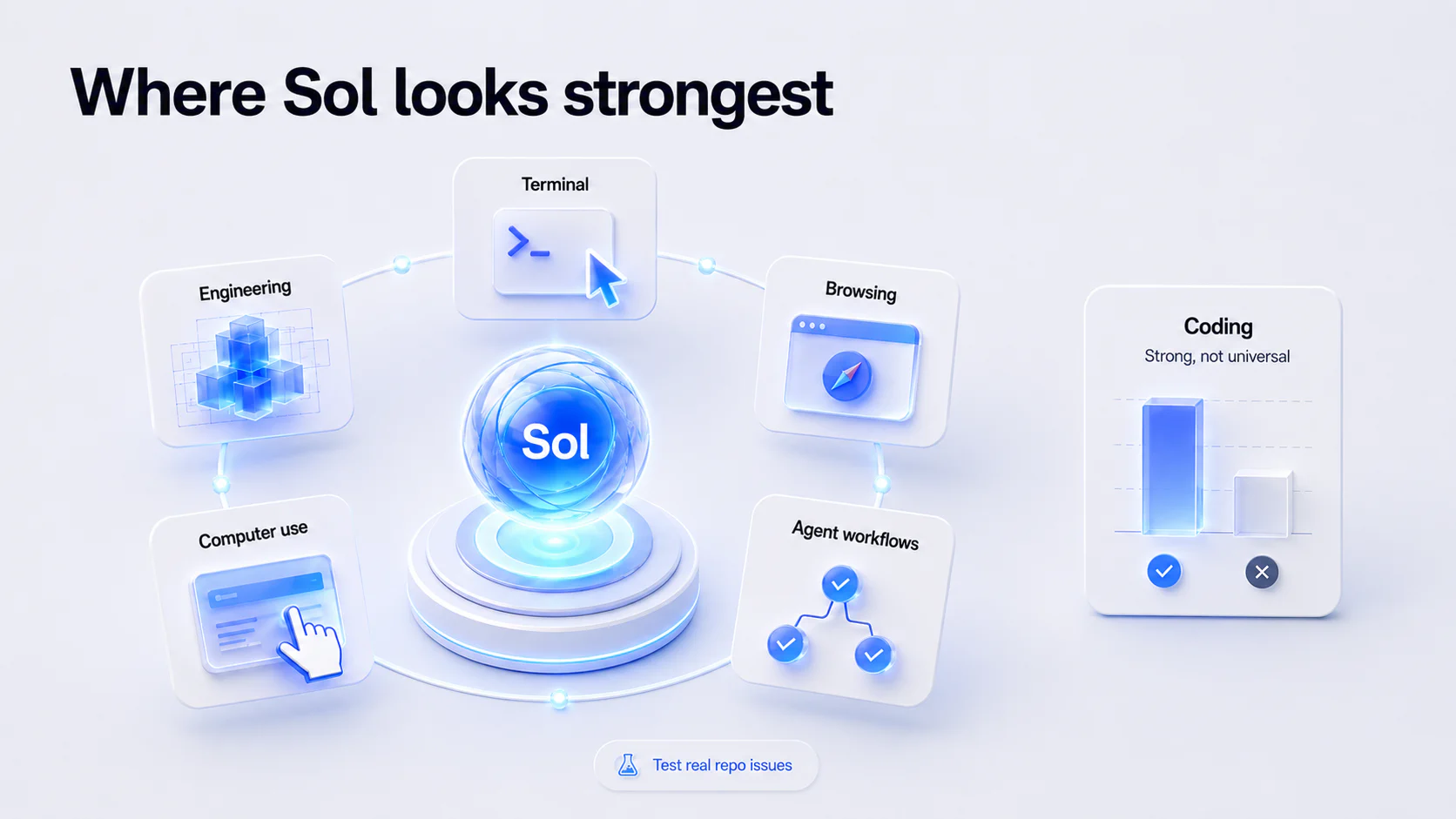
The most consistent signals are in terminal work, long-horizon engineering, browsing, computer use, and professional agent workflows. Those results fit the model’s tool breadth and OpenAI’s positioning of Sol as an end-to-end operator rather than a chat-only model.
For coding, the picture is strong but not universal. Sol leads the Coding Agent Index, DeepSWE, and Terminal-Bench in OpenAI’s table. Claude Fable 5 leads SWE-Bench Pro by a large margin. That is exactly why a team should test real repository issues instead of declaring a winner from one chart. Our GPT-5.6 Sol vs Claude Fable 5 comparison covers the conflicting coding results, long-context cost, access, and retention policies in detail.
What the benchmark table cannot tell you
It does not measure your tool definitions, repository quality, private documents, review standard, latency budget, or safeguard edge cases. A model may score higher while producing changes that require more human cleanup. Build an internal set of representative tasks and measure:
- accepted result rate without a retry;
- tests passed and regressions introduced;
- human correction time;
- wall-clock latency and tool-call count;
- input, cached, output, and reasoning tokens;
- refusal or interruption rate;
- total cost per accepted result.
Tools and workflow improvements
Sol’s upgrade is not just a higher benchmark score. The GPT-5.6 developer guidance adds controls that can change the architecture of a tool-heavy application.
Programmatic Tool Calling
Programmatic Tool Calling lets GPT-5.6 write JavaScript in a hosted runtime to coordinate eligible tools and process intermediate results. It is best suited to bounded operations such as filtering, joining, ranking, deduplication, aggregation, and validation.
The potential benefit is fewer model round trips and fewer intermediate tokens. The risk is moving too much judgment into code. If each tool result needs fresh semantic interpretation, direct tool calls may remain clearer and easier to debug.
Persisted reasoning and prompt caching
GPT-5.6 can reuse available reasoning items across turns, and developers can select how much earlier reasoning remains relevant. This may improve multi-turn continuity and caching efficiency, but history should still be pruned when the goal or assumptions change.
Explicit prompt caching lets an application mark reusable prefixes. Monitor both cache reads and cache writes. The correct question is not “did caching activate?” but “did reuse reduce the total cost of successful runs?”
Multi-agent and ultra-like workflows
Parallel agents help when a task can be divided into independent research, review, implementation, or validation streams. They help less when every step depends on the preceding answer or when the final synthesis cannot reliably resolve conflicts.
A sensible multi-agent test compares one agent and several agents on the same task while tracking quality, total tokens, root-agent latency, and review time. Faster wall-clock completion can still be more expensive because total usage includes the subagents.
Coding and computer use
Sol supports the building blocks needed for agentic engineering: hosted shell, apply patch, file and web search, computer use, MCP, skills, structured outputs, and function calling. Use least-privilege permissions, define approval boundaries, run tests, and require confirmation before destructive or external actions.
For the product-level workflow decision, see Claude Code vs Codex. A model benchmark does not capture IDE integration, sandbox behavior, permissions, review UX, or team adoption cost.
Limits and safeguards
Sol’s strongest features create real trade-offs:
- Long context is expensive. Above 272K input tokens, the full request moves to higher rates.
- Highest-effort modes use more compute.
max, Pro, ultra, and multi-agent workflows must justify their latency and token usage. - Fine-tuning is not supported on the current Sol model page.
- Output is text. The model accepts image input, but image generation happens through a supported tool rather than direct Sol image output.
- Plan access is conditional. ChatGPT entitlements, usage limits, workspace controls, and rollouts can differ.
- Dual-use safeguards can intervene. OpenAI says real-time cyber and biology misuse classifiers may block, refuse, or pause some requests, including occasional legitimate work near those boundaries.
For end-user API applications, OpenAI recommends sending a stable, privacy-preserving safety_identifier. Security, biology, or other high-risk workflows should be evaluated for refusal behavior and access requirements, not only answer quality.
GPT-5.6 Sol review: practical verdict
This is a source-based review of the released model and its official signals, not a claim that one benchmark table predicts every production workload.
| Area | Assessment | Why |
|---|---|---|
| Capability ceiling | Excellent | Flagship positioning, high reasoning settings, Pro mode, and strong multi-domain results |
| Coding and terminal work | Excellent, with a caveat | Sol leads several agentic and terminal tests, but not SWE-Bench Pro |
| Tool integration | Excellent | Broad Responses API tool support plus Programmatic Tool Calling and multi-agent beta |
| Context | Excellent capacity | 1.05M tokens is large, but the 272K pricing boundary matters |
| Cost efficiency | Good for a flagship | Strong short-context rates and cache reads; long-context and high-compute modes can get expensive |
| Routine chat | Overkill | GPT-5.5 Instant remains the default, and smaller GPT-5.6 models target cheaper work |
| Production readiness | Strong, evaluation required | Generally available with documented APIs, but beta orchestration and safeguard behavior need testing |
The strongest reason to choose Sol
Sol combines a high reasoning ceiling with a broad tool surface. It is a strong first candidate when a task spans research, terminal work, code changes, verification, documents, or computer use instead of ending after one text answer.
The strongest reason not to choose Sol
The flagship can be unnecessary. Terra or Luna may complete routine work at a lower price, GPT-5.5 Instant is faster for normal chat, and a competing model may fit a specific coding benchmark or ecosystem better. Above 272K input tokens, Sol’s headline $5 input rate no longer describes the request.
Overall verdict
GPT-5.6 Sol is a compelling flagship for difficult, tool-heavy work, not a universal default. Its benchmark profile is broad, its API controls are unusually flexible, and its short-context price is competitive for this tier. The correct rollout is selective: route the hardest work to Sol, keep cheaper baselines, and promote higher reasoning or multi-agent modes only when your evaluation proves a gain.
Who should use GPT-5.6 Sol?
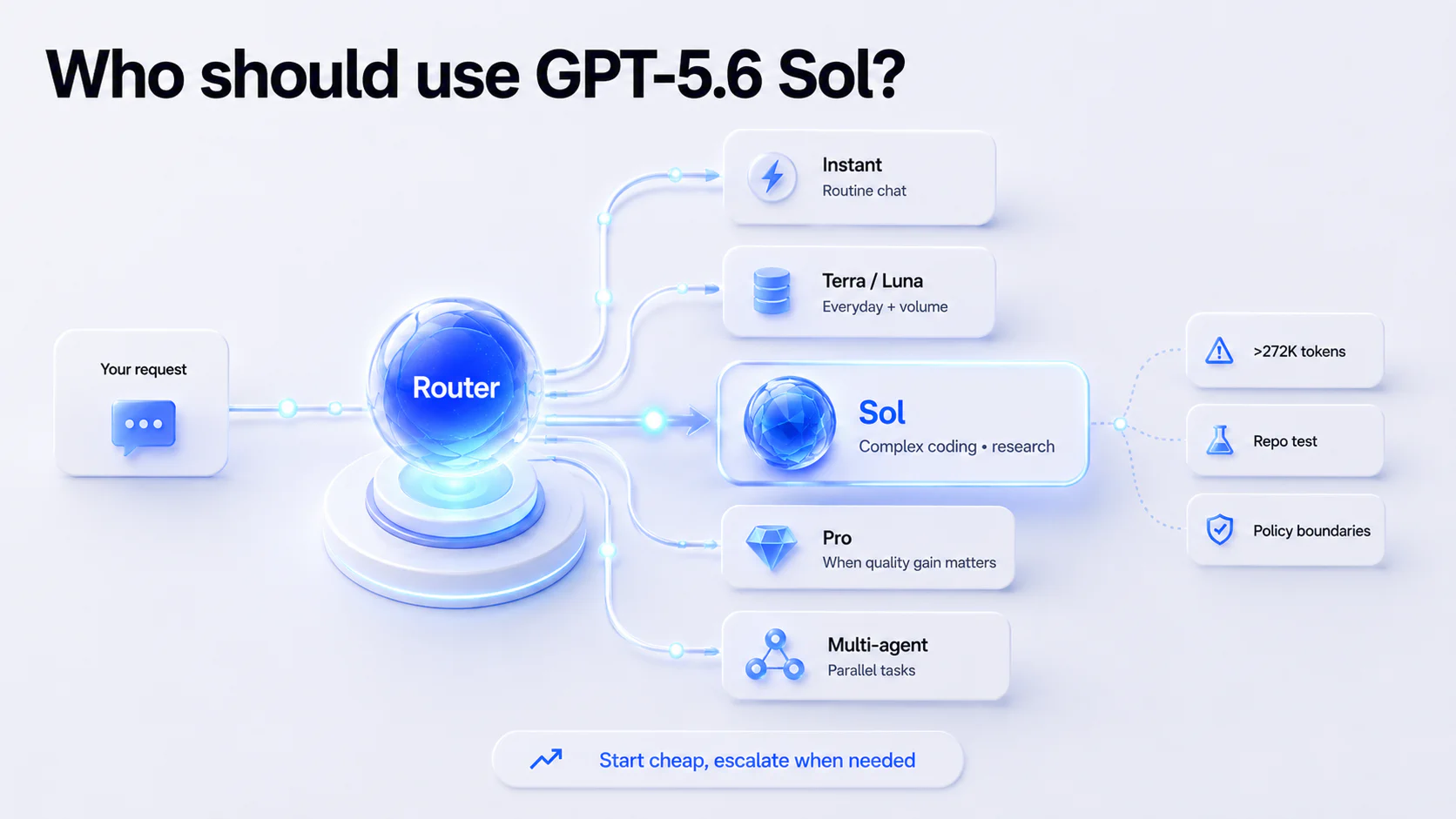
| Workload | Best first route |
|---|---|
| Complex coding agent with terminal, patching, and tests | Sol at a measured reasoning effort |
| Long research requiring web, files, and synthesis | Sol, with evidence and completion criteria |
| Difficult review where a small quality gain is valuable | Compare standard Sol with Pro mode |
| Parallelizable research or engineering task | Compare one-agent Sol with multi-agent execution |
| Routine chat or quick questions | GPT-5.5 Instant |
| High-volume structured processing | Start with Luna or Terra, then escalate failures |
| Balanced everyday professional work | Start with Terra |
| Request above 272K input tokens | Recalculate full-request cost and test retrieval first |
| Difficult repository issue | Test Sol and Fable 5 on the same repo task |
| Cybersecurity or biology near policy boundaries | Validate safeguards, access, and refusal handling before deployment |
The best production architecture is often a router, not one model everywhere. Start on the cheapest model that reliably passes the task, then escalate based on complexity, uncertainty, failed validation, or explicit quality requirements.
Evaluation checklist before switching
- Select 20–50 representative tasks, including failures and edge cases.
- Keep prompts, tools, context, permissions, and time limits fixed across models.
- Compare Sol at
mediumwith the same effort used by your current baseline. - Test one lower effort; GPT-5.6 may preserve quality with fewer tokens.
- Add
high,xhigh,max, or Pro only where the baseline misses important criteria. - Separate requests below and above 272K input tokens when calculating cost.
- Record cache writes as well as cache reads.
- Track complete task cost, including retries, subagents, tool calls, and human correction.
- Test refusal, timeout, and partial-completion behavior.
- Route routine passing tasks to Terra, Luna, or another cheaper model.
Bottom line
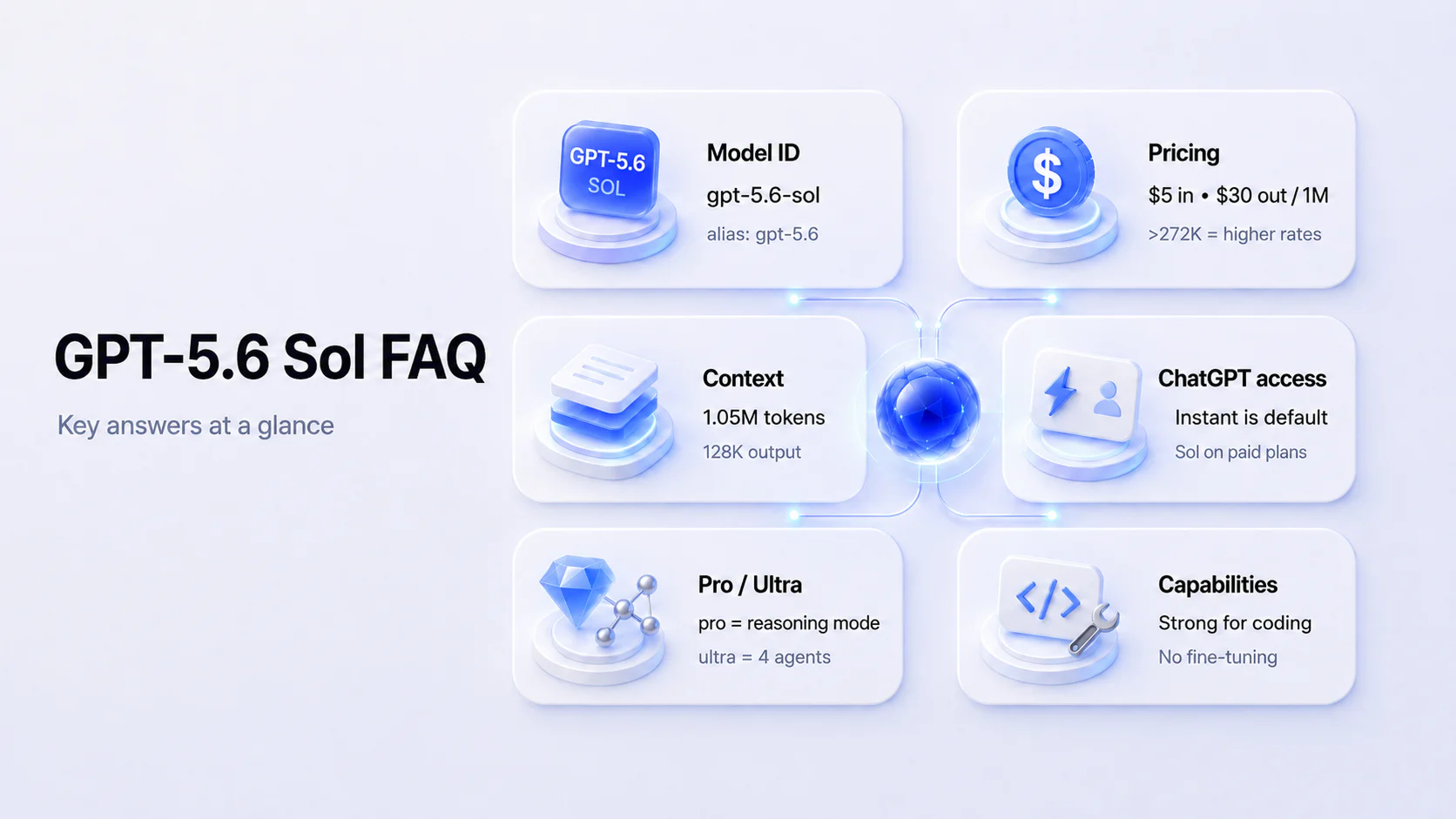
GPT-5.6 Sol is OpenAI’s flagship GPT-5.6 model and the model behind eligible ChatGPT reasoning options. Developers should use gpt-5.6-sol or the gpt-5.6 alias, expect a 1.05M-token context window and 128K max output, and budget from the full rate card rather than the $5/$30 headline alone.
Its official results are strongest across agentic coding, terminal work, browsing, computer use, and long-horizon professional tasks. They are not a clean sweep: Fable 5 leads important published tests, and smaller models can be the better economic choice. Sol is worth using where complexity and quality justify it—then proving that choice with your own evaluation.
FAQ
What is ChatGPT 5.6 Sol?
What is the GPT-5.6 Sol API model ID?
gpt-5.6-sol. The unsuffixed gpt-5.6 alias also routes requests to Sol. An explicit Sol slug makes the intended model tier clear in application code and evaluations.How much does GPT-5.6 Sol cost?
What is the GPT-5.6 Sol context window?
Is GPT-5.6 Sol the default model in ChatGPT?
Which ChatGPT plans include GPT-5.6 Sol?
Is there a separate GPT-5.6 Sol Pro API model ID?
gpt-5.6-sol and enable reasoning.mode: "pro" in the Responses API. Reasoning effort is configured separately.What is the difference between max and ultra?
max is the highest GPT-5.6 reasoning-effort setting and gives one model more time to explore and verify. ultra is a product setting that coordinates four agents in parallel by default. Developers can build ultra-like workflows with the Responses API multi-agent beta.