AI tools for HR now span everything from resume screening to payroll processing to leadership coaching. The problem is volume: hundreds of platforms claim to “transform” HR with artificial intelligence, and most of those claims land somewhere between exaggerated and useless.
This guide cuts through the noise. I picked the leading tools and organized them by the HR problems they solve, so you can jump straight to your biggest pain point.
Summary: Review and Comparison of the Top 20 HR AI Tools
| Tool | Best for | Company size | Starting price |
|---|---|---|---|
| ChatGPT | HR content, policies, interview prep | Any | Free. Plus $20/month. Business $30/user/month. Enterprise custom, about $40-$60+/user/month |
| SeekOut | Talent sourcing and diversity search | Mid-to-large | Starts around $833/seat/month on an annual contract |
| Juicebox.ai | Natural-language candidate search | Startups, SMBs | $139/seat/month. Free tier available |
| HireVue | Video interviewing and candidate assessment | Enterprise | Custom. Typical contract close to $50,000/year |
| Paradox (Olivia) | Recruiting automation and scheduling | Mid-to-large | Custom |
| Metaview.ai | Interview notes and candidate insights | SMBs to mid-market | Free: 25 sessions/month. Pro: $60/user/month |
| Gem | AI-first recruiting platform with ATS, CRM, sourcing, scheduling, and analytics | Startups to enterprise | Starts at $300/month. Startup program offers first 6 months free |
| Leena AI | Employee support and HR helpdesk automation | Enterprise | Custom. 14-day free trial |
| Moveworks | Enterprise HR support automation | Enterprise | Custom. Median about $130,000/year |
| Lattice | Performance management and engagement | Mid-market | From $11/person/month |
| Culture Amp | Employee engagement and feedback analytics | Mid-size to enterprise | Custom. Median about $22,590/year |
| CoachHub | Leadership coaching and people development | Enterprise | Custom. Median annual spend about $61,000 |
| Playroll Orbit (HR-GPT) | Global compliance guidance | Any | Free standalone tool. EOR starts at $399/employee/month. Contractor hiring starts at $35/contractor/month |
| Gusto | Payroll, HR, and benefits for small business | SMBs | From $49/month + $6/employee |
| Paychex | HCM, payroll, and AI-assisted recruiting | Any | Custom. Starts at $69-$132/employee/year for a company with 200 employees |
| HiBob (Bob) | Modern HR platform with AI automation | Mid-market | Custom. Free trial |
| Workday | Comprehensive HCM with embedded AI agents | Enterprise | Custom. Median about $48,301/year |
| Rippling | Unified HR, IT, payroll, and finance | SMB to mid-market | Custom. Median annual cost about $40,000 |
| Tool | Best for | Company size | Starting price |
|---|---|---|---|
| ChatGPT | HR content, policies, interview prep | Any | Free; Plus $20/mo |
| Playroll Orbit | Global compliance guidance | Mid-size+ | Free (standalone) |
| HireVue | Video interviewing, assessments | Enterprise (500+) | ~$35,000/year |
| Paradox (Olivia) | Recruiting automation, scheduling | Mid-to-large | Custom |
| SeekOut | Talent sourcing, diversity hiring | Mid-to-large | ~$8,000-$10,000/year |
| Juicebox.ai | Natural language candidate search | Startups, SMBs | $139/seat/mo |
| Metaview.ai | Interview notes, recruiting intel | Mid-market+ | Free; Pro $50/user/mo |
| Gem | AI-first all-in-one recruiting | Startups to enterprise | $139/mo (Essentials) |
| Leena AI | Employee support, HR helpdesk | Enterprise | Custom; 14-day trial |
| Moveworks | Enterprise HR support automation | Enterprise 5,000+ | ~$100-$200/employee/year |
| HiBob (Bob) | Modern HRIS, engagement | Mid-market | Custom |
| Lattice | Performance, engagement | Mid-market | $11/person/mo |
| Culture Amp | Employee engagement analytics | Mid-size+ | $9-$14/employee/month |
| CoachHub | Leadership coaching | Enterprise 500+ | ~$61,000/year median |
| Workday | HCM, payroll, talent management | Enterprise | $150,000-$1M+/year |
| Rippling | Unified HR, IT, payroll, finance | SMB to mid-market | $8/employee/month base |
| Gusto | Payroll, benefits for small business | 1-100 employees | $49/month + $6/employee |
| Justworks | PEO, payroll for SMBs | 5-100 employees | $109/employee/month |
| Paychex | HCM, payroll, AI recruiting | Any size | $39/month + $5/employee |
| Zenefits / TriNet HR Plus | All-in-one HR, benefits for SMBs | 5-200 employees | Custom |
General-Purpose AI Tool
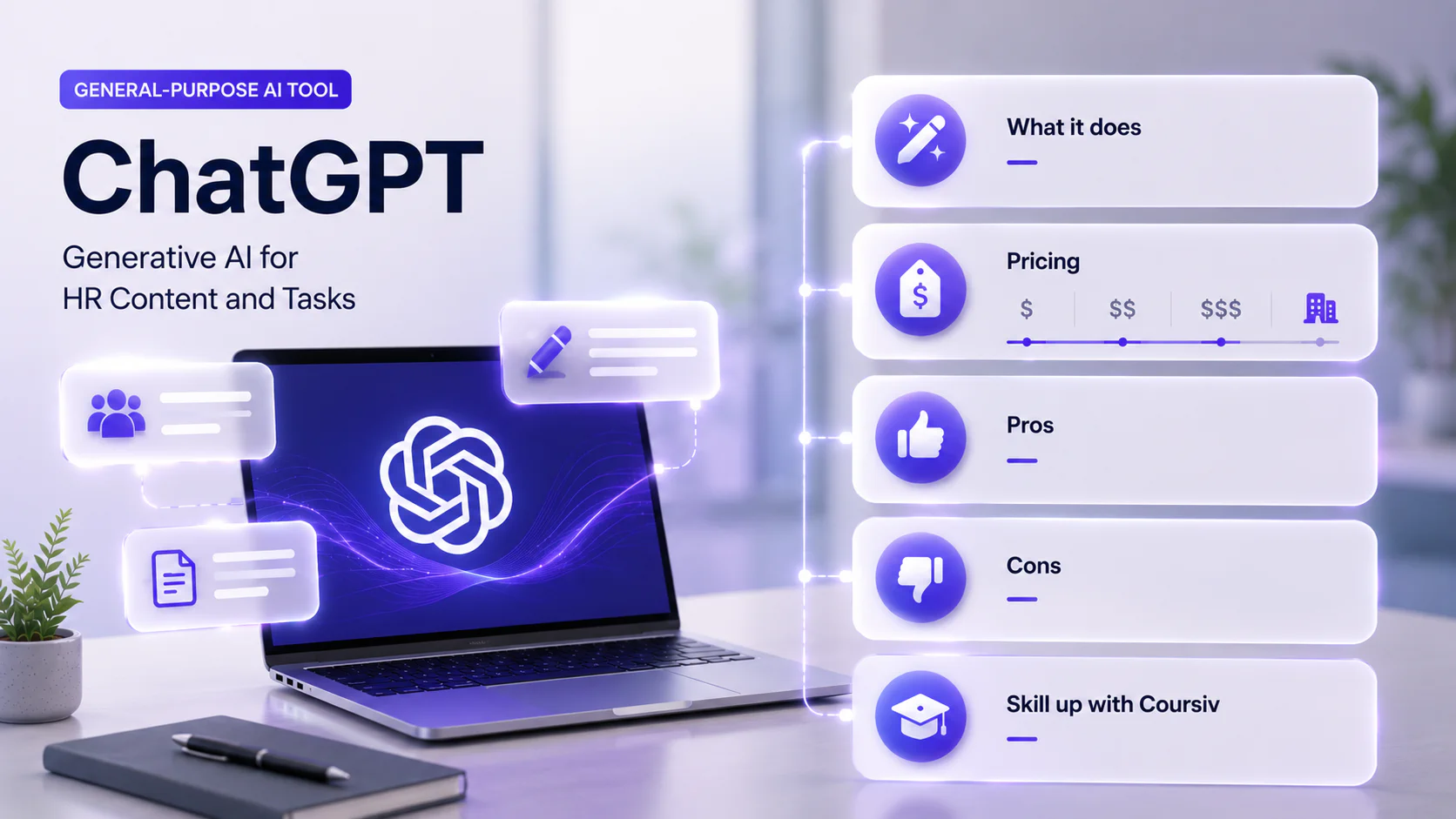
ChatGPT — Generative AI for HR Content and Tasks
ChatGPT handles the writing-heavy work that eats up HR time: job description drafts, interview question banks, policy rewrites, onboarding docs, internal memos.
Pricing: Free, Plus ($20/month), Business ($30/user/month), Enterprise (custom, ~$40-$60+/user/month).
Pros: Eliminates the blank-page problem for virtually any text-based HR task.
Cons: Hallucinates legal information, has no jurisdiction awareness, and leaves no compliance audit trail.
For HR professionals looking to build skills with ChatGPT, Coursiv’s AI Mastery pathway covers advanced prompting, workflow automation, and custom GPTs in bite-sized lessons designed for non-technical professionals.
AI Tools for Recruiting and Talent Sourcing
SeekOut — AI Talent Sourcing and Diversity Search
Pulls from 800M–1B+ candidate profiles across 50+ data sources, including LinkedIn, GitHub, academic publications, patents, and NPI (healthcare) databases.
Where SeekOut really pulls ahead is diversity hiring. You can filter by predicted diversity signals — gender, ethnicity, veteran status — and switch on a “Bias Reducer Mode” that strips out demographic details so reviewers focus on skills and experience instead of background.
Pricing: Starts around $833/seat/month on an annual contract.
Pros: Genuinely strong for technical roles and diversity-focused searches.
Cons: Less effective for passive outreach outside the U.S.
Juicebox.ai — AI Recruiting and Talent Search Platform
Describe the candidate you want in plain language; a shortlist comes back in under five minutes. Searches 800M+ profiles across 30+ real-time data sources.
Pricing: $139/seat/month, with a free tier.
Pros: Cheaper and quicker to get running than SeekOut, and you don’t need to know Boolean to use it effectively.
Cons: Doesn’t match SeekOut when it comes to diversity sourcing depth or enterprise-level integrations.
HireVue — AI-Powered Video Interviewing and Candidate Assessment
The basic idea: candidates record their answers to preset questions on their own time, no interviewer needed. HR teams then watch the recordings when it works for them.
NLP transcript analysis, game-based psychometric assessments, and technical coding evaluations.
Pricing: Custom quote only. The typical contract runs close to $50,000/year.
Pros: Candidates interview asynchronously, cutting scheduling overhead for high-volume roles.
Cons: One-way video feels impersonal, and the scoring logic stays opaque even after third-party audits.
Paradox (Olivia) — Conversational AI for Recruiting and Scheduling
Olivia automates candidate outreach via SMS, chat, and WhatsApp. It basically replaces traditional online application forms with a text-based chat. Instead of filling out a multi-page web form, the candidate texts a keyword or scans a QR code, and Olivia starts a chat conversation via SMS or WhatsApp.
Pricing: Custom.
Pros: When Chipotle rolled it out, their application completion rate went from 50% to 85% — a real proof point for high-volume hiring.
Cons: Struggles with off-script questions and offers limited reporting.
Metaview.ai — AI for Interview Notes and Candidate Insights
Plugs into your interview calls, captures everything, and breaks notes down by question — then pushes them straight to Greenhouse, Lever, or Ashby.
Pricing: Free: 25 sessions/month. Pro: $60/user/month.
Pros: Eliminates the note-taking vs. listening trade-off.
Cons: Non-English speakers and strong accents trip it up. Summaries can feel “too generic”.
Gem — Deep AI-Driven Candidate Matching Beyond Resumes
AI-first all-in-one recruiting platform combining ATS, CRM, sourcing, scheduling, and analytics. AI agents search 800M+ profiles, re-surface past candidates, and rank applications in minutes with transparent match scoring.
Pricing: $300/month to start. New startups can apply for the Gem Startup Program — first six months at no cost
Pros: Rolls ATS, CRM, sourcing, and scheduling into one tool, and the AI gets smarter the longer you use it because it draws on your past hiring data.
Cons: The interface can feel cluttered, and reporting customization is limited on lower tiers.
AI Tools for HR Automation of Operations and Employee Support
Leena AI — HR Virtual Assistant and Chatbot for Employee Support
Built to handle the questions HR gets on repeat: leave balances, payroll queries, policy lookups, benefits questions — all in 100+ languages without routing every request to your HR team. It connects to 1,000+ systems.
Pricing: Custom; 14-day free trial.
Pros: Built for large, distributed workforces that need to cut HR ticket volume without hiring more ops staff.
Cons: Pricing is opaque, and customization can be time-consuming during implementation.
Moveworks — Enterprise Conversational AI for HR Support
Multi-LLM reasoning engine resolving employee requests across IT, HR, Finance, and Facilities. Also provides enterprise semantic search across 100+ systems, proactive issue detection, and Creator Studio for building custom AI workflows.
Pricing: Custom. Median is $130,000 per year.
Pros: Best-in-class enterprise automation depth, now backed by ServiceNow’s workflow infrastructure.
Cons: Below 5,000 employees, the price tag is difficult to justify.
AI Tools for People Development
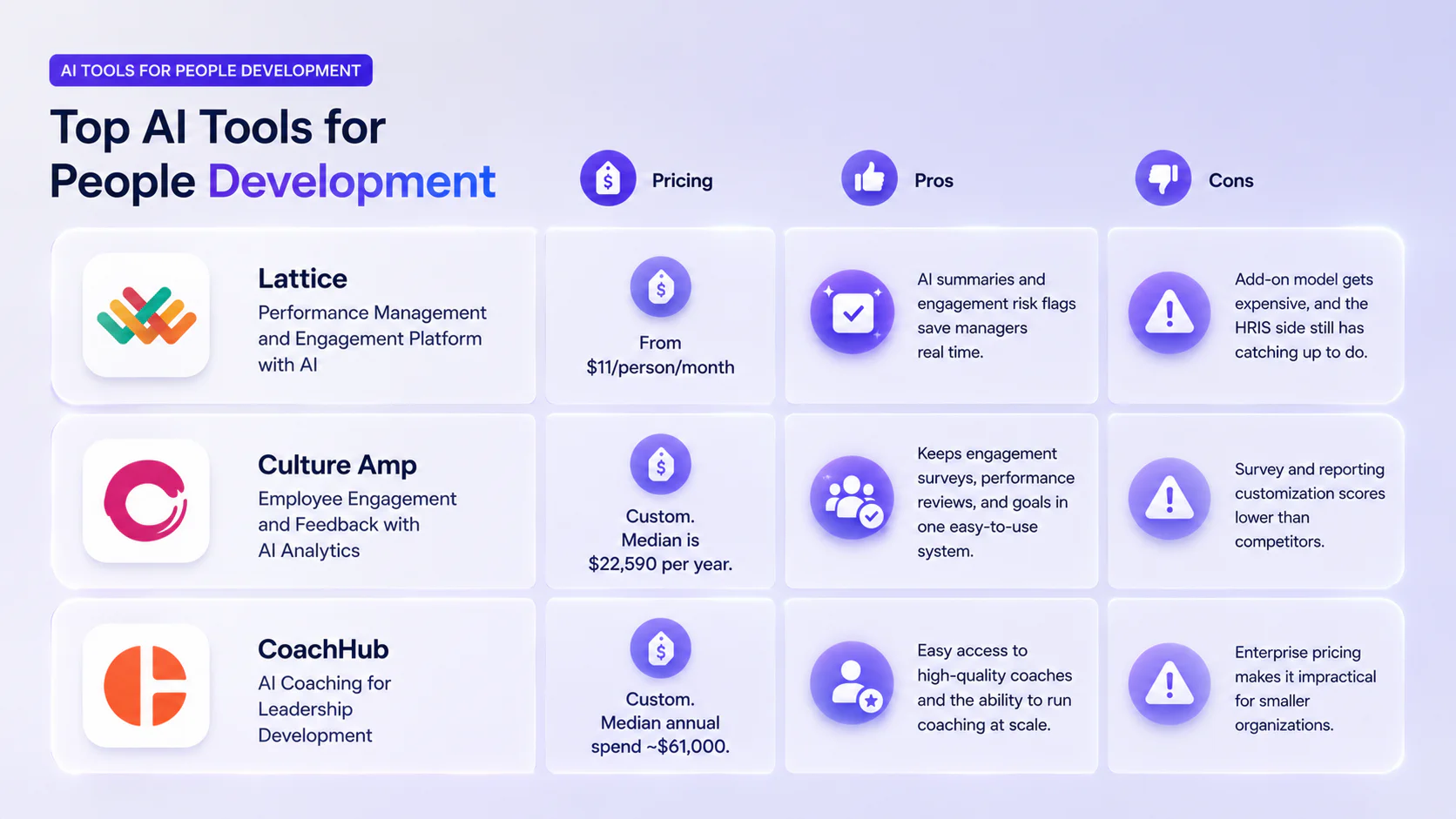
Lattice — Performance Management and Engagement Platform with AI
Lattice’s AI Agent serves as an always-on HR partner, taking notes and providing management guidance based on team data. It also offers AI tools for performance reviews, survey insights, feedback analysis, and personalized employee growth plans.
Pricing: From $11/person/month.
Pros: Useful that it keeps performance reviews and goals in the same place — the AI summaries and engagement risk flags save managers real time.
Cons: The add-on model gets expensive as you layer on features, and the HRIS side still has some catching up to do.
Culture Amp — Employee Engagement and Feedback with AI Analytics
Designed for HR teams that want to actually do something with their survey data — not just collect it. The platform pairs AI analysis with guidance from their own organizational psychologists, and layers in retention predictions, benchmarking, and personalized development tools.
Pricing: Custom. Median is $22,590 per year.
Pros: Keeps engagement surveys, performance reviews, and goals in one easy-to-use system.
Cons: Survey and reporting customization scores lower than competitors like Qualtrics.
CoachHub — AI Coaching for Leadership Development
Certified human coaches (top 5% acceptance rate, 90 countries) plus AIMY, a conversational AI coach in 60+ languages.
Pricing: Custom. Median annual spend ~$61,000.
Pros: Easy access to high‑quality, ICF‑accredited coaches and the ability to run coaching at scale across many managers/employees
Cons: Enterprise pricing makes it impractical for smaller organizations.
AI Tools for Payroll and Compliance
Playroll Orbit (HR-GPT) — Global HR Compliance and Guidance
Legally validated employment guidance across 180+ countries and 50 U.S. states, anchored to verified regulatory sources.
Pricing: Free as a standalone tool; EOR and contractor hiring start at $399/employee/month and $35/contractor/month.
Pros: Responsive, knowledgeable support that simplifies compliant multi‑country hiring and payroll.
Cons: Reporting and analytics are relatively basic, and onboarding or changes can sometimes be slower than expected.
Gusto — Payroll, HR, and Benefits Platform with AI
AutoPilot runs payroll in about eight minutes with automatic tax filing across all 50 states.
Pricing: From $49/month + $6/employee.
Pros: Easy‑to‑use payroll and HR with automated tax filings that small businesses say simplifies running payroll and onboarding.
Cons: Costs and fees can climb as you grow or add features, and some users report inconsistent support or tax‑handling issues in edge cases.
Paychex — HCM Platform with Payroll and AI-Assisted Recruiting
Paychex deploys AI across HR workflows, including agentic payroll processing via voice and email, AI candidate matching, generative employment law guidance, skill-based shift scheduling, automated timesheet approvals, AI employee survey analysis, and a knowledge-mesh system that extracts insights from unstructured workforce data.
Pricing: Custom. Starts at $69–$132/employee/year for a company with 200 employees.
Pros: Reliable, full‑service payroll and HR with strong tax filing and hands‑on support that many users say simplifies compliance and day‑to‑day processing.
Cons: Pricing is opaque with surprise add‑on fees, and the interface feels dated.
All-in-One HR Platforms
HiBob (Bob) — Modern HR Platform with AI Automation
HiBob’s AI features help HR teams generate feedback, navigate the platform with natural language, and access insights from company data. The platform also includes predictive analytics, financial planning tools, and core HR functions like onboarding, payroll, performance management, and people analytics.
Pricing: Custom; free trial.
Pros: Mid-market companies keep choosing it over legacy HRIS platforms because it’s genuinely easier to use.
Cons: Native payroll is limited to the U.S. and the U.K.; global payroll requires third-party integrations.
Workday — Comprehensive HCM Platform with Embedded AI Agents
12+ AI agents covering recruiting, payroll anomaly detection, talent mobility, and self-service.
Pricing: Custom. Median is $48,301 per year.
Pros: Unmatched depth of unified data.
Cons: Getting it live takes real time and effort — this is not a plug-and-play setup.
Rippling — Unified HR, IT, Payroll, and Finance Platform
Rippling stands out because it connects HR, IT device management, and Finance in one system. On the AI side, it handles candidate screening, summarizes interviews, flags compliance issues, and automates cross-department workflows.
Pricing: Custom. The median annual cost runs around $40,000.
Pros: A single employee change propagates across payroll, benefits, app access, and expense policies automatically.
Cons: Steep learning curve for administrators.
Top Free and Accessible HR AI Tools
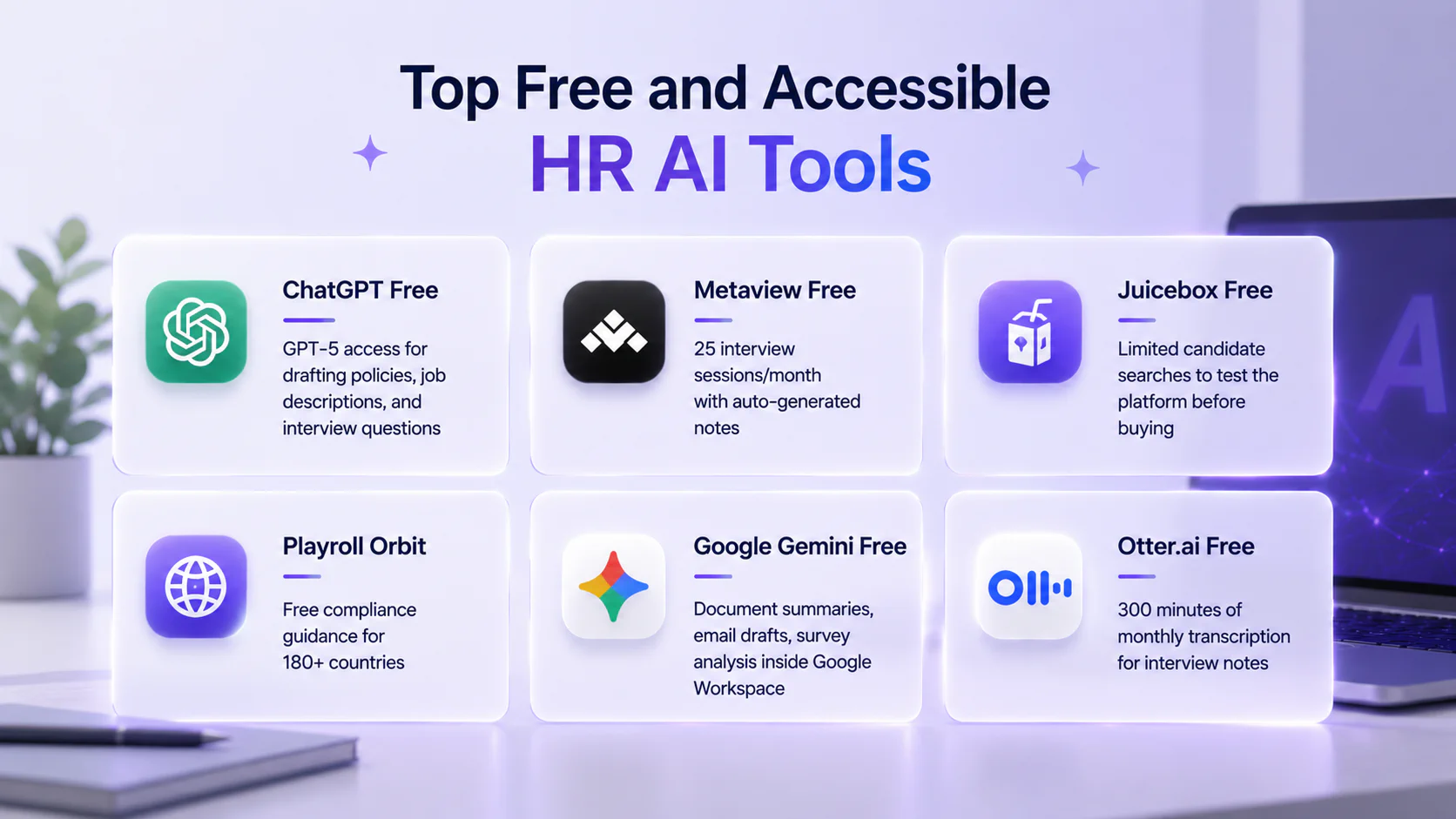
- ChatGPT Free — GPT-5 access for drafting policies, job descriptions, and interview questions
- Metaview Free — 25 interview sessions/month with auto-generated notes
- Juicebox Free — limited candidate searches to test the platform before buying
- Playroll Orbit — free compliance guidance for 180+ countries
- Google Gemini Free — document summaries, email drafts, survey analysis inside Google Workspace
- Otter.ai Free — 300 minutes of monthly transcription for interview notes
AI vs Traditional Recruiting Methods: Reducing Time-to-Hire with AI
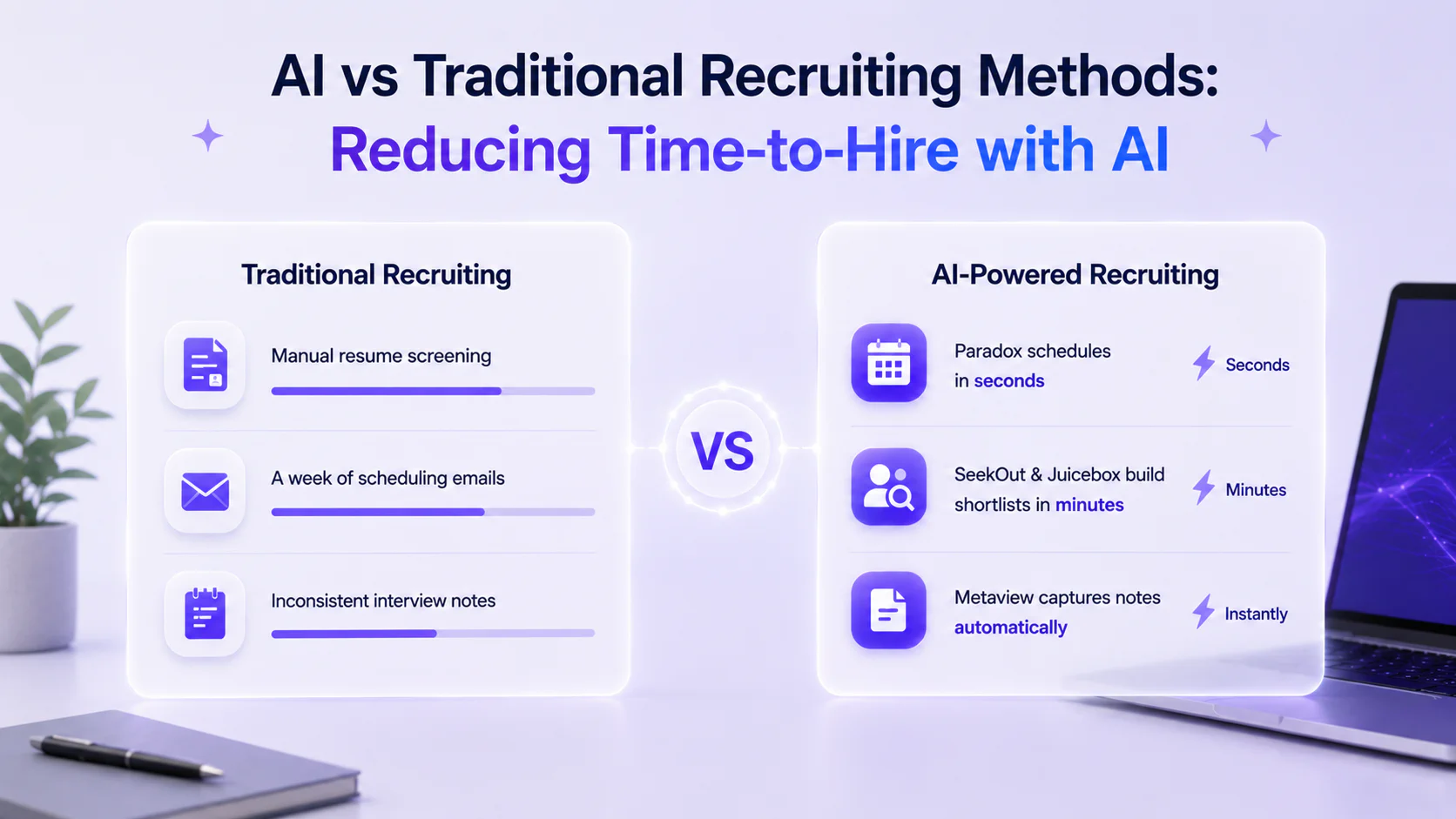
Speed is the main thing AI changes in recruiting. Traditional processes pile up delays: manual resume screening, a week of scheduling emails, and inconsistent interview notes.
AI tools cut through all of that. Paradox handles scheduling in seconds, SeekOut and Juicebox build sourcing shortlists in minutes, and Metaview captures notes automatically.
The real payoff, though, is what recruiters actually do with that time back — having real conversations, running sharper interviews, and making decisions they feel confident about.
Advantages of Using AI for Focused HR Automation
- Recruiters get their time back (scheduling, resume screening, and note-taking no longer eat up the day)
- Faster, more consistent hiring decisions (structured interview notes and candidate scoring reduce bias and delay)
- **You see retention risk earlier (**predictive tools can flag someone before they’ve already mentally left)
- Less admin burden on lean HR teams (document generation, policy drafts, and onboarding paperwork in minutes instead of hours)
- **Employees stop waiting on HR for basic questions (**Slack/Teams chatbots handle the routine stuff instantly)
- Payroll errors caught before they cost money (anomaly detection flags issues before checks go out)
Why AI Cannot Replace Humans in HR: The Psychological Factor in Recruitment
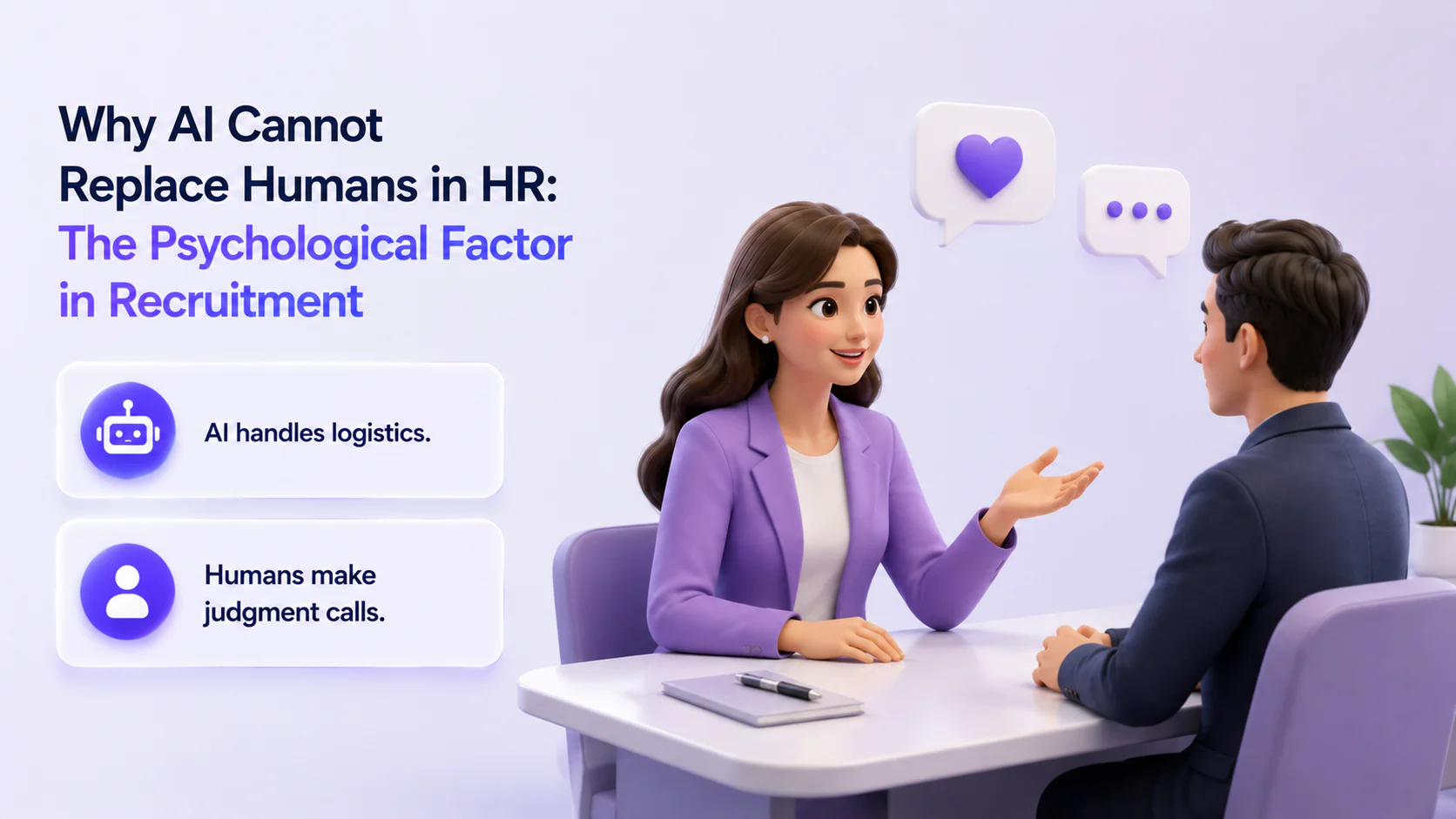
The candidates you most want to hire are reading signals beyond job specs and salary: culture, trust, and the feel of a conversation. No algorithm can sense when a strong candidate starts to pull back, navigate a comp negotiation, or build rapport that tips someone toward your offer.
AI tools earn their place by handling logistics, freeing HR professionals for the judgment calls that still drive the best hires.
FAQ
Is Paychex Using AI?
How to Best Use AI in HR?
What Is ChatGPT for HR?
Can ChatGPT Do Payroll?