
The best AI tools for ecommerce in 2026 depend on the bottleneck in your store: support tickets, product content, email marketing, personalization, product discovery, analytics, or conversion-rate optimization. For Shopify-heavy teams, the fastest ROI usually comes from customer support automation, product description workflows, and email/personalization tools before more complex analytics stacks.
Quick answer: start with support automation if tickets are eating time, content tools if your catalog is growing, personalization/search if shoppers cannot find products, and analytics/attribution if you are scaling paid channels. This guide compares 20 ecommerce AI tools across those use cases.
| Ecommerce bottleneck | Start with | Good tool category |
|---|---|---|
| Too many shipping, return, and order-status tickets | Support automation | Gorgias, Tidio, Intercom Fin, eDesk |
| Product pages are thin or duplicated | Content generation | Jasper, ChatGPT workflows, Photoroom, Flair.ai |
| Low repeat purchase rate | Email and SMS personalization | Klaviyo, Omnisend, GetResponse |
| Shoppers cannot find products | Search and product discovery | Constructor, Bloomreach, Klevu/Athos, Nosto |
| Paid ads are scaling but reporting is messy | Analytics and attribution | Triple Whale, Polar Analytics, FullStory |
| Founder wants one assistant inside Shopify | Native AI assistant | Shopify Sidekick and Shopify Magic workflows |
Source check — June 4, 2026: Shopify’s help center describes Sidekick as an AI-enabled commerce assistant inside Shopify admin that can generate content, analyze data, manage orders, edit products, and present changes for review. Vendor pricing in ecommerce AI changes constantly, so verify live pricing before relying on any static comparison table.
This is the full ecommerce AI tools roundup. If you only want ChatGPT prompts for product descriptions, email flows, ad copy, and support replies, use ChatGPT for ecommerce. For broader go-to-market workflows, pair it with ChatGPT for marketing, customer service automation, and AI agents for business.
e-Commerce Areas AI Automation Handle Best (and Where to Start)
AI touches every part of an online store, but five functions deliver measurable results the fastest.
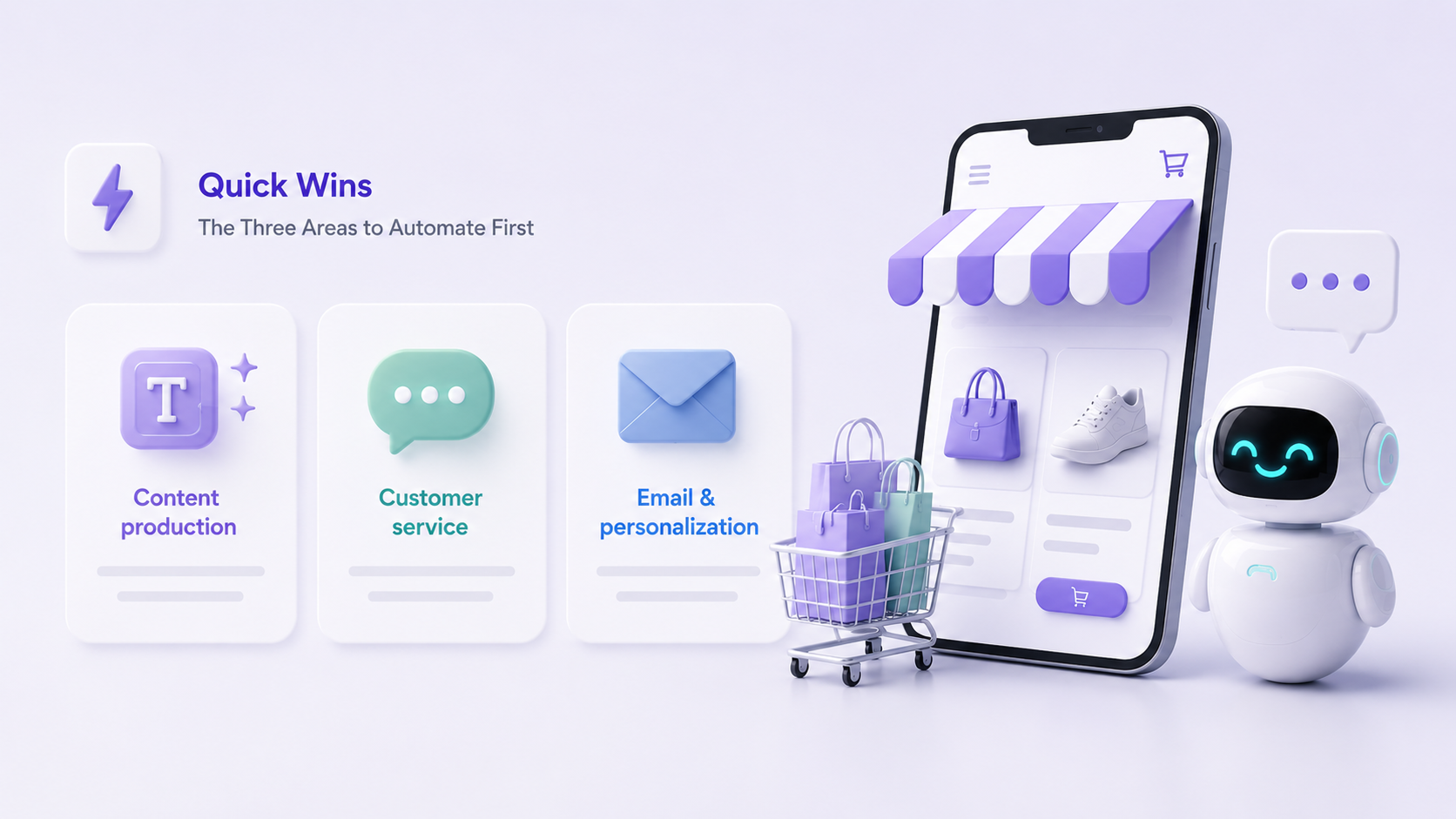
Quick Wins: The Three Areas to Automate First
The priority for most stores, especially small businesses, should be Generative AI for content creation and basic support.
Content production: Use no-code tools for automated product descriptions, ad copy ideation, and image editing.
Customer service: Turn on simple FAQ chatbots to handle 24/7 basic inquiries, which can resolve tickets faster and free up human agents for complex issues.
Core AI Use Cases for E-Commerce Growth
Adobe’s 2025 report surveyed 775 retail executives on where AI delivers the strongest results. The top areas line up with the five tool categories in this guide. Here’s how they stack up by speed of return and where different stores should begin.
Customer support closes the biggest experience gap. 66% of consumers expect fast help through chatbots or virtual assistants, yet only 33% feel brands deliver. That mismatch makes customer support an area where AI tools for an e-commerce business deliver the fastest ROI, often in days rather than months.
Start here if you spend more than a few hours a day answering repetitive questions about shipping, returns, or order status.
Content creation relieves the most operational pressure. Creative teams currently meet only about 55% of content demands across all touchpoints, and 45% of retailers already use generative AI to produce product descriptions. Another 42% use it for marketing copy.
Start here if your catalog is growing faster than your team can write descriptions and shoot product photos.
For repeatable prompt workflows around ads, email, landing pages, and SEO copy, pair this section with ChatGPT for marketing and Claude AI for writing.
Email and personalization rank as the top strategic priority. 51% of retail executives say personalized offers based on customer data were their number one AI focus for 2025, and 45% are working on real-time website personalization. Returns compound as your segments sharpen with each campaign.
Start here if your content workflows are already efficient and the next priority is meeting high consumer expectations for personalization.
Product discovery and search hide the largest revenue lifts. 69% of consumers want retailers to anticipate their needs with relevant offers at the right moment. Only 35% of brands pull that off. Shoppers who use site search convert at a rate two to three times that of browsers.
Start here if your store has 200+ products and customers struggle to find what they need.
Analytics and attribution make everything else measurable. 50% of retail executives report improved decision-making through AI insights, and 45% use AI for next-best-action recommendations. These tools take three to twelve months to show full ROI but answer the question every other tool raises: what’s actually working?
Start here if you scale toward multi-channel personalization and data feels “fragmented”.
Customer Support Tools
Customer support automation delivers the fastest ROI of any e-commerce AI category. Five tools span from free plans to fully managed enterprise outsourcing.
Gorgias
Gorgias is the go-to helpdesk for Shopify stores. It pulls order data, shipping status, and refund controls directly into support tickets, and it tracks how much revenue your support team generates.
Pricing uses a ticket-based model with unlimited agent seats. Starter costs $10/month (50 tickets), and plans scale to $750/month for 5,000 tickets. The AI Agent runs separately at $1 per resolved conversation.
Pros & Cons: Users praise the Shopify integration but flag unpredictable costs during seasonal spikes.
Best for mid-size DTC Shopify brands processing 300 to 5,000 tickets monthly.
Fin
Fin is Intercom’s AI agent that autonomously resolves customer queries across chat, email, phone, and SMS.
Pricing uses a resolution-based approach at $0.99 per solved issue, layered on top of Intercom’s platform ($29 to $132 per seat per month).
Fin also works standalone on Zendesk, Salesforce, or HubSpot.
At high volumes, costs add up quickly, so watch for “assumed resolutions” that leave customers without a true fix.
Pros & Cons: Reviewers love how quickly Fin resolves support tickets using the knowledge base with minimal setup, but many flag the $0.99-per-resolution pricing model as unpredictable and increasingly expensive at scale.
Best for tech-forward mid-market to enterprise teams. Less ideal for pure e-commerce than Gorgias, as it lacks deep order-management integration.
Tidio
Tidio combines live chat, the AI chatbot (Lyro, powered by Anthropic’s Claude), and a visual automation builder. The platform also performs Shopify actions, such as checking order status.
Pricing offers a free plan with 50 conversations per month. Paid plans start at $29/month, with Lyro as a $39/month add-on.
Pros & Cons: Users love the easy setup and generous free tier but flag confusing modular pricing.
Best for solo entrepreneurs and small Shopify or WordPress stores under 500 conversations per month.
eDesk
eDesk consolidates messages from 250+ channels, including Amazon, eBay, Walmart, TikTok Shop, and Shopify. It sits on both the Amazon and Walmart developer councils, giving it unmatched marketplace integration depth.
Pricing offers a per-user model starting at $49 per agent/month. AI features are paid add-ons.
Pros & Cons: Users call the marketplace integrations excellent but flag significant year-over-year price increases.
Best for multi-marketplace sellers who need every channel in one inbox.
Crescendo.ai
Crescendo.ai is fundamentally different from the others — it’s a complete customer support outsourcing service, not a self-serve tool. AI handles most inquiries, with seamless escalation to Crescendo’s trained human agents.
Pricing runs about $1.25 per AI resolution plus a $2,900/month fixed fee. A 30-day go-live guarantee is included.
Pros & Cons: The platform has earned industry awards for its multimodal AI handling voice, text, and visual inputs with reported near-perfect accuracy, though it has virtually no independent user reviews on G2, Trustpilot, or Capterra yet, making those claims hard to verify.
Best for mid-market brands ($10M+ revenue) that want to hand off CX operations fully.
Email Marketing Tools
Email and SMS automation generate the highest-margin revenue for most e-commerce brands. AI features in this category now include predictive analytics, send-time optimization, and autonomous campaign agents.
Klaviyo
Klaviyo is the de facto standard for e-commerce email/SMS marketing.
Klaviyo’s AI suite (“K:AI”) includes marketing and customer AI agents and 40+ personalization features.
The downsides: expensive at scale, limited support (no phone).
Pricing: Klaviyo uses a freemium, usage-based model where price scales with your number of active contacts and email/SMS volume. You get a small free tier, then paid plans that unlock higher sending limits and better support as your list grows.
Pros & Cons: Users praise exceptional segmentation and deep Shopify integration but frequently cite high costs at scale.
Best for data-driven brands with dedicated marketing teams.
Omnisend
If you’re running a small or mid-size Shopify store and want email, SMS, and push all in one place without paying platform fees for each, Omnisend is hard to beat. You get everything bundled into a single plan — and that alone saves a lot of money compared to stitching tools together.
Its AI automatically generates branded email copy, subject lines, and personalized product recommendations. Though AI features are newer and less advanced than Klaviyo’s, they lack predictive analytics or send-time optimization yet.
Pricing includes a free plan with 500 emails/month and all features unlocked. The standard plan starts at $16/month.
Pros & Cons: Reviewers keep mentioning the price-to-value ratio and the speed of the support team’s response, though several note the template editor feels rigid for custom designs, and SMS costs pile up fast on top of the base plan.
A solid fit if your store is still growing (roughly under $50K/month), and you need a full-featured marketing tool without enterprise pricing.
GetResponse
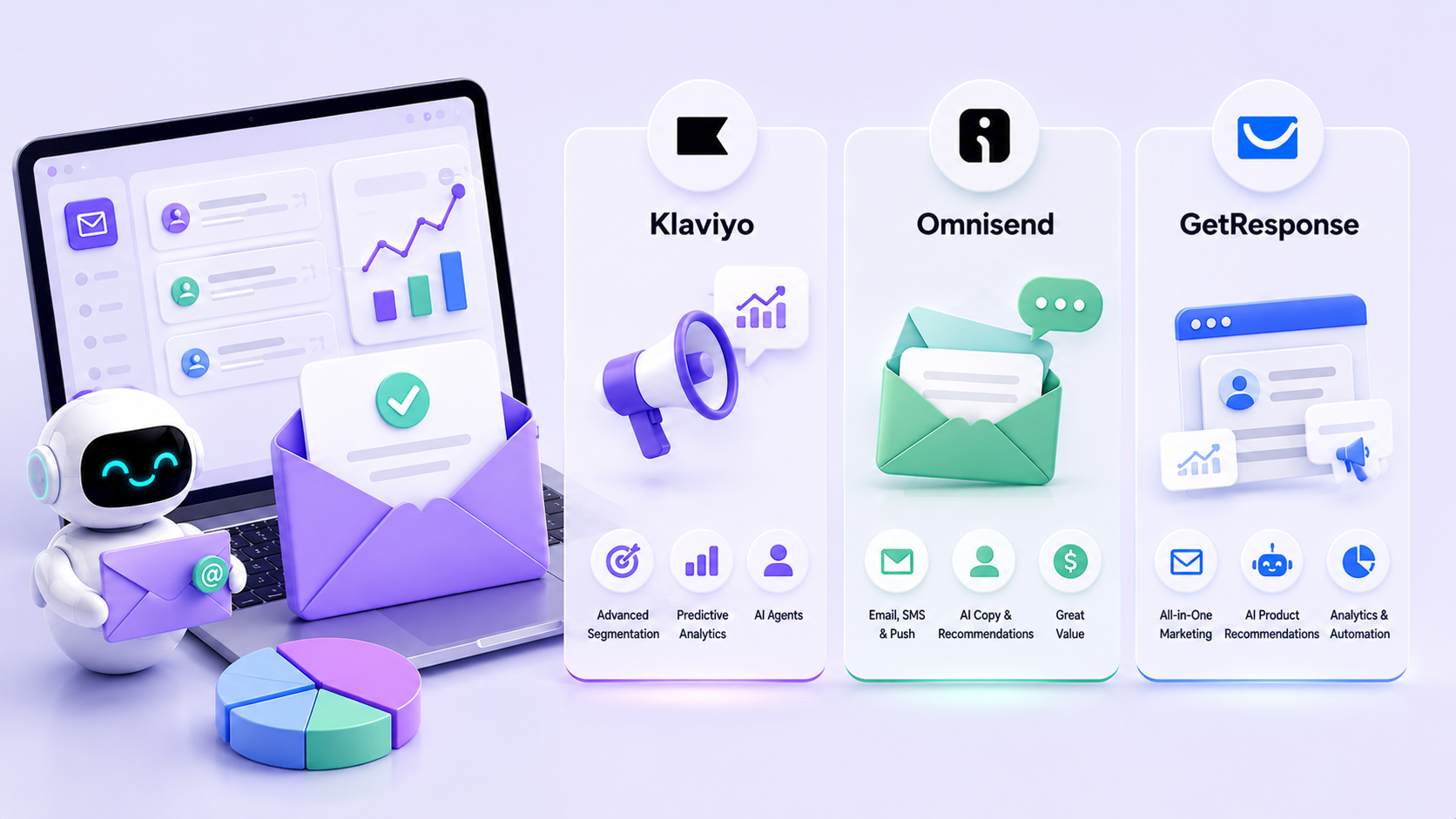
GetResponse tries to do everything — email, automation, landing pages, webinars, funnels, and a website builder under one roof. That breadth is also its limitation: if you’re running a dedicated e-commerce store, you’ll quickly notice that the shopping features feel tacked on rather than built first.
Pricing: Entry-level plan runs $19/month for up to 1,000 contacts with unlimited emails. Enterprise plan adds AI product recommendations.
Pros & Cons: Reviewers appreciate the all-in-one value — email, SMS, landing pages, webinars, and AI recommendations at competitive pricing — but quite a few flag a steep learning curve and report that the more powerful automation features are locked behind expensive higher tiers.
Best for businesses needing an all-in-one marketing solution that goes beyond e-commerce.
Search, Personalization, and Product Discovery
This is the category where AI tools for e-commerce businesses hide the biggest revenue lifts.
Constructor
Constructor is an AI-native product discovery platform serving enterprise retailers like Sephora, Petco, and Birkenstock.
Its proprietary Native Commerce Core Loadstone optimizes search results for revenue, conversion, and profit — not just keyword relevance. The AI Shopping Agent handles conversational queries like “I’m going to a wedding in Aruba — what should I wear?” and delivers personalized results.
Pricing isn’t publicly available, but some third-party sources estimate it at around $100,000+ per year.
Pros & Cons: Enterprise users highlight measurable conversion lifts from Constructor’s AI-powered search and product discovery, though several mention the integration process is more complex than expected and the analytics dashboard has a learning curve.
Named a Leader in both the Forrester Wave and Gartner Magic Quadrant for Search and Product Discovery in 2025.
Strictly for large retailers with $50M+ revenue.
Bloomreach
Bloomreach combines AI-powered search (Discovery), marketing automation and CDP (Engagement), headless CMS (Content), and conversational AI shopping (Clarity) in one ecosystem, all powered by Loomi AI built on 16+ years of e-commerce data.
Pricing isn’t publicly available, but some third-party sources estimate the average cost at around $180,000.
Pros & Cons: Reviewers like how much is packed in, but they’re pretty clear that getting it set up properly takes real time.
Worth looking at if you’re tired of juggling separate tools for search, marketing automation, and content management, and want them talking to each other natively.
Athos Commerce (Klevu)
In January 2025, Klevu and Searchspring joined forces under a new name: Athos Commerce. The combined platform delivers AI search, merchandising, personalization, and data feed management with strong NLP across 30+ languages.
Pricing is now custom only. Previously, it ranged from $449 to $849/month.
Pros & Cons: G2 reviewers are impressed by the intelligent search, which handles misspellings and vague queries remarkably well, but smaller merchants consistently flag that the pricing is steep and that the initial setup requires significant time and technical effort.
Best for mid-market retailers on Shopify, BigCommerce, or Magento who have outgrown basic search.
LimeSpot
LimeSpot is an AI personalization platform focused on product recommendations, upsells, cross-sells, and bundling. Its standout is transparent, affordable pricing with zero-code setup — install from the Shopify App Store, and it works immediately.
The trade-off with LimeSpot is scope: it focuses on on‑site recommendations and personalization, not on-site search, CMS, or full-scale marketing automation, and it’s built specifically for Shopify and BigCommerce stores.
Pricing starts at $50/month based on your monthly revenue.
Pros & Cons: Shopify merchants credit the AI-powered recommendations with noticeably boosting average order value and conversions, though a recurring complaint is confusing pricing that auto-escalates without clear notice as your store grows.
Best for SMBs wanting quick, affordable recommendation ROI without technical resources.
Nosto
Nosto is the most widely used commerce experience platform among Shopify Plus merchants. It combines personalization, search, merchandising, UGC, pop-ups, and A/B testing. In January 2025, Nosto launched full-site A/B testing and introduced Huginn, an AI agent that surfaces revenue opportunities around the clock.
Pricing uses a revenue-based model at 2.5 to 4% of Nosto-attributed sales, with an Incubator plan at $99/month.
Pros & Cons: Reviewers are generally positive about the depth of features, though quite a few flag that once your revenue picks up, the percentage-based pricing starts to sting.
A natural fit for Shopify Plus brands in fashion, beauty, or lifestyle that have outgrown basic recommendation widgets and need something built for their vertical.
Tolstoy
Tolstoy is one of the few platforms built specifically around video-driven shopping — shoppable video feeds, AI-assisted product imagery, virtual try-on. It’s the only platform syndicating shoppable videos to Walmart’s homepage and the Shop App for free.
Pricing includes a free plan covering Walmart and Shop App syndication. Paid plans start at $39/month.
Pros & Cons: Still building its review base, but early users consistently mention strong video engagement numbers and, crucially, no noticeable slowdown on their pages.
Makes most sense for D2C brands on Shopify that already have video assets sitting around (UGC, product demos, try-on clips) and want to actually put them to work.
Content and Visual Generation
If there’s one category where AI tools for e-commerce deliver fast, visible time savings, it’s content production.
Jasper
Jasper covers pretty much everything on the copywriting side (product descriptions, ad copy, emails, social, blog posts) with 50+ templates and support for 30+ languages. The feature that separates it is Brand Voice: you train it on your existing content, and it tries to match your tone across outputs instead of sounding generic.
Beyond AI writing, Jasper has evolved into a broader marketing copilot. It now offers tools for campaign automation, brand asset management, image generation, project management, and more.
Pricing is $59/seat/month (annual) or $69 monthly, with unlimited words, 3 Brand Voices, and SEO mode.
Pros & Cons: Marketing teams value the deep template library, brand voice controls, and multi-language support for speeding up content workflows, but an increasing number of reviewers feel it’s overpriced now that free alternatives like ChatGPT produce comparable output.
Best for mid-market marketing teams producing high-volume content every day.
Flair.ai
Flair.ai lets users upload a product image, place it on a drag-and-drop canvas, describe a scene, and generate photorealistic product photos in seconds. No physical photoshoot required. It handles fashion on-model shots, food scenes, furniture, jewelry, and tech products.
The limitation: AI can distort shapes, alter logos, and change colors. It’s better to use traditional photography for hero images on product pages.
Pricing starts at $8/month (annual) for unlimited designs. Pro+ costs $26/month with custom model training and commercial licensing.
Pros & Cons: Users praise the drag-and-drop canvas for generating studio-quality product photos at a fraction of traditional shoot costs, though Trustpilot reviews flag product distortion issues with fine details and a pricing model that feels steep for what you actually get.
A good pick when you need social ads and campaign copy out fast and aren’t going for perfection — speed and volume are the priority here, not polish.
Photoroom
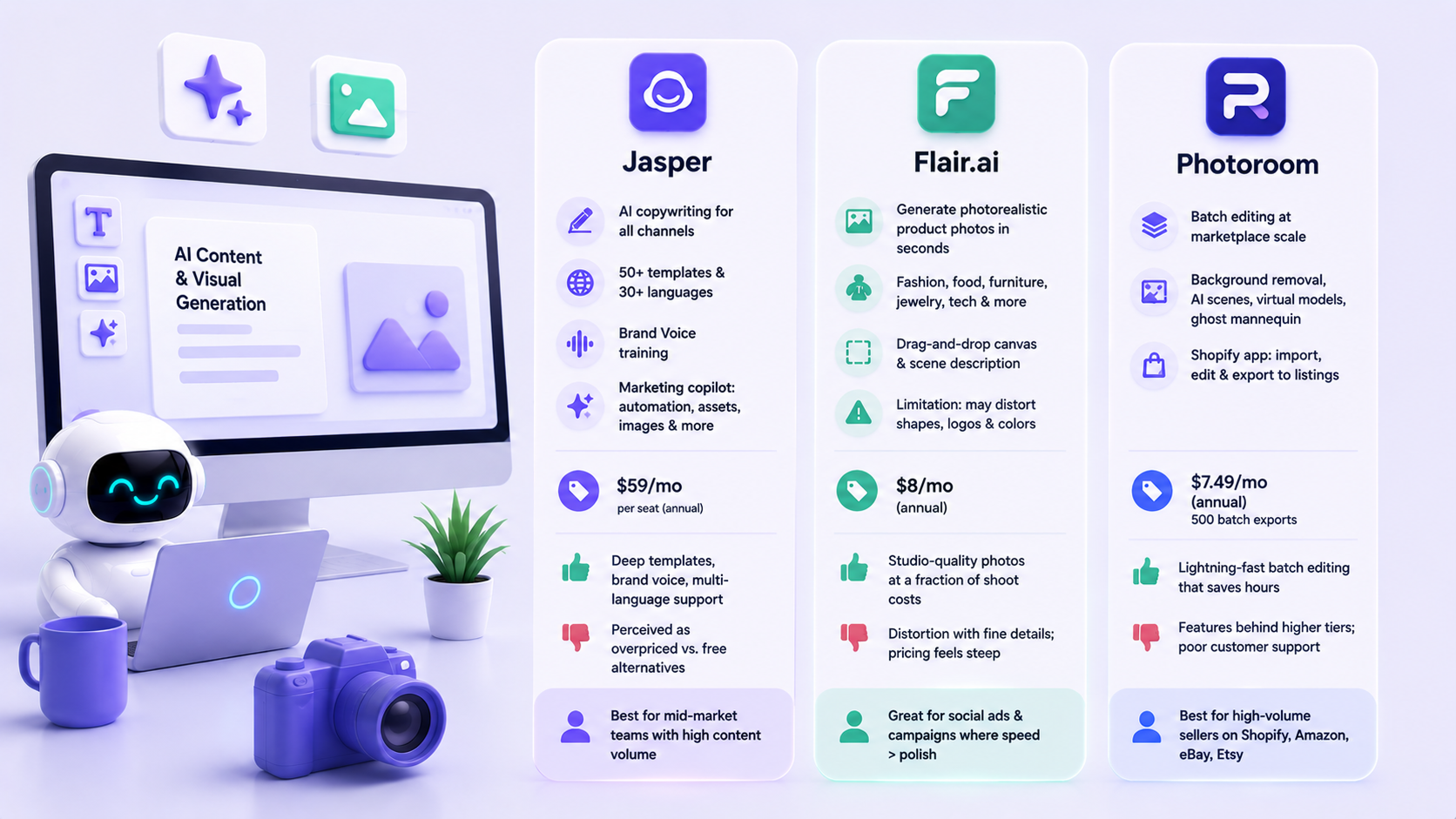
Photoroom specializes in batch editing at marketplace scale. Background removal, AI scene generation, virtual models, and ghost mannequin effects work across hundreds of images simultaneously. The Shopify app lets merchants import products, edit images, and export back to listings directly.
Pricing starts at $7.49/month (annual) with 500 batch exports per month. Max costs $20.99/month with 1,500 batch exports.
Pros & Cons: Users across G2 and app stores rave about the lightning-fast background removal and batch editing that genuinely save hours, but Trustpilot is flooded with complaints about features quietly moving behind higher-priced tiers and near-nonexistent customer support when billing issues arise.
Best for high-volume sellers on Shopify, Amazon, eBay, and Etsy.
Analytics and Attribution
Figuring out which channels actually drive purchases is one of the hardest problems AI tools for e-commerce businesses are now being built to solve. Ad platforms report inflated numbers, customer journeys span dozens of touchpoints, and privacy changes keep shrinking the data available to sellers.
If your team needs help turning messy ecommerce exports into dashboards and decisions, the ChatGPT for data analytics guide covers reporting, SQL, KPI interpretation, and analyst review workflows.
These three tools tackle the problem from different angles: behavioral analytics (FullStory), marketing attribution (Triple Whale), and customizable business intelligence (Polar Analytics).
Triple Whale
Triple Whale unifies marketing performance data from Meta, Google, TikTok, and 60+ platforms into a single Shopify dashboard. The Moby AI agent chats with your data, generates forecasts, and creates ad creatives. Shopify-only.
Pricing includes a free plan. Paid plans start around $149/month.
Pros & Cons: Strong reviews for the unified dashboard and AI features. Users flag attribution discrepancies and the Shopify-only limitation.
Best for DTC brands with significant paid media spend in the $10M to $40M GMV range.
Polar Analytics
Polar Analytics centralizes data from 50+ sources into customizable dashboards built on a dedicated Snowflake data warehouse per customer. The Ask Polar feature lets you type natural-language questions and get editable reports. Polar’s strongest advantage: you own your data.
The main drawbacks are no free plan (vs. Triple Whale’s), steep pricing after $5M GMV, Conjura, and less visual polish than Triple Whale.
Pricing isn’t publicly available.
Pros & Cons: Users praise the extreme customizability and excellent dedicated account managers.
Best for complex operations with multiple stores, countries, or marketplaces that need deep customization.
FullStory
FullStory answers a different question than the other two. Instead of “where did revenue come from?” it shows why users abandon checkout. Pixel-perfect session replay, heatmaps, and AI-powered friction detection reveal exactly where shoppers get stuck.
Pricing isn’t publicly available. Though based on Vendr, the annual cost ranges between $9,961 and $105,630.
Pros & Cons: Users praise intuitive session replay but flag steep costs that escalate with session volume.
Best for mid- to large-sized companies focused on conversion rate optimization.
Build AI Skills with Coursiv
Choosing the right tools is step one. Using them effectively is where results compound.
Coursiv’s AI Mastery pathway walks you through the AI tools for e-commerce businesses.
The ChatGPT guides teach advanced prompting for product descriptions, customer emails, and marketing copy.
The Jasper guide covers end-to-end content workflows from templates to brand voice calibration.
And the Productivity guide shows how to combine multiple AI tools into a repeatable system that saves hours every week.
Each guide takes three to seven hours to complete, with bite-sized lessons averaging six minutes each. Over 1.8 million users have built practical AI skills through the platform, and certificates from completed guides carry real professional weight.
Quick-Reference Comparison Table: AI Tools for e-Commerce Businesses
| Tool | Category | Starting Price | Best For |
|---|---|---|---|
| Gorgias | Support | $10/mo | Mid-size Shopify DTC |
| Fin (Intercom) | Support | $0.99/resolution + $29/seat | Tech-forward mid-market+ |
| Tidio | Support | Free | Small stores, solopreneurs |
| eDesk | Support | $49/agent/mo | Multi-marketplace sellers |
| Crescendo.ai | Support | ~$1.25/resolution + ~$2,900/mo | Enterprise CX outsourcing |
| Klaviyo | Free | Data-driven scaling brands | |
| Omnisend | Free | SMB Shopify stores | |
| GetResponse | $19/mo | All-in-one marketing | |
| Constructor | Discovery | ~$100,000/yr | Enterprise retailers |
| Bloomreach | Discovery | ~$180,000/yr avg | Mid-market to enterprise |
| Klevu/Athos | Discovery | Custom | Mid-market retailers |
| LimeSpot | Discovery | $50/mo | SMBs on Shopify/BigCommerce |
| Nosto | Discovery | $99/mo | Shopify Plus mid-market |
| Tolstoy | Discovery | Free | D2C brands with video content |
| Jasper | Content | $59/seat/mo | Marketing teams |
| Flair.ai | Content | $8/mo | AI product photography |
| Photoroom | Content | $7.49/mo | Batch editing at scale |
| Triple Whale | Analytics | Free | DTC Shopify attribution |
| Polar Analytics | Analytics | Not public | Multi-store BI |
| FullStory | Analytics | Not public | Conversion rate optimization |